
Direct answer:
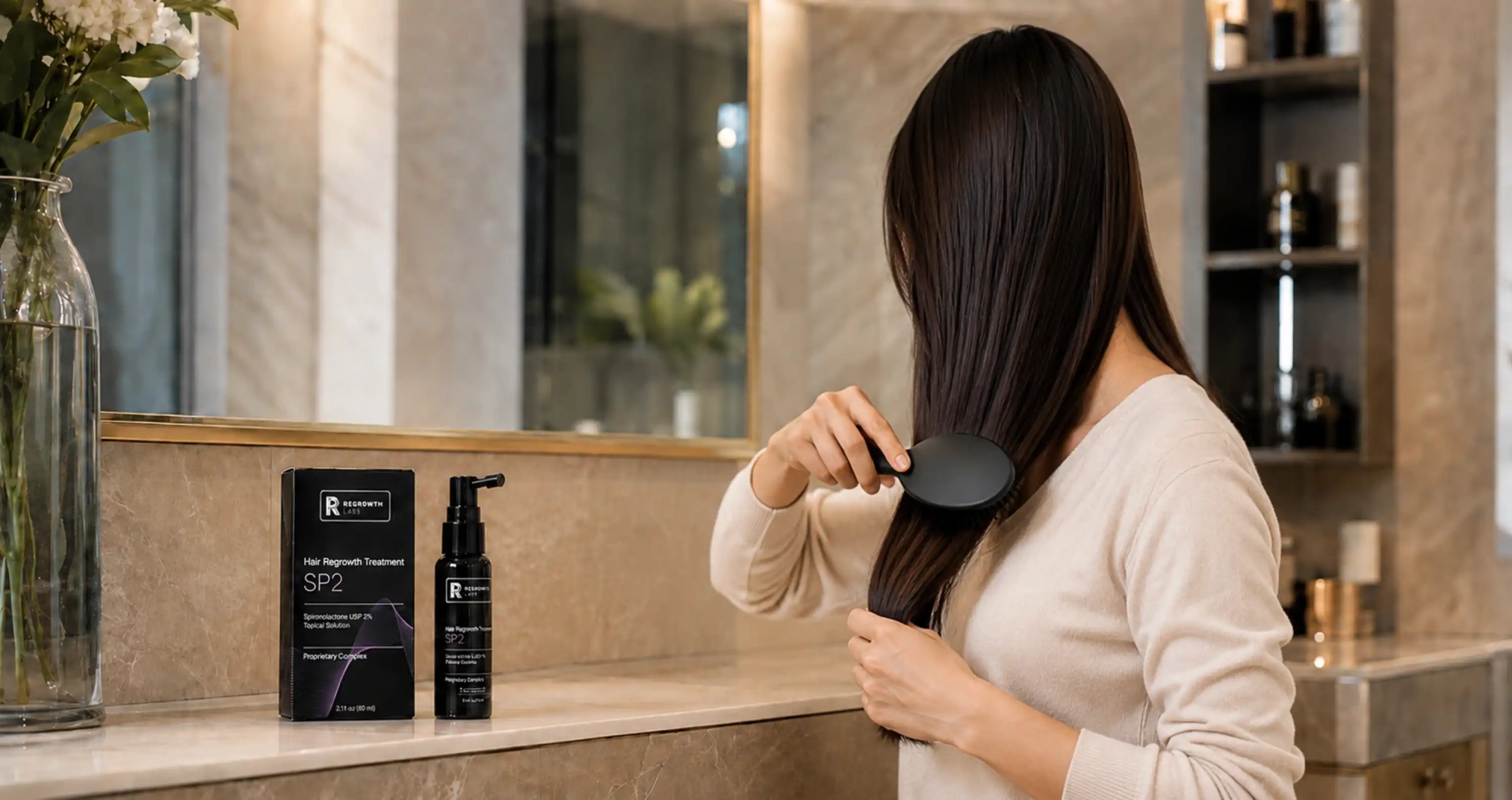
A local DHT blocker for women UAE readers may encounter is SP2 Hair Regrowth Treatment, a topical solution containing spironolactone USP 2% w/w as its listed active ingredient. The manufacturer positions spironolactone as an androgen-receptor antagonist intended to act where the solution is applied. That makes SP2 different from an oral hormone-targeting treatment and different from minoxidil. However, “topical” does not prove zero absorption, zero endocrine effect or zero risk. Independent studies of topical spironolactone for hair loss are limited, use formulations and concentrations that do not exactly match SP2, and do not establish that the finished SP2 product is superior to standard options.
For a woman with gradual, correctly diagnosed pattern hair loss, a local DHT blocker for women UAE such as SP2 may be a clinician-guided option when local anti-androgen positioning is the reason for choosing it. It is not a self-diagnosis tool, a pregnancy-safe default, or a substitute for investigating sudden shedding, scalp disease, nutritional problems or other medical causes.
Quick facts before considering SP2
| Question | Evidence-safe answer |
| What is the active ingredient? | Spironolactone USP 2% w/w, according to the current manufacturer page |
| Does SP2 contain minoxidil? | No minoxidil appears in the current official ingredient list |
| How is it intended to work? | The manufacturer positions it as a local androgen-receptor antagonist that may reduce DHT signalling at the follicle |
| Is it a 5-alpha-reductase inhibitor? | No. Spironolactone blocks androgen-receptor activity; it is not finasteride or dutasteride |
| Does topical use guarantee no systemic exposure? | No. Local application is the route and treatment intent; it is not proof of zero absorption |
| Is SP2-specific clinical evidence strong? | No independent randomised trial of the exact finished 2% SP2 formula was located during this review |
| Who should consider it? | An adult woman with a qualified diagnosis and a clinician-approved reason for local anti-androgen treatment |
| Who should pause? | Anyone pregnant, trying to conceive or breastfeeding; under 18; or with uncertain loss, scalp disease, heart disease or blood-pressure-lowering medicines pending clinical review |
| What is the current direction? | 1 mL (five sprays) twice daily to each targeted area, massage 2–4 minutes, wash hands and leave on four or more hours |
| How should it be stored in the UAE? | Closed at 20°C to 25°C; never in a hot car, direct sun or another place likely to exceed the range |
The local DHT blocker decision for women in the UAE is therefore not “topical good, oral bad.” It is whether SP2’s particular mechanism, level of evidence, label, medical suitability, and twice-daily routine fit the individual woman.
What does “local DHT blocking without systemic hormone targeting” mean?
The phrase has two useful parts and one important limit.
For a local DHT blocker for women in the UAE, the local application describes where the solution is placed: directly on targeted areas of the scalp. Unlike a swallowed tablet, the product does not begin by passing through the digestive system and entering circulation as the intended delivery route.
For this local DHT blocker for women in the UAE, local targeting describes the manufacturer’s proposed treatment goal: spironolactone at the scalp is intended to compete with androgens at follicular receptors. DHT can bind to androgen receptors in genetically susceptible follicles and contribute to miniaturisation. If receptor signalling is reduced at the treated site, local androgen-related pressure on those follicles may decrease.
The key limitation of a local DHT blocker for women in the UAE is that a topical route does not guarantee zero systemic exposure. Medicines applied to the skin can enter the body; how much enters depends on the molecule, concentration, vehicle, dose, treatment area, skin condition, contact time, and individual biology. No public SP2-specific pharmacokinetic study measured blood spironolactone or metabolites, potassium, blood pressure, menstrual effects, or endocrine markers after long-term scalp use of this exact 2% w/w formula.
The responsible claim is therefore:
SP2 is designed for local scalp application and is positioned to antagonise androgen receptors near treated follicles, with the aim of limiting systemic exposure compared with oral treatment. Zero absorption or zero systemic effect has not been established for the finished product.
This distinction keeps the local DHT blocker for women UAE discussion from two opposite errors: presenting topical spironolactone as if it were an oral tablet, or promising that topical use makes systemic considerations disappear.
DHT biology: receptor blocking is not the same as reducing DHT production
To understand a local DHT blocker for women UAE, note that dihydrotestosterone, or DHT, is formed when the enzyme 5-alpha-reductase converts testosterone into DHT. DHT then acts by binding to androgen receptors. Those are two different points in the pathway.
Finasteride and dutasteride are 5-alpha-reductase inhibitors. Their primary mechanism is to reduce conversion to DHT. Spironolactone is better described as an androgen-receptor antagonist with additional pharmacology depending on route and exposure. In the SP2 product story, the relevant proposed action is competition at the follicular androgen receptor, not proof that the solution switches off androgen production in the adrenal glands or ovaries.
That is why the current UAE product-page sentence about slowing androgen production needs revision. It mixes a systemic description with a topical local-action claim. A shopper could wrongly conclude either that SP2 intentionally changes whole-body hormone production or, because the same page says it does not affect hormone levels, that the product cannot have any systemic effect. Neither conclusion is supported by SP2-specific human data on the page.
| Treatment concept | Primary intended point of action | What it does not automatically prove |
| Topical spironolactone | Antagonism at androgen receptors in or near the treated scalp | Zero absorption, unchanged hormones or superior regrowth |
| Oral spironolactone | Systemic anti-androgen and mineralocorticoid-receptor effects | That topical SP2 has the same exposure or monitoring requirements |
| Finasteride or dutasteride | Inhibition of 5-alpha-reductase and reduced DHT formation | That every topical or oral product is interchangeable |
| Minoxidil | Non-anti-androgen hair-growth signalling; exact follicular mechanism remains incompletely defined | That it blocks DHT or replaces an anti-androgen decision |
Readers comparing entirely different women’s options can use the dedicated women’s hair-regrowth treatment ranking. This page stays focused on the SP2 local-application question.
What is actually in the SP2 formula?
The current manufacturer page for this local DHT blocker for women in the UAE lists one active ingredient and six other ingredient entries. The formula is not a spironolactone-minoxidil combination.
| Formula entry | Listed role or formulation function | Responsible interpretation |
| Spironolactone USP 2% w/w | Active ingredient | The anti-androgen component; 2% w/w means 2 grams per 100 grams of finished product, not automatically 20 mg/mL |
| Propanediol | Solvent, humectant and carrier | May be selected as an alternative to propylene glycol; it does not guarantee an irritation-free scalp |
| Ethanol SDA 40B 190 Proof | Solvent | Helps keep ingredients in solution and supports drying; alcohol can sting or dry sensitive or damaged skin |
| Deionised water | Vehicle | Part of the solution base |
| Phenoxyethanol / ethylhexylglycerin | Preservative system | Supports product preservation; either can still be unsuitable for an individual with sensitivity |
| Polysorbate 80 | Solubiliser or surfactant | Helps disperse ingredients; inclusion is formulation information, not independent clinical proof |
Why “2% w/w” must not be converted casually
For this local DHT blocker for women UAE, the manufacturer explicitly states 2% w/w. This is a mass-per-mass expression. Without verified product density, it should not be rewritten as 20 mg/mL. The directions separately state that five sprays equal 1 mL. Those two facts can both be printed without inventing a mass-per-volume conversion.
The physical label matters because public pages can be outdated, incomplete or copied incorrectly. Before publication, compare the bottle, carton and leaflet with the online list. If the packaging differs, stop and obtain clarification rather than choosing whichever version is more convenient.
Does propanediol make SP2 irritation-free?
No ingredient in a local DHT blocker for women UAE can support a universal “no irritation” promise. Propanediol may be chosen for tolerability and as a carrier, but SP2 also contains ethanol and preservatives. A sensitive scalp, damaged skin, allergy or simultaneous use of other topicals can change tolerance. “Formulated to minimize irritation” is a reasonable manufacturer-positioning statement. “Will not irritate” is not.
The Regrowth Labs collection is useful for product-family context, but formulas within one brand still differ substantially. Do not borrow directions, safety claims or expected results from another Regrowth Labs product.
What does the evidence say about topical spironolactone for hair loss?
The evidence for this local DHT blocker for women UAE is promising enough to justify research and clinician discussion, but not strong enough to support certainty about SP2.
Evidence level 1: the exact finished SP2 product
The most useful trial would randomise women with confirmed female pattern hair loss to SP2 2% w/w, a matched vehicle and an established comparator, with blinded hair-count and photographic assessment over sufficient follow-up. It would also measure adverse events and, ideally, systemic exposure or endocrine markers.
No independent peer-reviewed randomised trial of the exact finished local DHT blocker for women UAE SP2 2% w/w solution was located during this review. No SP2-specific pharmacokinetic study, head-to-head comparison, long-term pregnancy dataset or large post-marketing safety analysis was supplied on the reviewed product pages.
Therefore, the article must not claim that SP2:
is clinically proven to outperform minoxidil;
grows a specific number or percentage of hairs;
works equally on every scalp region;
produces no systemic hormonal effects;
is the safest or gentlest DHT option for all women;
works within a guaranteed number of weeks; or
is suitable during pregnancy or breastfeeding.
Evidence level 2: studies of topical spironolactone
A 2023 systematic review assessed oral and topical spironolactone for androgenetic alopecia. It included a relatively small and varied evidence base. The topical studies used preparations such as 1% gel or 5% solution, not the exact SP2 2% w/w vehicle. The review reported signals of benefit and fewer reported adverse effects with topical treatment than oral treatment, while calling for better randomised trials.
A randomised double-blind study indexed in PubMed evaluated 1% topical spironolactone gel, 5% topical minoxidil gel and their combination. The concentration, vehicle and combination do not match SP2. It can support the idea that topical spironolactone has been clinically investigated, but it cannot be used to assign the trial’s result to a 2% SP2 solution.
Other studies have evaluated 5% topical spironolactone, sometimes with minoxidil, and a more recent comparative study has examined topical spironolactone 5%, topical finasteride 1% and minoxidil 5% in female pattern hair loss. Again, different strengths and vehicles prevent a direct finished-product conclusion.
Evidence level 3: mechanism and oral evidence
Spironolactone’s anti-androgen activity and oral use in selected women with androgen-related hair loss provide biological plausibility. Oral data show why the medicine deserves serious screening, especially around pregnancy, blood pressure, potassium and interacting medicines. Oral risks and monitoring frequencies must not be copied directly onto SP2, because exposure is different and SP2-specific systemic absorption is unquantified.
Evidence level 4: manufacturer positioning
Manufacturer sources are appropriate for the ingredient list, directions, storage and stated product concept. Claims such as “gentlest” or “without systemic hormonal effects” require independent evidence before being presented as established fact.
The clean conclusion for a local DHT blocker for women UAE is that topical spironolactone is evidence-informed but still limited; SP2 is a particular 2% formulation whose exact clinical performance remains uncertain.
Who may be a reasonable SP2 candidate?
A local DHT blocker for women in the UAE, such as SP2, may be discussed with a clinician when an adult woman has gradual pattern thinning compatible with female pattern hair loss and there is a reason to consider a local anti-androgen approach. Possible reasons include androgen-sensitive pattern loss, concern about systemic treatment, or a need to compare mechanisms after standard options have been reviewed.
Considering a local DHT blocker for women UAE is not the same as saying every woman with hair fall needs a DHT blocker. Female pattern hair loss can occur with normal blood androgen levels because follicular sensitivity and genetics matter. Conversely, excess facial or body hair, acne, irregular periods or fertility concerns may point toward hyperandrogenism or polycystic ovary syndrome and deserve broader assessment rather than a scalp-only solution.
Before choosing a local DHT blocker for women UAE, a good pre-purchase consultation should cover:
The pattern, duration and speed of loss.
Scalp symptoms and examination findings.
Pregnancy, pregnancy planning and breastfeeding.
Heart disease, fainting, low blood pressure and current blood-pressure medicines.
Kidney, adrenal or electrolyte disorders and other spironolactone exposure.
Prescription, over-the-counter and topical medicines.
The ability to apply twice daily and protect a four-hour leave-on window.
The user’s goal: slowing progression, improving density, treating an androgen-related pattern, or simply stopping sudden shedding.
The broader women’s hair-care collection can show available categories, but a category page cannot replace individual diagnosis or product-label review.
When should a woman pause before using SP2?
Pregnancy, trying to conceive or breastfeeding
Spironolactone has anti-androgen activity. Oral product labelling discusses fetal risk concerns, including potential effects on male fetal sexual development in animal data. That oral label does not quantify risk from SP2, but the absence of topical SP2 pregnancy data is not reassurance. A woman who is pregnant, could be pregnant, is trying to conceive or is breastfeeding should not self-start SP2. She should take the actual bottle and leaflet to a qualified clinician and follow the locally applicable advice.
If pregnancy occurs during use, stop self-directed application and contact the prescriber or an appropriate healthcare professional promptly. Do not use this article as an individual pregnancy-risk assessment.
Under 18
The manufacturer says not to use SP2 under age 18. Hair loss in a child or adolescent requires assessment rather than adult product selection.
Heart disease or blood-pressure-lowering medicines
The manufacturer explicitly says not to use the product if the user has heart disease or is taking blood-pressure-lowering medication. Because that wording is unusually broad, it should be visible before purchase, not hidden after the CTA. A clinician can review the exact condition and medicines; the article should not make exceptions.
Sudden, patchy, painful or inflamed hair loss
Circular patches, scarring, marked scale, crusting, pus, pain, burning, rapid shedding or broken inflamed skin can indicate another diagnosis. Applying an alcohol-containing solution may worsen discomfort and delay appropriate treatment.
Unexplained diffuse shedding
Recent childbirth, fever, surgery, major stress, rapid weight change, iron deficiency, thyroid disease and other systemic factors can trigger shedding. A local DHT-targeting product will not correct every trigger. Diagnose before escalating products.
Known ingredient sensitivity or multiple scalp treatments
An individual can react to an active, solvent, preservative or surfactant. Do not layer SP2 with another medicated topical, microneedling or an irritated-scalp procedure without a clinician’s schedule.
SP2 versus oral spironolactone
For a local DHT blocker for women in the UAE, the key difference from oral spironolactone is intended exposure, not simply convenience.
| Decision factor | SP2 topical spironolactone 2% w/w | Oral spironolactone |
| Route | Applied to targeted scalp areas | Swallowed and intentionally distributed systemically |
| Intended hair-loss action | Local androgen-receptor antagonism near treated follicles | Systemic anti-androgen exposure |
| Evidence base | Small, heterogeneous topical studies; no exact SP2 trial located | Broader clinical experience for selected women, but hair-loss use and monitoring remain clinician-led |
| Systemic exposure | Intended to be limited, but not quantified for SP2 | Expected and therapeutically relevant |
| Monitoring | No SP2-specific universal protocol established publicly; health review remains important | Clinician may consider blood pressure, potassium, kidney function and interacting medicines according to the individual |
| Pregnancy | Do not self-use; exact topical risk is uncertain and anti-androgen mechanism matters | Generally requires strict clinician guidance because of fetal-risk concern |
| Scalp tolerability | Alcohol and other ingredients can cause local dryness or irritation | Does not avoid systemic adverse-effect considerations |
It would be misleading to say SP2 provides “all the benefit of oral spironolactone without systemic risk.” The finished product has not established that equivalence. It is also misleading to assume the oral tablet’s adverse-event rates apply directly to the topical solution. Route and exposure matter in both directions.
SP2 versus minoxidil for women
A local DHT blocker for women in the UAE, such as SP2 and minoxidil, are not two strengths of the same treatment. They represent different mechanisms and evidence histories.
Minoxidil is not a DHT blocker. It is a hair-growth treatment with a larger randomised-trial and regulatory evidence base for pattern hair loss. SP2 is a topical anti-androgen formula with more limited direct evidence. A clinician may choose one, discuss a carefully planned combination, or decide that neither is suitable until the diagnosis is clearer.
| Question | SP2 | Minoxidil |
| Main active | Spironolactone 2% w/w | Minoxidil at the labelled concentration |
| Primary concept | Local androgen-receptor antagonism | Support of follicular growth and hair-cycle activity |
| Blocks DHT? | Intended to reduce androgen signalling at the receptor; does not inhibit DHT production like finasteride | No |
| Exact product evidence | No independent SP2 finished-product trial located | Multiple trials exist for topical minoxidil products and strengths, though not every branded combination is equally studied |
| Typical caution themes | Pregnancy, anti-androgen mechanism, heart disease/BP-medicine manufacturer warning, local irritation | Cardiovascular symptoms, pregnancy/breastfeeding review, scalp irritation, unwanted facial hair and product-specific directions |
| Interchangeable? | No | No |
Women who need the basic minoxidil mechanism can use the topical minoxidil guide. The wider minoxidil treatment guide covers strength and safety context. For a concrete 2% minoxidil product comparison, see Follics FR02. None of those pages should describe SP2 as containing minoxidil.
Can SP2 and minoxidil be combined?
For a local DHT blocker for women in the UAE, some topical spironolactone studies have used minoxidil in another arm or in combination, which makes the idea scientifically plausible. It does not create a universal do-it-yourself combination schedule for SP2.
Layering two alcohol-based or otherwise active scalp solutions can increase irritation, complicate dose measurement, create transfer problems and make it difficult to identify which product caused a reaction. Applying one immediately after the other can also change drying and contact behaviour. A clinician who recommends both should specify:
the exact products and strengths;
which areas receive each product;
timing and spacing;
what to do on wash days;
how to manage a missed dose;
which adverse signs require stopping one or both; and
how pregnancy planning changes the regimen.
Do not mix the liquids in one bottle, change the stated doses, or assume that evidence from a pre-formulated clinical-study gel applies to two separately purchased products.
How to Use a Local DHT Blocker for Women UAE: Current SP2 Directions
The manufacturer’s current instructions are:
Apply 1 mL, described as five sprays, twice daily to each targeted area affected by thinning or loss.
Massage the solution into the scalp for 2 to 4 minutes.
Wash the hands after completing the application.
Leave the product on for four hours or more.
Continue use to achieve and maintain results.
Do not use more than directed; more is not expected to improve effectiveness.
The phrase “on each targeted area” could be misunderstood when a person has several thinning zones. Confirm on the physical label and with the seller or clinician whether 1 mL is the total dose or is intended per defined area. Do not multiply the dose across zones based only on ambiguous web copy.
A careful application method
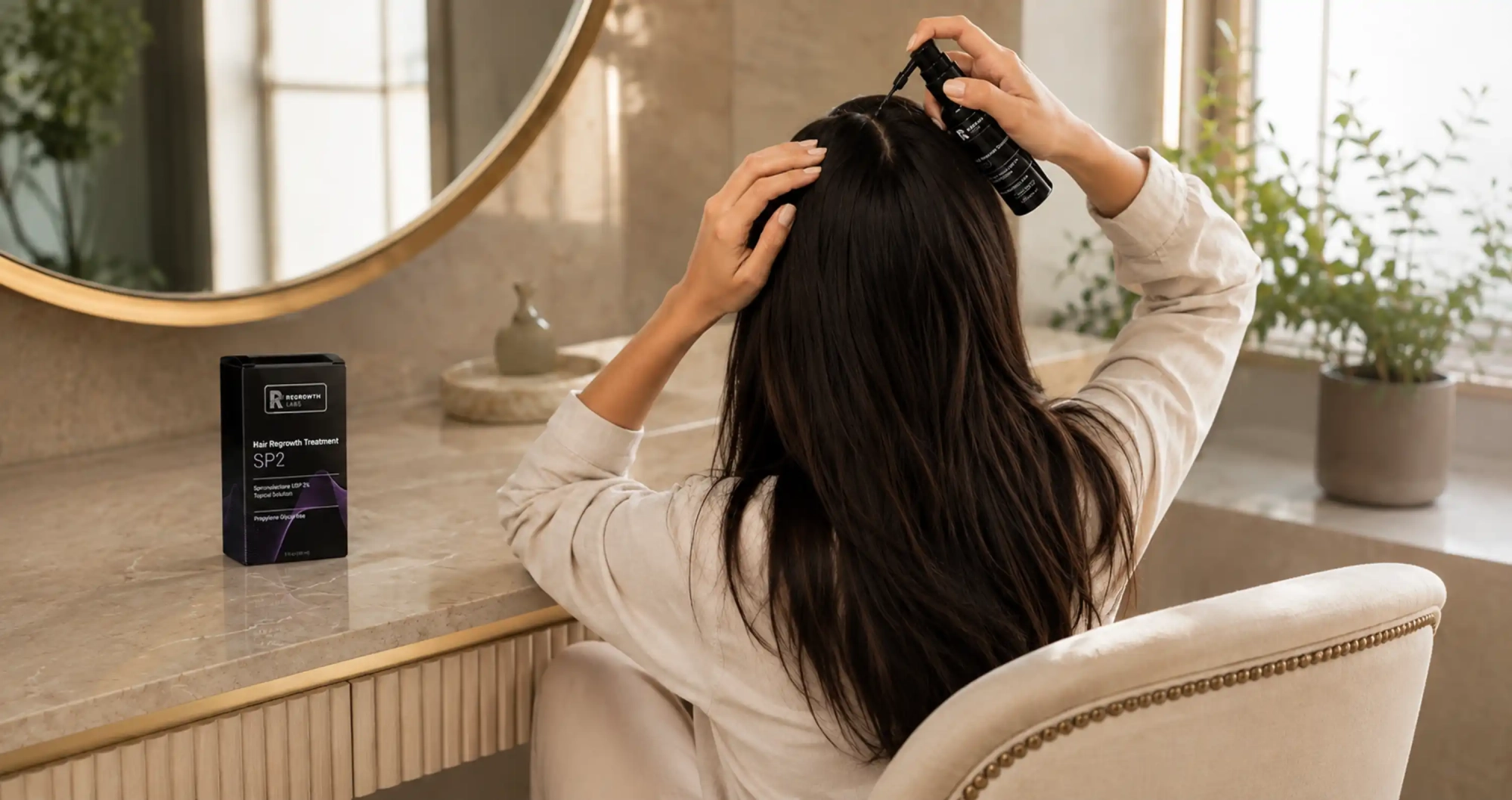
When applying a local DHT blocker for women in the UAE, such as SP2, start with a completely dry, intact scalp. Part the hair in narrow lines so the solution reaches the skin rather than coating the hair shafts. Keep the bottle upright if the applicator requires it and count the labelled sprays. Distribute rather than flooding one point. Massage gently with fingertips for the stated period, then wash hands with soap and water.
Avoid the eyes, face, neck and broken skin. If the product reaches the eyes, rinse thoroughly with water as the manufacturer advises. Allow the scalp to dry before wearing a close-fitting scarf, cap, helmet or sleep covering. Avoid skin-to-skin transfer to another person.
Missed doses and extra product
When using a local DHT blocker for women in the UAE, do not double the next dose to make up for a missed one. The manufacturer says that more does not increase effectiveness. Resume the normal schedule unless the clinician or the leaflet says otherwise.
Microneedling and irritated skin
Do not apply SP2 onto a freshly microneedled, sunburned, scratched or inflamed scalp without direct medical instruction. Skin-barrier disruption can change absorption and irritation. This is especially important when the central marketing position depends on local application with limited systemic exposure.
A UAE routine for heat, sweat, washing and head coverings
The complete hair-regrowth routine can organize the wider week, but SP2’s four-hour contact period needs a realistic daily slot.
| UAE routine point | Practical approach |
| Morning application | Apply only after the scalp is fully dry and when heavy exercise, swimming or washing is not planned for at least four hours |
| Outdoor work or commute | Let the solution dry before a head covering; plan around sweat and heat rather than applying immediately before leaving |
| Hijab, scarf, cap or helmet | Wait until dry to reduce fabric transfer and occlusion; wash contact fabrics regularly |
| Evening application | Apply early enough to dry before bed and reduce transfer to the face or pillowcase |
| Wudu, shower or wash day | Protect the manufacturer’s four-hour leave-on window; move the application rather than doubling later |
| Styling products | Apply SP2 to the scalp first and let it dry; avoid mixing it with oils, serums or sprays in the hand |
| Travel | Keep it in original packaging, closed and protected from heat; check airline liquid rules |
| Storage | Maintain 20°C to 25°C; avoid a parked vehicle, balcony, direct sun or hot bathroom shelf |
UAE summer heat makes storage more than a minor detail. A closed car can greatly exceed room temperature. Do not leave SP2 in a glove box, delivery box outdoors or luggage exposed to sun. The manufacturer notes that the solution may slightly darken over time without changing expected efficacy, but colour change outside the described normal variation, a damaged seal, particles, leakage, unusual smell or heat exposure should trigger product verification.
The 12-week hair-loss plan can be used to establish standardised photos, record tolerance and separate normal day-to-day variation from a trend.
Results: what timeline can be stated responsibly?
The manufacturer says results may be noticeable in as little as two months but more often around four months, and that individual results vary. This is manufacturer guidance, not a guaranteed SP2-specific trial result.
Weeks 1 to 4: confirm tolerance and routine
With a local DHT blocker for women UAE, the earliest useful outcome is whether the scalp tolerates the formula and the user can follow the schedule. Record redness, itch, scale, burning, headache, dizziness, palpitations, swelling, menstrual changes or any other new symptom. A temporal association does not prove the product caused every symptom, but it is a reason to pause and obtain advice when significant.
Weeks 5 to 12: judge consistency, not a single photo
Take photos under the same lighting, part, hair length and angle. Do not make weekly product changes. Investigate missed doses, washing conflicts, heat-damaged storage or wrong application before concluding that the mechanism failed.
Month 4 and beyond: review the individual result
A qualified clinician can compare baseline and follow-up, review tolerance and decide whether continued use is reasonable. The manufacturer states that continued use is necessary to maintain results. That does not promise that every user will respond or that stopping creates the same timeline in every person.
Do not claim a guaranteed “8–12 week regrowth” result. Studies of different topical spironolactone formulas, minoxidil combinations or concentrations cannot set a precise SP2 deadline.
Side effects, warnings and stop rules
Local scalp effects
Possible local issues include dryness, burning, redness, itch, flaking, tenderness or contact dermatitis. Ethanol can sting an already irritated scalp. Propanediol and the preservative system may be well tolerated by many users, but individual reactions remain possible.
Pause application and obtain advice if irritation is persistent, spreading, painful or accompanied by swelling or blistering. Do not keep applying simply because the product is marketed for sensitive scalps.
Systemic symptoms cannot be dismissed
The manufacturer instructs users to discontinue and see a doctor if chest pain or rapid heartbeat occurs. Seek urgent medical care for chest pain, severe shortness of breath, fainting, facial or throat swelling, or another severe reaction. Dizziness, unusual weakness, significant swelling, marked blood-pressure symptoms or menstrual changes also deserve prompt clinical review.
This does not prove those symptoms are common with SP2. It means the article should retain the manufacturer’s stop rules and avoid the claim that systemic effects are impossible.
Eye and transfer safety
SP2 is for external scalp use. Avoid eye contact and rinse thoroughly with water after accidental exposure. Wash hands immediately after use. Let the scalp dry before close contact, bed or a fabric covering, and keep the bottle out of children’s reach.
Health and medicine review
Do not use SP2 when the manufacturer’s heart-disease or blood-pressure-medicine warning applies unless a qualified clinician who has reviewed the actual product directs otherwise. Also disclose oral spironolactone or other diuretics, kidney or adrenal disease, low blood pressure, electrolyte problems and every prescription or over-the-counter medicine. The correct conclusion may vary by person; the disclosure step does not.
The seven most common SP2 mistakes
1. Assuming SP2 contains minoxidil
The current official formula does not list minoxidil. An older article that says otherwise should be corrected. SP2 and minoxidil have different mechanisms and evidence bases.
2. Treating “topical” as “zero systemic risk”
Topical describes route and intended local action. It does not prove that no ingredient crosses the skin. Avoid absolute claims unless exact SP2 human exposure data become available.
3. Applying to hair instead of scalp
Coating strands wastes product and increases transfer. Part the hair and target the skin.
4. Multiplying 1 mL across vaguely defined zones
The wording “each targeted area” needs label clarification. Do not invent a larger total dose.
5. Using more to speed results
The manufacturer explicitly says more does not increase effectiveness. Extra solution can increase mess, exposure and irritation.
6. Ignoring pregnancy planning
Anti-androgen mechanism makes pregnancy status and future plans part of the initial decision, not an afterthought.
7. Storing it in the car
The labelled 20°C to 25°C range is incompatible with a sun-heated UAE vehicle. Heat-exposed product should be checked rather than assumed stable.
A practical SP2 decision checklist
A local DHT blocker for women UAE such as SP2 is more reasonable to discuss when all of the following are true:
The user is an adult woman.
A qualified assessment supports female pattern hair loss or another appropriate androgen-sensitive diagnosis.
Sudden shedding, scarring disease, infection and major systemic triggers have been considered.
Pregnancy, trying to conceive and breastfeeding have been discussed.
Heart disease, blood pressure, medicines and relevant medical history have been reviewed.
The current bottle and leaflet confirm spironolactone 2% w/w and match the online formula.
The woman understands that SP2 does not contain minoxidil.
She accepts limited finished-product evidence and no guaranteed response.
Twice-daily application and a four-hour leave-on period are sustainable.
Safe 20°C to 25°C storage is available.
Baseline photos and a review date are planned.
Pause the purchase when diagnosis is uncertain, the label cannot be verified, pregnancy considerations are unresolved, a manufacturer warning applies, or the routine is unrealistic. The broader hair-loss treatment collection can show alternatives, but the next step should be a mechanism- and diagnosis-based decision rather than random product switching.
How to verify the physical SP2 product before first use
Online copy is not the final authority when a medicated product arrives. Check:
Identity: “SP2” and “Spironolactone USP 2% w/w” are printed clearly.
Seal: tamper evidence is intact and the bottle does not leak.
Batch and expiry: legible and consistent across bottle and carton.
Volume and applicator: bottle volume is printed, and the spray conversion matches the leaflet.
Ingredients: active and other ingredients agree with the current manufacturer list.
Directions: dose, frequency, massage time and leave-on period are present.
Warnings: age, external-use, eyes, heart disease, blood-pressure medicine and stop rules are visible.
Storage: 20°C to 25°C and closed-container wording is present.
UAE supply details: importer or distributor and any locally required information are identifiable.
Condition: no heat damage, broken packaging, unexplained sediment, leakage or unusual odour.
If the actual leaflet contradicts the website, contact the seller and follow qualified medical advice. Do not combine fragments from two versions to create a homemade instruction set.
Final verdict: is SP2 a sensible local DHT blocker for women in the UAE?
SP2 is a clearly differentiated product: a 2% w/w topical spironolactone solution designed for local scalp application, not a minoxidil formula and not an oral hormone treatment. Its mechanism is biologically plausible, and topical spironolactone has limited clinical evidence suggesting potential benefit. The exact finished SP2 product, however, lacks the strong independent evidence needed for superiority, guaranteed timelines or absolute systemic-safety claims.
For a correctly assessed adult woman who has a clinician-supported reason to consider local androgen-receptor antagonism, can comply with the twice-daily four-hour routine, and has no unresolved pregnancy or health warning, SP2 may be a reasonable option to discuss. For unexplained shedding, pregnancy, damaged scalp, under-18 use, heart disease or blood-pressure medicine exposure, self-starting is not responsible.
The best next action is to verify the physical label, bring the complete ingredient and warning list to a UAE-licensed clinician, and compare mechanisms rather than marketing adjectives. If that review supports SP2, use it exactly as directed, store it correctly and assess progress objectively.
Consider the current SP2 Hair Regrowth Treatment page only after the page corrections above are made and the physical label is verified. Readers still comparing product families can review the women’s hair-care collection, The Regrowth Labs collection, and the wider hair-loss treatment collection.
Frequently asked questions
1. What is a local DHT blocker for women UAE shoppers can consider?
SP2 is one topical option marketed in the UAE. It lists spironolactone USP 2% w/w and is positioned as a local androgen-receptor antagonist. “Local” describes its scalp application and intended target; it does not prove zero systemic absorption.
2. Does SP2 contain minoxidil?
No minoxidil appears in the current official SP2 ingredient list. The listed active is spironolactone USP 2% w/w. Any older Hims n Hers UAE copy describing SP2 as a spironolactone-and-minoxidil combination should be corrected.
3. Does SP2 lower DHT levels throughout the body?
That is not the intended product claim. SP2 is positioned to reduce androgen signalling locally by antagonising receptors near treated follicles. No public SP2-specific human study was located that establishes whole-body hormone changes or proves that they never occur.
4. Is topical spironolactone safer than oral spironolactone?
Topical application is intended to limit systemic exposure, and small topical studies have reported fewer systemic adverse effects than oral studies. However, the exact SP2 exposure is not quantified publicly, so “risk-free” or “no hormonal effect” would be too strong. Route, dose, skin and individual health all matter.
5. Can I use SP2 during pregnancy or while trying to conceive?
Do not self-start it. Spironolactone has anti-androgen activity, and the reviewed SP2 public pages did not provide a pregnancy safety dataset or clear pregnancy warning. Discuss the actual product with a qualified clinician before pregnancy, while trying to conceive or during breastfeeding.
6. How much SP2 should be applied?
The current manufacturer directions say 1 mL, described as five sprays, twice daily to each targeted area, followed by 2–4 minutes of massage, handwashing and a four-hour or longer leave-on period. Because “each targeted area” may be ambiguous, verify the total dose on the physical leaflet before treating multiple zones.
7. How long does SP2 take to work?
The manufacturer says results may be noticeable in as little as two months but more often around four months, with individual variation. That is not a guaranteed trial result for every user. Review tolerance and adherence early, then assess standardised photos over months.
8. Can SP2 be used with minoxidil?
Possibly in a clinician-designed regimen, but do not improvise the combination. The products have different mechanisms and may have overlapping irritation or transfer problems. A professional should specify the exact products, areas, timing, spacing and stop rules.
9. What side effects should make me stop SP2?
Stop and seek medical advice for significant or worsening scalp irritation. The manufacturer specifically says to discontinue and see a doctor for chest pain or rapid heartbeat. Seek urgent care for chest pain, severe breathing difficulty, fainting or facial or throat swelling.
10. How should SP2 be stored in Dubai or elsewhere in the UAE?
Keep the container closed at 20°C to 25°C. Do not store it in a parked car, direct sunlight, a balcony, hot bathroom shelf or other place likely to exceed room temperature. If it was exposed to extreme heat or the product looks abnormal, verify it before use.
Editorial source list
Hims n Hers UAE. SP2 Hair Regrowth Treatment. Current product copy, price and category reviewed 22 July 2026. https://www.himsnhers.ae/product/sp2-hair-regrowth-treatment/
Regrowth Labs. SP2 — Spironolactone USP 2% Topical Solution. Ingredients, directions, storage and warnings reviewed 22 July 2026. https://www.regrowthlabs.com/en/our-products/sp2/
Wang C, et al. The Efficacy and Safety of Oral and Topical Spironolactone in Androgenetic Alopecia Treatment: A Systematic Review. Clinical, Cosmetic and Investigational Dermatology. 2023. https://pmc.ncbi.nlm.nih.gov/articles/PMC10010138/
Abdel-Raouf H, et al. A novel topical combination of minoxidil and spironolactone for androgenetic alopecia: a randomized, double-blind study. Journal of Cosmetic Dermatology. PubMed PMID: 33320406. https://pubmed.ncbi.nlm.nih.gov/33320406/
Ibrahim ZA, et al. Evaluation of the efficacy and safety of topical spironolactone 5% in the treatment of androgenetic alopecia. Journal of Cosmetic Dermatology. PubMed PMID: 36039391. https://pubmed.ncbi.nlm.nih.gov/36039391/
Institute for Quality and Efficiency in Health Care. Using medication: Topical medications. Updated 10 December 2025. https://www.ncbi.nlm.nih.gov/books/NBK361003/
Pfizer. Aldactone (spironolactone) prescribing information. Pregnancy and systemic pharmacology used only for precautionary context, not as SP2 exposure evidence. https://labeling.pfizer.com/ShowLabeling.aspx?id=12861