
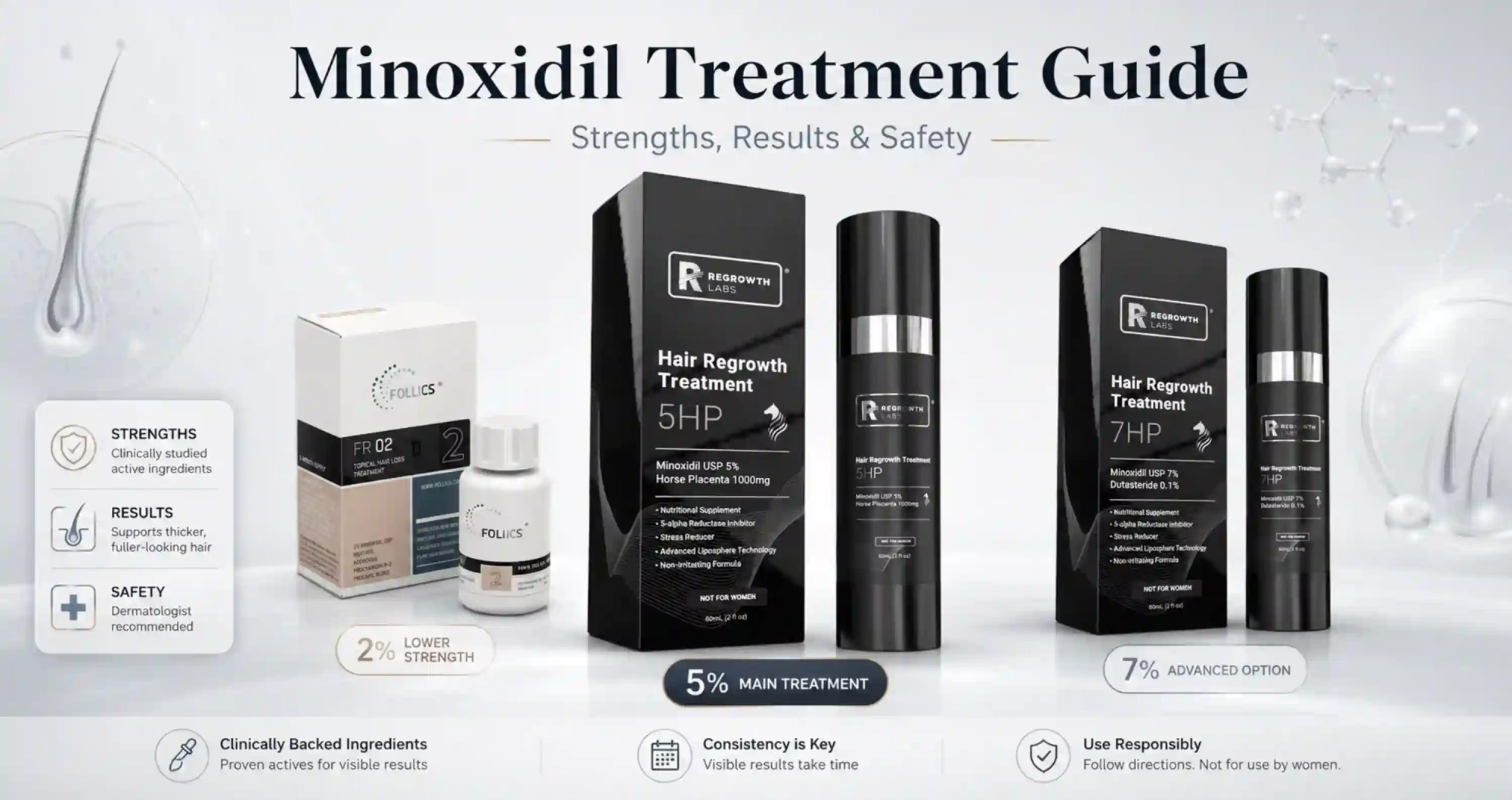
Minoxidil treatment is one of the most widely used topical options for pattern hair loss, and at Hims n Hers UAE, it generates more customer questions than almost any other product we carry. For UAE users comparing options, the hair loss treatment collection is the most relevant place to review topical minoxidil products, combination formulas, and supporting treatment categories. That track record makes sense: it works for both men and women, it’s accessible without a prescription at standard strengths, and decades of clinical data back it up. But knowing it works is only useful if you understand what it actually does, how to use it correctly, and what to realistically expect from it.
This minoxidil treatment guide covers what you genuinely need to know before starting: how minoxidil triggers hair growth, who responds well, how to choose the right formulation and strength, the correct application technique, and what the evidence says about timelines and side effects. Just the information that helps you make a clear decision and stick with your treatment long enough for it to work.
What minoxidil actually is and how it triggers hair growth
The prodrug story: how minoxidil sulfate does the real work
Minoxidil is a prodrug, which means it has no direct effect on your follicles. After you apply it to your scalp, enzymes called sulfotransferases convert it into minoxidil sulfate, and that converted form is what actually stimulates hair growth. This is a clinically important detail: enzyme activity varies between individuals, which explains why some people respond strongly to minoxidil treatment while others see very little change on the same dose. It also explains why a minoxidil treatment plan should be assessed over months rather than judged after only a few applications. Sulfotransferase activity is partly determined by individual biology, so the variability in response is real and not simply a matter of applying the product incorrectly.
Why it works specifically for androgenetic alopecia
In pattern hair loss, follicles gradually miniaturize and spend increasingly long periods in the telogen (resting) phase, producing thinner, shorter hairs with each cycle. Minoxidil works by pushing follicles back into the anagen (active growth) phase and prolonging that phase so hairs have more time to develop density and length. The key distinction to understand from the start: minoxidil treatment does not correct the hormonal cause of androgenetic alopecia. It does not block dihydrotestosterone (DHT). It improves the follicle’s behavior despite the hormonal environment, which is why stopping minoxidil typically leads to a return of shedding within a few months.
Who responds well to minoxidil treatment
The ideal candidate: pattern hair loss in men and women
Androgenetic alopecia is the primary indication, and minoxidil has the strongest evidence base for this specific type of hair loss. For men, the classic presentation is vertex thinning and mid-scalp recession. For women, diffuse thinning along the crown and a widening part line are the most common patterns targeted. The 5% concentration is the standard for men and carries the most robust clinical data.
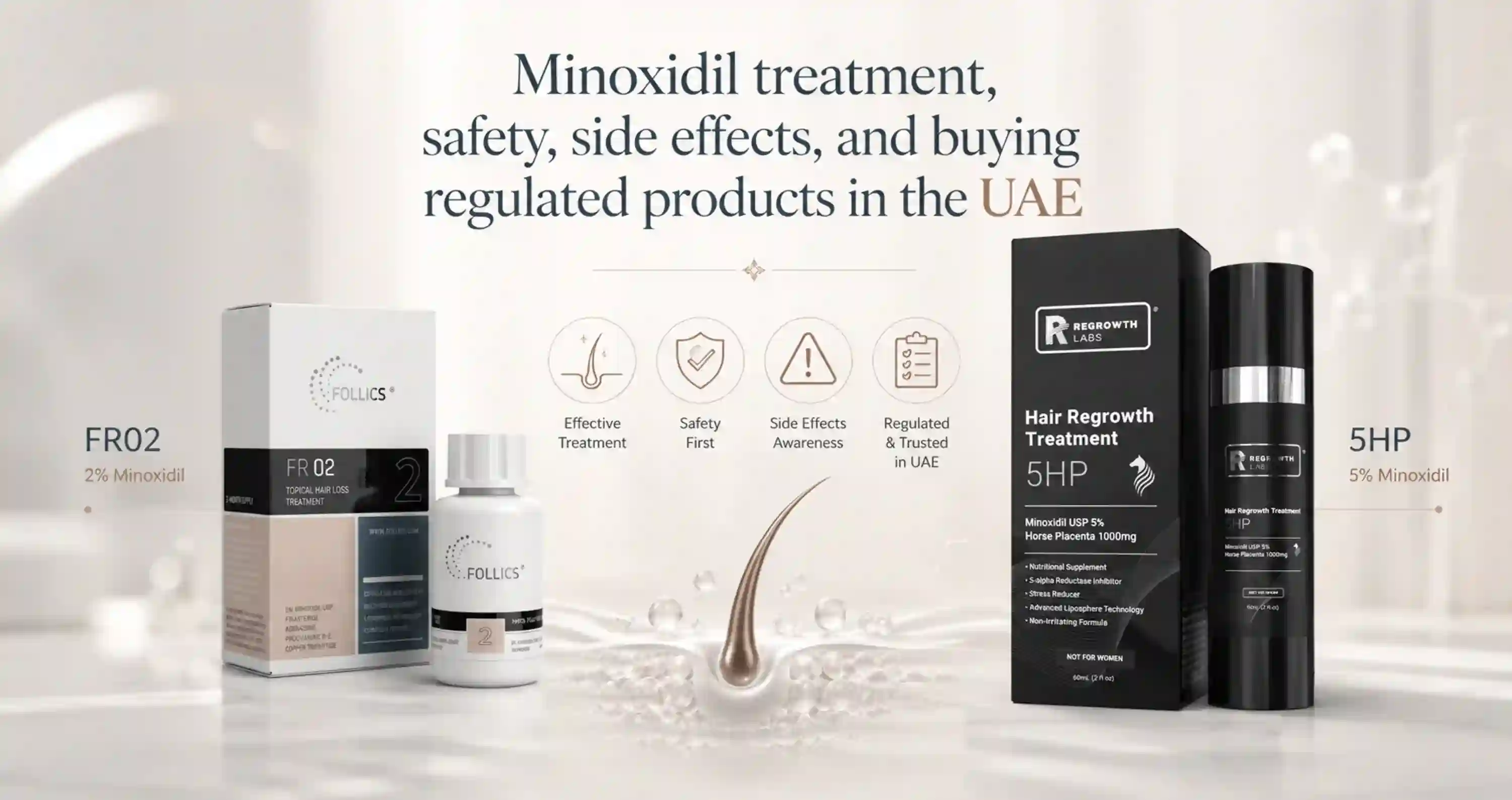
A product such as 5HP Hair Regrowth Treatment with Minoxidil 5% sits in this core 5% topical growth-stimulation category. For women, both 2% and 5% have clinical evidence, with 5% foam in randomized trials showing performance roughly comparable to 2% solution at 24 weeks while being better tolerated on the scalp. For a lower-strength topical option, FOLLICS FR02 Hair Growth Treatment with 2% Minoxidil is the most direct internal match.
When minoxidil is not the right fit
Minoxidil is not a universal answer for every type of hair loss. During pregnancy and breastfeeding, topical minoxidil is not recommended due to insufficient safety data. Known hypersensitivity to minoxidil or any component of the formulation is an absolute contraindication. Scalp conditions such as active psoriasis, seborrheic dermatitis, or eczema can compromise the skin barrier and increase systemic absorption, which raises the risk of side effects. Patchy alopecia (alopecia areata) and traction alopecia have different underlying mechanisms, so minoxidil is not a first-line treatment for these conditions and results are far less predictable.
Choosing the right formulation, foam, solution, and strength
Foam vs solution: what actually differs in practice
The active ingredient is identical across foam and solution at the same concentration. What changes is the vehicle. Solution formulations typically contain propylene glycol and alcohol, which can cause scalp dryness, flaking, and irritation in sensitive users. Foam was developed as a propylene glycol-free alternative, and clinical reviews of minoxidil consistently show lower rates of itching, redness, and dermatitis with foam. It also dries faster, which matters practically when you’re applying before work or before styling.
The trade-off is cost and precision. Solution is generally cheaper and applies more precisely through a dropper, which is useful if you’re targeting a specific zone. Foam melts quickly on warm skin, so it works best when dispensed onto cool fingers first rather than directly onto the scalp. If you have a sensitive scalp or find that solution causes persistent irritation, switching vehicle is a reasonable first adjustment before reducing frequency or changing strength. A tolerable minoxidil treatment is more valuable than an aggressive one you cannot use consistently.
Matching strength to your stage of loss: 2%, 5%, and 10%
The 2% solution was the original formulation and remains an appropriate starting point for women or anyone with significant scalp sensitivity. In a minoxidil treatment plan, starting lower can make sense when irritation risk is high. The 5% concentration is the current standard for men and is also widely used in women with moderate to significant thinning. For many users, this is the practical middle ground between evidence strength and daily tolerability. Clinical trials in women found 5% foam to be noninferior to 2% solution at 24 weeks with better tolerability, which is why 5% has become the more common recommendation.
The 10% formulation is a different category. In the UAE, the 2% and 5% strengths are available over the counter through pharmacies and licensed online retailers. The 10% topical concentration is not an OTC product under MOHAP guidelines: it requires a prescription or medical consultation due to the higher potency and greater potential for side effects.
If you’ve used 5% consistently for six or more months without adequate response, a conversation with a dermatologist or trichologist about higher-concentration or combination options is the right next step. For advanced comparison, the 7HP Hair Regrowth Treatment with Minoxidil 7% and Dutasteride 0.1% represents a combination approach rather than a basic minoxidil-only step. Higher concentration does not automatically mean better results, and tolerability becomes more of a factor as strength increases.
Which minoxidil treatment product fits your stage?
A useful product comparison starts with strength and purpose. A 2% topical option is usually discussed for sensitive scalps or lower-strength starting routines. A 5% topical option is the standard evidence-backed step for many men and is also used by women under appropriate guidance. Higher-strength or combination formulas are not automatically better; they belong in a more advanced conversation about tolerance, diagnosis, and response after consistent use.
For this reason, the most relevant Hims n Hers UAE product pathway is simple: FR02 for a 2% minoxidil treatment, 5HP for a 5% minoxidil treatment, and the treatments category for users comparing stronger topical combinations. FIN25 is relevant only when the user is adding DHT control to a broader hair-loss plan rather than looking for minoxidil alone.
This keeps the article product-focused without confusing the reader. The main topic is minoxidil treatment, so minoxidil-based products should be primary, while finasteride, dutasteride, supplements, and shampoos should remain secondary support or comparison links.
Minoxidil treatment: how to apply it correctly
Applying the solution: the right technique
For any minoxidil treatment, start with a completely dry scalp. Applying to wet hair is not advised, as product instructions consistently recommend a dry surface for proper absorption. Part your hair to expose the thinning area, then measure exactly 1 mL using the calibrated dropper. Apply the solution drop by drop from the center of the thinning zone outward, covering the affected area without spreading beyond it.
Massage lightly with fingertips to distribute evenly, then wash your hands thoroughly. Stick to the 1 mL limit: there is no proven benefit from applying more, and higher volumes may increase systemic exposure through the scalp. Correct dosing is one of the simplest ways to make minoxidil treatment safer and easier to maintain.
Applying the foam: what changes
Hold the can upside down and dispense approximately half a capful onto your fingertips rather than directly onto the scalp. Foam melts rapidly on warm skin, so targeting fingers first gives you better control. Apply to the thinning zones and spread gently. After applying either formulation, allow the scalp to dry fully before styling, using heat tools, or wetting the hair. Most 5% solution and foam products are used twice daily, morning and evening. The 10% spray formulation, when prescribed, is typically once daily per prescriber guidance. Following the exact dosing frequency matters more than most users realize: missing applications consistently slows results. A minoxidil treatment routine only works when it becomes a repeatable daily habit.
What to expect: timeline and realistic outcomes
The initial shedding phase: why it happens and what it means
Most new users notice increased shedding starting somewhere between weeks two and six. This is not a sign that minoxidil treatment is making hair loss worse. When minoxidil pushes resting follicles into the growth phase, it forces old telogen hairs out to make room for new ones. The shedding is a sign the product is working at the follicle level. In androgenetic alopecia, many follicles are already enriched in telogen, so minoxidil can push more of them into the same phase simultaneously, making the initial shed look more pronounced.
This phase typically lasts around 4 to 8 weeks, though it can continue for up to three months in some users. Knowing this in advance separates users who stay the course from those who stop at week four, assume minoxidil treatment caused more loss, and miss the period where regrowth actually begins. If significant shedding persists beyond 16 weeks, that warrants evaluation for an unrelated cause rather than a straightforward minoxidil reaction.
Reading the actual timeline: what research shows
Reduced shedding and subtle thickening can appear at 2 to 4 months in users who respond well. Visible improvement that you can see in photographs or in the mirror typically takes 4 to 6 months. Clinical trials in women showed clear, statistically meaningful separation from placebo at 48 weeks. For men, trials and post-marketing data suggest about 62.5% of users rate 5% minoxidil as effective or very effective, but the reliable assessment window is still 6 months, not 6 weeks.
One consistent finding across the research is this: earlier treatment produces better outcomes. The general principle is well established, the longer hair loss has been progressing before treatment begins, the harder it is to reverse. Starting minoxidil treatment when thinning is first noticeable, rather than waiting for it to become severe, is the single most controllable factor in how well it works for you. Combination treatment with finasteride also improves results above minoxidil alone. Hims n Hers UAE also lists Regrowth Labs FIN25 topical finasteride solution for users comparing DHT-control options alongside minoxidil, with meta-analysis data showing better hair density, diameter, and global photographic scores with the combination versus either treatment as monotherapy.
Minoxidil treatment, safety, side effects, and buying regulated products in the UAE
Side effects to monitor and when to stop
The most common side effects from topical minoxidil treatment are local: scalp dryness, flaking, itching, and occasional redness. These are largely linked to the propylene glycol in solution formulations and are usually manageable by switching to foam or temporarily reducing application frequency. They are not a reason to stop treatment permanently unless they persist after switching vehicles.
Women specifically need to be aware of hypertrichosis, the growth of unwanted facial hair, particularly on the forehead and cheeks. This happens when product runs down from the scalp during sleep or application. Applying to a completely dry scalp, keeping the application zone targeted, and avoiding lying down immediately after application reduces this risk significantly. Systemic absorption from topical use is generally low, but users with known cardiovascular conditions should speak to a doctor before starting, because minoxidil’s original use was as an antihypertensive. Stop use and seek medical attention if you experience chest pain, dizziness, or a rapid or irregular heartbeat after application.
Where to buy regulated minoxidil in the UAE
In the UAE, 2% and 5% minoxidil are sold legally over the counter through licensed pharmacies and online retailers without a prescription. Regulated brands available locally include Regaine (Rogaine), Hairgrow by Dar Al Dawa, and Avogain by Avalon Pharma. Price ranges vary considerably by format: 5% solution in 50 mL bottles runs from approximately AED 21 to 60 depending on brand and retailer, while 5% foam (60g) is typically around AED 136. The 10% concentration requires medical authorization and is not available OTC under MOHAP guidelines.
If you’re sourcing these products locally and want to build a more structured treatment plan, Hims n Hers UAE carries a wide range in one place, including Follics FR topical creams, oral finasteride and dutasteride options, Priorin N nutritional supplements, and supporting hair-growth categories. Having access to the right products through a single specialist retailer with local UAE expertise makes consistency easier, and consistency is what determines results.
Taking the next step with confidence
Minoxidil treatment works for androgenetic alopecia in both men and women, but it requires the right formulation, consistent application to a dry scalp, and patience through at least 4 to 6 months before making any judgment about whether it’s working. The initial shed is not failure. A slow start at 3 months is not failure. Stopping at week six because you expected visible results by then is the most common reason people miss the full benefit.
The practical approach is straightforward. Choose the right strength for your sex and severity, 5% is the default for most users. Decide between foam and solution based on your scalp tolerance. Apply the correct dose. Don’t quit during the initial shedding phase, and do not switch your minoxidil treatment every few weeks just because visible change is slow. Reassess at 6 months with photographs, and consider whether combining minoxidil treatment with finasteride or adding supplementary support makes sense for your pattern and goals. The evidence for combination therapy is strong, and the products are available locally.
For residents across the UAE looking for a reliable local source with specialist-level product knowledge, Hims n Hers UAE has been serving UAE customers navigating hair loss treatment since 2020. Whether you’re starting with 5% foam for the first time or stepping up to a full combination protocol, the range, the expertise, and the support are all in one place.
FAQS
Q: How does minoxidil actually make hair grow?
A: Minoxidil is a prodrug that must be converted by sulfotransferase enzymes on the scalp into minoxidil sulfate, and that converted form is what stimulates hair growth. Because enzyme activity varies between people, this conversion — and therefore the treatment response — differs from person to person.
Q: Who is a good candidate for minoxidil treatment?
A: Minoxidil is best for androgenetic alopecia in both men and women — men typically with vertex and mid‑scalp thinning, and women with diffuse crown thinning and a widening part. The 5% concentration is the standard for men; women have clinical evidence for both 2% and 5%, with 5% foam performing roughly comparable to 2% solution at 24 weeks while being better tolerated.
Q: Should I choose foam or solution, and does strength matter?
A: The active ingredient is identical at the same concentration; the difference is the vehicle, which affects feel and scalp tolerability. Strength matters clinically: 5% is the standard for men, while women can use 2% or 5% formulations, and 5% foam has shown similar efficacy to 2% solution at 24 weeks with better scalp tolerance.
Q: How long until I see results and what happens if I stop using minoxidil?
A: Clinical comparisons note outcomes at around 24 weeks, and meaningful changes typically take several months to appear. Because minoxidil doesn’t alter the underlying hormonal cause, stopping treatment usually leads to a return of shedding within a few months.
Q: What are the main safety concerns and who should avoid minoxidil?
A: Topical minoxidil is not recommended during pregnancy or breastfeeding due to insufficient safety data, and anyone with known hypersensitivity to minoxidil or formulation components should avoid it. Active scalp conditions like psoriasis, seborrheic dermatitis, or eczema can increase absorption and side‑effect risk, and conditions such as alopecia areata or traction alopecia are not treated predictably with minoxidil.
Q: Why do some people not respond to minoxidil even when they use it correctly?
A: Response depends on conversion to minoxidil sulfate by sulfotransferase enzymes, and individual enzyme activity varies, so some people convert less drug and see little benefit. That biological variability explains why poor response is not always due to incorrect application.
Q: Does minoxidil treat the hormonal cause of pattern hair loss?
A: No — minoxidil does not block dihydrotestosterone (DHT) or correct the hormonal driver of androgenetic alopecia. Instead it pushes follicles back into the anagen (growth) phase and prolongs that phase, improving hair density while it’s used.