

If you’re dealing with thinning hair, there’s a good chance you already have something sitting on your bathroom shelf. A minoxidil bottle from the pharmacy, maybe a biotin supplement someone recommended, possibly a specialist shampoo gathering dust by the sink. The products are rarely the problem. What’s missing is a system: a structured hair regrowth routine that defines which products to use, in what order, at what time of day, and with enough consistency to actually deliver results. A good hair regrowth routine also makes it easier to understand which products are doing the clinical work and which products are supporting scalp comfort, nutrition, and breakage control.
A hair regrowth routine works best as a layered approach where each element has a defined role. Topical minoxidil stimulates follicle activity. Finasteride reduces the DHT-driven miniaturization that shrinks follicles over time. A specialist shampoo supports scalp health and reduces the inflammation that quietly worsens shedding. Supplements address the nutritional gaps that compound the problem. These are not redundant purchases competing for the same result, they target different parts of the same problem, which is why combination therapy consistently outperforms any single treatment in clinical data.
For UAE residents, sourcing this full stack used to mean juggling a clinic prescription, a pharmacy visit, and an international order. Hims n Hers UAE was built specifically to solve that. Every category covered in this guide, clinical hair loss treatments, Follics FR scalp care, and Priorin N supplements, is available in a single order with local UAE delivery.
What actually goes into an effective hair regrowth product stack
Before building a daily hair regrowth routine, it helps to understand what the routine is built from and why each layer exists. Think of it in two tiers: the clinical core and the supportive layer. Both matter, and neither replaces the other.
The clinical core: minoxidil and finasteride
Minoxidil and finasteride work through completely different mechanisms, which is exactly why they pair well. Minoxidil prolongs the anagen (growth) phase of the hair cycle, pushing follicles to produce thicker, longer strands. Finasteride targets the upstream cause of androgenetic alopecia by blocking DHT, the androgen responsible for miniaturizing follicles over time. A randomized study comparing topical minoxidil plus topical finasteride against either treatment alone found significantly greater hair density improvement at both 3 and 6 months in the combination group, with good tolerability. That is not a coincidence; it is what complementary mechanisms look like in practice.
Concentration matters too. A 5% minoxidil hair regrowth treatment works well for many people, but high-concentration formulations up to 16% exist for more resistant cases. Hims n Hers UAE carries both ranges, including Follics FR16 Minoxidil 16% + Finasteride Hair Regrowth Cream, a combination formulation that delivers minoxidil and finasteride in a single topical application. This is why a hair regrowth routine should compare strength, tolerance, and application schedule rather than choosing only the highest percentage.
The supportive layer: shampoo, conditioner, and supplements
Among adjunct shampoo ingredients, ketoconazole has the strongest clinical support. One study found that ketoconazole shampoo improved hair density, hair size, and anagen-follicle proportion at levels broadly comparable to a minoxidil regimen, though it is best viewed as a supportive tool rather than a standalone treatment. The Follics FR S1 shampoo and conditioner range is formulated specifically for hair loss, going well beyond what a standard pharmacy shampoo offers. A good conditioner also reduces breakage of fragile, regrowing strands between wash days, something that matters more than most people realize in the early stages of any hair regrowth routine.
On the nutritional side, iron (specifically ferritin), vitamin D, and zinc are the three deficiencies most consistently linked to diffuse shedding in clinical literature. Vitamin D deficiency is especially common in the UAE, despite the abundant sunshine, because most residents spend the majority of their time indoors or covered up outdoors. Priorin N capsules, stocked at Hims n Hers UAE, provide a multi-nutrient supplement approach specifically designed to support hair growth from the inside out.
A product stack that fits a hair regrowth routine
A practical hair regrowth routine should not force every person into the same product stack. Someone with early diffuse thinning may start with a lower-strength topical and scalp support, while someone with long-standing androgenetic alopecia may need a stronger DHT-focused routine under clinical guidance. The best stack is the one that matches diagnosis, tolerance, daily schedule, and realistic follow-up.
For a routine built around stimulation, 5HP offers a 5% minoxidil-based option. For a stronger combined minoxidil and finasteride approach, FR16 belongs in the high-strength category. For users focusing on topical DHT control, FIN25 is a more targeted finasteride option. Priorin N and the Follics FR S1 shampoo sit in the supportive layer rather than replacing the clinical core.
This layered approach keeps the hair regrowth routine organised: one or two clinical actives for the main mechanism, scalp care to improve tolerability, and supplements only when nutritional support is relevant.
Your morning hair regrowth routine, step by step
The morning part of a hair regrowth routine does the heavy lifting of the day. On wash days, the sequence starts at the scalp and works outward. On non-wash days, it is considerably shorter.
On wash days: what to do before anything else
Most hair types do well with washing every two to three days, frequent enough to keep the scalp clean and reduce sebum buildup without stripping the skin barrier. When you do wash, use your specialist shampoo (a ketoconazole-based or Follics FR formula) and work it into the scalp for two to three minutes before rinsing. The common mistake is lathering and rinsing in under a minute, which defeats the purpose of a scalp-active formula.
After rinsing, apply conditioner to the lengths and ends, then rinse. Towel-dry gently and give the scalp time to dry fully before applying any topical treatment. For a practical, step-by-step hair care routine aimed at thinning hair, see this guide on a complete hair care routine for thinning hair.
Applying topical minoxidil to a clean, dry scalp
The scalp is the target, not the hair strands. Apply minoxidil directly to the thinning areas using the measured dropper or foam applicator as directed. More product does not accelerate results; it increases the risk of scalp irritation and product runoff. Leave minoxidil to absorb for at least four hours before anything that involves significant scalp contact, sweat, or washing. Basic styling after 30 minutes is generally acceptable. Women use minoxidil once daily; men use it twice daily, making this the first of two applications for men.
The supplement window: morning is the most practical time
Taking Priorin N or any hair growth supplement at breakfast is the single easiest habit anchor for daily consistency. The nutrients most clinically linked to hair thinning work over months of sustained supplementation, not days. One practical detail most routine guides skip: if you are supplementing iron separately, avoid taking it alongside tea or coffee, as polyphenols and tannins reduce iron absorption significantly. Give it at least an hour on either side of those drinks.
Your evening hair regrowth routine: the layer most people skip
The evening sequence is where a hair regrowth routine becomes consistent: men complete their second minoxidil application and finasteride fits most naturally into the day. It is also the part of the routine most people abandon first, which is exactly why it deserves its own structure.
Second minoxidil application for men: why the spacing matters
Men using minoxidil twice daily should space applications roughly 8 to 12 hours apart. Morning and evening fits this naturally. The second application follows the same protocol as the morning: clean, dry scalp, measured dose, applied directly to the thinning zones. If you shower in the evening, let the scalp dry fully before applying. Women using minoxidil once daily do not need an evening application, which makes the evening routine significantly lighter.
Finasteride timing: oral or topical and when it slots in
Oral finasteride (1mg daily) works best when taken at the same time each day, because consistency matters more than the specific hour. Evening tends to work well because it does not compete with the morning minoxidil application. Topical finasteride creams and solutions, including the Regrowth Labs FIN25 topical finasteride solution and selected Follics FR combination formulations, can be applied to the scalp in the evening after minoxidil has had time to absorb. If you apply topical finasteride separately from minoxidil, let the minoxidil absorb first and space the applications by at least a few hours.
Finasteride is a slow-acting treatment. Its mechanism reduces DHT levels over time, supporting the regrowth driven by minoxidil rather than producing visible results on its own timeline. Think of it as protecting the gains minoxidil is working to create.
How you sleep matters more than you’d think
Silk or satin pillowcases reduce the friction that breaks fine, regrowing hair strands overnight. It is a low-cost change that protects the fragile early-growth phase better than most people expect. Avoid tight overnight styles, such as braids or high buns, that create traction on vulnerable follicles. If scalp dryness or irritation along the hairline is an issue, a very light scalp oil applied only at the perimeter, not over the treatment zones, can protect the skin without interfering with overnight absorption.
Weekly scalp care for regrowth: treatments that multiply your results
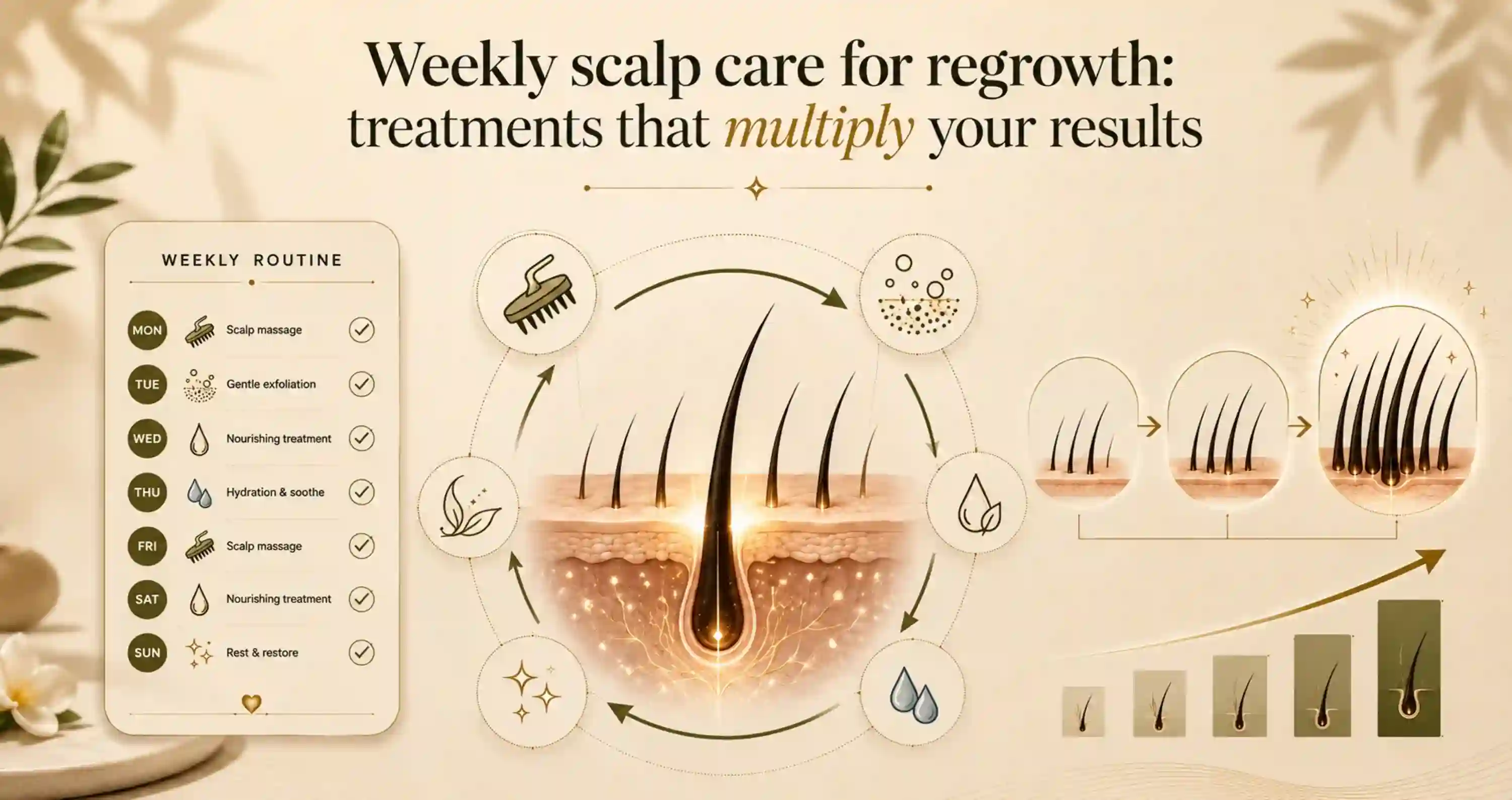
The daily hair regrowth routine is the foundation. These weekly additions are evidence-backed amplifiers with enough clinical data to earn their place in the schedule.
Scalp microneedling: the absorption booster with real evidence
Microneedling creates microchannels in the stratum corneum that significantly enhance topical treatment absorption. The numbers from clinical trials are hard to ignore: one study reported hair density improvement of 38.3/cm² at week 24 in the microneedling plus minoxidil group, versus 18.8/cm² in the minoxidil-only group. A 2020 trial found an 86% improvement rate in the combination group compared to 63% with minoxidil alone.
Apply minoxidil after microneedling, not before, to use the enhanced absorption window. At-home derma rollers at 0.5mm are appropriate for weekly use; deeper needle depths above 1mm are better left to clinician-supervised sessions, as they require a longer wait before topical application to avoid excessive systemic absorption. For a practical comparison of microneedling combined with topical treatments versus other approaches, see this discussion of microneedling with topical minoxidil.
Low-level laser therapy: FDA-cleared and worth scheduling
Low-level laser therapy (LLLT) devices are FDA-cleared for hereditary hair loss in both men and women. Clinical trials on FDA-cleared LLLT devices have shown measurable improvements in hair density, one randomized controlled trial reported a 35% increase in hair count with consistent use over 26 weeks, though study sizes remain modest. The mechanism involves stimulating the follicle environment and improving scalp circulation. Schedule two to three sessions per week and allow at least three to six months before evaluating progress. LLLT works best as a supportive treatment in a combined hair restoration routine; paired with minoxidil and finasteride, it adds a meaningful additional stimulus to the follicle environment.
The honest regrowth timeline: what to expect month by month
Most people quit within the first two months because they expected visible results and got increased shedding instead. Setting accurate expectations is not pessimism, it is the single most effective way to improve treatment adherence to a hair regrowth routine.
Months 1 to 3: shedding, adjustment, and early signals
The minoxidil shed, an increase in shedding during the first four to eight weeks, is a normal part of the process. Follicles cycle out of a dormant phase to begin a new growth cycle, and old hairs shed to make way for them. It is not a sign that the treatment is failing; it is often a sign that it is working. The realistic first signals in this window are a gradually reduced shed rate and subtle thickening at the scalp, not visible regrowth. Consistency during this phase is the single most important variable in the entire hair regrowth routine.
Months 4 to 12: when real density change becomes visible
Minoxidil begins showing measurable benefit around 2 to 4 months. Finasteride’s impact on follicle miniaturization typically becomes visible from 3 to 6 months onward. For combination therapy users, the 4 to 8 month window is usually where clearer changes in density and hairline definition appear. Maximum benefit from most protocols is assessed at 12 months, which is why monthly photos taken under consistent lighting are the most reliable way to track progress. The camera sees what the mirror misses when you are standing in the same place every day.
Why stopping treatment reverses your progress
Both minoxidil and finasteride are maintenance treatments, not cures. The underlying androgenetic alopecia does not stop; the treatment manages it. Hair gained during treatment is gradually lost once the product stack is discontinued, typically over the months following cessation. This is no different from managing any other chronic condition with long-term tools. The goal is not to complete a course, it is to build a sustainable hair loss treatment plan.
When your hair regrowth routine needs a specialist’s input
The routine described in this guide is most effective for confirmed androgenetic hair loss. There are several situations where a DIY approach is not enough, and in some cases, it actively delays the right treatment.
Nutritional deficiencies that silently worsen pattern hair loss
Lab testing is the only reliable way to know whether nutritional deficiencies are compounding your hair loss. The recommended baseline panel includes a CBC plus ferritin for iron status, 25-hydroxy vitamin D for vitamin D levels, and serum zinc. These are standard tests available through any UAE clinic or hospital. If results confirm deficiency, dosing should be prescribed by a clinician, excess iron and zinc supplementation carries its own risks and should not be self-managed. Vitamin D deficiency in particular is extremely prevalent among UAE adults, making this panel worth running before assuming supplements alone will cover the gap.
Red flags that point beyond androgenetic alopecia
Sudden onset, patchy loss, an itchy or scaly scalp, or hair loss accompanied by fatigue, weight changes, or other systemic symptoms are not pattern hair loss. Alopecia areata, telogen effluvium triggered by illness or stress, and thyroid-related hair loss all look different from androgenetic alopecia on closer examination but are frequently self-treated incorrectly with regrowth products. If your loss does not fit the gradual, diffuse pattern typical of androgenetic alopecia, a dermatologist or trichologist consultation is the right next step before committing to any hair loss treatment plan.
Start the routine, then stay the course
An effective hair regrowth routine is not about having the most products on your shelf. It is about using the right ones in the right sequence, consistently, over long enough for the biology to respond. The morning-evening-weekly structure laid out in this guide addresses the problem from every angle: clinical treatment, scalp care for regrowth, nutritional support, and follicle stimulation.
For UAE residents, Hims n Hers UAE makes starting this routine straightforward. The full product stack, Follics FR shampoos, high-concentration minoxidil formulations, oral and topical finasteride options, and Priorin N supplements, is available through the hair loss treatment collection and related hair-care categories in a single order with local UAE delivery, no importing required. Browse the full range at Hims n Hers UAE and build your stack based on what this guide has outlined.
Commit to 12 months. Take monthly photos. Judge the results at the 12-month mark, not at week six. That is the honest timeline, and this hair regrowth routine is designed to support you through all of it.
FAQS
Q: What is the most effective daily hair regrowth routine for thinning hair?
A: The article recommends a layered routine with a clinical core (minoxidil plus finasteride) and a supportive layer (specialist shampoo/conditioner and supplements). Consistency, defined order, and timing are key, because each element targets a different part of the problem and combination therapy outperforms single treatments.
Q: How should I layer minoxidil, finasteride, shampoo, and supplements in my routine?
A: Build the routine around the clinical core first — minoxidil and finasteride — then add supportive scalp care and daily supplements. Use shampoo and conditioner on wash days to manage inflammation and breakage, and take supplements daily to address nutritional gaps; whether finasteride is oral or topical (combination topicals like Follics FR exist) depends on your prescription and preference.
Q: Do I need finasteride if I’m already using minoxidil?
A: Minoxidil and finasteride work by different mechanisms, so using both is often more effective than either alone. The article cites a randomized study showing greater hair density with the combination versus single treatments, because finasteride blocks DHT-driven miniaturization while minoxidil prolongs the anagen growth phase.
Q: What strength of minoxidil should I use for regrowth?
A: Standard 5% minoxidil works well for many people, but higher-concentration formulations up to 16% are available for more resistant cases. Choice of concentration should be guided by tolerance and clinical advice; combination topical products like some Follics FR formulations also pair minoxidil with finasteride in one application.
Q: What role does ketoconazole shampoo play in hair regrowth?
A: Ketoconazole shampoo is a supportive tool with strong clinical backing: studies show it can improve hair density, hair size, and the proportion of anagen follicles. It should be used as an adjunct to core treatments rather than as a standalone therapy, and specialist ranges like Follics FR are formulated specifically for hair loss.
Q: Which supplements are most important for reducing diffuse shedding?
A: Iron (measured as ferritin), vitamin D, and zinc are the three deficiencies most consistently linked to diffuse shedding in the literature. The article notes vitamin D deficiency is common in the UAE, and products like Priorin N offer a multi-nutrient supplement approach to address these gaps.
Q: Where can I buy a complete hair regrowth stack in the UAE?
A: The article highlights Hims n Hers UAE as a one-stop source that stocks clinical treatments, the Follics FR scalp-care range, high-concentration minoxidil formulas, finasteride options, shampoo, conditioner, and Priorin N supplements. The goal is to build a structured hair regrowth routine from relevant categories rather than buying unrelated products separately.