
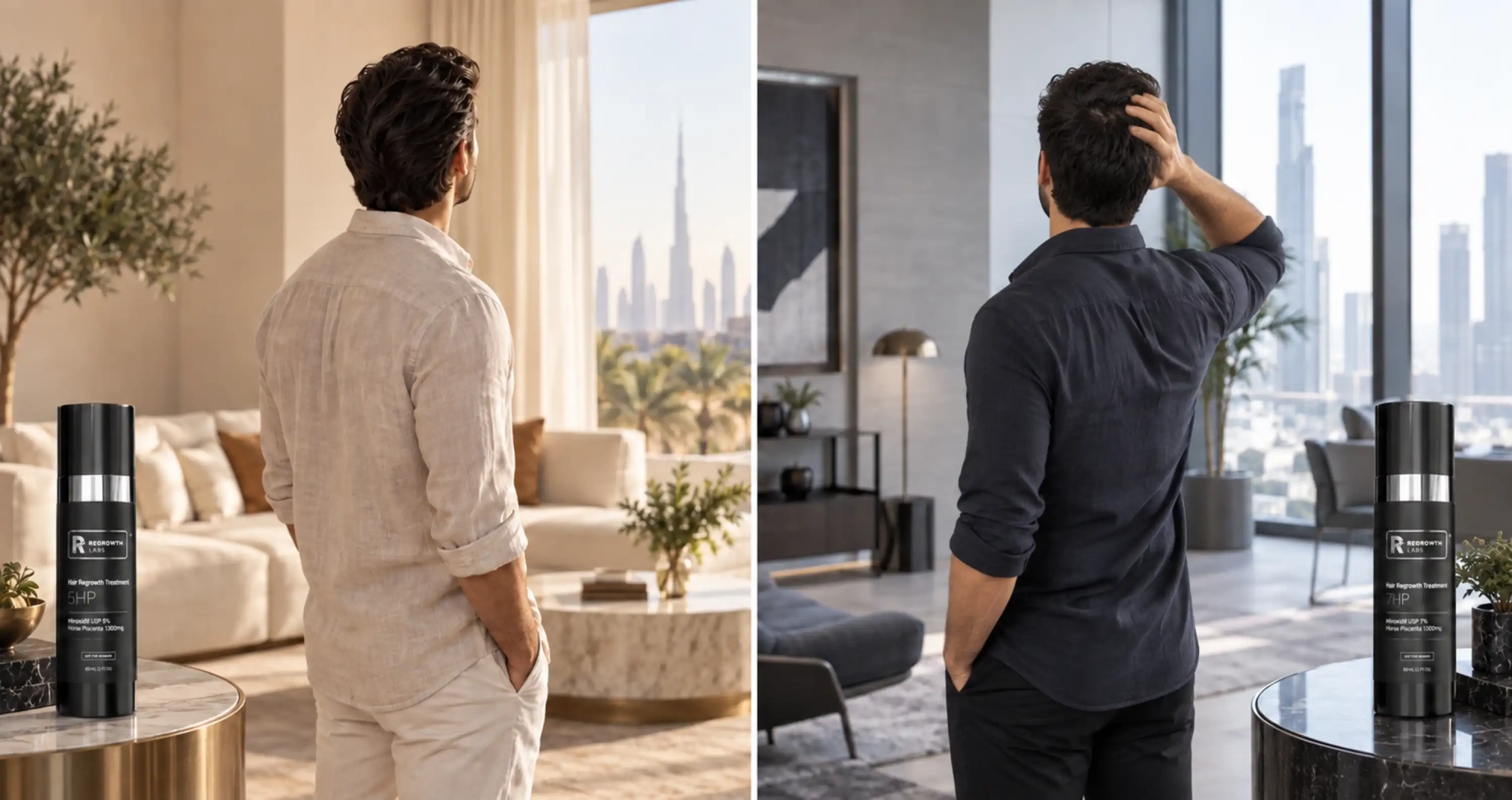
7HP vs 5HP looks like a simple strength comparison, but the number on the bottle does not answer the whole buying question. The current manufacturer information says that 7HP Hair Regrowth Treatment and 5HP Hair Regrowth Treatment are the same.
They list the same amounts of dutasteride, horse placenta extract, and oxytocin. They also share the same published vehicle ingredients, application schedule and storage range. The verified formulation difference is minoxidil: 7HP lists 7% w/w, while 5HP lists 5% w/w.
In a 7HP vs 5HP comparison, that two-point increase makes 7HP the stronger option. It does not make it better.
Evidence for topical minoxidil is strongest at 5%. A higher strength may raise exposure and side effects. It does not always give much better results.
A clinician reviewed an adult male with confirmed androgenetic alopecia. He followed the plan as documented.
He did not respond well to a suitable lower-strength plan. He may have a reason to discuss 7HP. A buyer who is new to treatment, sensitive to topical bases, or not yet diagnosed may want to start simple. They may prefer a more established option.
This 7HP vs 5HP comparison focuses on the two finished products.
It does not cover M7α or a general strength roundup. Buyers who need to find the cause of shedding should start with a full hair-loss action plan. They should not pick a bottle only because it has the highest percentage.
Direct answer:
5HP is the more evidence-based starting choice of these two hybrid formulas. Its minoxidil component is 5% w/w. 7HP may appeal as a clinician-led escalation discussion. It suits adult men with confirmed pattern hair loss.
They have used an appropriate plan consistently. They now need to consider a higher minoxidil concentration. The 7% label does not prove that 7HP will perform better than 5HP. Researchers found no independent head-to-head trial of the finished 7HP and 5HP products.
Quick comparison: 7HP vs 5HP
| Decision factor | 7HP | 5HP |
| Minoxidil listed by manufacturer | 7% w/w | 5% w/w |
| Dutasteride | 0.1% w/w | 0.1% w/w |
| Horse placenta extract | 1.67% w/w | 1.67% w/w |
| Oxytocin | 0.1% w/w | 0.1% w/w |
| Vehicle ingredients | Propylene glycol, ethanol, peppermint oil, menthol, African pepper extract and water | Same listed vehicle ingredients |
| Published directions | Five sprays twice daily; massage for two to four minutes | Same published directions |
| Manufacturer positioning | Men with moderate to severe hair loss; vertex | Men; vertex |
| Evidence fit | Finished 7% hybrid has no identified independent head-to-head product trial | 5% minoxidil has the stronger concentration-specific evidence base, but finished 5HP still lacks its own independent comparative trial |
| Main buying advantage | Higher labelled minoxidil concentration within the same hybrid concept | More conservative minoxidil strength within the same hybrid concept |
| Main trade-off | Higher strength may increase irritation or exposure without proving better efficacy | Lower strength does not mean risk-free because dutasteride and the same vehicle remain present |
| Better discussion candidate | Experienced, clinician-reviewed user with a documented reason to escalate | Buyer for whom the 5% hybrid concept is clinically appropriate and a higher strength is not justified |
7HP vs 5HP: what actually changes?
The most important fact in the 7HP vs 5HP comparison is how little changes on the public manufacturer labels. Both formulas list:
horse placenta extract 1.67% w/w;
dutasteride 0.1% w/w;
oxytocin 0.1% w/w;
deionised water, propylene glycol and ethanol;
peppermint oil, menthol and African pepper extract;
five sprays twice daily;
a two-to-four-minute scalp massage;
storage at 20°C to 25°C with the container closed.
The only variable that changes between 7HP and 5HP is minoxidil.
7% w/w is in 7HP, and 5% w/w is in 5HP. Expressed by finished-product weight, that means the label lists 7 g versus 5 g of minoxidil per 100 g of product. A two-percentage-point absolute difference and a 40% relative increase in listed concentration are present.
Do not rewrite that calculation as “40% more effective.”
In a 7HP vs 5HP comparison, do not rewrite it as “40% more effective.” Concentration, scalp delivery, tolerance, adherence, and biological response are different concepts. A larger quantity of active in the formula does not create a matching percentage increase in hair count.
Inventing a milligram-per-spray comparison is also unsafe. The label lists both products as w/w.
The manufacturer does not publish the mass of five sprays. It also does not provide a verified product density. Without those values, we cannot reliably calculate the exact minoxidil mass that one spray or one application delivers.
Product-label verification: the reliable comparison source
For 7HP vs 5HP, the current manufacturer pages provide the clearest public side-by-side formulation data. The Hims n Hers UAE product pages remain the transaction pages.
However, the current 5HP page has conflicting ingredient text.
Also, the 7HP search description appears to include an outdated 5% reference.
What the 7HP manufacturer says
The manufacturer describes 7HP as a multi-mechanism product for men with moderate to severe hair loss. It lists minoxidil USP 7% w/w, dutasteride 0.1% w/w, horse placenta extract 1.67% w/w and oxytocin 0.1% w/w. Its stated treatment zone is the vertex.
In the 7HP vs 5HP decision, this reflects manufacturer positioning.
It does not prove that a “moderate” or “severe” clinical stage needs 7% by default. Document the hair-loss stage using pattern, density, duration, miniaturisation, and treatment history rather than estimating it from anxiety or a single photograph.
What the 5HP manufacturer says
The manufacturer lists the same supporting actives and vehicle for 5HP, with minoxidil USP at 5% w/w. The published indication also specifies men and the vertex.
The broader Regrowth Labs product-family overview can help buyers understand how the brand groups its treatments. It should not replace checking each exact label because product-family descriptions can simplify important differences.
What “Horse Placenta 1,000 mg” does not prove
Both product titles use a 1,000 mg horse-placenta claim while the technical ingredient panels state 1.67% w/w. Those values may match a specific filled-product mass.
But verify the package net weight before you calculate it. Liquid volume alone isn’t enough to convert a weight-by-weight percentage into total milligrams.
The safe editorial wording is that both manufacturer pages list horse placenta extract at 1.67% w/w.
They also market the packages as containing 1,000 mg. Do not create a per-spray or per-millilitre value from those statements.
Does 7% minoxidil have stronger evidence than 5%?
Not on the evidence currently available for these products. In 7HP vs 5HP, the 7HP label shows a higher minoxidil concentration.
But a higher concentration is not the same as stronger clinical evidence.
The site’s minoxidil treatment guide explains the established concentration landscape. Standard evidence and drug labelling for topical minoxidil centre on 2% and 5% formulations. A randomised trial in men found 5% topical minoxidil superior to 2% for hair regrowth. That supports the importance of concentration in studied products.
But it does not show that every increase above 5% leads to a better outcome.
A separate randomized study compared 10% topical minoxidil with 5% and placebo.
It found that 5% was moderately better than 10% in that study.
Irritation was more common with 10%. The trial did not test 7HP, 5HP, dutasteride, horse placenta, oxytocin or the Regrowth Labs vehicle. It therefore cannot prove that 5HP beats 7HP. It does show why a simple “more minoxidil equals more regrowth” rule is not scientifically reliable.
The correct evidence statement is:
5% topical minoxidil has direct concentration-specific human evidence and official drug labelling in conventional formulations;
7% minoxidil is a higher concentration, but no independent human trial of the exact finished 7HP product was identified;
no independent head-to-head human trial of finished 7HP versus finished 5HP was identified;
You cannot fully apply evidence for one active ingredient to a formula with many actives.
This is especially true when the vehicle and dose unit differ.
Evidence hierarchy for this buying decision
| Evidence level | What it tells the buyer | What it does not prove |
| Official 5% minoxidil drug labels | Standard 5% topical use, vertex indication, warnings and continued-use requirement | Exact dose, safety or outcome for 5HP or 7HP |
| Randomised 5% vs 2% minoxidil trial | 5% can outperform 2% in a studied conventional formulation | That every strength above 5% is better |
| Randomised 10% vs 5% minoxidil trial | A higher concentration did not automatically outperform 5% and caused more irritation in that study | Direct performance of a 7% hybrid formula |
| Randomised topical-dutasteride research | Supports clinical investigation of topical dutasteride as a route | Finished 7HP or 5HP efficacy; the trial did not test either blend |
| Manufacturer labels | Exact public formula, directions, storage and warnings | Independent clinical superiority |
| Finished-product head-to-head trial | None identified | No claim that 7HP is clinically superior to 5HP should be made |
Hair-loss stage: why the label cannot diagnose the buyer
The calendar topic asks which strength fits a hair-loss stage, but “stage” must be used carefully. A product percentage cannot show if someone has androgenetic alopecia, telogen effluvium, or alopecia areata.
It also cannot show scarring alopecia, traction loss, thyroid-related shedding, or iron deficiency.
Pattern hair loss usually progresses gradually and follows recognisable areas. Sudden shedding, patchy loss, broken hairs, pain, pustules, marked scaling or scarring require diagnostic assessment. A person with the wrong diagnosis may gain no benefit from either hybrid formula and could delay appropriate care.
The complete hair-loss action plan provides a cause-first pathway. UAE buyers who need a wider product shortlist can use the guide to advanced hair-thinning solutions in Dubai.
Use it after reviewing the cause and pattern.
Early or first-diagnosed pattern thinning
In a 7HP vs 5HP decision, neither product should be chosen solely because the buyer has noticed early thinning. A first-time user may do better with a step-by-step plan. This plan checks tolerance and results with a proven active first. Then, it adds more ingredients.
For 7HP vs 5HP, if a clinician recommends the Regrowth Labs hybrid concept, 5HP is more conservative. It has a lower minoxidil strength. That does not make it a basic cosmetic serum.
It still contains 0.1% dutasteride. It also has reproductive and hormonal risks. Transfer risks and monitoring needs also exist.
Established pattern thinning with incomplete response
In a 7HP vs 5HP decision, 7HP may be discussed when the diagnosis is confirmed.
The buyer should have used a suitable lower-strength plan consistently.
Application technique should be correct.
The scalp should tolerate the vehicle.
Response should remain inadequate after a reasonable review period.
Before escalating, the clinician should check if the apparent failure is due to missed applications. It may also be due to unrealistic timelines. Check if treatment was applied to hair shafts, not the scalp. Also check for poor storage. Consider ongoing inflammatory scalp disease. Also consider a different diagnosis. Increasing concentration cannot correct those problems
Moderate or severe visual loss
The manufacturer positions 7HP for moderate to severe loss, but advanced visual loss does not guarantee that more topical minoxidil will revive follicles that are no longer viable. Duration, miniaturisation and donor-area status matter. Some users with substantial loss need procedural or surgical evaluation rather than serial increases in topical strength.
In 7HP vs 5HP, the phrase “severe hair loss” must describe a reason for professional assessment, not a promise that 7HP is the inevitable winner.
Which buyer may fit 5HP better?
In a 7HP vs 5HP comparison, 5HP may be the more rational product to discuss when the buyer:
is an adult man with clinician-confirmed androgenetic alopecia;
has a specific reason to use a combined minoxidil-and-dutasteride topical;
does not have a documented need to move beyond the 5% minoxidil component;
values the stronger evidence base surrounding conventional 5% topical minoxidil;
wants to minimise unnecessary concentration escalation;
can reliably prevent transfer of wet dutasteride-containing product;
understands that the animal-derived ingredient and vehicle may affect acceptability;
accepts that product-specific evidence for the finished 5HP blend is limited.
The 5HP Hair Regrowth Treatment page should be used only after its conflicting ingredient copy is corrected. Until then, the manufacturer label and the physical package should control the factual description.
Which buyer may have a reason to discuss 7HP?
In a 7HP vs 5HP comparison, 7HP may be a reasonable escalation conversation when the buyer:
is an adult man with confirmed androgenetic alopecia rather than unexplained shedding;
has documented progression or inadequate response despite correct, consistent use of an appropriate plan;
has reviewed adherence, technique, storage and treatment duration with a clinician;
already tolerates a similar propylene-glycol and alcohol-based topical vehicle;
understands that 7% has less direct evidence than conventional 5% topical formulations;
accepts that higher concentration may increase irritation without guaranteeing better regrowth;
has been counselled about dutasteride-related sexual, fertility, breast, mood, prostate and transfer considerations;
has a defined review date and stop/escalation criteria.
The current 7HP Hair Regrowth Treatment page lists the relevant actives and directions, but its search-result description should be corrected if it still refers to 5% minoxidil.
When is neither 7HP nor 5HP the right starting point?
A multi-active hybrid may not be the right first choice when:
the cause of loss is unknown;
shedding is sudden, patchy or accompanied by systemic symptoms;
the scalp is inflamed, infected, sunburned, abraded or scarred;
the buyer has not yet tolerated topical minoxidil;
heart disease or blood-pressure-lowering medication requires medical review;
sexual, fertility, breast, mood, liver or prostate-health concerns have not been discussed;
wet-product transfer to a pregnant person cannot be reliably prevented;
the buyer objects to an animal-derived ingredient;
propylene glycol, ethanol, peppermint oil, menthol or African pepper extract has previously caused a reaction;
the routine of five sprays twice daily is unrealistic.
In these situations, the broader hair-loss treatment collection can show the available formats, but the next step should still be diagnosis and clinician-led selection—not random substitution.
The shared dutasteride changes the risk conversation
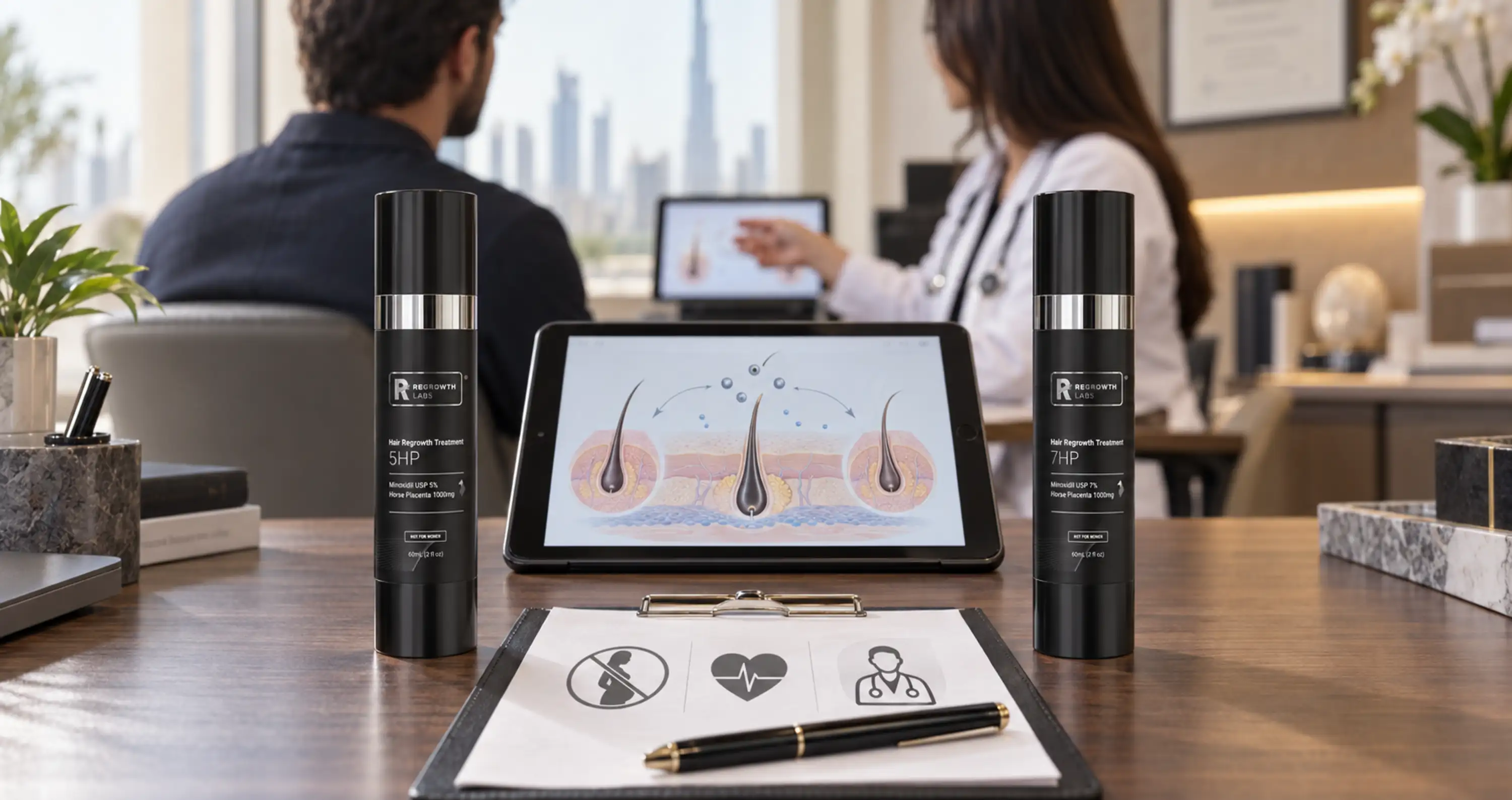
Both products list dutasteride 0.1% w/w. This means 5HP is not simply a standard minoxidil 5% product, and 7HP is not simply a standard minoxidil 7% product. Each combines a growth stimulant with a 5-alpha-reductase inhibitor.
The guide to topical vs oral dutasteride explains why route matters and why topical use should not be equated with zero systemic exposure. A 2025 randomised study investigated topical dutasteride solutions up to 0.05% w/v. That work supports interest in the topical route, but it did not test the 0.1% w/w concentration, vehicle or multi-active blends used in 7HP and 5HP.
Buyers comparing DHT blockers can use the overview of finasteride vs dutasteride for mechanism context. “Stronger DHT inhibition” must not be translated into “safer,” “better for everyone” or “appropriate without medical review.”
Transfer and pregnancy precautions
Dutasteride can harm development of a male fetus. Women who are pregnant or may become pregnant should not apply either product or touch wet solution. The user should wash hands after application, clean spills, allow the scalp to dry before close contact, avoid transfer to pillows and towels, and keep the bottle away from children.
The published 7HP and 5HP manufacturer warnings do not provide a complete topical-dutasteride counselling protocol. A clinician and the supplied leaflet should be used for individual precautions.
The shared vehicle changes the tolerability comparison
Both manufacturer pages list propylene glycol, ethanol, peppermint oil, menthol and African pepper extract. A buyer who reacted to the base in 5HP should not assume that 7HP will solve the problem; the listed vehicle is the same. Moving from 5HP to 7HP also introduces a higher minoxidil concentration into that vehicle.
Possible local problems include dryness, flaking, stinging, redness, itching and contact dermatitis. Unwanted facial hair can occur when product runs beyond the target area or transfers before drying. A higher-strength switch should not be made on an already inflamed scalp.
This is why tolerability is part of efficacy. A formula that is used inconsistently because it irritates the scalp may perform worse in real life than a more tolerable plan used correctly.
Horse placenta and oxytocin: shared ingredients, shared uncertainty
Because both products list the same concentrations of horse placenta extract and oxytocin, these ingredients do not explain the 7HP vs 5HP choice.
The manufacturer describes horse placenta as a source of peptides, nutrients and growth factors. That is formulation rationale, not independent proof that the exact 1.67% w/w extract improves clinical outcomes in either finished product. Species, extraction method, concentration and final vehicle matter.
Laboratory research has explored oxytocin signalling in hair-follicle and dermal-papilla models. Such findings do not prove that topical oxytocin 0.1% produces clinically meaningful regrowth or treats stress in people. The article must not claim that either product reduces anxiety, improves confidence hormonally or delivers a proven mental-health effect.
Buyers may also have allergy, ethical, cultural or religious concerns about animal-derived ingredients. Because the ingredient appears in both formulas, choosing 7HP over 5HP does not remove that consideration.
Directions: the same schedule does not mean the same dose
The manufacturer gives both products the same directions:
Apply five sprays directly to the scalp in the hair-loss area.
Use twice daily.
Massage the scalp for two to four minutes.
Do not apply more or more often in an attempt to improve results.
Continue use to maintain regrowth.
The shared spray count does not establish the exact milligrams of minoxidil, dutasteride or other ingredients delivered. Spray output can be expressed by mass or volume only when the dispenser output and product density are known. Those values are not published on the current manufacturer pages.
Do not convert “five sprays” into 1 mL or another volume without verified packaging information. Do not layer 7HP and 5HP together, alternate them to create an average 6% routine or add another minoxidil or DHT-blocker product without clinician review.
UAE use and storage routine
The manufacturer says to store both products at 20°C to 25°C and keep the container closed. UAE conditions make that instruction operationally important.
Do not leave either bottle in a parked car, sunny window, balcony, outdoor gym bag or delivery box exposed to heat.
Apply to a dry scalp when heavy sweating, swimming or showering is not imminent.
Keep the solution away from open flame or high heat because the vehicle contains ethanol.
Allow the scalp to dry before wearing tight headwear or lying on a pillow.
Wash hands thoroughly and prevent wet transfer to another person.
Keep the nozzle clean and the cap closed.
Use standardised photographs under the same lighting, angle and hairstyle at baseline and review points.
The Regrowth Labs collection can be used to compare current product formats, but storage instructions must be checked on each individual bottle rather than assumed across the brand.
What to review before moving from 5HP to 7HP
An escalation decision should answer seven questions:
Is the diagnosis correct? Pattern loss should be distinguished from sudden, inflammatory, nutritional, endocrine or scarring causes.
Was 5HP or another appropriate plan used consistently? Missed applications do not prove concentration failure.
Was the review period long enough? The manufacturer notes that results may take two to four months and vary, while clinical assessment often needs a longer standardised follow-up.
Was application technique correct? Product needs to reach the scalp rather than mainly coating the hair.
Was the vehicle tolerated? 7HP uses the same listed irritant-prone base as 5HP.
Are dutasteride precautions already addressed? Both formulas contain the same listed dutasteride concentration.
What outcome would justify continuing? Define photographic, shedding, density and tolerability measures before switching.
If several questions in the 7HP vs 5HP decision remain unanswered, the next step is assessment—not a stronger bottle. The guide to advanced hair-thinning solutions in Dubai can help organize a shortlist, but it cannot replace a diagnosis.
Common comparison mistakes
Mistake 1: treating 7% as proven superior to 5%
The label difference is real. A proven outcome difference is not. No finished-product head-to-head trial was identified.
Mistake 2: assuming 5HP is low-risk because its number is lower
5HP still contains dutasteride, horse placenta, oxytocin, propylene glycol, ethanol, menthol, peppermint oil and African pepper extract. It is the lower minoxidil strength of the pair, not a minimal-ingredient serum.
Mistake 3: choosing by visual stage alone
Two men with similar photographs may have different diagnoses, durations, viable follicles, medical histories and previous treatment exposure.
Mistake 4: blaming concentration before checking adherence
Inconsistent use, incorrect scalp placement, heat-damaged storage or premature review can make an appropriate formula look ineffective.
Mistake 5: comparing 7HP with M7α inside this article
That is a different product comparison with a different formulation intent. This page owns only 7HP versus 5HP and intentionally excludes M7α.
Mistake 6: relying on the current 5HP “Science Matters” block
The live page contains mismatched ingredient copy. Use the corrected product page, manufacturer data and verified physical label before publishing.
Buyer decision matrix
| Buyer situation | More rational next step | Why |
| New, unexplained or sudden hair loss | Diagnosis before either product | Strength cannot correct the wrong diagnosis |
| Confirmed male pattern loss; hybrid formula specifically advised; no need for escalation | Discuss 5HP | 5% is the more evidence-aligned minoxidil strength of the two |
| Confirmed pattern loss; correct lower-strength plan used consistently; inadequate response; good tolerance | Discuss whether 7HP is justified | Higher concentration may be considered, but benefit is not guaranteed |
| Sensitive or inflamed scalp | Treat the scalp issue and reconsider vehicle | Both list the same propylene-glycol, alcohol and botanical base |
| Pregnancy-transfer controls cannot be maintained | Neither product until risk is resolved | Both contain dutasteride |
| Buyer does not accept animal-derived ingredients | Choose a different formula | Both contain horse placenta extract |
| Severe longstanding loss with limited viable follicles | Specialist/procedural assessment | A stronger topical may not restore inactive or absent follicles |
Final verdict: which strength fits the stage?
In a responsible 7HP vs 5HP decision, 5HP is the more conservative hybrid option and the one whose minoxidil concentration sits closer to the strongest conventional evidence base. It may fit an adult male when a clinician has confirmed androgenetic alopecia and specifically judged a combined minoxidil-and-dutasteride topical appropriate.
7HP is the higher-strength formulation, but the case for it should come from treatment history rather than label psychology. A user who has adhered to an appropriate plan, tolerated the shared vehicle and still has documented progression may have a reason to discuss escalation. The 7% concentration is a reason for a more careful review, not a shortcut around one.
Neither product wins universally. Both contain the same listed dutasteride concentration, animal-derived placenta extract, oxytocin and potentially irritating vehicle components. Both use the same public directions. The verified difference is minoxidil 7% w/w versus 5% w/w, and no independent finished-product head-to-head trial was identified.
The practical winner is therefore the lowest-complexity, lowest-necessary-strength plan that matches the diagnosis, can be tolerated, can be used consistently and has a defined review point. Buyers who remain unsure should compare clinician-appropriate options in the hair-loss treatment collection rather than selecting the largest percentage by default.
Frequently asked questions
What is the main difference between 7HP and 5HP?
The current manufacturer labels list minoxidil 7% w/w in 7HP and 5% w/w in 5HP. They list the same concentrations of dutasteride, horse placenta extract and oxytocin, along with the same other ingredients, directions and storage range.
Is 7HP proven to work better than 5HP?
No independent head-to-head human trial of the finished 7HP and 5HP products was identified. A higher labelled concentration does not by itself prove superior regrowth.
Does 7HP contain more dutasteride than 5HP?
No. Both current manufacturer pages list dutasteride 0.1% w/w. The stated difference is the minoxidil concentration.
Is 5HP just a standard 5% minoxidil serum?
No. 5HP also lists dutasteride 0.1% w/w, horse placenta extract 1.67% w/w and oxytocin 0.1% w/w. Its evidence and safety cannot be treated as identical to a conventional single-active 5% minoxidil product.
Should severe hair loss automatically be treated with 7HP?
No. Severe or longstanding loss needs diagnosis and assessment of follicle viability, duration, previous treatment and procedural options. The manufacturer’s positioning does not replace clinical selection.
Can 5HP and 7HP be used together?
Not without clinician direction. Both contain minoxidil and dutasteride, so combining them can increase exposure and irritation without proving better results.
Do five sprays equal 1 mL?
The public manufacturer pages do not state a verified volume or mass for five sprays. A millilitre or milligram conversion should not be invented.
Do both formulas contain propylene glycol?
Yes. Both current manufacturer ingredient lists include propylene glycol, ethanol, peppermint oil, menthol and African pepper extract.
Are 7HP and 5HP intended for the hairline?
The current manufacturer pages specify the scalp vertex. Seller positioning may discuss other areas, but equal evidence for frontal and vertex use should not be promised.
Can women use 7HP or 5HP?
The manufacturer identifies both products for men, and each contains dutasteride. Women who are pregnant or may become pregnant must avoid exposure to wet product because dutasteride can harm development of a male fetus.
Where can UAE buyers compare both products?
The verified Regrowth Labs collection lists both formulas. Compare the corrected product pages, physical labels and clinician guidance before buying.
CTA
If a qualified clinician has confirmed male androgenetic alopecia and advised a multi-active topical, compare the corrected labels and current directions for 7HP Hair Regrowth Treatment and 5HP Hair Regrowth Treatment. Buyers who need a wider shortlist can review the Regrowth Labs collection or the broader hair-loss treatment collection without assuming that the higher percentage is automatically the better fit.
Medical disclaimer:
This article is educational and does not diagnose hair loss or replace medical advice. 7HP and 5HP contain pharmacologically active minoxidil and dutasteride. Suitability, strength, use, monitoring and combination treatment should be determined by a qualified healthcare professional. Seek urgent care for chest pain, fainting, a sustained rapid heartbeat, severe swelling, a serious allergic reaction or thoughts of self-harm.