
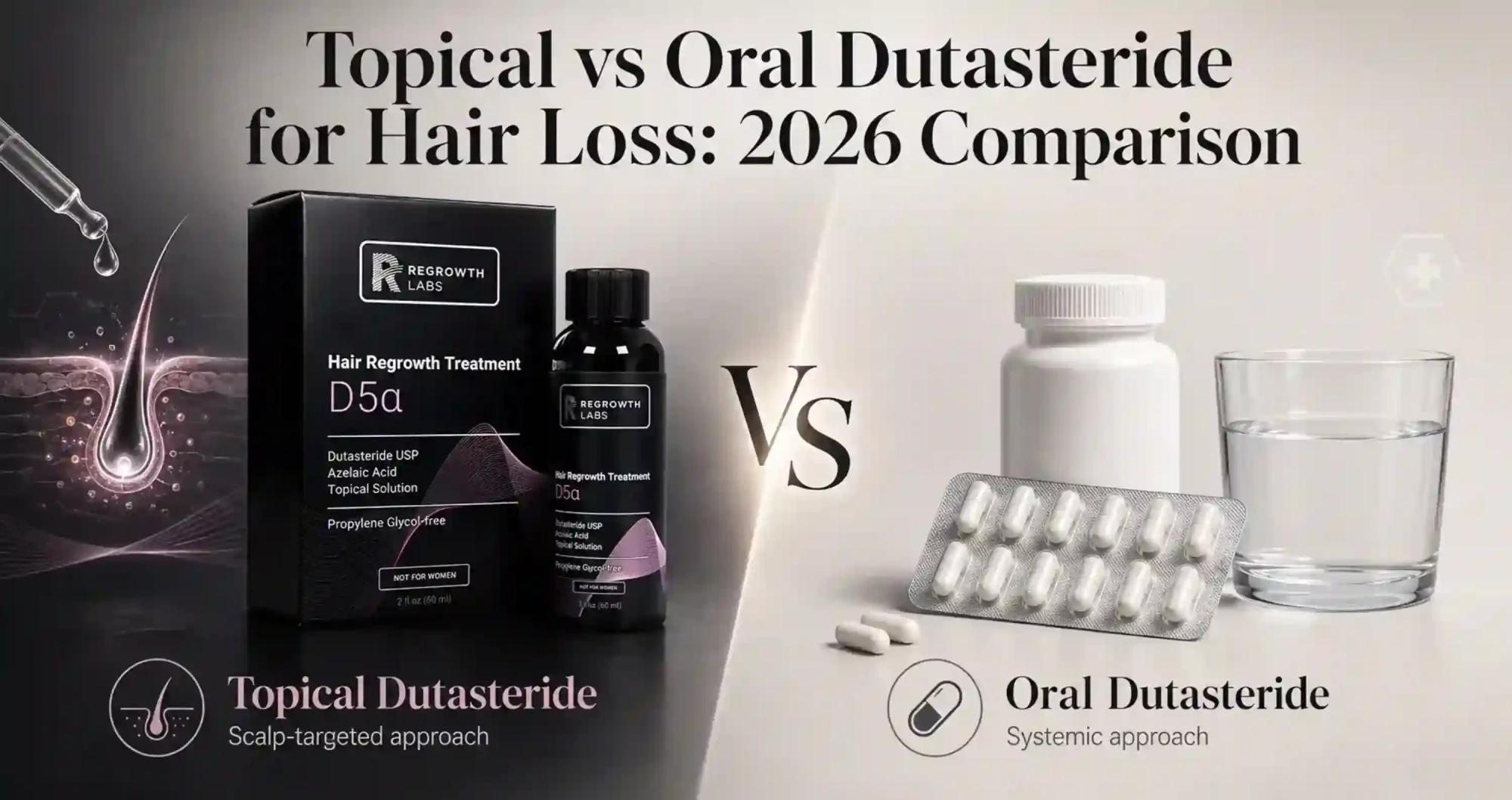
Two men walk into a dermatologist’s office with similar hairlines, similar Norwood stages, and the same drug on their prescription: dutasteride. One leaves with an oral tablet. The other leaves with a topical formulation. Both are puzzled about why. If you’ve ever wondered how topical vs oral dutasteride compares for hair loss, you’re asking one of the most common questions the team at Hims n Hers UAE hears from customers, and it deserves a clear, clinical answer. The choice between topical vs oral dutasteride should be based on hair-loss stage, absorption, side-effect tolerance, and clinician guidance.
Dutasteride is the most potent 5-alpha-reductase inhibitor (5-ARI) available for androgenetic alopecia. It blocks both type I and type II isoenzymes of 5-alpha-reductase, the enzymes responsible for converting testosterone into dihydrotestosterone (DHT) at the follicle. That dual inhibition is what separates it from finasteride, which only targets type II. The question isn’t whether dutasteride works. The real question is whether the delivery method changes what you get, and what risks you carry along with it. That is why a topical vs oral dutasteride comparison has to look at both efficacy and exposure.
This article breaks that question down using pharmacokinetic data, clinical trial results, and real-world formulation context relevant to patients in the UAE. It also explains where topical dutasteride products sit inside the Hims n Hers UAE treatment range. It covers mechanism, absorption, DHT suppression, clinical efficacy, side effects, and available formulations, so you’ll have a solid foundation for a focused conversation with your dermatologist or trichologist.
How dutasteride reaches your hair follicles depends on how you take it
Oral dutasteride: full systemic distribution
When you swallow a 0.5 mg dutasteride tablet, the drug is absorbed through the gastrointestinal tract and distributed throughout your entire body via blood circulation. In any topical vs oral dutasteride discussion, this systemic distribution is the major difference. It reaches scalp follicles, but it also reaches every other tissue where DHT plays a role: prostate, skin, liver, and reproductive organs. That systemic reach is precisely what makes oral dutasteride so powerful for hair loss, and it’s also what drives the side-effect conversation.
Oral dutasteride has an exceptionally long half-life of approximately five weeks. The drug accumulates in your system over months, and it takes equally long to clear if you stop. For hair regrowth, that slow accumulation delivers consistent, sustained suppression of DHT. For patients sensitive to systemic androgen changes, it also means that side effects, if they appear, don’t resolve quickly once you discontinue.
Topical dutasteride: scalp-targeted delivery with limited systemic spread
Topical dutasteride is applied directly to the scalp, with the intended goal of inhibiting DHT production locally at the follicle while limiting how much of the drug enters the bloodstream. A relevant UAE product example is D5a Hair Regrowth Treatment with Dutasteride USP 0.5% and Azelaic Acid, which is positioned as a topical dutasteride-based formula rather than an oral capsule. The vehicle matters enormously here. Gels and solutions designed with controlled-release or enhanced-permeation technology aim to push the drug into the dermal papilla without allowing significant systemic absorption. When paired with microneedling, the drug can be delivered more directly to the follicular unit, bypassing the skin barrier that otherwise limits penetration.
The result is a fundamentally different pharmacokinetic profile. This is the central reason topical vs oral dutasteride cannot be judged by the active ingredient name alone. Topical dutasteride can inhibit local testosterone-to-DHT conversion at the follicle without triggering the body-wide DHT suppression that oral dosing produces. Whether that local inhibition is sufficient depends on hair loss severity and individual response, which is where the clinical data become essential.
How topical vs oral dutasteride for hair loss: pharmacokinetics and DHT suppression
Serum dutasteride concentrations compared
The pharmacokinetic difference between the two delivery methods is substantial. It is also the strongest scientific reason patients ask about topical vs oral dutasteride before committing to long-term use. In clinical gel studies, mean serum dutasteride concentration after topical application measured approximately 1.54 ng/mL. Oral dutasteride 0.5 mg produced a mean serum concentration of 28.1 ng/mL. That’s roughly 17 to 18 times more drug circulating systemically with the oral route.
The serum DHT suppression figures follow the same pattern. Topical dutasteride gel reduced serum DHT by approximately 19% in one pharmacokinetic safety study, and between 8.9% and 11% in a separate randomized 0.05% solution trial at weeks 12 and 24 respectively. Neither reduction reached statistical significance compared to baseline. Oral dutasteride, by contrast, suppresses serum DHT by 90 to 98% consistently across published trials. The gap isn’t marginal: it represents the clinical difference between a local follicular adjustment and a near-complete systemic shutdown of DHT production. For patients comparing topical vs oral dutasteride, this difference shapes both benefit expectations and safety concerns.
What lower systemic DHT suppression means for scalp DHT
This is the nuance most people miss in a topical vs oral dutasteride comparison: lower serum DHT doesn’t automatically mean insufficient scalp DHT suppression. Hair follicles produce their own DHT locally, converting testosterone via the 5-alpha-reductase enzymes present in the dermal papilla. Topical dutasteride applied directly to the scalp can inhibit that local enzymatic conversion without needing to suppress DHT across the entire body.
That distinction has two practical implications. First, topical dutasteride may deliver meaningful follicular protection even while leaving systemic DHT largely intact. Second, the reduced systemic exposure is precisely why its side-effect profile differs so sharply from oral dutasteride. Both points are central to understanding which option suits a given patient.
Clinical efficacy: what the regrowth studies actually show
Oral dutasteride trial results
The evidence base for oral dutasteride in androgenetic alopecia is well-established and consistently positive. Multiple controlled trials demonstrate statistically significant improvements in total hair count, hair density, and shaft thickness in men with male pattern hair loss. Head-to-head comparisons with finasteride consistently favor dutasteride on regrowth outcomes, which is expected given its broader enzymatic blockade. Network meta-analyses rank oral dutasteride 0.5 mg among the most effective available monotherapies for androgenetic alopecia.
Dosing protocols, monitoring timelines, and expected response windows are well-characterized, built on a clinical history that spans BPH treatment from the early 2000s and a strong, growing evidence base specifically for hair loss. For patients with moderate to advanced hair loss, that depth of evidence is a genuine clinical advantage. This is why topical vs oral dutasteride is not simply a safety comparison; it is also an evidence-depth comparison.
Topical vs oral dutasteride for hair loss: phase II and comparative findings
The phase II double-blind randomized trial of 0.05% topical dutasteride produced compelling results. At 24 weeks, the 0.05% concentration arm showed a mean increase of approximately 75.5 hairs per cm² in total hair count, compared to roughly 41.2 hairs per cm² with oral finasteride and essentially no change with placebo. That’s a meaningful signal. For hair width, both topical dutasteride and finasteride outperformed placebo, though topical dutasteride didn’t clearly separate from finasteride on that endpoint.
The microneedling combination data add another layer to the topical vs oral dutasteride decision. In a comparative study pairing topical dutasteride via microneedling plus topical minoxidil against oral dutasteride plus topical minoxidil, the microneedling group demonstrated hair density and thickness improvements comparable to the oral combination, with fewer systemic adverse events.
A separate 20-week randomized trial confirmed that 0.01% dutasteride delivered via microneedling outperformed saline microneedling alone on hair thickness, density, and the vellus-to-terminal hair ratio. These are genuinely encouraging results, but two important caveats apply: most topical studies are small, short, or rely on adjunct delivery methods, and there is no large, clean head-to-head trial comparing topical dutasteride monotherapy directly against oral dutasteride monotherapy.
Side effect profiles: where the real clinical difference lies
Sexual adverse events and oral dutasteride
The systemic side-effect profile of oral dutasteride centers on sexual function. Across pooled clinical trial data, sexual adverse events occurred in approximately 8.27% of dutasteride-treated participants versus 6.23% with placebo. The most consistently reported events are decreased libido, erectile dysfunction, and ejaculatory dysfunction. A pooled relative risk estimate for decreased libido was 1.99, trending toward increased risk though not reaching statistical significance in all analyses. Gynecomastia and rare mood-related changes are also documented in the broader literature, with overall adverse event rates reaching up to 13% in higher-dose studies.
In practice, the sexual side-effect signal for oral dutasteride is real, dose-dependent, and inconsistent across studies. Some trials show no statistically significant difference from placebo; others document a clear excess. What doesn’t vary is that these adverse events are the primary reason patients and clinicians look toward topical alternatives. For many users, topical vs oral dutasteride is really a question about how much systemic DHT suppression they are willing to accept. With a five-week half-life, any side effects that appear can persist well after stopping treatment.
What topical dutasteride users actually report
Published topical dutasteride studies report a predominantly local adverse event profile. That makes the topical vs oral dutasteride safety profile one of the most important practical differences. Scalp erythema, dryness, and pruritus are the most common reactions, along with occasional contact irritation. These are generally mild and often formulation-dependent, and switching vehicle or adjusting application frequency typically resolves them.
Because systemic exposure with topical dutasteride is dramatically lower, significant rates of sexual dysfunction, mood changes, or other systemic events have not emerged in published trials. The evidence base is too small to make definitive long-term safety claims, and that limitation deserves acknowledgment. What pharmacokinetics and available trial data do support is straightforward: if the drug is largely staying at the scalp rather than flooding the bloodstream, the mechanism driving systemic sexual side effects in oral dutasteride is substantially blunted. This is the clearest safety argument in favor of topical vs oral dutasteride for selected patients. For patients who have experienced side effects on finasteride or oral dutasteride, that biological logic carries real clinical weight.
Topical dutasteride formulations in 2026: what’s available and at what strength
Compounded solutions, gels, and combination preparations
As of 2026, no FDA-approved commercial topical dutasteride hair-loss product exists. Per available FDA drug approval records, topical dutasteride remains a compounded, prescription-only therapy. As noted by the American Hair Loss Association, available preparations span a range of concentrations: 0.01% solution (used in microneedling studies), 0.05% solution (the concentration tested in the phase II trial), and 0.1% solution or gel, which is the most commonly referenced concentration in clinical guidance. Some specialist compounding pharmacies offer 0.3% solutions or gels for patients requiring higher-strength formulations, and proprietary gel products using controlled-release systems have been formulated at concentrations as high as 2%, though these fall outside the standard compounding benchmark.
The absence of a single standardized commercial product means availability varies considerably by country, clinic, and compounding pharmacy. For UAE shoppers comparing topical options, the hair loss treatment collection is the most relevant internal category because it includes topical dutasteride and other prescription-style treatment formats. Topical dutasteride is also frequently compounded in combination with minoxidil, both for application convenience and for the potentially additive mechanism: minoxidil promotes follicular circulation and extends the anagen phase, while dutasteride addresses the androgenic cause of follicle miniaturization. On Hims n Hers UAE, 7HP Hair Regrowth Treatment with Minoxidil 7% and Dutasteride 0.1% is the most relevant internal example of this combination strategy.
Proprietary controlled-release approaches and formulation patents describe strategies to maximise scalp delivery while minimising systemic absorption; see the patent for topical dutasteride formulations for examples of those technical approaches.
Combining dutasteride with minoxidil or microneedling
The combination evidence, though limited, points in a consistent direction. It also shows why topical vs oral dutasteride often becomes a broader conversation about combination therapy. Adding dutasteride to a minoxidil regimen outperforms minoxidil alone for hair density and shaft width in the available comparative studies. Microneedling appears to enhance topical dutasteride’s efficacy, likely by creating micro-channels that improve dermal penetration directly to the follicular unit. The previously mentioned comparative study found that topical dutasteride via microneedling plus minoxidil achieved outcomes comparable to oral dutasteride plus minoxidil, with fewer systemic events and what the authors described as negligible side effects.
A published case report on oral dutasteride combined with oral minoxidil documented visible improvements in hair thickness and density, with minor facial hypertrichosis but no libido changes, cardiovascular events, or edema. This is a single case report, not a controlled trial, and it shouldn’t be extrapolated broadly. What the combination data collectively show is that dutasteride and minoxidil work on complementary mechanisms, and pairing them is rational. The delivery method for dutasteride still matters, which keeps topical vs oral dutasteride central to the decision. The delivery method for each component still matters, and the ideal combination for a given patient requires clinical input.
A UAE product pathway for topical vs oral dutasteride
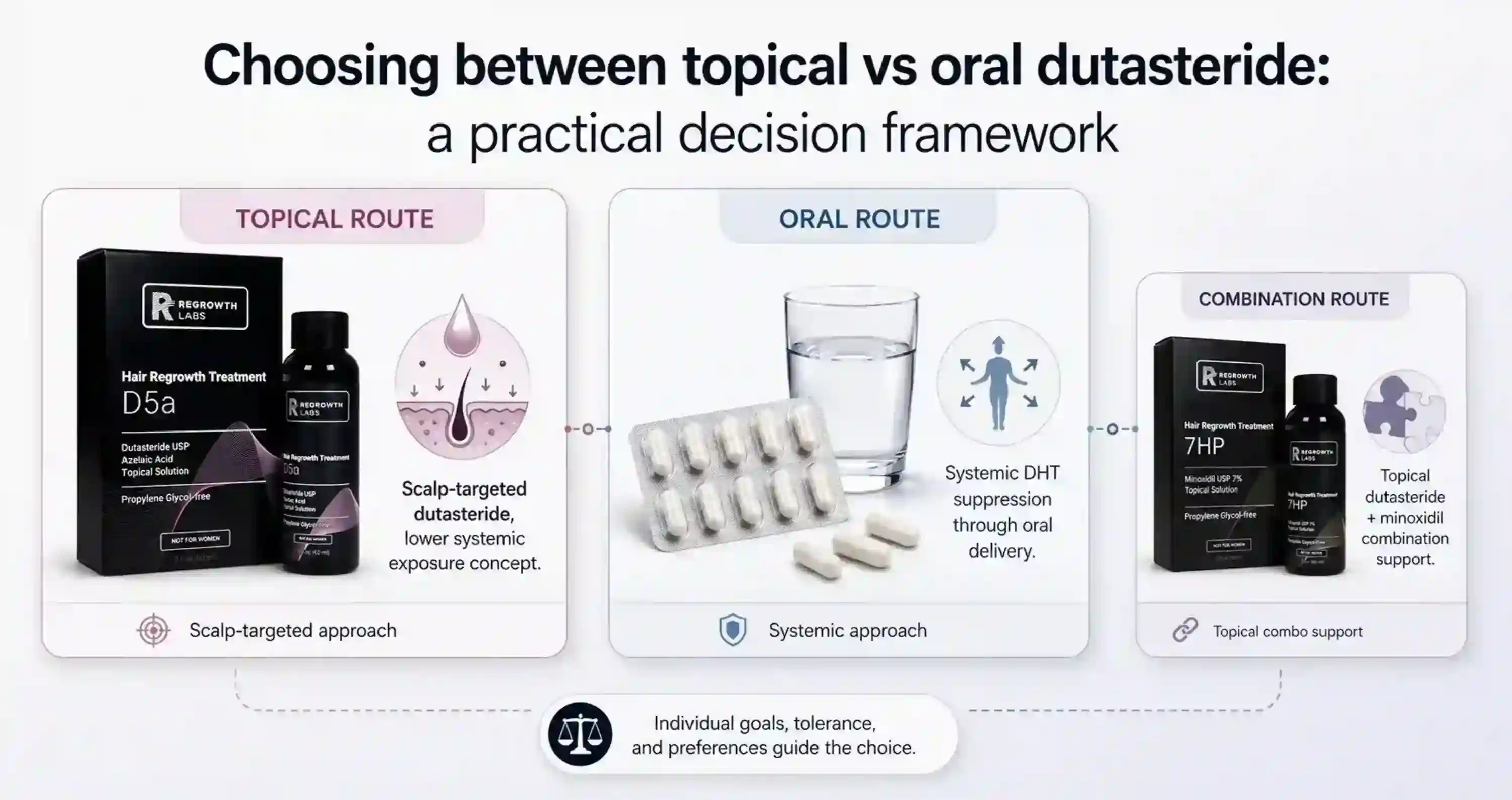
A practical UAE product pathway should separate topical dutasteride products from oral dutasteride discussions. D5a is the most direct topical dutasteride product because it is built around Dutasteride USP 0.5% with azelaic acid. 7HP is different: it combines Minoxidil 7% with Dutasteride 0.1%, making it a combination-growth strategy rather than a topical dutasteride-only example.
This distinction matters for topical vs oral dutasteride because topical products can vary by concentration, vehicle, added actives, and application schedule. A patient comparing D5a, 7HP, and oral dutasteride is not comparing three versions of the same thing. They are comparing a high-strength topical dutasteride formula, a minoxidil-plus-dutasteride combination, and a systemic oral medicine.
Use the product pages to confirm ingredients and availability, then use a clinician to decide whether topical vs oral dutasteride is the safer and more effective direction for your specific stage of androgenetic alopecia.
Choosing between topical vs oral dutasteride: a practical decision framework
When oral dutasteride is the stronger choice
Oral dutasteride suits patients with moderate to advanced androgenetic alopecia who need maximum, sustained DHT suppression across the scalp for the highest probability of regrowth. In a topical vs oral dutasteride decision, this is the main argument for the oral route. It’s also the appropriate step for patients who have tried finasteride and achieved an inadequate response, given that dutasteride’s dual inhibition produces meaningfully superior outcomes in that context. Patients with no significant concern about systemic side effects, and those who benefit from a well-characterized, long-established clinical evidence base, are strong candidates for the oral route.
When topical dutasteride is worth considering
Topical dutasteride makes clinical sense for patients who want a scalp-targeted approach that minimizes systemic DHT disruption. In a topical vs oral dutasteride decision, this is the main argument for the topical route. It’s particularly worth exploring for patients who have experienced sexual or mood-related side effects on oral 5-ARIs, for those with earlier-stage hair loss where aggressive full-body DHT suppression is less critical, and for patients who prefer a more localized treatment philosophy before committing to systemic therapy. Microneedling-assisted delivery can strengthen the case for topical dutasteride in patients willing to add that step to their routine, given the enhanced penetration data and the comparative trial results supporting it.
Accessing dutasteride in the UAE: what patients need to know
Accessing compounded topical dutasteride or prescription-strength oral dutasteride in the UAE requires careful navigation of local prescribing and pharmacy availability. Hims n Hers UAE supports patients in this process by offering a range of hair loss formulations and complementary hair care products; confirm current availability directly with the team, as product lines are updated regularly. You can also begin at Hims n Hers UAE before comparing the specific treatment pages discussed above.
Once you’ve completed the clinical conversation with your dermatologist or trichologist and settled on a treatment plan, knowing where to source your formulation reliably matters. Availability of compounded dutasteride products varies by clinic and pharmacy, so it’s worth confirming supply with your prescriber or a specialist pharmacy before committing to a protocol. Patients searching for topical dutasteride in the UAE or a dutasteride prescription in the UAE should also ask their clinician about local regulatory requirements, as prescription pathways can differ from those in other markets.
Use this article as preparation for that clinical conversation. Know what questions to ask: What stage is my hair loss? Have I already tried finasteride? What’s my risk tolerance for systemic side effects? Am I a candidate for microneedling? The answers will shape which form of dutasteride, and which complementary products, belong in your regimen. A good topical vs oral dutasteride plan should be personalised rather than copied from a forum protocol.
Frequently asked questions: topical vs oral dutasteride for hair loss
Is topical dutasteride as effective as oral dutasteride?
Based on available phase II trial data, topical dutasteride at 0.05% showed a stronger hair count response than oral finasteride at 24 weeks, but no large head-to-head trial directly comparing topical dutasteride monotherapy to oral dutasteride monotherapy has been published. This is the main evidence limitation in the topical vs oral dutasteride debate. Oral dutasteride has a more mature evidence base and delivers far greater systemic DHT suppression, making it the stronger choice for advanced hair loss. Topical dutasteride shows genuine promise, particularly when paired with microneedling or minoxidil.
Does topical dutasteride cause sexual side effects?
Published trials have not reported significant rates of sexual dysfunction with topical dutasteride, which is consistent with its dramatically lower systemic absorption compared to the oral form. However, the evidence base for long-term topical dutasteride safety is still limited, and individual responses vary. Discuss your full medical history with a qualified clinician before starting either formulation.
Can I get topical dutasteride in the UAE without a prescription?
No. Topical dutasteride is a prescription-only compounded medication in the UAE. A consultation with a licensed dermatologist or trichologist is required before it can be dispensed.
The bottom line on how topical dutasteride compares to oral for hair loss
When comparing topical vs oral dutasteride for hair loss, the core tradeoff is between systemic potency and targeted delivery. Oral dutasteride suppresses systemic DHT by 90 to 98%, backed by a mature clinical evidence base and well-established dosing protocols. It’s the stronger option for advanced androgenetic alopecia and for patients who need maximum efficacy. Topical dutasteride offers a localized mechanism with dramatically lower systemic exposure, a more favorable side-effect profile based on available data, and emerging clinical evidence supporting real regrowth outcomes, particularly when combined with microneedling or minoxidil.
Neither delivery method is universally superior. The right choice depends on your hair loss stage, sensitivity to systemic androgens, prior treatment history, and what a qualified clinician assesses as the appropriate risk-benefit balance for you. Discussing both options with a specialist, whether in a UAE dermatology clinic or through a dedicated hair loss service, is the most reliable way to land on the right formulation for your situation.
FAQS
Q: How do topical and oral dutasteride reach hair follicles differently?
A: Oral dutasteride is absorbed through the gastrointestinal tract and distributes systemically via the bloodstream, so it reaches scalp follicles as well as other tissues where DHT matters. Topical dutasteride is applied to the scalp to target follicles locally and limit systemic absorption, with formulation vehicle and techniques like microneedling strongly influencing how well the drug penetrates the dermal papilla.
Q: Is topical dutasteride as effective as oral dutasteride for hair regrowth?
A: Effectiveness depends on severity of hair loss and individual response; oral dutasteride delivers much higher systemic exposure and sustained DHT suppression, which tends to make it more powerful for many patients. Topical dutasteride can suppress DHT locally and may be sufficient for some people, but clinical data and individual response determine whether it matches oral results.
Q: How much systemic absorption does topical dutasteride have compared with oral dutasteride?
A: Clinical gel studies showed mean serum dutasteride after topical application around 1.54 ng/mL, compared with about 28.1 ng/mL after a 0.5 mg oral dose — roughly 17 to 18 times more systemic drug with the oral route. The same pattern appears in serum DHT suppression, with topical producing much smaller systemic reductions in most studies.
Q: Does topical dutasteride cause the same systemic side effects as oral dutasteride?
A: Topical formulations are designed to limit systemic exposure and therefore reduce the risk of body-wide side effects, but the actual risk depends on vehicle, dose, and whether techniques like microneedling are used. Oral dutasteride has a long half-life and accumulates systemically, so any systemic side effects that appear may persist longer after stopping the drug.
Q: What topical dutasteride formulations exist and does the vehicle matter?
A: Topical products are typically gels or solutions that use controlled-release or enhanced-permeation technologies to drive drug into the follicle while minimizing systemic absorption. The vehicle is critical: it determines scalp penetration, local delivery to the dermal papilla, and how much drug ends up in the bloodstream.
Q: Can microneedling improve the delivery of topical dutasteride?
A: Yes — when paired with microneedling, topical dutasteride can bypass portions of the skin barrier and deliver the drug more directly to the follicular unit, increasing local follicle exposure. That enhanced delivery can improve local efficacy but may also alter systemic absorption compared with topical use alone.
Q: How long does oral dutasteride stay in your system and why does that matter?
A: Oral dutasteride has an exceptionally long half-life of approximately five weeks, so the drug accumulates over months of use and takes a similar time to clear after stopping. This slow clearance contributes to sustained DHT suppression for hair regrowth but also means systemic side effects, if they occur, may not resolve quickly.