
You notice it first in small ways: a few extra hairs on your pillow, a thinner-looking ponytail, a photo where the light catches your hairline differently. It’s one of those quiet moments that hits harder than people admit. The reassuring truth is that in 2026, there are real, evidence-based answers for how to stop hair loss, and in many cases, for reversing it. The key is to stop hair loss with a cause-based plan rather than guessing from product to product. But the plan that works for you depends almost entirely on why you’re losing hair in the first place.
Throwing random products at the problem is the most common mistake people make. They cycle through shampoos, vitamins, and serums without ever addressing the underlying mechanism. This guide organizes the response by cause and by evidence strength: from immediate lifestyle fixes to prescription-grade treatments and, when necessary, clinical procedures. For UAE residents who want a clear path forward without waiting weeks for a clinic appointment, this is your starting point. The hair loss treatment collection is the most relevant product category when you are ready to compare evidence-based options.
Why your hair is falling out (and why it changes everything)
The treatment approach differs dramatically depending on the underlying cause. Without identifying what’s actually driving the shedding, even the best products deliver inconsistent results. Dermatology data collected across Middle Eastern clinics puts this in sharp perspective: around 71% of men in their late 30s and 77% in their 40s already have androgenetic alopecia. For women, the figures are lower but still significant, with roughly 20% affected by their late 30s and 29% by their 40s.
Understanding which type of hair loss you have is the foundation of any effective hair loss prevention plan. It is also the first step if you want to stop hair loss without wasting months on the wrong routine. For a clear, user-friendly breakdown of common causes, see this overview of what causes hair loss and the typical triggers involved: what causes hair loss: top reasons.
Pattern hair loss vs. sudden shedding: what the difference looks like
Androgenetic alopecia is the most common cause of hair loss in both sexes, but it presents differently depending on gender. Men typically see a receding hairline and thinning at the crown, while women usually notice a widening part and diffuse thinning across the top of the scalp with their ponytail shrinking in volume. This is distinct from telogen effluvium, a shedding disorder triggered by stress, illness, childbirth, or crash dieting, where hair falls out in larger amounts across the whole scalp rather than following a recognizable pattern.
Medical causes hiding behind hair thinning
Thyroid disease, iron deficiency, PCOS, and hormonal imbalances are common medical contributors to hair loss, particularly in women. Medication side effects, including antidepressants, blood thinners, and some contraceptives, also cause diffuse shedding that can be mistaken for pattern loss. The practical rule: if your shedding is sudden, diffuse, or accompanied by scalp symptoms like itching or redness, a blood panel is the right first step. No product will fix a thyroid problem or an iron deficiency. For a reliable patient-focused summary of female hair-loss causes and evaluation steps, see this resource on what causes female hair loss.
How to stop hair loss: lifestyle and diet changes you can make right now
These are the foundational steps. They won’t regrow hair on their own if you have pattern hair loss, but they remove the active triggers that sabotage any treatment plan layered on top, and they cost little to nothing. For many people trying to stop hair loss, correcting these basics makes medical treatment more consistent and easier to tolerate. Address these first before adding anything else.
Protein, calories, and the nutritional floor your follicles need
Hair is made of keratin, which is a protein. When the body runs a protein deficit or a significant calorie deficit, common with crash dieting, it deprioritizes hair follicle function. The AAD is clear on this: eating too few calories is a documented cause of increased shedding. Restoring adequate protein and total calorie intake removes this trigger. This isn’t about superfoods or elaborate hair-specific diets; it’s simply about eating enough of the right things consistently.
Habits that work against your treatment plan
The AAD links smoking to reduced follicle circulation and recommends stopping as part of hair loss management. Tight hairstyles, including slicked-back ponytails, cornrows, and tight braids, create traction alopecia by pulling on hair at the root. Excessive heat styling and chemical processing add mechanical and thermal stress to already-fragile shafts. Stopping these habits won’t regrow hair, but it prevents them from actively undermining any clinical treatment you start.
Clinically proven treatments: minoxidil, finasteride, and accessing them in the UAE
This is where the real work happens. Two treatments carry the strongest clinical evidence for androgenetic alopecia, and a 2025 systematic review and meta-analysis of seven randomized controlled trials confirmed that combining them outperforms either one alone for hair density, hair diameter, and global photographic assessment. If the goal is to stop hair loss caused by androgenetic alopecia, this clinical layer usually matters more than cosmetic add-ons. Starting early matters: earlier intervention consistently produces better outcomes than waiting, which is why knowing how to stop hair loss before the progression advances is worth acting on immediately.
Minoxidil: concentrations, timelines, and the early shed explained
Topical minoxidil is the most widely used regrowth stimulator and is available in concentrations from 2% up to 16%. A product such as 5HP Hair Regrowth Treatment with Minoxidil 5% sits in the standard topical-growth-stimulation category. The evidence is clearest for 5%: it outperforms 2% on hair count and density, and one double-blind randomized trial found that 10% produced more scalp irritation without superior results compared to 5%. Women should use 2% or 5%; men can consider higher concentrations based on their dermatologist’s guidance and response.
For more intensive topical routines, Follics FR16 Minoxidil 16% + Finasteride Hair Regrowth Cream is a high-strength combination option, but stronger formulas should be matched to tolerance and clinical advice rather than used automatically. Expect reduced shedding within weeks, with visible regrowth emerging at 4 to 6 months and full benefit around the 12-month mark. For a practical timeline and expectations on how long minoxidil takes to show results, see this guide on how long before minoxidil starts working.
One important detail that causes many people to quit too soon: a temporary shedding phase can begin 2 to 4 weeks after starting minoxidil and typically lasts 3 to 6 weeks. This is the treatment working, not failing. Hair loss will resume if minoxidil is discontinued, which means this is a long-term commitment, not a short course.
Finasteride for men: blocking DHT at the source
Finasteride works by reducing DHT, the hormone responsible for miniaturizing follicles in androgenetic alopecia. Hims n Hers UAE lists FinaLloyd Finasteride 1 mg as an oral finasteride option for men, while topical users can compare it with other DHT-focused products. In randomized controlled trials, statistically significant hair density improvement was first detected at around 3 months, with clearer differences at 6 months. The 12-month primary endpoint confirmed the difference clearly: a documented 107-hair improvement versus placebo in a defined scalp area.
Finasteride is most effective at stopping further loss, making early use the highest-leverage strategy. Sexual function changes, including reduced libido and erectile dysfunction, occur in a minority of users and are the main reason some discontinue; this risk is real but should not be overstated. Anyone using finasteride to stop hair loss should understand both the potential benefit and the need for medical supervision.
Combination therapy and where to find it in the UAE
A 2026 observational study of 502 men using oral minoxidil and finasteride together found 92.4% were stable or improved at 12 months, with 57.4% showing clear regrowth. Because it was observational rather than randomized, it sits below RCT-level evidence, but it reflects real-world outcomes at meaningful scale. The mechanism is straightforward: finasteride reduces DHT to slow the underlying progression, while minoxidil promotes follicular growth and prolongs the anagen phase. They address different parts of the problem, which is why the combination consistently outperforms monotherapy for hair fall control. Combination therapy can be a practical way to stop hair loss progression when the diagnosis and safety profile support it.
Hims n Hers UAE, a Dubai-based online specialist, stocks the core treatment options in one place: minoxidil in a range of concentrations, oral finasteride, Regrowth Labs FIN25 topical finasteride solution, and the Follics FR line of shampoos, conditioners, and minoxidil-finasteride creams formulated specifically for hair loss. For UAE residents who have been juggling multiple pharmacies or waiting on import orders, this is a more direct and clinically-oriented option.
A UAE product stack to help stop hair loss
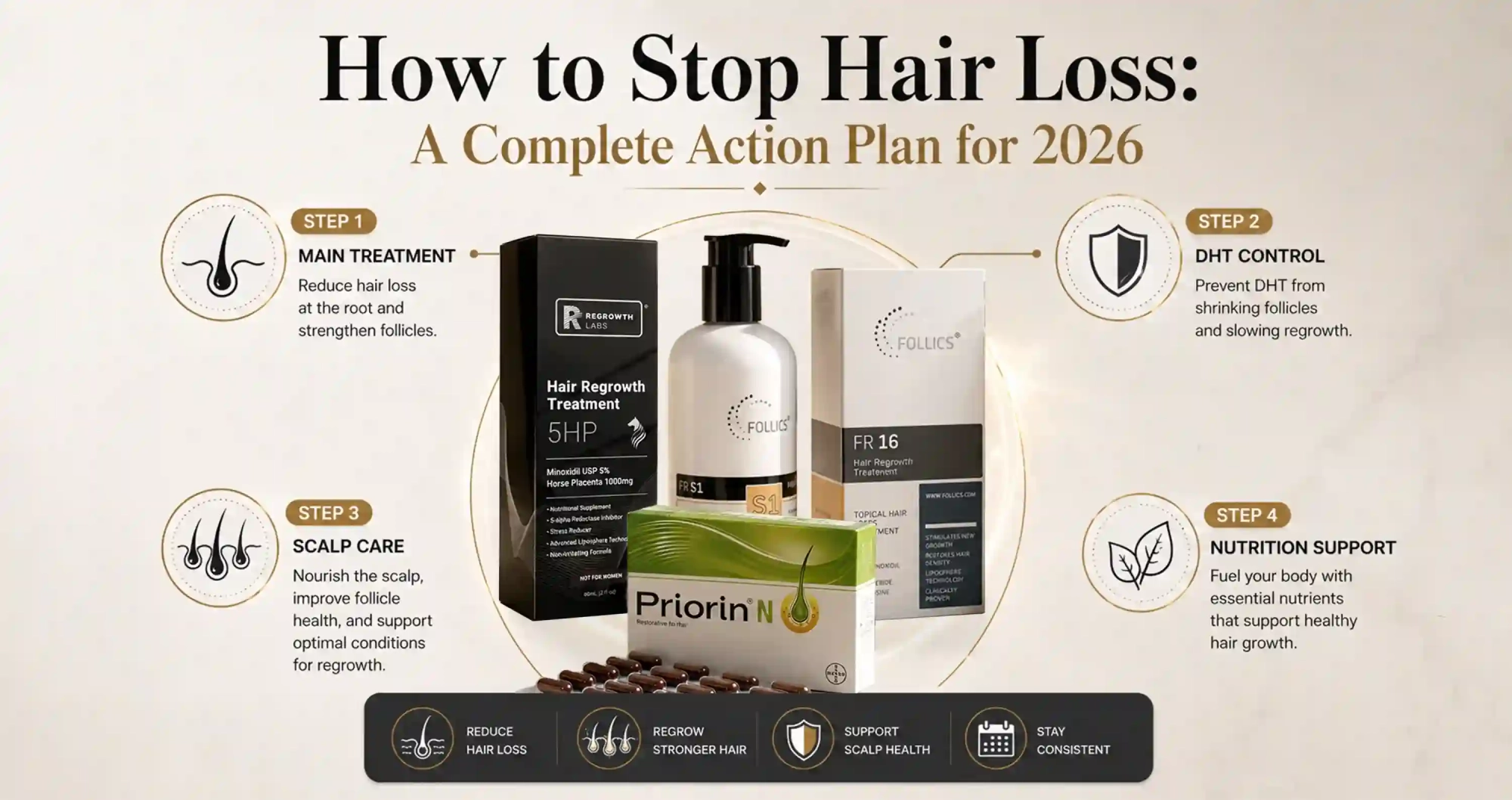
A practical product stack should match the cause of shedding. For many UAE users with pattern hair loss, the core comparison starts with minoxidil for stimulation and finasteride for DHT control. Supportive products such as shampoo and supplements then sit around that core rather than replacing it.
For a standard topical growth-stimulation step, 5HP provides a 5% minoxidil-based option. For a high-strength minoxidil and finasteride routine, FR16 is more intensive and should be treated as an advanced topical choice. For users who want a more focused topical finasteride product, FIN25 is the more direct option. Priorin N and Follics FR S1 shampoo belong in the supportive layer of the plan.
This structure makes it easier to stop hair loss in a disciplined way: pick the product category according to the mechanism, use it consistently for the correct timeline, and avoid switching formulas before the follicles have had time to respond.
Supplements and scalp nutrition that actually have evidence
Most “hair vitamin” products on the market are built on weak evidence. The clinical approach is deficiency-first, not supplement-first. The AAD is explicit: supplements can do more harm than good, and excess vitamin A, selenium, and vitamin E are actually linked to increased hair loss.
How to stop hair loss through nutrition: iron, vitamin D, and zinc
Iron deficiency is a documented cause of hair loss, especially in women, and supplementation is evidence-based when deficiency is confirmed. Vitamin D deficiency is both commonly seen in hair-loss evaluations and widely prevalent among UAE and broader Middle Eastern populations. Zinc and vitamin B12 deficiencies also appear regularly in the blood panels of hair-loss patients across Middle Eastern clinics. The approach is straightforward: get a blood panel, identify what’s actually low, then correct those deficiencies specifically. For an accessible review on nutritional deficiencies and hair loss to guide blood-panel prioritization, see this article on nutritional deficiencies relevant to hair loss.
Supplement formulas worth considering
For those looking for a structured multi-nutrient option rather than piecing together individual supplements, Priorin N capsules, available through Hims n Hers UAE, offer a nutritional support formula built around the micronutrient requirements of the hair cycle rather than being a catch-all wellness supplement, a meaningful distinction if nutritional support is part of your plan. Supplements alone rarely stop hair loss when DHT-driven miniaturization is the main cause, but they can support a plan when deficiency or nutritional stress is present. This is a different category from generic “hair, skin, and nails” vitamins, which typically lack meaningful clinical dosing of the relevant nutrients.
How to stop hair loss: scalp care essentials and daily habits your follicles need
Scalp health directly affects the environment in which your follicles operate. The good news is that the most impactful changes here are also the most practical ones.
Washing and drying habits that reduce mechanical loss
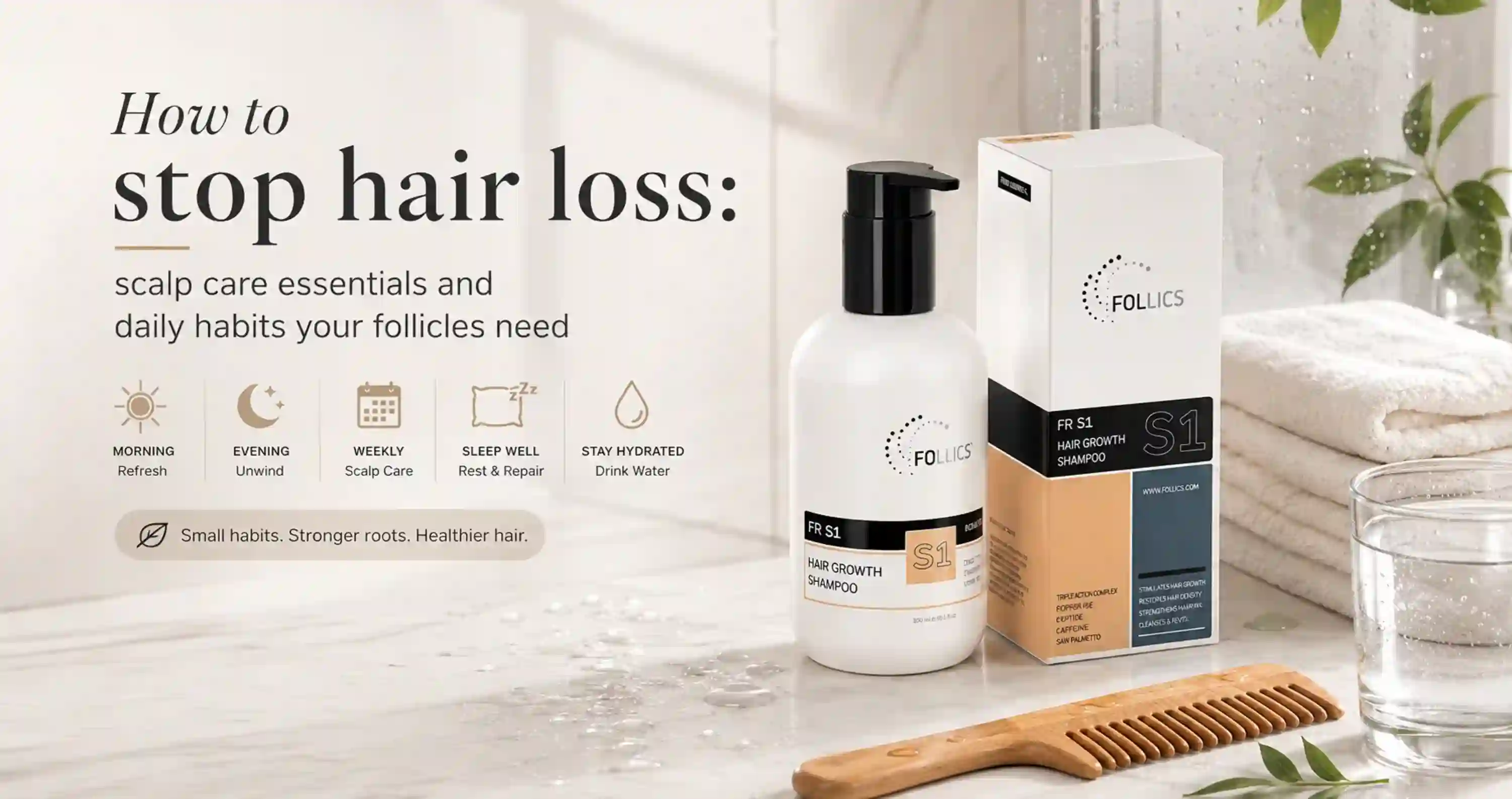
Switch to a mild, hair-loss-specific shampoo such as Follics FR S1 shampoo and wash with lukewarm, not hot, water. Pat hair dry with a microfiber towel instead of rubbing with a regular one, and air-dry when possible to remove unnecessary heat stress from already-fragile shafts. The Follics FR shampoo line is designed as a supportive daily scalp wash for those incorporating it into an existing hair loss regimen, making it easy to add without disrupting your routine. Good scalp care will not stop hair loss by itself, but it can reduce irritation and mechanical breakage while core treatments do the clinical work.
Scalp massage and protective styling for follicle health
Daily scalp massage of 5 to 10 minutes, using gentle circular motion with your fingertips, has clinical support for improving hair thickness over time by stimulating blood flow to the follicles. Switch to looser hairstyles and avoid tight elastics. Apply a leave-in conditioner or detangler before combing to reduce mechanical breakage, particularly when hair is wet and more vulnerable to snapping.
When to escalate: in-clinic options and the right time to act
If you’ve followed a consistent treatment plan for 6 to 12 months without adequate response, or if your hair loss is significant from the outset, in-clinic options become the right conversation. These are not replacements for the first-tier approach; they work best layered on top of it.
PRP, laser therapy, and who actually benefits
PRP (platelet-rich plasma) therapy is best suited for early-to-moderate androgenetic alopecia. A 2024 systematic review found significant increases in hair density and terminal hair count, and a 2023 randomized trial reported a negative hair-pull test in 91.7% of PRP patients compared to 69.4% with minoxidil alone.
Low-level laser therapy is a separate conversation. A 2021 meta-analysis found moderate efficacy in approximately 51.9% of patients with mild androgenetic alopecia, and it performs best as an adjunct to other treatments rather than a standalone solution.
Hair transplant and the right moment to consider it
FUE hair transplant is the appropriate step when donor hair is sufficient and when other treatments are no longer maintaining coverage. Modern FUE techniques report approximately 90% graft survival, with visible results developing over 6 to 12 months. It is a procedure, not a cure: hereditary loss in untreated areas can continue after the transplant, which is why ongoing medical treatment remains important. UAE residents experiencing sudden, patchy, or inflammatory hair loss should book a dermatologist consultation rather than self-treating.
Your action plan starts now
Knowing how to stop hair loss in 2026 comes down to a clear sequence: identify your specific cause first, then layer evidence-based responses in order of their strength. A structured plan to stop hair loss should begin with diagnosis, move into targeted treatment, and use supportive products only where they add a clear role. Start with lifestyle basics, adequate nutrition, gentle hair habits, and daily scalp care. Add clinically proven treatments, minoxidil, finasteride, or both, as early as possible, because the research is consistent: earlier intervention produces better outcomes. Use supplements to correct confirmed deficiencies, not as a substitute for treatment. Escalate to in-clinic options when first-tier approaches have been given adequate time and haven’t delivered sufficient results.
FAQS
Q: How can I tell what’s causing my hair loss?
A: Start by noting the pattern and timing: patterned recession or crown thinning suggests Androgenetic alopecia, while sudden, diffuse shedding across the scalp points to telogen effluvium. Also review recent illnesses, medications, childbirth, diet changes and any scalp symptoms; if it’s sudden or diffuse, a blood panel is the right next step and often a dermatologist visit helps confirm the cause.
Q: What’s the difference between pattern hair loss and sudden shedding?
A: Pattern hair loss (Androgenetic alopecia) follows recognizable areas—receding hairline and crown thinning in men, widening part and diffuse top thinning in women—whereas telogen effluvium causes larger amounts of hair to fall out diffusely across the whole scalp. The pattern determines treatment approach and prognosis.
Q: Can lifestyle and diet changes stop hair loss?
A: Lifestyle and diet fixes are foundational: restoring adequate calories and protein removes common triggers like crash dieting that increase shedding, and they improve the effectiveness of any subsequent treatment. However, these steps alone usually won’t regrow hair if you have established pattern hair loss; they prevent ongoing damage and prepare follicles for other therapies.
Q: When should I get blood tests for hair loss?
A: Get blood tests if your shedding is sudden, diffuse, or accompanied by scalp symptoms like itching or redness, or if you suspect medical causes such as thyroid disease, iron deficiency, or PCOS. The article stresses that no topical product will fix systemic problems, so a blood panel should be an early diagnostic step.
Q: How common is Androgenetic alopecia in the Middle East or UAE?
A: Dermatology data from Middle Eastern clinics cited in the article show high prevalence: about 71% of men in their late 30s and 77% in their 40s have Androgenetic alopecia, while roughly 20% of women in their late 30s and 29% in their 40s are affected. Those numbers highlight how frequently pattern hair loss contributes to thinning in the region.
Q: Will switching shampoos, vitamins, or serums stop my hair from falling out?
A: No — the article calls throwing random products at the problem the most common mistake because these products often don’t address the underlying mechanism of your hair loss. Identifying the cause first is essential; lifestyle fixes or targeted medical treatments are far more effective than cycling through over-the-counter items.
Q: What should I do if lifestyle changes don’t stop my hair loss?
A: If foundational measures (nutrition, managing triggers) don’t halt progression, the next step is targeted evaluation and treatment with a clinician: this can include prescription-grade therapies and, when necessary, clinical procedures. For UAE residents, the guide recommends starting with the basic steps immediately while arranging a dermatology consultation to explore prescription or procedural options. You can also use Hims n Hers UAE as a starting point for comparing the product categories discussed in this guide.