
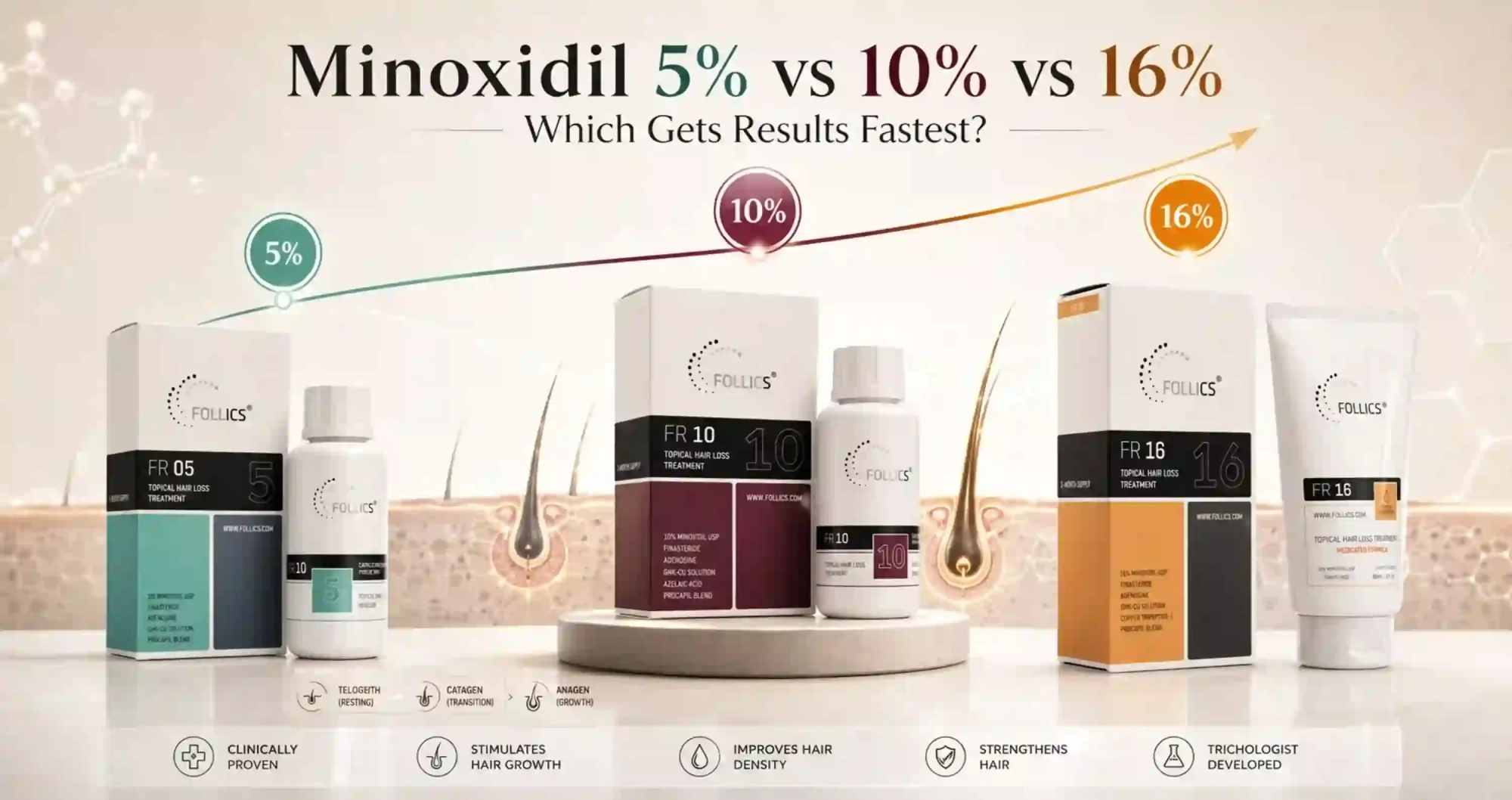
Which minoxidil concentration works fastest for hair regrowth? Most people picking up their first bottle assume more concentration equals faster results. That logic is understandable, but it doesn’t hold up to the clinical data. The relationship between minoxidil strength and regrowth speed is more complicated, and choosing the wrong concentration doesn’t just slow your results, it can pile on side effects you have no reason to deal with.
This article covers the three concentrations most relevant to UAE users right now: 5%, 10%, and 16%. All three are accessible through specialist retailers like Hims n Hers UAE, which makes the decision more practical than theoretical. Read through to find out which strength fits your situation, what timeline to realistically expect, and the specific scenarios where stronger actually isn’t smarter.
Why minoxidil concentration affects how fast your follicles respond
Minoxidil doesn’t work the moment it touches your scalp. It’s a prodrug, meaning it needs to be converted into its active form, minoxidil sulfate, before it can stimulate follicle activity. That conversion is handled by a scalp enzyme called sulfotransferase (specifically SULT1A1), and the amount of this enzyme varies significantly between individuals. This single biological fact explains why two people on the same concentration can get completely different results.
The enzyme factor that most people ignore
If your scalp produces low levels of sulfotransferase, applying a higher concentration of topical minoxidil won’t break through that conversion bottleneck. Predictive SULT1A1 assays carry 95% sensitivity in identifying likely topical responders, which tells you how central this enzyme is to the entire equation. Someone with high enzyme activity can respond strongly at 5%. Someone with low activity won’t see dramatically faster results from 10% because the limiting factor isn’t the dose sitting on their scalp, it’s the enzyme capacity available to convert it.
What “faster regrowth” actually means in clinical terms
Clinical trials measure regrowth in specific ways: onset of vellus hairs (the fine, initial growth), measurable increases in nonvellus hair count, and peak density gains at a fixed endpoint. When a study says one concentration outperforms another, it’s typically referring to density and count at week 36 or 48, not weeks shaved off the initial timeline. No topical minoxidil at any concentration delivers noticeable density before 3 months for most users. Keeping that distinction clear prevents a lot of premature abandonment.
Which minoxidil concentration works fastest for hair regrowth: what 5% delivers
Five percent is the benchmark. Every higher concentration is measured against it, and for good reason: the evidence base is extensive and consistent. In randomized trials with men experiencing androgenetic alopecia, 5% users gained an average of 18.6 hairs/cm² on the vertex compared to 12.7 hairs/cm² for 2% users at week 48. At week 8, 14% of 5% users already showed early regrowth signs versus just 8% on 2%. The data isn’t close.
Common branded options such as Rogaine 5% fall into this same evidence category, which is why searches comparing 5% vs 2% products consistently point back to the same clinical conclusion: the higher standard concentration outperforms the lower one on every meaningful metric.
The 3-to-6-month window you need to commit to
No concentration shortcuts this timeline. Visible regrowth for most users begins between 8 and 12 weeks, with peak density continuing to build toward 12 months. What differs between concentrations is not the onset timing but the density and coverage of regrowth once it appears. Commit to 6 months before evaluating any result, anything shorter gives you incomplete data and leads to bad decisions.
Men vs. women: different starting points, same direction
Historically, the guidance was 5% for men and 2% for women. That distinction was driven by marketing history and early FDA labeling, not by meaningful biological difference. A 2023 review published in the Journal of the American Academy of Dermatology supports 5% minoxidil for women, particularly the foam formulation applied once daily, which reduces dripping and lowers the risk of hypertrichosis significantly. If you’re a woman in the UAE who purchased 2% based on outdated packaging, you may be underserving your follicles based on a label that no longer reflects the science.
Does 10% minoxidil actually get you there faster?
That logic breaks down at 10%. In randomized controlled trials comparing 10% to 5%, the higher concentration did not show statistically significant superiority in total vertex hair count after 36 weeks. In several parameters, 5% actually outperformed 10%. Efficacy appears to plateau at 5%, and increasing concentration beyond that primarily adds irritation rather than measurable regrowth.
What the studies actually found
A trial of 90 men (Olsen et al.) found 5% moderately superior to 10% for overall hair count. A 2024 study of 51 participants found 10% showed slightly better frontal hair count in one narrow parameter, roughly a 15% improvement, but vertex results were essentially identical, with 5% still performing better overall. The 10% concentration is not FDA-approved specifically because of the adverse event profile and the lack of meaningful efficacy gain over the established standard.
When 10% has a rational use case
There is a narrow exception worth acknowledging. Users who show no response at all after 6 months on 5% may have very low sulfotransferase activity. A higher topical dose theoretically delivers more substrate to a limited enzyme, potentially pushing more conversion than a standard dose achieves. This is a dermatologist-supervised conversation, not a self-directed upgrade based on frustration in month three.
High-concentration formulas: where 16% minoxidil fits in
If 10% is the story of “more isn’t always more,” then 16% belongs to a different category. Compounded high-concentration formulas are designed for a specific user: someone who has already established a minoxidil routine, confirmed a response, and wants to push results further without moving to an oral agent. These formulations often include additional actives or penetration enhancers that distinguish them from simply scaling up a standard solution.
No published randomized controlled trials specifically evaluate 16% minoxidil against 5% for androgenetic alopecia. Any use of 16% rests on specialist compounding rationale and individualized clinical assessment, context that matters before reaching for a higher-strength bottle.
Who actually benefits from 16% concentration
The right candidate has already completed 6 to 12 months on 5%, experienced measurable regrowth, and hit a clear plateau. They want to optimize density further before exploring systemic alternatives. This is not a formula for someone two months into their first bottle wondering why results aren’t more dramatic yet. Starting at 16% without an established baseline and response history is simply adding risk without logical justification.
Follics FR16: a relevant option for UAE users
For UAE residents who fit that specific profile, the Follics FR16 formula available through Hims n Hers UAE is one of the few high-concentration topical options accessible locally without international shipping or customs uncertainty. It’s formulated for scalp application and suited for users who have already established a minoxidil response and want to escalate systematically. It’s a considered option for the right candidate, not a universal upgrade for anyone impatient with their current results.
Side effects scale with concentration: what you’re trading for speed
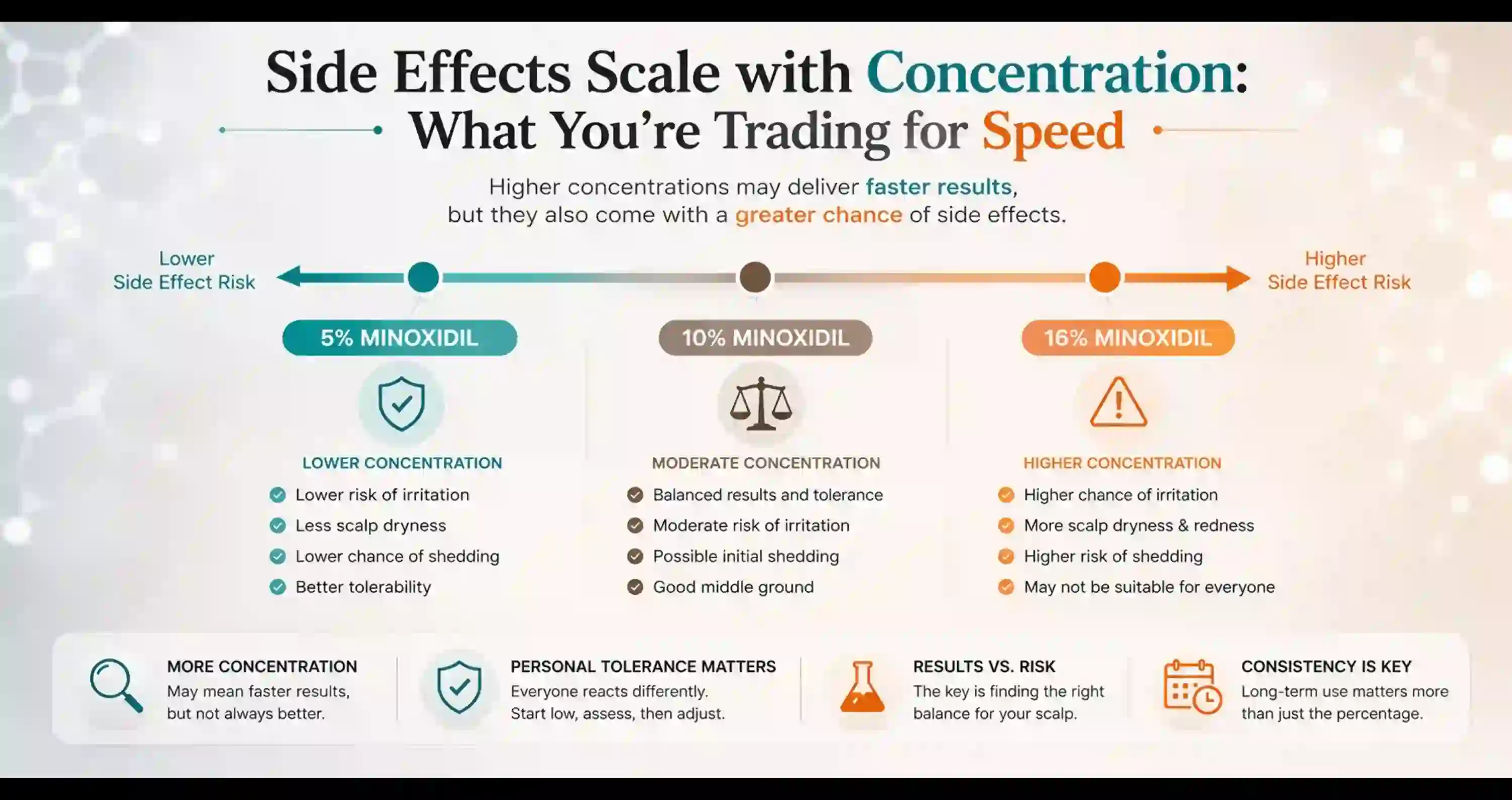
Higher concentration means higher incidence of adverse effects. Scalp irritation occurs in 3 to 5% of 2% users, 7 to 10% of 5% users, and increases further as concentration rises. The primary driver of irritation is propylene glycol, the solubilizing agent used in most solutions, not minoxidil itself. This is why some higher-strength formulations use alternative carriers to reduce irritation without dropping the active concentration.
Scalp irritation, itching, and contact dermatitis
Most irritation is manageable and resolves within the first 4 to 6 weeks as your scalp adapts. Persistent redness, scaling, or weeping means you should stop use and consult a dermatologist before continuing. Switching from solution format to foam significantly reduces propylene glycol exposure and is the first practical step for anyone experiencing ongoing irritation at any concentration.
Systemic absorption and hypertrichosis: separating fact from fear
Systemic side effects like palpitations or blood pressure changes are associated with oral minoxidil, not topical use at any studied concentration. Multiple randomized trials found no evidence of systemic effects with topical application at either 2% or 5%. Hypertrichosis, unwanted facial or body hair, is real and more common with solution formats at higher concentrations, but it’s caused by product dripping rather than systemic absorption. Switching to foam essentially eliminates the dripping mechanism and substantially reduces this risk.
Which minoxidil strength is right for your situation?
Start at 5%: the right call for most people
If you’re new to minoxidil, male or female, 5% is your rational starting point. It has the strongest evidence base, the clearest safety profile, and delivers meaningful regrowth for the majority of consistent users. There’s no clinical justification for skipping it in favor of something higher based purely on the assumption that stronger is faster. Commit to 6 months before drawing any conclusions about your response.
When stepping up to higher concentrations makes sense
After 6 to 12 months at 5% with a partial response or clear plateau, moving to a higher-concentration formula becomes a reasonable conversation to have with your dermatologist. That decision should be based on documented response history, not impatience in month two. Products like Follics FR16 from Hims n Hers UAE, or a dermatologist-supervised compounded formula, enter the picture at that specific point in the journey, not before it.
Signs that concentration isn’t your problem
If 5% minoxidil produces no visible response after 6 months of consistent use, the issue is more likely low sulfotransferase enzyme activity, an underlying hormonal factor, or a nutritional deficiency. Increasing the topical percentage won’t fix a conversion bottleneck. In these cases, adding finasteride or dutasteride, switching to low-dose oral minoxidil under medical supervision, or consulting a trichologist will do more than chasing a higher number on a label.
The bottom line: which minoxidil concentration works fastest for hair regrowth
Concentration matters, but it isn’t the whole story. Five percent is the most effective option for the majority of users, supported by the strongest clinical evidence and the clearest safety profile. Ten percent offers limited incremental gains in one narrow parameter while adding irritation and reducing compliance. Sixteen percent serves a specific profile: the established user who has plateaued and wants to optimize without going oral.
The timeline doesn’t shift with concentration. Expect a minimum of 3 to 6 months before passing judgment on any formulation, regardless of how high the percentage reads on the bottle. Start at 5%, evaluate honestly at 6 months, and escalate only when you have a real reason backed by your actual response history.
In short, when asking which minoxidil concentration works fastest for hair regrowth, the answer for most users is 5%, it delivers the best results per unit of risk and has the deepest evidence base behind it. If you’re ready to start or want to explore a step up based on where you are in your routine, Hims n Hers UAE stocks the full range from standard 5% formulations through to Follics FR16, with delivery across the UAE.
Frequently asked questions
How long does minoxidil take to work at different concentrations?
Regardless of concentration, 5%, 10%, or 16%, visible regrowth typically begins between 8 and 12 weeks, with peak results continuing to build toward the 12-month mark. Higher concentrations do not meaningfully shorten this window. The timeline is driven primarily by your hair growth cycle, not the percentage on the bottle.
Is 5% minoxidil available in the UAE without a prescription?
Yes. Five percent topical minoxidil is widely available through specialist retailers in the UAE, including Hims n Hers UAE, without a prescription. Higher concentrations such as 10% and 16% compounded formulas are also stocked but are best used under dermatologist guidance given their more limited evidence base.
Which minoxidil concentration works fastest for hair regrowth, solution or foam?
Concentration and formulation are separate variables. A 5% foam and a 5% solution contain the same active dose, but foam eliminates propylene glycol as a carrier, which reduces scalp irritation and the risk of hypertrichosis from dripping. For users who experience irritation or facial hair growth on solution formats, switching to foam at the same concentration is the right move before considering a higher percentage.