
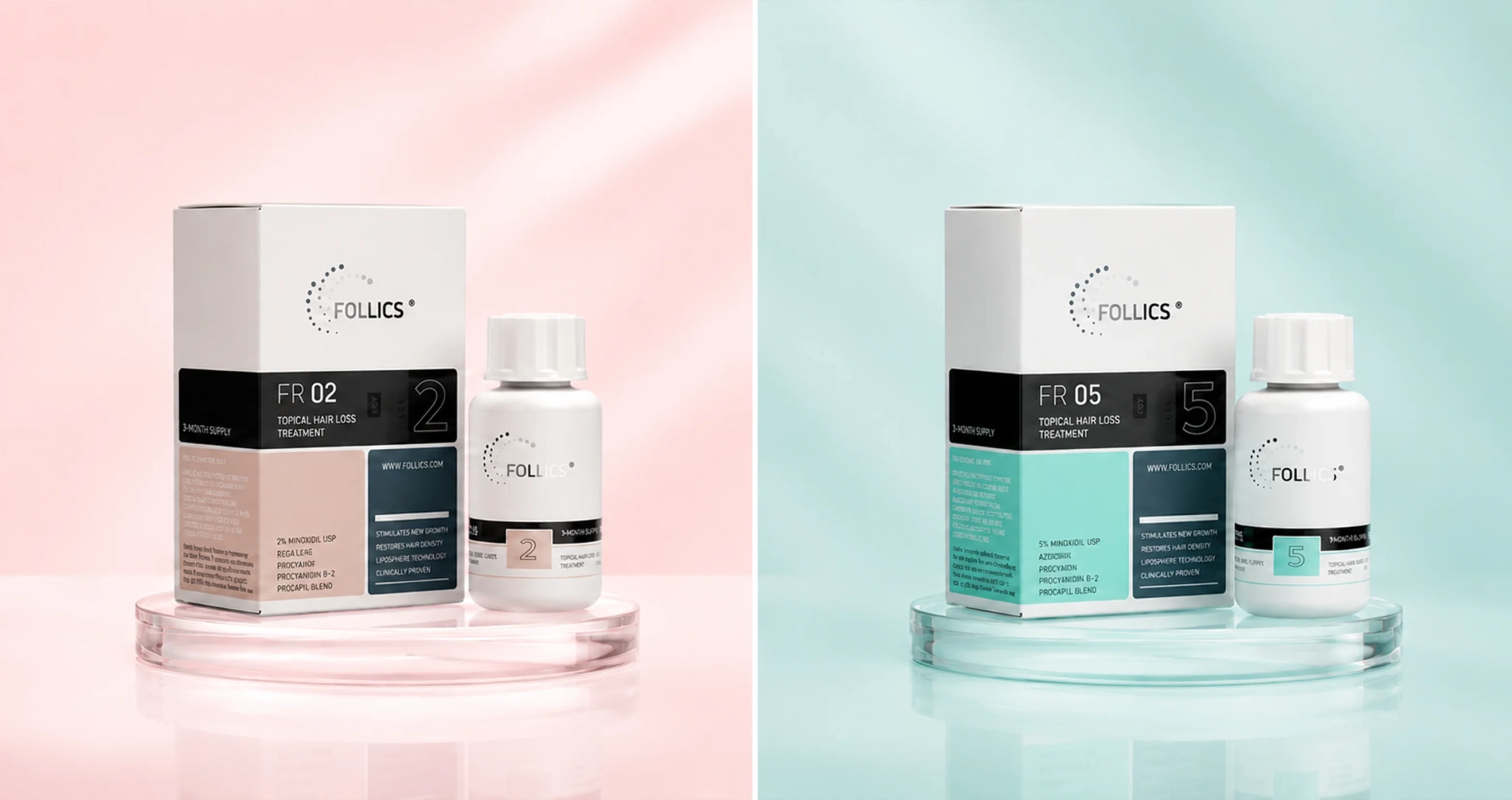
You’ve done your research, you’ve decided minoxidil 2% vs 5%, and specialist formulations climbing well above that. The instinct is understandable: higher must mean stronger, stronger must mean better results. The clinical evidence, though, tells a more complicated story. If you’re asking what percentage minoxidil is most effective for your situation, the answer isn’t simply “the highest one available”, and it’s worth understanding why before you commit to a concentration.
This article breaks down what each strength actually delivers, according to trials that tested them head-to-head. You’ll find a clear picture of where adverse effects increase, what regulators recommend, and how the foam-versus-solution question fits in. In the UAE, Hims n Hers UAE stocks a broad concentration range, making these clinical distinctions genuinely practical rather than theoretical.
What percentage of minoxidil is most effective? The minoxidil 2% vs 5% head-to-head evidence
The strongest evidence for minoxidil comes from two 48-week multicenter randomized controlled trials: one in men with androgenetic alopecia, one in women with female pattern hair loss. Both compared minoxidil 2% vs 5% topical minoxidil directly against each other and against placebo. The results favor 5%, but the margin differs between sexes. See the original 48‑week randomized trials for more detail on the published RCTs.
What the men’s trial showed
In men, 5% topical minoxidil was significantly superior to 2% on four of six efficacy measures at week 48, including nonvellus hair count, scalp coverage rated by both patients and investigators, and patient-reported treatment benefit. The reported magnitude of difference was approximately 45% more hair regrowth with 5% compared to 2% at the same timepoint. The 5% group also showed earlier response, reinforcing it as the stronger starting point for men with pattern hair loss. In terms of which minoxidil percentage is most effective for men, the 48-week RCT data points clearly to 5%.
What the women’s trial showed
In a 381-woman trial, minoxidil 2% vs 5% outperformed placebo on key endpoints including hair count and investigator assessment of scalp coverage at week 48. The statistically significant advantage of minoxidil 2% vs 5% appeared specifically on patient-assessed treatment benefit; on objective hair-count measures, the gap between the two concentrations was narrower than in men. This matters for clinical decision-making: 5% is still the stronger option, but its superiority over 2% in women is less pronounced on the objective endpoints.
What happens above 5%: is a higher percentage more effective?
The clinical evidence for concentrations above 5% exists, but it is considerably thinner and less consistent than the minoxidil 2% vs 5% literature. A 2022 review published in a peer-reviewed dermatology journal examined topical minoxidil across a range of 1% to 15% and found conflicting results when comparing higher strengths against standard 5%. The honest clinical picture is that going above 5% does not reliably produce proportionally better outcomes, which is a critical consideration when weighing best minoxidil concentration against side-effect risk.
Where higher concentrations showed promise
One study within that review reported 15% minoxidil performing significantly better than 5% at weeks 12 and 24, an outcome that forms part of the clinical rationale behind high-strength formulations. For patients who have genuinely plateaued on 5% with consistent use, this data point is clinically meaningful. That said, a single study at one timepoint is not a replicated evidence base, and anyone considering this step should do so under clinical guidance, with realistic expectations about what the data does and does not confirm.
The plateau problem and evidence gaps
Equally relevant is the fact that another higher-strength study in the same review found no significant efficacy advantage over 5%, while reporting more local adverse events in the higher-concentration group. A separate randomized trial directly comparing 5% and 10% in 90 men over 36 weeks found that 5% was actually superior overall in hair regrowth, with similar global photography improvement scores (88.8% vs 87.5%) but significantly higher local adverse events in the 10% group. For concentrations above 10%, direct efficacy and safety data are sparse. Any use at those strengths is an extrapolation from neighboring high-dose trials rather than a validated, replicated evidence base. The dose-response relationship for minoxidil is not linear above 5%.
How side effects scale with concentration: local, systemic, and practical
Understanding the adverse-event profile at each strength is as important as understanding topical minoxidil effectiveness, particularly when considering formulations above the standard range. Multiple reviews and trials report the same pattern: local effects increase with concentration, and systemic effects shift in character when you move from topical to oral delivery.
Topical irritation and contact dermatitis
Clinical studies report dermatitis rates of around 1.8% at 2%, with pruritus and rash relatively uncommon. At 5%, the same measures rise: one comparative study in the published minoxidil 2% vs 5% trial data reported dermatitis at 3.6% and pruritus at 8.9%. The propylene glycol vehicle used in solution formulations contributes meaningfully to this pattern. Above 5%, the peer-reviewed literature does not offer clean pooled rates, but consistently reports that local irritation and contact dermatitis increase with concentration. The 10% versus 5% trial confirmed this: adverse events were significantly higher in the 10% group despite no clear efficacy advantage.
Hypertrichosis, systemic effects, and the oral minoxidil picture
Hypertrichosis, unwanted hair growth at sites beyond the scalp, is a recognized effect across all topical concentrations. Reported rates vary across studies and cohorts; some reports indicate very high rates even at lower strengths, which underscores how common this effect can be regardless of concentration. With low-dose oral minoxidil, the dynamic shifts: one randomized trial reported hypertrichosis in 49% of participants, alongside headache in 14%. Tachycardia is a recognized risk with oral use. For general patient information about systemic effects and safe use, refer to the Mayo Clinic’s minoxidil drug information. Serious cardiovascular events were uncommon in the trials reviewed, but the systemic risk profile differs meaningfully from topical application and warrants proper clinical oversight before starting.
Sex-specific guidance and what regulators recommend
Regulatory approvals and clinical guidelines consistently frame minoxidil concentration recommendations by sex. Understanding the reasoning behind these distinctions explains why dermatologists and trichologists use the starting points they do, rather than simply defaulting to the highest available strength.
The standard guidance for men
The FDA approved both 2% and 5% topical minoxidil for hair loss, with older labeling specifically designating 5% solution for men with vertex scalp thinning. The AAD and ISHRS both position 5% as the standard concentration for men with androgenetic alopecia, consistent with the stronger RCT evidence in male populations. The 5% foam also received FDA approval for both sexes; regulatory labeling and comparative trial data indicate it offers improved tolerability relative to the 5% propylene glycol solution, which contributes to its broad adoption in clinical practice.
Why women are typically started at 2%
Traditional guidance from the BAD and ISHRS starts women at 2% to reduce the risk of facial hypertrichosis, a cosmetically significant concern for many patients. The distinction is a starting-point recommendation, not a ceiling. Both the ISHRS and current clinical evidence acknowledge that 5% once daily can be appropriate for women and may deliver better outcomes than 2% twice daily with comparable or fewer adverse effects overall. A dermatologist or trichologist can assess whether 5% is appropriate from the outset, particularly for women with more advanced thinning.
Foam vs solution: does formulation change what your scalp absorbs?
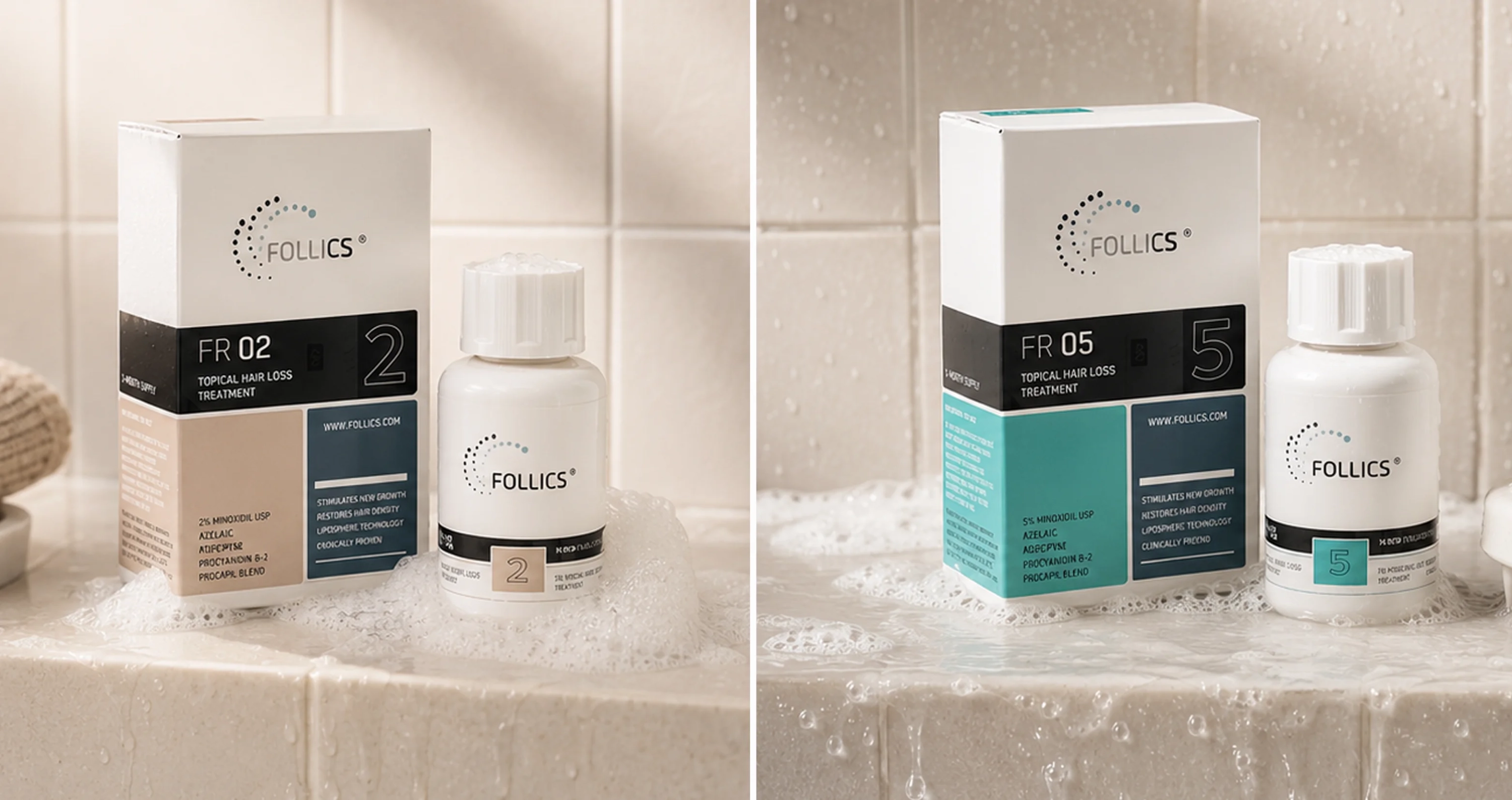
For the same minoxidil percentage, the vehicle matters for both tolerability and real-world effectiveness. The two standard formats are aqueous solution with propylene glycol and propylene glycol-free foam. Neither is definitively superior in head-to-head clinical trials, but the practical differences are real.
When foam tends to win
Foam dries faster, feels less greasy, and avoids the propylene glycol responsible for dermatitis and pruritus in many users. Better tolerability directly improves adherence, and consistent daily application is one of the strongest predictors of clinical response. If a solution causes enough scalp irritation to disrupt your routine, any theoretical absorption advantage becomes irrelevant.
When solution may have an edge
Propylene glycol aids dissolution and, in theory, may enhance minoxidil’s penetration into the scalp, though in vitro penetration studies suggest this mechanism is plausible rather than definitively proven in human trials. For a review of topical mechanisms and formulation differences, see this overview of topical minoxidil pharmacology on PubMed Central. At the same concentration, neither foam nor solution has been proven clinically superior in head-to-head RCTs. The most effective formulation is the one you apply correctly and consistently, and for most people that means the format that causes the least irritation.
Choosing the right concentration: a practical framework
The evidence points to 5% as the best minoxidil concentration with the strongest, most consistent clinical support across the widest range of patients. Individual circumstances vary, though, and knowing where the clinical logic shifts helps you make a better-informed decision before your next consultation.
Starting points by treatment profile
First-time users with no contraindications are best served by 5%: the RCT backing is robust, the side-effect profile is well-characterized, and it outperforms 2% in the only head-to-head trial of sufficient duration and scale. Women concerned about facial hypertrichosis may reasonably start at 2% and reassess at 6 to 12 months. Those who have used 5% consistently for at least 12 months without satisfactory results are the candidates most likely to benefit from a clinician-guided conversation about stepping up to a higher strength.
High-strength formulations and where to find them in the UAE
For patients who have genuinely plateaued at standard concentrations, high-strength compounded formulations are a legitimate clinical option when approached under proper guidance. Hims n Hers UAE carries a broad concentration range that extends beyond what most standard UAE pharmacy shelves carry, making it a practical starting point for that escalation conversation. The right step up in concentration should always be matched to your treatment history and discussed with a clinician, not chosen based on availability alone.
The bottom line on what percentage minoxidil is most effective
The clinical evidence is clearest at 5%: it outperforms 2% meaningfully in men, modestly in women, and carries a well-understood side-effect profile built on solid RCT data. Above 5%, the evidence thins and results become inconsistent. Some studies show incremental gains at higher concentrations; others show no added efficacy alongside more local irritation. High-strength formulations are not without a clinical rationale, but they are a step up for documented non-responders, not a starting point.
So what percentage minoxidil is most effective? For most people beginning treatment, that answer is 5%, but the full picture depends on your sex, your treatment history, and your scalp tolerance. Getting that decision right matters more than reaching for the highest number on the label. If you’re navigating that choice in the UAE, Hims n Hers UAE stocks a wide concentration range so the right option is available when you genuinely need it.
FAQS
Q: Which minoxidil percentage is most effective overall?
A: Clinical trials show 5% topical minoxidil is the most consistently effective starting point: head-to-head 48-week randomized trials favored 5% over 2%. The degree of advantage varies by sex (larger in men, smaller in women) and evidence above 5% is inconsistent, so the highest available concentration is not always the best choice.
Q: Is 5% minoxidil better than 2% for men with pattern hair loss?
A: Yes. In a 48-week multicenter randomized trial in men with androgenetic alopecia, 5% outperformed 2% on multiple efficacy measures, with about 45% more hair regrowth reported at week 48 and earlier clinical response in the 5% group.
Q: Should women use minoxidil 2% vs 5%? Which works better for female hair loss?
A: Both minoxidil 2% vs 5% outperformed placebo in a 381-woman trial, but 5% showed a statistically significant advantage mainly on patient-assessed treatment benefit. Objective hair-count differences between minoxidil 2% vs 5% were smaller than in men, so 5% is stronger but its superiority in women is less pronounced on objective endpoints.
Q: Does using more than 5% minoxidil give better results?
A: The evidence for concentrations above 5% is thinner and inconsistent. A review found mixed results: one study reported 15% outperforming 5% at weeks 12 and 24, but other studies found no clear advantage, so higher strengths do not reliably produce proportionally better outcomes.
Q: What are the risks or side effects of using higher-strength minoxidil?
A: Higher concentrations tend to increase the risk of local adverse effects such as irritation and may raise other tolerability issues. Because the benefit above 5% is not consistently proven, higher strengths should be weighed against the greater side-effect risk and considered under clinical supervision.
Q: If I’ve plateaued on 5% minoxidil, should I try a stronger formulation like 15%?
A: A single study showing benefit with 15% at early timepoints provides a possible option for patients who have truly plateaued, but this finding is not a replicated evidence base. Any step above 5% should be taken with realistic expectations and under clinical guidance due to limited and conflicting data.
Q: Where can I find different minoxidil concentrations locally?
A: Availability varies by country, but the article notes that in the UAE Hims n Hers UAE stocks a broad concentration range, making these clinical distinctions practical. Otherwise, concentrations are commonly available through pharmacies or dermatology clinics depending on local regulation.