
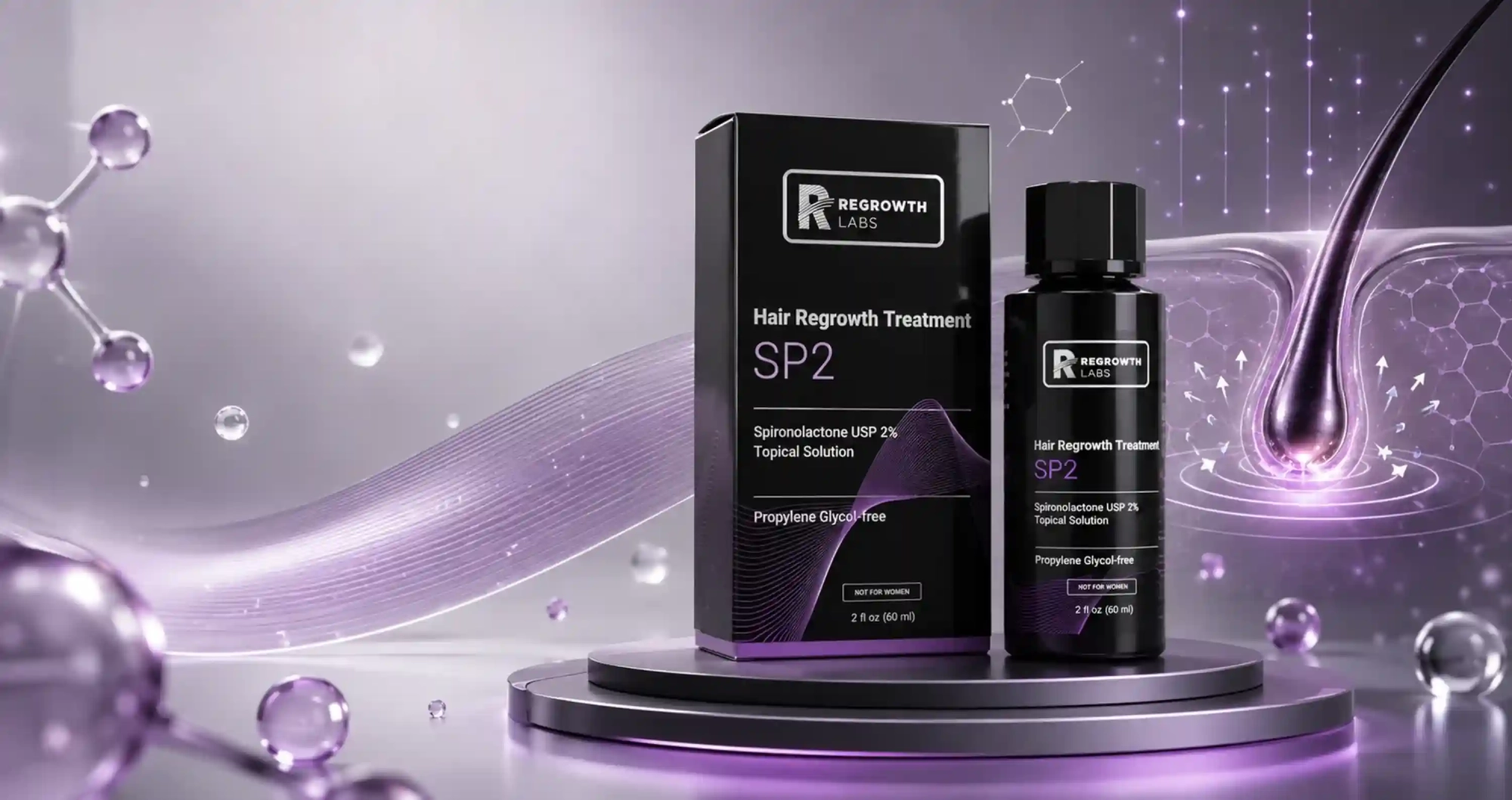
SP2 topical spironolactone 2% UAE is a leave-on scalp solution intended to reduce androgen signalling at the hair follicle. Unlike finasteride, which reduces the production of dihydrotestosterone through enzyme inhibition, spironolactone is primarily used in hair-loss treatment for its ability to oppose androgens at receptor level.
SP2 Hair Regrowth Treatment currently lists:
- Spironolactone USP 2% w/w as the active ingredient
- Propanediol
- Ethanol SDA 40B 190 proof
- Deionised water
- Phenoxyethanol and ethylhexylglycerin
- Polysorbate 80 as inactive ingredients
The official directions are:
Apply 1 mL or 5 sprays
↓
Use on each targeted thinning area
↓
Repeat twice daily
↓
Massage for 2–4 minutes
↓
Wash hands
↓
Leave on for at least 4 hours
The manufacturer states that using more will not improve effectiveness and that continued treatment is needed to achieve and maintain results.
The formula is conceptually different from both minoxidil and finasteride:
Minoxidil
↓
Supports follicular growth activity
Finasteride
↓
Reduces DHT production
Spironolactone
↓
Opposes androgen action at the receptor
These differences affect:
- Appropriate candidates
- Expected benefits
- Evidence strength
- Pregnancy precautions
- Potential systemic concerns
- Combination-treatment planning
Direct Answer
SP2 topical spironolactone 2% UAE and finasteride both aim to reduce androgen-related follicular miniaturisation, but they intervene at different stages.
Spironolactone acts as an anti-androgen and can compete with testosterone and DHT at androgen receptors.
A simplified comparison is:
Finasteride pathway
Testosterone
↓
5-alpha-reductase
✕ Finasteride inhibits the enzyme
↓
Less DHT is produced
Spironolactone pathway
Testosterone or DHT
↓
Attempts to bind androgen receptor
✕ Spironolactone antagonises the receptor
↓
Reduced androgen-receptor signalling
SP2 should therefore not be described as topical finasteride under another name.
It should also not be described as proven to avoid all systemic hormonal effects. The current public pages do not show SP2-specific blood concentrations, potassium levels, blood-pressure monitoring or endocrine measurements.
SP2 Topical Spironolactone 2% UAE: What the Current Label Confirms
The official Regrowth Labs page confirms:
| Product feature | Current public information |
| Active ingredient | Spironolactone USP |
| Concentration | 2% w/w |
| Format | Topical leave-on solution |
| Dose | 1 mL or five sprays |
| Frequency | Twice daily |
| Massage time | Two to four minutes |
| Minimum contact time | Four hours |
| Storage | 20°C to 25°C |
| Age boundary | Do not use below 18 |
| Reviews on UAE page | None currently shown |
What the Public Pages Do Not Confirm
The pages do not provide:
- Bottle volume on the parsed official page
- Milligrams of spironolactone per one-millilitre dose
- Density needed to convert 2% w/w into mg/mL
- Product-specific scalp absorption
- Blood spironolactone levels
- Canrenone or active-metabolite levels
- Serum potassium measurements
- Blood-pressure changes
- Testosterone or DHT measurements
- Menstrual-effect monitoring
- A randomised trial of exact SP2
- A comparison with FIN25
- A comparison with oral spironolactone
- UAE medicine-registration details
- Pregnancy or breastfeeding instructions
These omissions prevent several strong marketing claims.
Concentration Is Not the Same as Dose
SP2 states 2% w/w.
That means spironolactone represents two per cent of the formulation by weight.
It does not automatically mean:
- 20 mg per millilitre
- 20 mg per five sprays
- 40 mg per day
Those calculations would require the solution’s density or a separately verified mg/mL statement.
The correct equation is:
2% w/w
×
Verified weight of 1 mL
=
Spironolactone weight per application
Do not convert SP2 into a milligram dose until the manufacturer confirms:
- Solution density
- Weight delivered by five sprays
- Milligrams per millilitre
What Is an Androgen Receptor?
An androgen receptor is a cellular receptor activated by androgen hormones, including testosterone and DHT.
In genetically susceptible scalp follicles, androgen-receptor signalling contributes to:
- Shorter growth phases
- Progressive follicular miniaturisation
- Finer hair shafts
- Reduced visible density
A simplified pathway is:
DHT or testosterone
↓
Binds androgen receptor
↓
Androgen-sensitive follicular signalling
↓
Progressive miniaturisation
Spironolactone is used as an anti-androgen because it can reduce androgen action at this receptor.
Does Spironolactone Destroy DHT?
No.
Spironolactone does not remove DHT from the scalp or permanently deactivate androgen receptors.
It is intended to compete with androgen action while treatment is present.
The most accurate description is:
Spironolactone antagonises androgen receptors and may reduce the effect of circulating and locally available androgens on susceptible follicles.
Avoid:
- Destroys DHT
- Eliminates testosterone
- Permanently switches off androgen receptors
- Removes all hormonal hair loss
- Prevents every androgen molecule from binding
How Finasteride Works Differently
FIN25 Topical Finasteride Spray represents a different anti-androgen strategy.
Finasteride acts upstream by reducing the creation of DHT.
Spironolactone acts downstream by opposing androgen action at receptor level.
| Comparison factor | SP2 spironolactone | Finasteride |
| Main target | Androgen receptor | 5-alpha-reductase enzyme |
| Primary action | Opposes androgen binding/signalling | Reduces conversion of testosterone to DHT |
| Testosterone-to-DHT conversion | Not its primary target | Reduced |
| DHT already present | Intended to oppose receptor action | Does not directly remove receptor binding |
| Oral approved uses | Cardiovascular and fluid-related conditions | Prostate disease and male pattern hair loss, depending on dose |
| Topical hair-loss status | Off-label or non-standard | No FDA-approved topical formulation in the US |
| Common hair-loss population | Often women in clinical practice | Mainly men |
| Pregnancy concern | Anti-androgenic fetal risk | Male-fetal development risk |
| Exact SP2/FIN25 comparison trial | Not presented | Not presented |
The FDA states that no topical-finasteride formulation is currently approved in the United States and that skin absorption and transfer to other people are expected concerns with compounded products.
SP2 likewise needs its own topical safety and absorption data.
Is SP2 a DHT-Production Blocker?
No.
The product may still be described as DHT-targeting because DHT is one of the hormones activating androgen receptors.
However, the wording must distinguish:
Finasteride
Reduces DHT formation
from:
Spironolactone
Reduces the action of DHT and testosterone
at androgen receptors
Calling both products simply “DHT blockers” hides this clinically relevant difference.
Is Spironolactone a Potassium-Sparing Diuretic?
Oral spironolactone is an aldosterone antagonist and potassium-sparing diuretic used for conditions including heart failure, hypertension and hyperaldosteronism.
Oral exposure can cause:
- Hyperkalaemia
- Hypotension
- Renal-function changes
- Electrolyte disturbances
- Gynaecomastia
- Menstrual changes
- Reduced libido or erectile difficulty
Those oral risks should not be assigned to SP2 at the same frequency.
They also should not be dismissed automatically.
The relevant question is:
Does the SP2 scalp dose produce enough systemic spironolactone or active metabolites to create clinically meaningful exposure?
The reviewed product pages do not answer that question.
Does Topical SP2 Affect Potassium?
No SP2-specific potassium study is shown publicly.
It would therefore be inaccurate to state either:
- SP2 raises potassium like oral spironolactone.
or:
- SP2 cannot affect potassium.
A cautious approach is particularly relevant for a user who has:
- Kidney disease
- Existing high potassium
- Addison’s disease
- Heart failure
- Significant dehydration
- Treatment with oral spironolactone
- Treatment with eplerenone
- Potassium supplementation
- Potassium-containing salt substitutes
- ACE-inhibitor or ARB treatment
Oral spironolactone labelling identifies hyperkalaemia and renal-function risks, especially with kidney impairment or medicines that raise potassium.
Product-specific professional advice is appropriate before SP2 use in these situations.
What Evidence Supports Topical Spironolactone?
SP2 topical spironolactone 2% UAE sits within a smaller topical spironolactone evidence base than standard minoxidil and oral finasteride.
Published studies have evaluated formulations including:
- Topical spironolactone 1% gel
- Topical spironolactone 5% solution
- Combination topical spironolactone and minoxidil
- Different male and female androgenetic-alopecia populations
A 2021 study reported that minoxidil 5% gel and spironolactone 1% gel each produced improvement, with the combination performing better in the tested study design.
A 2022 study evaluated topical spironolactone 5%, minoxidil 5% and their combination and reported favourable dermoscopic outcomes.
A 2025 comparative study investigated topical spironolactone against topical minoxidil in female pattern hair loss.
These studies support continued investigation of topical spironolactone.
They do not directly prove SP2 because:
- SP2 uses 2% rather than 1% or 5%.
- Its vehicle is different.
- Its applied amount may differ.
- Its treatment frequency may differ.
- Its study population has not been defined.
- Its exact product has not been compared with placebo.
- Its systemic absorption has not been published.
Why 1%, 2% and 5% Cannot Be Treated as Equivalent
A concentration difference can change:
- Amount delivered
- Solubility
- Skin penetration
- Receptor exposure
- Irritation
- Systemic absorption
- Stability
The existence of a 5% spironolactone study does not prove:
- 2% achieves the same receptor blockade
- 2% is safer
- 2% is more suitable for sensitive scalps
- 2% produces the same timeline
- 2% causes no systemic effect
Likewise, a 1% combination study cannot prove SP2 monotherapy.
Evidence Hierarchy for SP2
Level 1 — Strongest
Randomised trial of exact SP2 2% solution
Level 2
SP2 pharmacokinetic, potassium and hormone study
Level 3
Controlled trial of another 2% topical spironolactone solution
Level 4
Topical spironolactone 1% and 5% clinical studies
Level 5
Oral spironolactone hair-loss evidence
Level 6
General anti-androgen pharmacology
Level 7
Manufacturer local-action and sensitive-scalp claims
Level 8 — Weakest
Testimonials and before-and-after photographs
The current evidence position is:
- Topical spironolactone has promising but limited clinical research.
- Studies have used formulations and concentrations different from SP2.
- The current UAE SP2 listing has no reviews.
- Exact SP2 systemic and clinical data are not displayed.
- More high-quality randomised research remains necessary.
Is SP2 Proven Safer Than Oral Spironolactone?
No exact SP2 comparison is presented.
Topical delivery is intended to concentrate treatment at the scalp and may reduce systemic exposure compared with oral administration.
“May reduce” is not the same as:
- Eliminates
- Prevents
- Guarantees no systemic effects
- Requires no medical history
- Requires no medicine-interaction review
A proper comparison would measure:
- Blood spironolactone
- Active metabolites
- Serum potassium
- Kidney function
- Blood pressure
- Menstrual symptoms
- Breast symptoms
- Sexual effects
- Hair outcomes
Why SP2 May Be Researched by Women
The UAE product is placed in the women’s category, and both public pages describe spironolactone as potentially helpful for women with androgen-related hair loss.
Spironolactone is commonly considered in female pattern hair loss because:
- It has anti-androgen activity.
- Finasteride is generally avoided during pregnancy.
- Some women have hyperandrogenic features.
- Oral spironolactone is already used off-label in women for androgen-related conditions.
This does not make SP2 suitable for every woman.
Pattern hair loss in women may occur:
- With normal androgen levels
- With polycystic ovary syndrome
- During perimenopause
- After pregnancy
- Alongside iron or thyroid problems
- With another shedding disorder
Diagnosis remains necessary.
Can Men Use SP2?
The official product page discusses women, while the broader Regrowth Labs page positions SP2 as a sensitive-scalp DHT-targeting option without clearly restricting it to women.
Topical spironolactone has been studied in male and female androgenetic alopecia populations.
However, suitability for men should not be assumed from ingredient pharmacology alone.
Possible concerns include:
- Breast tenderness
- Gynaecomastia
- Sexual symptoms
- Unknown systemic exposure
- Combination with finasteride or dutasteride
- Lack of exact SP2 male trial data
The physical UAE label should clearly state the intended population.
Pregnancy Warning
Oral spironolactone labelling advises avoiding use in pregnancy because its anti-androgenic properties may affect sex differentiation of a male fetus.
The exact pregnancy risk from topical SP2 has not been quantified.
That does not justify saying it is safe during pregnancy.
Practical precautions should include:
- Do not use SP2 during pregnancy without explicit specialist approval.
- Prevent pregnant individuals from applying another person’s treatment.
- Wash hands after application.
- Clean accidental spills.
- Allow the scalp to dry before close contact.
- Avoid transfer through towels, pillowcases or headwear.
- Seek professional advice after pregnancy-related exposure.
Breastfeeding
The public SP2 pages do not provide breastfeeding instructions.
Do not state:
- Safe while breastfeeding
- No transfer into milk
- No infant risk
The decision should consider:
- Possible systemic absorption
- Infant skin contact
- Transfer from treated hair
- Product contact with the breast
- The anti-androgenic mechanism
Can SP2 Affect Menstrual Cycles?
Oral spironolactone can be associated with menstrual irregularities because of systemic hormonal and receptor effects.
The frequency of menstrual changes from topical SP2 is unknown.
A user should report:
- New irregular bleeding
- Missed periods
- Breast tenderness
- New dizziness
- Unexplained weakness
- Other systemic symptoms
Those symptoms do not prove SP2 caused the change, but they warrant assessment.
Can SP2 Cause Breast Symptoms in Men?
Oral spironolactone can cause gynaecomastia, with risk related to dose and exposure.
No SP2-specific rate is available.
Men should report:
- Breast enlargement
- Breast tenderness
- A breast lump
- Nipple discharge
The product should not claim that topical use makes those effects impossible.
Local Scalp Reactions
SP2 may cause:
- Dryness
- Itching
- Redness
- Burning
- Stinging
- Scaling
- Contact dermatitis
- Folliculitis-like bumps
- Changes in hair feel
Potential causes include:
- Ethanol
- Propanediol
- Spironolactone
- Phenoxyethanol
- Ethylhexylglycerin
- Polysorbate 80
- Another scalp product
The “sensitive scalp” positioning does not guarantee tolerability.
Propanediol Versus Propylene Glycol
The product uses propanediol instead of propylene glycol.
Potential formulation reasons include:
- Solvent function
- Humectancy
- Cosmetic feel
- Active-ingredient delivery
- Reduced irritation potential in some users
The official page goes too far by describing propanediol as having “no irritation” and guaranteeing excellent delivery.
Use:
Propanediol is used as the main carrier and may offer a different sensory and tolerability profile from propylene glycol.
Do not use:
Propanediol cannot irritate skin.
Ethanol and Sensitive Scalps
SP2 contains high-proof denatured ethanol.
Ethanol may:
- Help dissolve the active
- Support drying
- Affect penetration
- Improve cosmetic lightness
It may also contribute to:
- Dryness
- Burning
- Flaking
- Barrier irritation
A person with eczema, psoriasis, active dermatitis or damaged scalp should obtain assessment rather than assuming the “gentlest” Regrowth Labs product will be suitable.
Does SP2 Stimulate Hair Growth Directly?
Spironolactone’s primary rationale is anti-androgenic.
It is not a direct follicular stimulant in the same established category as minoxidil.
Use:
SP2 aims to reduce androgen pressure on susceptible follicles.
Do not use:
SP2 directly stimulates circulation and wakes dormant follicles.
The existing Regrowth Labs introduction should remove its circulation and follicle-stimulation claims for SP2.
SP2 Versus Minoxidil
| Factor | SP2 | Standard minoxidil |
| Main active | Spironolactone 2% | Minoxidil |
| Primary pathway | Androgen-receptor antagonism | Follicular growth stimulation |
| DHT production | Not directly inhibited | Not directly targeted |
| Direct growth stimulation | Not primary mechanism | Primary treatment role |
| Evidence strength | Limited topical studies | Extensive clinical evidence |
| Typical role | Anti-androgen option | Core growth treatment |
| Combination possible | Sometimes studied | Sometimes combined |
| Interchangeable | No | No |
Readers needing minoxidil-strength guidance should use the Minoxidil Treatment Guide.
SP2 is not “minoxidil without minoxidil.”
SP2 Versus FIN25
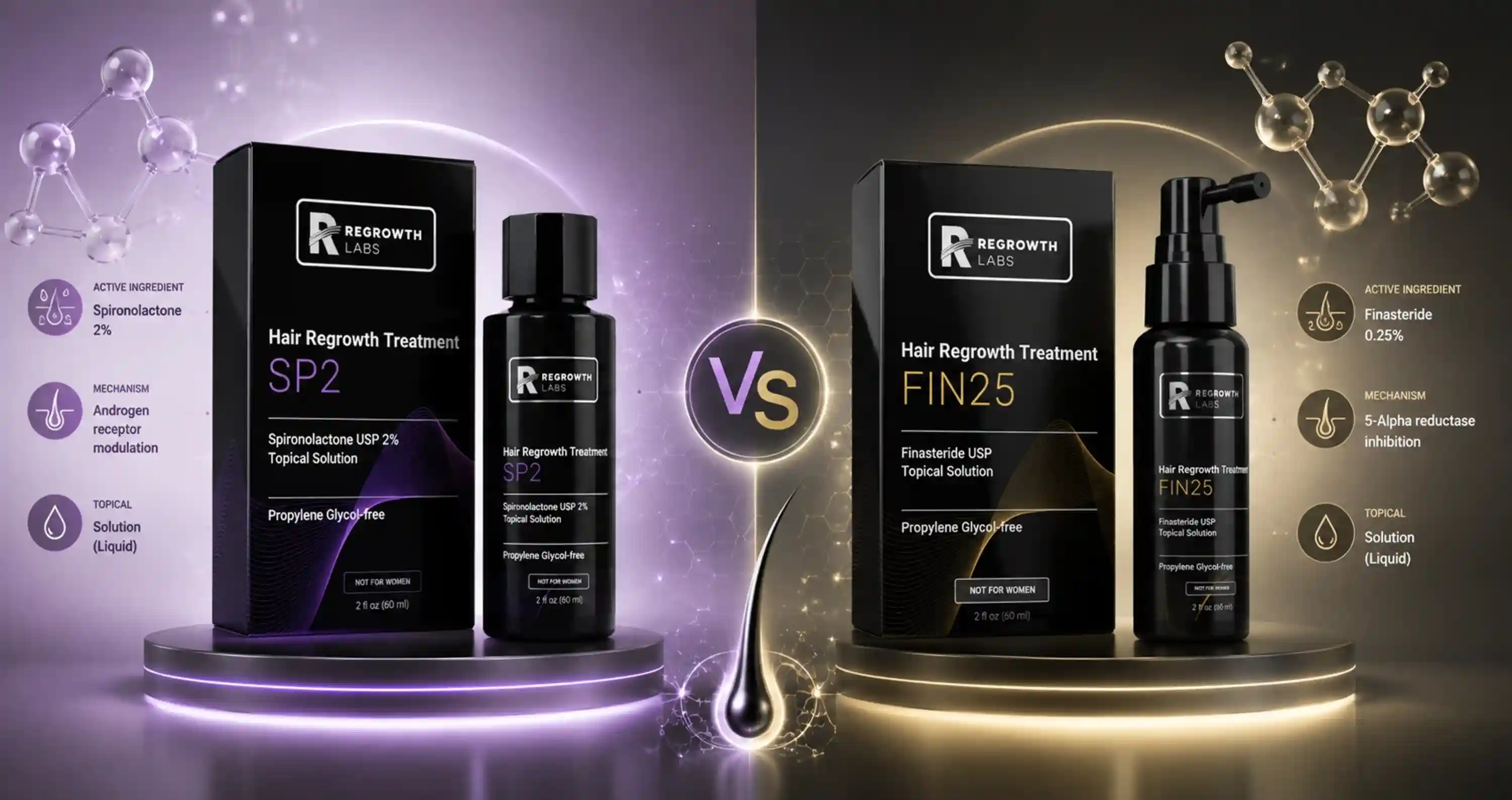
| Factor | SP2 | FIN25 |
| Active | Spironolactone 2% | Finasteride 0.25% |
| Target | Androgen receptor | 5-alpha-reductase |
| Reduces DHT creation | Not primary action | Yes |
| Opposes testosterone at receptor | Yes, intended | Not primary mechanism |
| Current sex positioning | Women on UAE page | Men |
| Pregnancy concern | Anti-androgenic | Male-fetal developmental risk |
| Exact finished-product trial | Not displayed | Not displayed |
| Systemic exposure data | Not displayed | Not displayed on product page |
The products should not be combined casually.
Using both could create two anti-androgen strategies:
Finasteride
↓
Less DHT created
Spironolactone
↓
Reduced androgen-receptor signalling
Whether that produces additional benefit or unnecessary risk requires professional review.
Can SP2 Be Combined With Oral Spironolactone?
Combining topical and oral spironolactone may increase total exposure.
A user taking oral spironolactone may already require monitoring related to:
- Potassium
- Kidney function
- Blood pressure
- Menstrual changes
- Breast symptoms
- Medicine interactions
Do not assume that a topical dose is too small to matter.
Can SP2 Be Combined With Finasteride or Dutasteride?
Combining SP2 with:
- Oral finasteride
- Topical finasteride
- Oral dutasteride
- Topical dutasteride
- D5a
- 5HP
- 7HP
may produce overlapping anti-androgen effects.
Possible concerns include:
- Difficulty identifying the cause of side effects
- Greater reproductive precautions
- Unknown combined systemic exposure
- Excessive treatment complexity
- Lack of direct combination evidence
The wider medicine comparison is discussed in the Finasteride vs Dutasteride guide.
Can SP2 Be Combined With Minoxidil?
Topical spironolactone and minoxidil have been studied together in small trials, and combination groups have shown favourable outcomes in some studies.
That does not mean every SP2 user should add minoxidil.
Before combining them, verify:
- Whether they should be applied together or separately
- Total volume on the scalp
- Drying sequence
- Irritation risk
- Propylene-glycol or alcohol overlap
- Blood-pressure history
- Pregnancy status
- Product-specific prescriber instructions
Confirmed SP2 Application Directions
The current official instructions are:
- Apply one millilitre or five sprays.
- Apply twice daily.
- Use on each targeted thinning area.
- Massage for two to four minutes.
- Wash the hands.
- Leave on for four or more hours.
- Continue use to achieve and maintain benefit.
- Do not use more than directed.
Critical “Each Targeted Area” Ambiguity
The wording “1 mL on each targeted area” could be interpreted as:
- One millilitre total, divided across all areas
or:
- One millilitre separately on every area
Those interpretations could produce very different daily exposure.
The manufacturer must clarify:
Hairline + crown
↓
One combined 1 mL dose?
or
Hairline 1 mL
+
Crown 1 mL?
Until resolved, do not instruct users to multiply the dose by the number of scalp zones.
Should SP2 Be Applied to a Dry Scalp?
The SP2 page does not state dry scalp in its specific directions, but the Regrowth Labs FAQ says its leave-in products are generally applied to a dry scalp.
The physical label should confirm this for SP2.
A dry scalp generally allows:
- More accurate application
- Less dilution
- Reduced run-off
- Better identification of treated areas
What Happens After a Missed Application?
SP2’s public directions do not include a missed-dose instruction.
Do not:
- Apply ten sprays next time
- Double the millilitres
- Apply two doses close together
- Add a late-night extra application
Resume the normal verified schedule unless professional instructions state otherwise.
Hairline Application
The UAE product page says SP2 treats the vertex and hairline.
For the hairline:
- Use scalp partings.
- Keep the solution away from the forehead.
- Avoid eyebrows and eyes.
- Remove run-off promptly.
- Do not add extra product for both temples.
- Allow it to dry before cosmetics or headwear.
The page does not present a frontal-hairline SP2 clinical trial.
Crown Application
The crown may require several partings to reach the skin.
Do not compensate for dense hair by increasing the dose.
The verified total amount should be divided across exposed scalp lines.
Microneedling and Damaged Skin
Do not apply SP2 immediately after microneedling without specialist instructions.
Damaged skin may alter exposure to:
- Spironolactone
- Ethanol
- Propanediol
- Preservatives
Avoid use on:
- Open cuts
- Bleeding skin
- Active infection
- Painful inflammation
- Severe dermatitis
- Sunburn
Eye and Facial Exposure
SP2 is for external scalp use.
The manufacturer advises avoiding eye contact and rinsing thoroughly after accidental exposure.
Do not use SP2 on:
- Eyebrows
- Eyelashes
- Face
- Beard
- Other body areas
Seek medical help after persistent eye pain, marked redness or visual changes.
UAE Routine Considerations
Heat and Sweat
Applying immediately before outdoor exercise may cause run-off toward the forehead and eyes.
Allow the solution to dry before:
- Exercise
- Wearing a helmet
- Wearing tight headwear
- Lying down
Headwear
Wet solution may transfer to:
- Caps
- Helmets
- Ghutras
- Pillowcases
- Towels
This may reduce the scalp dose and expose another person.
Showering
SP2 should remain on the scalp for at least four hours. Do not apply it shortly before swimming or showering.
Air Conditioning and Dryness
Alcohol-containing scalp solutions may feel drying in air-conditioned environments.
Do not add heavy oils immediately over SP2 without checking whether they alter drying, spread or absorption.
Storage in Dubai and the UAE
SP2 should be stored at 20°C to 25°C with the container closed. The manufacturer says slight darkening can occur over time without necessarily changing expected efficacy.
Do not store it:
- Inside a parked car
- On a sunny windowsill
- On a balcony
- Near a cooker
- In an unlabelled container
- With the pump open
- Where children can reach it
Seek supplier advice after:
- Heavy precipitation
- Major colour change
- Separation
- Leakage
- Broken seal
- Missing batch or expiry information
- Strong unexpected odour
What Results Should Buyers Expect?
The manufacturer says results may appear in as little as two months but more often around four months. This is manufacturer guidance rather than an independent SP2 trial outcome.
Do not promise:
- Visible growth in eight weeks
- Guaranteed hairline restoration
- A fixed improvement percentage
- Better results than finasteride
- Better results than minoxidil
- No systemic effects
- Results for every woman with high androgens
- Permanent results after stopping
- Initial shedding as proof of success
The existing SP2 article’s week-by-week result table should be removed.
Tracking Results and Safety
Take standardised photographs approximately every four weeks:
- Centre part
- Frontal hairline
- Left temple
- Right temple
- Crown
Record:
- Start date
- Five-spray applications
- Treatment zones
- Missed applications
- Scalp irritation
- Dizziness
- Weakness
- Breast symptoms
- Menstrual changes
- Sexual symptoms
- Blood-pressure symptoms
- Other anti-androgen products
- Oral spironolactone
- Minoxidil
- Microneedling
Photographs cannot prove:
- Receptor blockade
- Zero systemic exposure
- Potassium safety
- Hormone-level stability
- Superiority over finasteride
- Product authenticity
Questions to Ask Before Buying SP2
- Does the bottle confirm spironolactone 2% w/w?
- What is the corresponding mg/mL concentration?
- Do five sprays equal one millilitre?
- What is the bottle volume?
- Is one millilitre the total dose or the dose for each scalp area?
- Is the product intended for women, men or both?
- Has SP2 been tested in women with normal androgen levels?
- Has it been tested in men?
- Have blood spironolactone levels been measured?
- Have active metabolites been measured?
- Has serum potassium been tested?
- Has blood pressure been monitored?
- Have menstrual changes been evaluated?
- Has the exact product been compared with placebo?
- Has SP2 been compared with finasteride?
- Has it been compared with minoxidil?
- Is pregnancy use prohibited?
- What breastfeeding guidance applies?
- Can it be combined with oral spironolactone?
- Can it be combined with FIN25?
- Why does the product carry heart-disease warnings?
- Is the solution fragrance free?
- What is the UAE regulatory status?
- What symptoms require stopping treatment?
- How should a missed application be handled?
Frequently Asked Questions
What is SP2?
SP2 is a leave-on topical solution containing Spironolactone USP 2% w/w. It is marketed as an androgen-receptor antagonist for pattern hair loss.
Does SP2 contain minoxidil?
No. Minoxidil is not listed in the verified official SP2 formula.
Does SP2 contain finasteride?
No. Its active ingredient is spironolactone 2%.
Is spironolactone the same as finasteride?
No. Spironolactone antagonises androgen receptors, while finasteride inhibits the enzyme responsible for converting testosterone into DHT.
Does SP2 prevent DHT production?
That is not its primary mechanism. It is intended to oppose DHT and testosterone action at the androgen receptor.
Is SP2 a local androgen blocker?
It is formulated for local scalp application, but the reviewed pages do not prove that all effects remain exclusively local.
Does SP2 have zero systemic absorption?
No product-specific evidence reviewed here proves zero systemic absorption.
Does SP2 affect overall hormone levels?
The manufacturer claims no systemic hormonal effects, but does not publicly provide SP2 hormone or pharmacokinetic testing.
Is topical spironolactone clinically proven?
Small studies support topical spironolactone as a promising treatment concept. Exact SP2 2% clinical evidence was not presented publicly.
What concentrations have been studied?
Published hair-loss studies have evaluated topical formulations including 1% and 5%. Those results cannot automatically be applied to SP2 2%.
Is SP2 FDA approved for hair loss?
The reviewed public evidence does not establish FDA approval of the finished SP2 product. The manufacturer says Regrowth Labs products are supplied to international markets and are not sold or distributed in the United States.
Is SP2 suitable for women?
The UAE page categorises it for women, and spironolactone is commonly researched in female pattern hair loss. Individual suitability depends on diagnosis, pregnancy risk and medical history.
Can men use SP2?
Topical spironolactone has been studied in men, but the exact SP2 label and risk profile should be reviewed before use.
Can SP2 be used during pregnancy?
It should not be presented as safe during pregnancy. Oral spironolactone labelling advises avoidance because of potential anti-androgenic effects on a male fetus.
Can SP2 be used while breastfeeding?
Product-specific breastfeeding safety is not displayed publicly. Obtain professional guidance.
Can SP2 raise potassium?
SP2-specific potassium data are not publicly presented. Oral spironolactone can raise potassium, so users with kidney disease or interacting medicines require careful review.
Does topical SP2 require blood tests?
The product page does not state a testing requirement. Monitoring decisions should reflect medical history, concurrent oral spironolactone and the uncertainty around systemic exposure.
Can SP2 cause menstrual changes?
The SP2-specific rate is unknown. Menstrual changes are recognised with systemic spironolactone exposure and should be reported.
Can SP2 cause breast tenderness?
The exact topical rate is unknown. Breast symptoms occur with systemic spironolactone and warrant assessment.
Can SP2 cause gynaecomastia in men?
This cannot be ruled out without product-specific systemic-exposure data. Oral spironolactone is associated with gynaecomastia.
How much SP2 should be used?
The manufacturer states one millilitre or five sprays twice daily.
Does one millilitre apply to every treatment zone?
The wording is ambiguous. Confirm whether one millilitre is the total scalp dose before multiplying it across areas.
How long should SP2 remain on the scalp?
The current directions say four or more hours.
Can more SP2 improve results?
No. The manufacturer states that more than directed will not increase effectiveness.
Can SP2 irritate the scalp?
Yes. Spironolactone, ethanol, propanediol, preservatives or other vehicle ingredients may cause irritation.
Is propanediol completely non-irritating?
No ingredient can be guaranteed non-irritating for every user.
Can SP2 be combined with minoxidil?
Topical spironolactone and minoxidil have been studied together, but an individual combination routine requires dosage and irritation review.
Can SP2 be combined with FIN25?
This would combine receptor antagonism with reduced DHT production. It should not be started without professional supervision.
Can SP2 be used with oral spironolactone?
Combining topical and oral spironolactone may increase exposure and should be professionally reviewed.
Can SP2 be used after microneedling?
Do not apply it to freshly microneedled or damaged skin without explicit specialist instructions.
How should SP2 be stored in Dubai?
Store it at 20°C to 25°C, keep the container closed and do not leave it inside a parked vehicle.
Final Perspective
SP2 topical spironolactone 2% UAE and finasteride address androgen-sensitive hair loss through different pharmacological strategies.
Finasteride
↓
Inhibits 5-alpha-reductase
↓
Reduces production of DHT
SP2 spironolactone
↓
Antagonises androgen receptors
↓
Reduces signalling from DHT and testosterone
That makes SP2 scientifically distinct rather than interchangeable with topical finasteride.
Its potential advantages include:
- A receptor-level mechanism
- A non-minoxidil treatment pathway
- A formulation positioned for sensitive scalps
- Relevance to some women with androgen-sensitive pattern loss
- A propanediol-based vehicle
Its key evidence limitations include:
- No exact SP2 randomised trial displayed
- No public pharmacokinetic study
- No potassium or hormone measurements
- No direct comparison with FIN25
- No proof of zero systemic hormonal effects
- No complete pregnancy or breastfeeding guidance
- Ambiguous “one millilitre per targeted area” wording
The strongest potential buyer fit is an adult who:
- Has a diagnosis consistent with androgenetic alopecia
- Has discussed anti-androgen treatment
- Understands the receptor-blocking mechanism
- Has reviewed pregnancy precautions
- Has considered kidney, potassium and blood-pressure history
- Can follow a twice-daily four-hour routine
- Will not multiply the dose across scalp zones without clarification
- Will not combine anti-androgens casually
- Can monitor local and possible systemic symptoms
- Has realistic expectations
The responsible conclusion is:
SP2 is a topical spironolactone 2% androgen-receptor antagonist. It differs from finasteride because it targets androgen action at the receptor rather than reducing DHT production. Topical application may support local treatment, but the current public evidence does not prove that SP2 remains entirely local, leaves hormone levels unchanged or produces no systemic effects.
CTA: Review the current SP2 Hair Regrowth Treatment, compare its receptor-level mechanism with FIN25 Topical Finasteride, and explore other Regrowth Labs treatments before beginning a topical anti-androgen routine.