
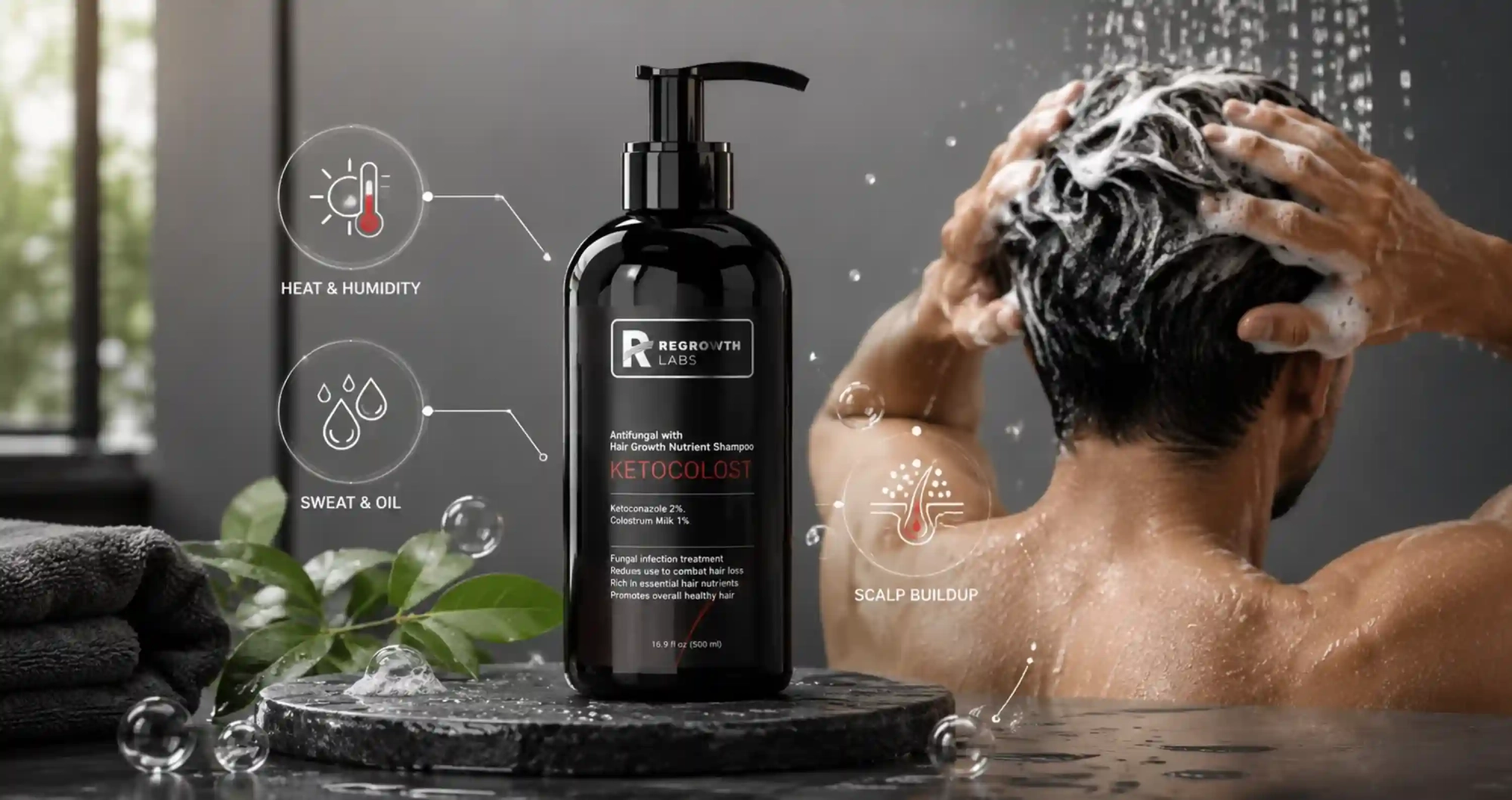
Using Ketocolost for sweaty scalp UAE concerns begins with one important distinction:
Sweat and buildup are not diagnoses.
A scalp may feel greasy, sticky or itchy after:
- Outdoor heat
- Exercise
- Helmets
- Caps
- Ghutras
- Commuting
- Hair fibres
- Dry shampoo
- Styling wax
- Leave-on scalp treatment
- Infrequent washing
These experiences do not automatically mean the scalp has a fungal infection.
Ketocolost Anti-Fungal Shampoo contains Ketoconazole 2% and Colostrum Milk 1%, according to Regrowth Labs. Its most defensible role is where symptoms or a diagnosis indicate dandruff, seborrhoeic dermatitis or another ketoconazole-responsive condition—not simply because the scalp produced sweat.
Direct Answer
Ketocolost for sweaty scalp UAE may be worth considering when a sweat-prone scalp also develops:
- Recurrent greasy or white flakes
- Persistent itching
- Red or inflamed areas
- Greasy scale
- Symptoms returning after ordinary shampoo
- A previous diagnosis of seborrhoeic dermatitis
- A professional recommendation for ketoconazole shampoo
An ordinary gentle shampoo may be more appropriate when the main problem is:
- Sweat without redness
- Salt residue after exercise
- Styling-product buildup
- Helmet odour
- Oily roots without flakes
- Dry-shampoo residue
- A need for frequent cleansing
Ketocolost for sweaty scalp UAE is not automatically the best daily cleanser for every active UAE resident.
What Is Sweat-Related Scalp Buildup?
“Buildup” is a broad cosmetic term rather than one recognised diagnosis.
Material on the scalp may include:
Sweat
+
Sebum
+
Dead skin cells
+
Styling products
+
Hair fibres or dry shampoo
+
Dust and environmental particles
=
Visible or palpable scalp residue
Different components require different solutions.
Sweat
Sweat is mostly water and electrolytes. After evaporation, salt residue may remain and contribute to tightness, itching or a coated feeling.
Sebum
Sebum is oil produced by sebaceous glands. It helps protect skin and hair but can contribute to a greasy appearance and combine with scale.
Dead Skin
Normal skin shedding may become more visible when particles collect in oily hair.
Styling Products
Wax, gel, spray, silicone-rich products, dry shampoo and hair fibres can create cosmetic residue without infection.
Inflammatory Scale
Seborrhoeic dermatitis, psoriasis, eczema and contact dermatitis can all produce flaking. They require different management.
Ketocolost for sweaty scalp UAE only makes sense when the suspected or diagnosed problem fits its antifungal role.
Sweat Does Not Create a Fungal Infection by Itself
Malassezia yeast normally lives on human skin. Seborrhoeic dermatitis is a chronic inflammatory condition involving multiple factors, including sebaceous areas, Malassezia activity, skin-barrier function and individual inflammatory response. It is not simply “dirty scalp fungus.”
Avoid statements such as:
- Sweat causes fungus.
- Humidity always creates seborrhoeic dermatitis.
- Every oily scalp has Malassezia overgrowth.
- Shampooing after every sweat episode prevents fungal disease.
A more accurate explanation is:
Sweat, occlusion, sebum and residue may make an already sensitive scalp feel worse or make existing scaling more noticeable. Persistent inflammation and scaling require proper diagnosis.
What Seborrhoeic Dermatitis Usually Looks Like
Seborrhoeic dermatitis commonly affects oil-rich areas such as the scalp and may present with:
- Flaking
- Greasy scale
- Redness
- Itching
- Recurrent symptoms
- Involvement around eyebrows, ears or the sides of the nose
It is chronic or relapsing rather than a one-time hygiene problem.
Dandruff may represent a milder scalp form with visible scaling and little or no obvious inflammation.
When Flakes May Not Be Dandruff
Flakes can also come from:
- Dry scalp
- Psoriasis
- Atopic dermatitis
- Allergic contact dermatitis
- Irritant dermatitis
- Hair-dye reaction
- Product residue
- Tinea capitis
- Sunburn
- Scalp-picking
- Inadequate rinsing
Ketocolost for sweaty scalp UAE should not delay assessment where the diagnosis is uncertain.
Why Ketoconazole 2% Is Relevant
Ketoconazole is an azole antifungal medicine.
Its scalp role is primarily linked to reducing yeast-related activity associated with:
- Dandruff
- Seborrhoeic dermatitis
- Other susceptible fungal conditions
A contemporary review concluded that ketoconazole shampoo has consistent evidence for dandruff and seborrhoeic dermatitis, while a 2024 narrative review summarised multiple trials showing improvement in scaling and irritation.
Ketocolost’s verified 2% concentration places it within a commonly studied medicated-shampoo strength.
It does not establish that every Ketocolost claim has been independently tested.
Ketocolost Versus an Ordinary Clarifying Shampoo
| Question | Ketocolost | Ordinary clarifying shampoo |
| Contains an antifungal medicine | Yes, ketoconazole 2% | Usually no |
| Best aligned use | Dandruff, seborrhoeic dermatitis or diagnosed fungal concern | Oil, sweat and styling residue |
| Suitable for every wash | Not confirmed publicly | Depends on formula and scalp |
| May cause dryness or irritation | Yes | Yes, especially if harsh |
| Treats every form of buildup | No | No |
| Proven hair-regrowth replacement | No | No |
| Requires label-specific timing | Yes | Yes |
A buyer should not select medicated shampoo solely because it sounds “stronger.”
UAE Heat Changes the Routine, Not the Diagnosis
Hot conditions may lead to:
- More sweating
- More frequent showers
- Increased helmet or headwear use
- Greater reliance on dry shampoo
- More salt residue
- More frequent product reapplication
- Increased friction
- Concern about scalp odour
These factors may justify more thoughtful cleansing.
They do not justify using Ketocolost for sweaty scalp UAE more frequently than its label.
After Exercise: Should You Use Ketocolost Every Time?
Not automatically.
Someone exercising five or six days each week could overuse a medicated shampoo if it were applied after every workout without product-specific guidance.
A practical decision framework is:
Sweat only, no flaking or inflammation
↓
Rinse or use a suitable gentle cleanser
Recurring flakes, redness or greasy scale
↓
Confirm whether dandruff or seborrhoeic dermatitis is present
Ketoconazole-responsive diagnosis
↓
Use Ketocolost according to its verified label
Ketocolost for sweaty scalp UAE should be part of a planned routine—not an automatic post-gym wash.
What to Do Immediately After Heavy Sweating
After heavy sweat:
- Remove tight headwear.
- Allow heat to dissipate.
- Avoid scratching the scalp.
- Rinse or cleanse when practical.
- Dry the scalp and hair thoroughly.
- Clean helmets, caps and pillowcases regularly.
- Do not cover wet hair immediately.
- Watch for recurrent redness, scale or pain.
These steps reduce residue and occlusion without assuming infection.
Helmet and Cap Buildup
Helmets and caps may retain:
- Sweat
- Oil
- Skin cells
- Styling residue
- Microorganisms
- Product transfer
Practical hygiene includes:
- Cleaning removable helmet liners
- Allowing headwear to dry fully
- Rotating caps
- Avoiding shared headwear
- Not placing a helmet over wet medicated shampoo
- Washing the scalp after prolonged sweating where appropriate
Ketocolost for sweaty scalp UAE cannot compensate for repeatedly wearing damp, unclean headwear.
Ghutra, Scarf and Head-Covering Considerations
Head coverings may increase:
- Occlusion
- Friction
- Sweat retention
- Transfer of hair products
- Pressure on inflamed areas
Use clean, dry fabric and allow the scalp to dry before covering it.
Do not imply that Ketocolost for sweaty scalp UAE is required simply because someone wears a head covering.
Can Sweat Wash Off Leave-On Hair Treatment?
Sweat may move or dilute a leave-on scalp treatment if exercise begins before it has dried or completed its required contact period.
Ketocolost for sweaty scalp UAE should not be used automatically to “reset” the scalp after every wet application.
Instead:
- Follow the leave-on treatment’s timing.
- Schedule exercise around its drying period.
- Wash only when needed.
- Avoid immediately reapplying a missed or sweated-off dose.
- Do not assume Ketocolost improves subsequent absorption.
A future dedicated article should own Ketocolost-before-minoxidil timing.
Using Ketocolost Before a Hair-Regrowth Spray
A clean scalp can make measured application easier, but Ketocolost should be fully rinsed out.
The scalp should then be dried according to the leave-on medicine’s directions.
Do not layer minoxidil, finasteride or dutasteride onto:
- Active shampoo foam
- Wet scalp
- Conditioner residue
- Irritated skin
- Fresh scratches
Do not claim that washing with Ketocolost makes a topical medicine clinically stronger.
Contact Time Must Follow the Ketocolost Label
Generic ketoconazole 2% shampoos commonly direct three-to-five-minute or five-minute contact before rinsing.
Ketocolost’s current official text page does not publish a contact time.
Therefore:
- Do not invent a five-minute Ketocolost rule.
- Do not rinse immediately unless the label says so.
- Do not leave it on for twenty minutes.
- Do not sleep with it on.
- Do not use social-media instructions instead of the pack.
The physical bottle is the required source.
Frequency Must Follow the Ketocolost Label
Generic ketoconazole shampoo treatment frequencies vary by:
- Diagnosis
- Product
- Country
- Concentration
- Treatment stage
- Maintenance stage
When considering Ketocolost for sweaty scalp UAE, the public page does not provide a verified frequency.
Do not publish:
- Daily use
- Every-other-day use
- Twice-weekly use
- Once-weekly maintenance
until the physical label is checked.
Why Daily Medicated Washing May Be a Problem
Unnecessary frequent use may contribute to:
- Dryness
- Burning
- Itching
- Hair-texture changes
- Scalp irritation
- Colour-treated-hair changes
- Difficulty identifying the actual cause of symptoms
Ketoconazole shampoo labels document possible reactions, including burning, itching, contact dermatitis, dry skin, hair-texture changes, hair discolouration, rash and hypersensitivity.
Can Ketocolost Cause More Flaking?
Yes, a user may interpret dryness or irritation as worsening dandruff.
Possible explanations include:
- Overuse
- Reaction to the cleansing base
- Fragrance sensitivity
- Contact dermatitis
- Incorrect diagnosis
- Inadequate rinsing
- Another scalp condition
When using Ketocolost for sweaty scalp UAE, do not simply increase frequency when flaking worsens.
Colostrum Milk 1% and Sweat-Prone Scalp
Colostrum Milk 1% is the second verified active listed for Ketocolost.
It may be intended to add conditioning or scalp-support properties to an antifungal shampoo.
Public evidence does not show that the 1% colostrum component:
- Prevents sweat
- Removes salt buildup
- Repairs every inflamed scalp
- Delivers intact growth factors to follicles
- Prevents ketoconazole dryness
- Regrows hair
- Makes the shampoo hypoallergenic
The product should also disclose whether milk proteins remain in the finished shampoo.
Milk Allergy Considerations
Because the product lists Colostrum Milk 1%, a person with severe milk-protein allergy should not assume the rinse-off format eliminates exposure.
The physical label should state:
- Animal species
- Milk-protein content
- Processing method
- Allergen warning
- Cross-contamination controls
This is different from lactose intolerance, which relates primarily to ingestion of lactose.
Is Ketocolost Vegan?
No vegan claim should be used because colostrum is animal derived.
The shampoo category currently contains broad vegan language that appears alongside Ketocolost. That category copy should be corrected so it does not apply one claim to every listed product.
Is Ketocolost Suitable for Women?
The UAE product page categorises Ketocolost under both men and women, and the official manufacturer’s ketoconazole text discusses androgenetic alopecia in both sexes.
However, the current physical bottle should still be checked for:
- Sex-specific restrictions
- Pregnancy
- Breastfeeding
- Age limits
- Market-specific instructions
Do not use a universal “safe for everyone” statement.
Pregnancy and Breastfeeding
Topical ketoconazole shampoo generally has low systemic exposure when used on intact scalp, and some regulated product information reports undetectable plasma levels after scalp shampooing.
That evidence concerns specific regulated ketoconazole shampoos—not the complete Ketocolost formula with Colostrum Milk 1%.
The physical label or a qualified professional should guide pregnancy and breastfeeding use.
Avoid:
- Pregnancy safe
- Breastfeeding safe
- No absorption
- No fetal risk
without product-specific documentation.
Eye Exposure
Ketoconazole shampoos are for external use.
Avoid contact with:
- Eyes
- Eyelids
- Mouth
- Broken facial skin
After eye exposure:
- Rinse with clean water.
- Do not rub.
- Remove contact lenses where appropriate.
- Seek advice if pain, redness or visual changes persist.
Broken or Infected Scalp
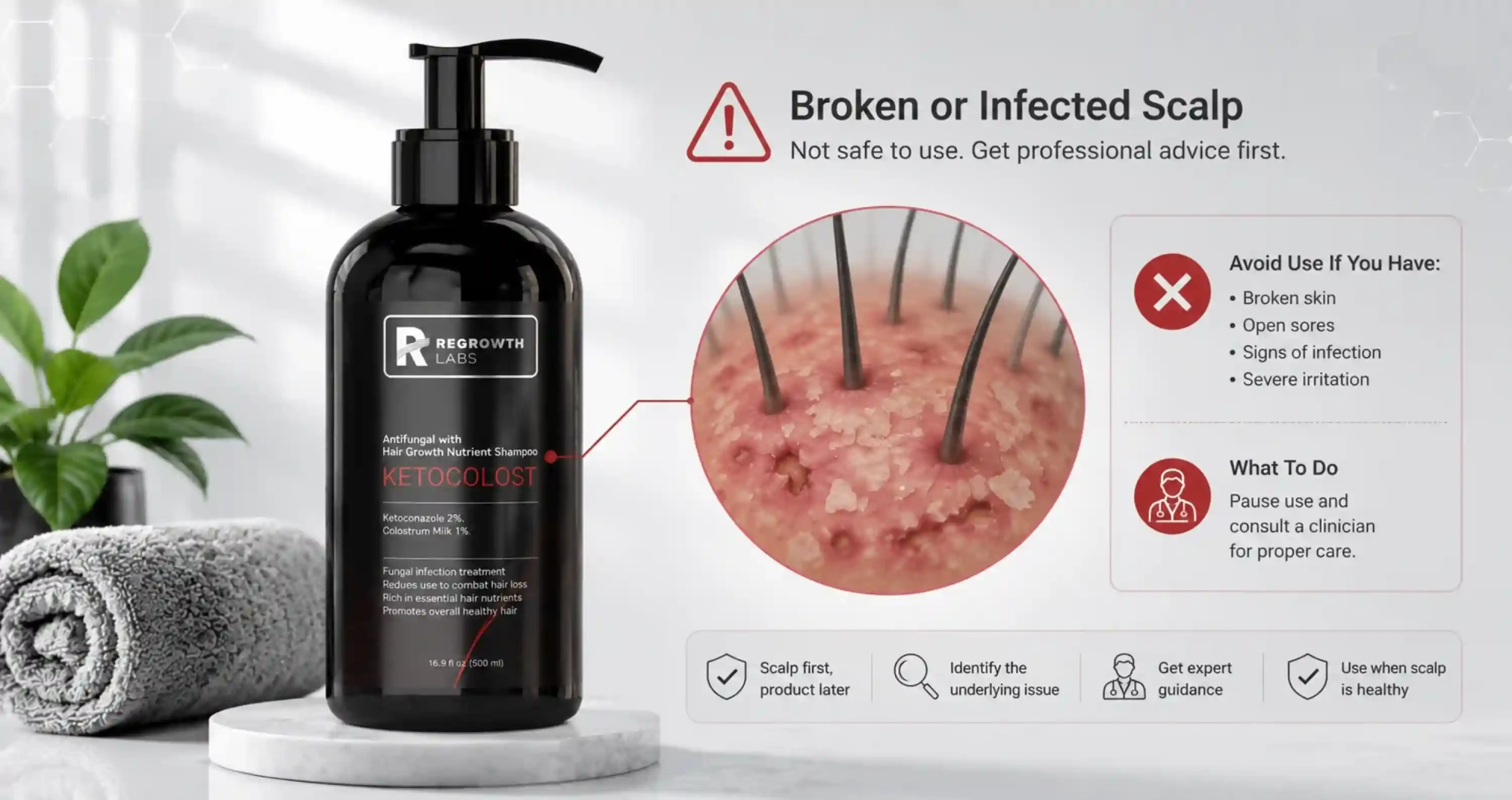
Do not self-treat open, bleeding or severely inflamed skin with Ketocolost without assessment.
Seek professional review for:
- Pus
- Painful swelling
- Fever
- Spreading redness
- Broken skin
- Thick crust
- Tender lymph nodes
- Sudden patchy hair loss
- Ring-shaped lesions
- Hair breaking close to scalp
These may indicate bacterial infection, tinea capitis or another condition that shampoo alone may not adequately treat.
Tinea Capitis Is Not Ordinary Dandruff
Tinea capitis can produce:
- Patchy hair loss
- Broken hairs
- Scaling
- Black dots
- Tender inflammation
- Pustules
- Lymph-node swelling
It often requires systemic antifungal treatment rather than shampoo alone.
Ketocolost for sweaty scalp UAE should not be promoted as a stand-alone cure for every fungal scalp infection.
Seborrhoeic Dermatitis Does Not Usually Cause Permanent Hair Loss
Seborrhoeic dermatitis may increase scratching, breakage or temporary shedding during inflammation, but it is not generally considered a direct cause of permanent follicular destruction.
Do not use fear-based language such as:
Untreated dandruff permanently kills hair follicles.
Persistent thinning should be assessed separately.
Ketocolost and Androgenetic Alopecia
Ketoconazole may be used as supportive scalp care for someone who also has pattern hair loss.
It does not replace:
- Diagnosis
- Minoxidil
- Finasteride
- Dutasteride
- Medical monitoring
- A complete treatment plan
Readers with gradual crown or hairline miniaturisation should use the confirmed androgenetic alopecia treatment guide rather than expecting an antifungal shampoo to address the entire condition.
When Buildup Is Mostly Cosmetic
Signs favouring cosmetic buildup may include:
- Residue appears after styling
- Flakes match dry-shampoo colour
- Symptoms resolve after ordinary cleansing
- No redness
- No persistent itch
- No greasy inflammatory scale
- No facial or ear involvement
- No recurrent pattern
In that case, Ketocolost for sweaty scalp UAE may not be necessary; compare options in the confirmed shampoo category instead of defaulting to medicated treatment.
When Ketocolost May Be a Better Match
Ketocolost for sweaty scalp UAE may fit more logically when:
- A clinician diagnosed seborrhoeic dermatitis
- Dandruff repeatedly returns
- Flaking is greasy or inflammatory
- Ordinary shampoo does not control symptoms
- Ketoconazole was recommended
- The user can follow the label’s timing and frequency
- The full ingredient list is acceptable
- Milk-derived colostrum suits the user’s allergy and ethical preferences
Who Should Not Self-Select Ketocolost?
Professional assessment is especially important when:
- Hair loss is sudden or patchy
- The scalp is painful
- Thick plaques are present
- Pus or crusting occurs
- Hair shafts break near the scalp
- Eyebrows or eyelashes are affected
- Symptoms began after hair dye
- Severe milk allergy exists
- Pregnancy or breastfeeding is relevant
- The user is a child
- Multiple medicated shampoos are already used
- The condition persists despite correct treatment
Avoid Over-Cleansing
A sweat-prone scalp can become irritated from repeated:
- Shampooing
- Hot water
- Scrubbing
- Clarifying products
- Ketoconazole
- Salicylic acid
- Fragrance
- Alcohol-containing leave-ons
Over-cleansing may cause:
- Tightness
- Burning
- Dry flakes
- Increased sensitivity
- Rebound oiliness perception
- Hair-shaft dryness
Use Ketocolost for sweaty scalp UAE only for its intended condition, not as punishment for sweating.
A Practical UAE Scalp Routine
On Ordinary Sweat Days
- Remove tight headwear.
- Rinse or use a suitable gentle cleanser if needed.
- Dry the scalp thoroughly.
- Clean caps and helmet liners.
- Avoid heavy dry-shampoo layering.
- Monitor for recurring flakes or inflammation.
On Labelled Ketocolost Days
- Wet the scalp as directed.
- Apply the verified amount.
- Distribute over affected scalp areas.
- Follow the physical-label contact time.
- Rinse thoroughly.
- Use conditioner only as appropriate.
- Dry before applying a separate leave-on medicine.
- Stop after significant irritation.
Between Uses
- Do not add extra Ketocolost after every sweat event.
- Do not scratch flakes away.
- Do not layer several antifungal shampoos.
- Do not leave a medicated shampoo on overnight.
- Do not assume residue equals fungal disease.
Storage in UAE Heat
Keep Ketocolost:
- In original packaging
- With the cap closed
- Away from direct sunlight
- Away from parked vehicles
- Away from high bathroom heat where possible
- Away from children
The current official text page does not publish product-specific storage temperatures, so the physical label must be followed.
Evidence Hierarchy
Level 1 — Strongest
Randomised trial of exact Ketocolost formula
Level 2
Ketocolost ketoconazole, colostrum and finished-product testing
Level 3
Clinical ketoconazole 2% shampoo trials for scalp disease
Level 4
Systematic and narrative reviews of ketoconazole shampoo
Level 5
General seborrhoeic-dermatitis and Malassezia evidence
Level 6
Cleansing and scalp-hygiene principles
Level 7
Manufacturer Ketocolost claims
Level 8 — Weakest
Testimonials, retailer statements and edited images
The current evidence position is:
- Ketoconazole shampoo is supported for dandruff and seborrhoeic dermatitis.
- Ketocolost lists Ketoconazole 2% and Colostrum Milk 1%.
- Exact Ketocolost clinical outcomes are not published on the reviewed pages.
- Full INCI, contact time and frequency are missing publicly.
- Colostrum’s claimed hair-regrowth contribution is unverified.
- Sweat and buildup do not diagnose fungal infection.
- The current UAE product page displays no customer reviews.
Frequently Asked Questions
Is Ketocolost suitable for a sweaty scalp?
It may be appropriate when sweating coincides with diagnosed or likely dandruff or seborrhoeic dermatitis. Sweat alone does not create an indication for ketoconazole.
Does sweat cause scalp fungus?
Sweat does not automatically cause fungal infection. Seborrhoeic dermatitis involves Malassezia, sebum, skin-barrier and inflammatory factors.
What is in Ketocolost?
The official manufacturer page lists Ketoconazole 2% and Colostrum Milk 1%.
Is Ketocolost a regular shampoo?
It is a medicated antifungal shampoo rather than an ordinary cosmetic cleanser.
Does Ketocolost remove sweat buildup?
It cleanses the scalp, but its main medicinal distinction is ketoconazole. Ordinary sweat or styling residue may not require an antifungal shampoo.
Can I use Ketocolost after every workout?
Not unless that frequency appears on the current label or is professionally recommended.
How often should Ketocolost be used?
The reviewed public Ketocolost pages do not state a frequency. Follow the physical label.
How long should Ketocolost remain on the scalp?
The public Ketocolost text pages do not provide a contact time. Generic ketoconazole instructions should not replace its physical label.
Do generic ketoconazole shampoos stay on for five minutes?
Many regulated ketoconazole 2% products use a three-to-five-minute or five-minute contact period. That does not prove exact Ketocolost timing.
Can I leave Ketocolost on longer?
Longer contact is not proven to improve Ketocolost results and may increase irritation.
Can I sleep with Ketocolost on?
No. It is a rinse-off shampoo.
Can Ketocolost be used daily?
Daily use should not be recommended without verified Ketocolost instructions.
Does Ketocolost treat dandruff?
Its ketoconazole 2% component is relevant to dandruff and seborrhoeic dermatitis.
Does Ketocolost treat seborrhoeic dermatitis?
Ketoconazole shampoo is an established option for seborrhoeic dermatitis. Exact use should follow the product label or clinician’s advice.
Does Ketocolost treat psoriasis?
No. Psoriasis requires separate diagnosis and treatment.
Does it treat tinea capitis?
Shampoo alone is generally not sufficient for scalp ringworm, which may require systemic treatment.
Does Ketocolost regrow hair?
No finished-product clinical trial is shown proving that Ketocolost regrows hair. Its strongest role is antifungal scalp care.
Does ketoconazole help pattern hair loss?
Ketoconazole may have a supportive role, but it is not a substitute for established androgenetic-alopecia treatment.
Does colostrum regrow hair?
No Ketocolost trial is displayed showing independent regrowth from Colostrum Milk 1%.
Is Ketocolost vegan?
It should not be called vegan because it contains colostrum milk.
Is Ketocolost dairy free?
No dairy-free claim should be used without finished-product allergen documentation.
Can people with milk allergy use it?
Someone with severe milk-protein allergy should review the label and seek professional advice because the product lists Colostrum Milk 1%.
Can women use Ketocolost?
The UAE page categorises it for men and women, but pregnancy, breastfeeding and market-specific restrictions must be checked on the current physical label.
Can children use Ketocolost?
The reviewed pages do not provide paediatric directions. Do not give it to a child without qualified guidance.
Can Ketocolost cause dryness?
Yes. Ketoconazole shampoos can cause dryness, irritation, burning, itching or hair-texture changes.
Can it make flaking worse?
Irritation, dryness, overuse or an incorrect diagnosis can make flaking seem worse.
Can Ketocolost be used with minoxidil?
It may be used within a reviewed routine. Rinse the shampoo fully and let the scalp dry before applying leave-on treatment.
Does Ketocolost improve minoxidil absorption?
No product-specific evidence proves that it increases minoxidil absorption.
Should Ketocolost be used before topical finasteride?
Only according to a planned cleansing and medicine schedule. Do not layer topical treatment onto shampoo residue or wet scalp.
Can it be used after microneedling?
Do not use it on freshly microneedled, bleeding or significantly inflamed scalp without explicit professional guidance.
Can it be used after a hair transplant?
Only after the transplant clinician approves medicated shampooing and scalp massage.
Is Ketocolost FDA approved?
The reviewed pages do not establish FDA approval of the finished Ketocolost product.
Does FDA facility registration prove approval?
No. Manufacturing-facility registration does not prove product approval or clinical efficacy.
How should Ketocolost be stored in Dubai?
Keep it closed, protected from excessive heat and direct sunlight, and never leave it for prolonged periods inside a parked vehicle.
Final Perspective
Ketocolost can be understood through a simple decision pathway:
Sweat, oil or product residue
↓
Does the scalp have recurring flakes,
redness, itching or greasy scale?
↓
No
Ordinary cleansing may be sufficient
↓
Yes
Assess for dandruff, seborrhoeic dermatitis
or another scalp disorder
↓
Ketoconazole-responsive condition
↓
Use Ketocolost according to its verified label
The strongest reasons to consider Ketocolost are:
- Verified Ketoconazole 2%
- Recurrent dandruff
- Seborrhoeic dermatitis
- Greasy inflammatory scale
- Professional ketoconazole recommendation
- Symptoms not controlled by ordinary cleansing
The reasons not to default to it are:
- Sweat without scale
- Styling-product residue
- Helmet odour
- Dry-shampoo buildup
- Need for daily gentle cleansing
- Uncertain diagnosis
- Active broken skin
- Severe milk allergy
- Missing physical-label instructions
Its key evidence limitations are:
- No exact finished-product clinical trial shown
- No complete public INCI
- No public Ketocolost contact time
- No public treatment frequency
- No verified absorption-enhancement study
- No evidence that colostrum reverses hair loss
- No proof that every sweaty scalp has fungal overgrowth
- No proof that it replaces pattern-hair-loss treatment
The responsible conclusion is:
Ketocolost for sweaty scalp UAE concerns is most appropriate when sweat and residue occur alongside dandruff, seborrhoeic dermatitis or another ketoconazole-responsive scalp problem. It should not be used simply because the scalp feels sweaty. Match the shampoo to the diagnosis, follow the physical-label frequency and contact time, and use an ordinary gentle cleanser for routine sweat removal when medicated treatment is not needed.
CTA: Review the current Ketocolost Anti-Fungal Shampoo, compare other verified options in the scalp-care shampoo category and follow the cause-based hair-loss action plan if shedding continues after scalp symptoms improve.