

FR12 copper peptide GHK Cu is included as a supporting ingredient within a much broader high-strength hair-loss formula.
The official FR12 page currently lists:
- Minoxidil 12%
- Finasteride
- Alfatradiol
- Retinol liposomes
- Adenosine
- Procapil
- Azelaic acid
- Procyanidin B2
- Copper Peptide GHK-Cu
- Liposphere technology (follics.com)
The UAE product page describes a similar formula and says GHK-Cu provides antioxidant and anti-inflammatory effects while supporting collagen, glycosaminoglycan synthesis and blood-vessel growth. (Hims N Hers FZ LLC)
These claims create a plausible scalp-support rationale.
They do not establish that GHK-Cu is one of FR12’s primary proven hair-loss medicines.
The evidence hierarchy within the formula should be presented as:
Primary pharmaceutical pathways
Minoxidil
Finasteride
Alfatradiol
↓
Supporting biological and cosmetic pathways
Adenosine
Azelaic Acid
Procapil / other complexes
Procyanidin B2
Retinol Liposomes
GHK-Cu
Direct Answer
FR12 copper peptide GHK Cu is included because laboratory and tissue-repair research suggests copper peptides may influence:
- Extracellular-matrix remodelling
- Fibroblast activity
- Collagen and glycosaminoglycan production
- Angiogenesis-related signalling
- Antioxidant pathways
- Inflammatory responses
- Wound-repair processes
GHK-Cu research is strongest in skin repair, remodelling and preclinical biology. Reviews describe regenerative, antioxidant and anti-inflammatory actions across in vitro and animal models, while emphasising the need for stronger human clinical evidence for many claimed uses. (PMC)
The correct interpretation is:
GHK-Cu may help create a supportive scalp environment, but exact FR12 evidence does not prove that the peptide independently regrows hair or enhances minoxidil and finasteride results.
What Is GHK-Cu?
GHK is the tripeptide:
- Glycine
- Histidine
- Lysine
When it binds a copper ion, it forms the complex commonly written as GHK-Cu.
GHK occurs naturally in human biological fluids and has attracted research interest because of its copper-binding and cell-signalling properties. Research reviews associate the complex with tissue repair, extracellular-matrix regulation and cellular responses relevant to skin regeneration. (PMC)
GHK-Cu is not:
- Elemental copper powder
- An oral copper supplement
- A mineral replacement treatment
- A DHT inhibitor
- Minoxidil
- Finasteride
- A growth factor
- A stem-cell treatment
It is a small copper-binding peptide complex.
Why Copper Is Bound to a Peptide
Free copper ions participate in essential biological reactions but may also contribute to oxidative damage when poorly controlled.
Binding copper to a peptide may influence:
- Transport
- Local availability
- Cellular signalling
- Interaction with proteins and enzymes
- Release of copper in biological environments
The presence of a copper ion does not mean the product supplies a nutritionally meaningful oral-copper dose.
Topical GHK-Cu should not be marketed as correcting systemic copper deficiency.
FR12 Copper Peptide GHK Cu: The Scalp-Support Theory
A hair follicle sits inside living skin and depends on a surrounding environment that includes:
- Dermal tissue
- Blood vessels
- Extracellular matrix
- Fibroblasts
- Immune cells
- Dermal papilla cells
- Sebaceous structures
- Signalling molecules
A supportive scalp environment may help maintain normal tissue function.
The proposed GHK-Cu pathway is:
Topical GHK-Cu
↓
Interaction with scalp cells and tissue signals
↓
Potential support for remodelling,
antioxidant and inflammatory pathways
↓
Potentially healthier tissue environment
around viable follicles
The final step should remain potential, not established FR12 clinical fact.
GHK-Cu and Collagen
Collagen contributes structural support to skin and connective tissue.
GHK-Cu research has been associated with:
- Collagen synthesis
- Collagen remodelling
- Regulation of matrix metalloproteinases
- Balancing matrix breakdown and repair
- Fibroblast activity
Reviews of GHK-Cu describe effects on collagen, elastin and glycosaminoglycan-related pathways, mainly from laboratory and preclinical research. (PMC)
This does not mean that more collagen automatically creates more scalp hair.
Excessive or abnormal collagen deposition can also occur in scarring conditions.
The responsible claim is:
FR12 copper peptide GHK Cu is included partly for extracellular-matrix and tissue-remodelling support.
Avoid:
GHK-Cu rebuilds every damaged follicle with new collagen.
Glycosaminoglycan Support
Glycosaminoglycans are molecules involved in:
- Hydration
- Extracellular-matrix organisation
- Cell signalling
- Tissue structure
The FR12 product page says GHK-Cu contributes to glycosaminoglycan synthesis in skin fibroblasts. (Hims N Hers FZ LLC)
That is a mechanism-level claim.
The reviewed public pages do not show that FR12:
- Increases scalp glycosaminoglycans in users
- Changes follicle size through this pathway
- Improves hair counts because of this effect
- Uses a clinically validated GHK-Cu dose
Angiogenesis and Blood-Vessel Claims
GHK-Cu research has been associated with blood-vessel and tissue-repair signalling.
Angiogenesis means the formation of new blood vessels.
This concept is sometimes simplified into:
GHK-Cu increases scalp blood flow and grows hair.
That conclusion is too strong.
Blood-vessel growth in a wound-repair model does not establish:
- Increased scalp circulation after FR12
- Greater minoxidil absorption
- Improved hair counts
- Better frontal-hairline response
- Reduced DHT-related miniaturisation
Use:
GHK-Cu has been studied in tissue-repair pathways that include angiogenesis-related activity.
Do not use:
GHK-Cu clinically increases scalp blood flow.
Antioxidant Rationale
Oxidative stress refers to an imbalance between reactive molecules and protective biological systems.
GHK-Cu has been studied in antioxidant and gene-regulatory contexts, including laboratory models of oxidative injury. (PMC)
That supports an antioxidant rationale.
It does not prove that FR12:
- Neutralises all scalp oxidative stress
- Prevents androgenetic alopecia
- Protects follicles from every environmental exposure
- Reverses damage caused by DHT
- Replaces sun protection or scalp-disease management
Anti-Inflammatory Rationale
Inflammatory signalling may influence scalp comfort and several scalp disorders.
Reviews describe anti-inflammatory effects associated with GHK-Cu in laboratory and preclinical research. (PMC)
However, androgenetic alopecia is not simply an inflammatory scalp disease.
FR12 should not be marketed as treating:
- Psoriasis
- Seborrhoeic dermatitis
- Folliculitis
- Fungal infection
- Scarring alopecia
- Autoimmune alopecia
because GHK-Cu is present.
A red, painful, infected or inflamed scalp requires diagnosis.
Wound-Healing Evidence Is Not Hair-Regrowth Evidence
GHK-Cu is widely discussed in relation to tissue repair and wound healing.
A topical-delivery study noted that GHK-Cu’s hydrophilic nature makes skin penetration challenging and investigated microneedles to enhance delivery. (PubMed)
This provides two important lessons:
- The molecule has genuine tissue-repair research interest.
- Topical delivery cannot be assumed merely because GHK-Cu appears in a solution.
Wound closure and hair regrowth are different clinical outcomes.
Do not write:
GHK-Cu heals the scalp, so it regrows hair.
Use:
Tissue-repair studies provide mechanistic support, but direct hair-loss trials are required.
GHK-Cu Versus AHK-Cu
The names look similar but refer to different peptide sequences.
| Peptide | General identity | Hair evidence relevance |
| GHK-Cu | Gly-His-Lys copper complex | Broad tissue-repair and skin research |
| AHK-Cu | Ala-His-Lys copper complex | Human follicle and dermal-papilla laboratory study |
| Other peptide-copper complexes | Multiple possible structures | Animal or preclinical findings may vary |
The commonly cited 2007 human-hair-follicle study used AHK-Cu. It reported follicle elongation and dermal-papilla effects in laboratory systems. (PubMed)
That study cannot prove:
- GHK-Cu produces the same effect
- FR12 contains an equivalent concentration
- FR12’s vehicle delivers the peptide similarly
- Twice-daily FR12 improves hair counts through GHK-Cu
- The peptide adds benefit beyond minoxidil and finasteride
Does FR12 Copper Peptide GHK Cu Stimulate Hair Follicles?
The most accurate answer is:
Copper peptides have produced hair-follicle-related effects in laboratory and animal research, but robust clinical evidence for topical GHK-Cu in androgenetic alopecia remains limited.
A small peptide can show activity in:
- Isolated follicles
- Cell cultures
- Mouse models
without producing the same result after application to intact human scalp.
Human efficacy depends on:
- Formulation
- Concentration
- Stability
- Skin penetration
- Follicular deposition
- Application dose
- Frequency
- Duration
- Diagnosis
- Concurrent ingredients
Is GHK-Cu Proven to Increase Hair Count?
No FR12-specific trial is displayed publicly.
The reviewed product pages do not provide:
- Baseline and post-treatment hair counts
- GHK-Cu-only treatment group
- Vehicle control
- FR12 without GHK-Cu comparison
- Trichoscopy outcomes
- Hair-diameter measurements
- Investigator-blinded photography
- Statistical analysis
- Adverse-effect rates
Therefore, the site should not state that GHK-Cu independently increases hair count in FR12 users.
Does GHK-Cu Make FR12 Better Than Minoxidil Alone?
That has not been demonstrated.
To establish the additive value of GHK-Cu, a controlled trial would need groups such as:
- Vehicle only
- Minoxidil alone
- Minoxidil plus finasteride and alfatradiol
- The same formula without GHK-Cu
- Complete FR12 with GHK-Cu
Only then could researchers isolate whether GHK-Cu adds:
- Hair-count benefit
- Hair-diameter improvement
- Better tolerability
- Reduced inflammation
- Improved adherence
- Better scalp appearance
The current manufacturer page describes a broad multi-active formula but does not publish such a comparison. (follics.com)
Does GHK-Cu Improve Minoxidil Absorption?
No direct public evidence shows that GHK-Cu improves minoxidil absorption.
GHK-Cu is not primarily a penetration enhancer.
The product separately uses liposphere and retinol-liposome terminology for delivery-related claims. (follics.com)
Do not claim:
- GHK-Cu drives minoxidil deeper
- GHK-Cu activates minoxidil
- GHK-Cu converts minoxidil to minoxidil sulphate
- GHK-Cu prevents minoxidil resistance
Liposphere Delivery and GHK-Cu
The manufacturer states that FR12 uses liposphere technology to deliver active ingredients deeper into the scalp. (follics.com)
For GHK-Cu, a convincing delivery dossier would include:
- Whether GHK-Cu is encapsulated
- Particle size
- Peptide loading
- Encapsulation efficiency
- Release profile
- Peptide stability
- Protection from degradation
- Follicular deposition
- Skin-layer distribution
- Systemic copper and peptide exposure
- Comparison with unencapsulated GHK-Cu
These data are not shown on the public pages.
Use:
FR12 uses a proprietary delivery concept intended to support topical delivery.
Do not use:
Lipospheres prove that GHK-Cu reaches the dermal papilla.
Can Retinol Affect GHK-Cu Delivery?
FR12 lists retinol liposomes as a separate component.
The manufacturer says retinol supports cell renewal and improves companion-active absorption. (follics.com)
The site should not assume that retinol automatically enhances GHK-Cu delivery.
The product would need:
- Compatibility data
- Peptide stability data
- Release testing
- Human penetration studies
- Irritation comparison
Retinol-related irritation may also affect scalp tolerance.
Does GHK-Cu Block DHT?
No.
GHK-Cu is not a 5-alpha-reductase inhibitor in the same established pharmacological category as finasteride.
FR12’s main DHT-targeting ingredients are positioned as:
- Finasteride
- Alfatradiol
- Azelaic acid or supporting botanical complexes, with varying evidence
GHK-Cu should be described through tissue-support pathways rather than DHT reduction.
Does GHK-Cu Replace Finasteride?
No.
Finasteride has defined 5-alpha-reductase pharmacology.
GHK-Cu has a different biological rationale involving:
- Tissue signalling
- Matrix remodelling
- Repair
- Antioxidant activity
- Inflammatory pathways
The ingredients are not substitutes.
Does GHK-Cu Replace Minoxidil?
No.
Minoxidil is the formula’s primary growth-stimulation medicine.
GHK-Cu should not be described as:
- Natural minoxidil
- Minoxidil without cardiovascular effects
- A substitute for minoxidil
- A guaranteed anagen activator
Is GHK-Cu the Main Active in FR12?
No.
FR12 is primarily positioned around high-strength minoxidil plus hormonal-pathway ingredients.
FR12 copper peptide GHK Cu is one supporting component inside a complex formula.
A responsible hierarchy is:
| Ingredient category | FR12 role |
| Minoxidil | Primary growth-stimulation medicine |
| Finasteride | Primary DHT-reduction medicine |
| Alfatradiol | Additional androgen-pathway support |
| GHK-Cu | Tissue and scalp-support rationale |
| Other actives | Additional complementary mechanisms |
This hierarchy avoids presenting every ingredient as equally proven.
Why the FR12 Copper Peptide GHK Cu Dose Matters
A compound may produce different effects at:
- Very low concentrations
- Moderate concentrations
- High concentrations
- Different copper-to-peptide ratios
- Different pH
- Different vehicles
Without the FR12 copper peptide GHK Cu concentration, users cannot know whether the product uses:
- A research-relevant level
- A cosmetic trace amount
- A stability-focused amount
- A proprietary blend amount
The label should disclose GHK-Cu quantitatively.
Peptide Stability
Peptides may be affected by:
- pH
- Heat
- Light
- Oxidation
- Water activity
- Metal interactions
- Other formula components
- Long storage
- Container exposure
FR12 includes multiple active ingredients and is stored at 20°C to 25°C with the container closed. The manufacturer notes that slight darkening may occur over time. (follics.com)
The website does not provide:
- GHK-Cu assay at manufacture
- Assay at expiry
- Degradation products
- Copper-binding stability
- Batch-to-batch variation
UAE Heat and Storage
FR12 should be stored between 20°C and 25°C according to the official page. The UAE page advises protection from direct sunlight, freezing and excessive heat. (follics.com)
Do not store it:
- Inside a parked car
- On a sunny windowsill
- On a balcony
- Near a cooker
- In an unlabelled container
- With the pump open
- Where children can reach it
Seek supplier guidance after:
- Heavy separation
- Precipitation
- Crystallisation
- Pump blockage
- Leakage
- Broken seal
- Missing batch details
- Major unexpected colour or odour change
Slight darkening described by the manufacturer should not be confused with severe formula instability.
Official FR12 Application Directions
The official directions state:
- Dispense five pumps.
- Apply twice daily.
- Massage into thinning areas for two to four minutes.
- Wash the hands.
- Leave on for four or more hours.
- Do not use more than directed. (follics.com)
The public pages do not disclose:
- Millilitres per pump
- Total five-pump volume
- GHK-Cu amount per application
- Minoxidil amount per application
- Finasteride amount per application
- Maximum treated surface area
- Bottle volume in the parsed directions
Do not convert five pumps into one millilitre without verification.
Does Massage Improve GHK-Cu Penetration?
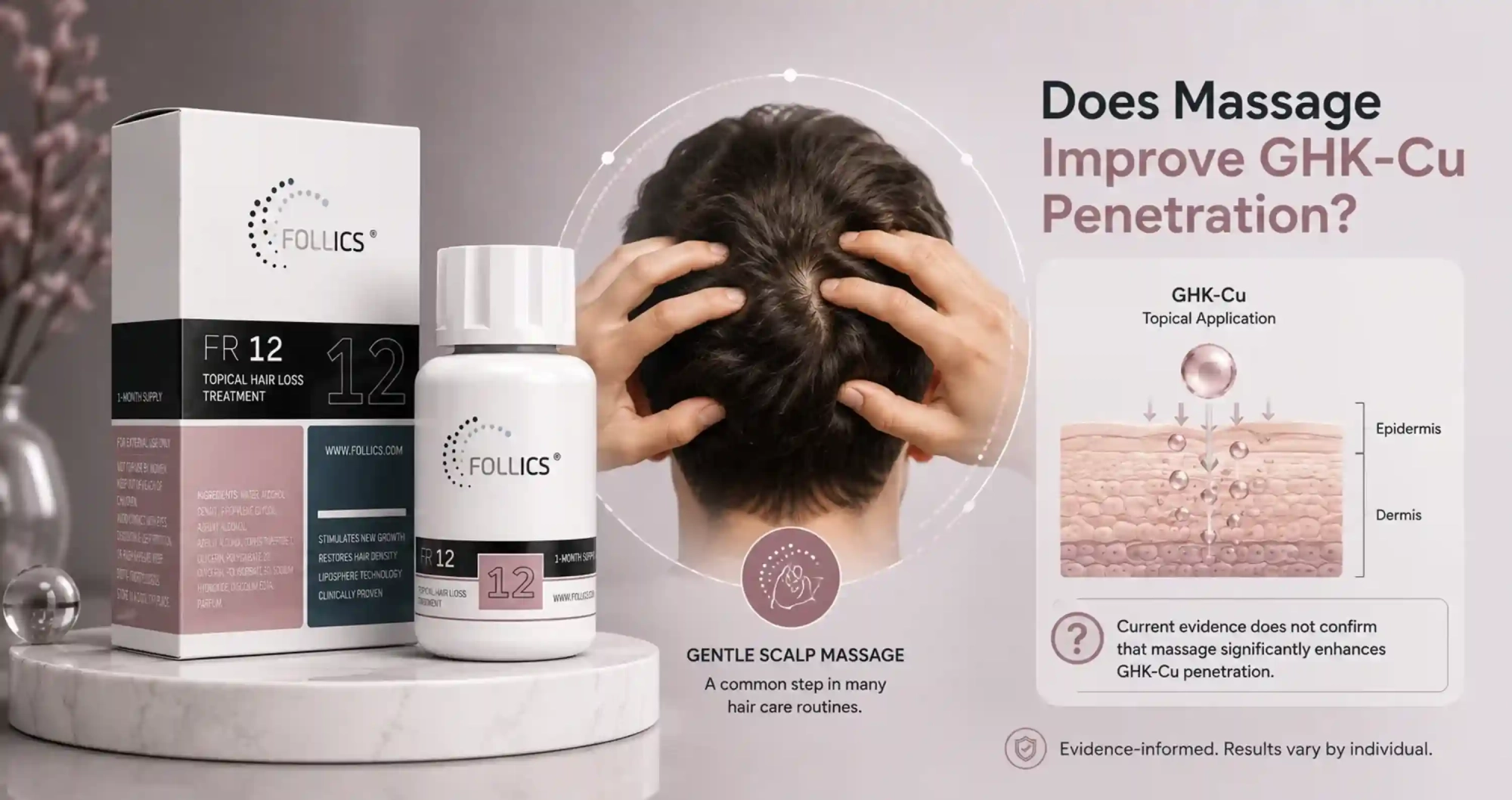
The manufacturer directs massage for two to four minutes. (follics.com)
Massage may help spread the product over the scalp.
It does not prove:
- Increased peptide absorption
- Deeper liposphere penetration
- Greater hair growth
- Improved blood-vessel formation
- Better finasteride delivery
The website should describe massage as an application and distribution step.
Can FR12 Be Used After Microneedling?
Do not apply FR12 immediately after microneedling without explicit professional guidance.
A GHK-Cu delivery study used microneedles specifically because intact-skin penetration was challenging. That does not make unsupervised microneedling plus FR12 appropriate. (PubMed)
Microneedling may change exposure to:
- Minoxidil 12%
- Finasteride
- Alfatradiol
- Retinol
- GHK-Cu
- Azelaic acid
- Vehicle ingredients
This may increase:
- Burning
- Inflammation
- Systemic exposure
- Pregnancy-transfer risk
- Cardiovascular effects
- Unpredictable dosing
Can FR12 Be Applied to Broken or Inflamed Skin?
No routine use should be advised on:
- Open wounds
- Bleeding scalp
- Infection
- Severe dermatitis
- Active psoriasis flare
- Painful folliculitis
- Sunburn
- Fresh transplant sites
GHK-Cu’s wound-repair research does not transform FR12 into a wound treatment.
The product contains high-strength minoxidil, finasteride and several additional actives.
Pregnancy and Household Transfer
FR12 contains finasteride.
Pregnant individuals should not apply or contact wet finasteride-containing treatment because of the potential effect on male fetal development.
Practical precautions include:
- Wash hands thoroughly.
- Clean beneath fingernails.
- Wipe forehead run-off.
- Allow the scalp to dry.
- Avoid shared wet towels.
- Avoid contact with wet treated hair.
- Clean spills.
- Keep the pump away from children.
- Seek professional advice after pregnancy-related exposure.
GHK-Cu does not reduce or neutralise finasteride’s pregnancy precautions.
Cardiovascular Warnings
FR12 contains high-strength minoxidil.
Standard topical-minoxidil warning signs include:
- Chest pain
- Rapid heartbeat
- Dizziness
- Faintness
- Sudden unexplained weight gain
- Swelling of the hands or feet
- Persistent scalp irritation
- Unwanted facial hair
The FR12 copper peptide GHK Cu scalp-support rationale does not reduce these warning categories.
Sexual and Psychiatric Warnings
Finasteride exposure may be associated with:
- Reduced libido
- Erectile difficulty
- Ejaculation changes
- Testicular discomfort
- Mood changes
- Depression
- Suicidal thoughts
The exact FR12 systemic exposure and adverse-event frequency are not displayed publicly.
Topical use must not be described as risk free.
Local Reactions
FR12 may cause:
- Burning
- Stinging
- Redness
- Itching
- Dryness
- Scaling
- Contact dermatitis
- Follicular bumps
- Changes in hair feel
- Unwanted facial hair
Possible triggers include:
- Minoxidil
- Finasteride
- Retinol
- Azelaic acid
- GHK-Cu
- Solvents
- Preservatives
- Other supporting ingredients
A copper peptide should not be assumed to soothe every scalp reaction.
Is Copper Allergy Possible?
Copper-related skin reactions are considered uncommon, but any complete topical formula can cause irritation or allergy.
A user should discontinue use and obtain assessment after:
- Significant swelling
- Widespread rash
- Persistent burning
- Blistering
- Wheezing
- Facial swelling
- Difficulty breathing
The exact FR12 allergy rate is unknown.
Does GHK-Cu Make FR12 Suitable for Sensitive Scalps?
No.
FR12 contains:
- High-strength minoxidil
- Finasteride
- Alfatradiol
- Retinol
- Azelaic acid
- Multiple delivery components
Even where GHK-Cu has anti-inflammatory rationale, the complete formula may still irritate.
Use:
GHK-Cu adds a scalp-support concept.
Do not use:
GHK-Cu makes FR12 gentle or non-irritating.
Who May Research FR12?
FR12 may be researched by an adult who:
- Has diagnosed androgenetic alopecia
- Has reviewed standard minoxidil options
- Understands the high-strength formula
- Understands that GHK-Cu is a supporting ingredient
- Can apply five pumps twice daily
- Can leave it on for four hours
- Can prevent finasteride transfer
- Can monitor cardiovascular, sexual, mood and scalp symptoms
- Will not combine overlapping treatments casually
- Has realistic expectations
This is not an individual recommendation.
Who Should Not Self-Select FR12?
Professional assessment is particularly important when:
- Hair loss is sudden
- Hair loss is patchy
- The diagnosis is uncertain
- The scalp is painful or inflamed
- Smooth or scarred areas are visible
- The user is under 18
- Pregnancy exposure is possible
- Heart disease is present
- Blood-pressure medicines are used
- Sexual or fertility concerns are present
- Depression or suicidal thoughts are relevant
- Another minoxidil or finasteride product is used
- Microneedling is part of the routine
Evidence Hierarchy for GHK-Cu in FR12
Level 1 — Strongest
Randomised clinical trial of complete FR12
Level 2
FR12 with GHK-Cu versus FR12 without GHK-Cu
Level 3
Human scalp penetration and follicular-deposition study
Level 4
Human trial of topical GHK-Cu for androgenetic alopecia
Level 5
Ex vivo human hair-follicle studies of GHK-Cu
Level 6
Related AHK-Cu human-follicle laboratory research
Level 7
Peptide-copper animal hair studies
Level 8
GHK-Cu skin-remodelling and wound-repair research
Level 9
Manufacturer ingredient claims
Level 10 — Weakest
Testimonials and edited before-and-after images
The current evidence position is:
- GHK-Cu has meaningful skin and tissue-repair research interest.
- Direct human hair-loss trials remain limited.
- A frequently cited follicle study used AHK-Cu rather than GHK-Cu.
- Peptide-copper hair findings include animal and laboratory evidence.
- Topical GHK-Cu penetration can be challenging.
- The FR12 concentration is undisclosed.
- No exact FR12 trial isolating GHK-Cu is displayed.
- The UAE FR12 listing currently has no customer reviews. (PubMed)
Questions to Ask About FR12 Copper Peptide GHK Cu Before Buying
- Does the physical label list GHK-Cu?
- What is the GHK-Cu concentration?
- How many micrograms or milligrams are delivered per pump?
- Is GHK-Cu encapsulated?
- What is the peptide-to-copper ratio?
- Has the peptide’s stability been tested through expiry?
- Has scalp penetration been measured?
- Has follicular deposition been measured?
- Has complete FR12 been clinically studied?
- Has FR12 been tested without GHK-Cu as a comparator?
- Does current stock contain minoxidil base or minoxidil sulphate?
- Is the minoxidil percentage w/v or w/w?
- What is the finasteride concentration?
- What is the alfatradiol concentration?
- Does FR12 contain Procapil, Follicusan or both?
- Does it contain Procyanidin B2?
- Does it contain beta-sitosterol?
- What is the bottle volume?
- How much do five pumps deliver?
- Is five pumps the total scalp dose?
- What is the maximum daily application?
- What pregnancy-transfer warning applies?
- What cardiovascular warning appears?
- What sexual and psychiatric warnings appear?
- What is the UAE regulatory classification?
Frequently Asked Questions
What is GHK-Cu?
GHK-Cu is a copper complex of the tripeptide glycine-histidine-lysine. It has been studied mainly for tissue-repair, matrix-remodelling, antioxidant and anti-inflammatory pathways. (PMC)
Why Is FR12 Copper Peptide GHK Cu Included?
It is included as a supporting ingredient intended to promote tissue repair, follicular strength and a healthier scalp environment. These are manufacturer and mechanism-level claims rather than proof of independent FR12 hair regrowth. (follics.com)
Is GHK-Cu the main active ingredient in FR12?
No. FR12’s primary pharmaceutical actives include high-strength minoxidil and finasteride, with alfatradiol also targeting androgen-related pathways.
Does GHK-Cu block DHT?
No. It is not an established 5-alpha-reductase inhibitor like finasteride.
Is GHK-Cu the same as finasteride?
No. They have completely different mechanisms.
Is GHK-Cu the same as minoxidil?
No. GHK-Cu is a copper peptide, while minoxidil is a pharmaceutical hair-growth active.
Is GHK-Cu proven to regrow hair?
Copper peptides have promising laboratory and animal findings, but robust clinical evidence for topical GHK-Cu in androgenetic alopecia remains limited.
Was GHK-Cu tested on human hair follicles?
A commonly cited human-follicle study evaluated AHK-Cu, not the exact GHK-Cu peptide listed in FR12. (PubMed)
What did the AHK-Cu study find?
The study reported increased elongation of isolated human hair follicles and effects on dermal-papilla-cell proliferation and apoptosis-related pathways. It was not a clinical FR12 trial. (PubMed)
Have copper peptides grown hair in animals?
Peptide-copper complexes have shown hair-follicle-stimulating properties in mouse research. Animal findings cannot establish FR12 efficacy in humans. (PubMed)
Does GHK-Cu stimulate collagen?
Research reviews associate GHK-Cu with collagen and extracellular-matrix regulation, mainly in laboratory and preclinical contexts. (PMC)
Does more scalp collagen mean more hair?
Not automatically. Hair growth depends on many biological pathways, and abnormal collagen can also be involved in scarring.
Is GHK-Cu anti-inflammatory?
Laboratory and preclinical literature describes anti-inflammatory activity. Exact FR12 clinical anti-inflammatory effects have not been established. (PMC)
Is GHK-Cu an antioxidant?
It has been researched in antioxidant and oxidative-stress pathways. This does not prove that FR12 prevents oxidative hair loss.
Does GHK-Cu increase scalp blood flow?
Angiogenesis-related effects appear in tissue-repair research, but FR12-specific scalp-blood-flow measurements are not displayed.
Does GHK-Cu improve minoxidil absorption?
No direct public evidence shows that GHK-Cu improves minoxidil absorption.
Does FR12 use liposphere technology?
Yes, according to the manufacturer. Public particle-size and human follicular-deposition data are not displayed. (follics.com)
Is GHK-Cu easy to absorb through skin?
A delivery study described skin penetration as challenging because of GHK-Cu’s hydrophilic nature and investigated microneedles to improve delivery. (PubMed)
Does microneedling make FR12 work better?
That has not been established and may increase exposure to high-strength minoxidil, finasteride and other actives. Do not combine them without explicit professional guidance.
What is the GHK-Cu concentration in FR12?
The reviewed public pages do not disclose it.
How many pumps of FR12 are used?
The official direction states five pumps twice daily. (follics.com)
Do five pumps equal one millilitre?
The reviewed public pages do not confirm this.
How long should FR12 remain on the scalp?
The current direction states four or more hours. (follics.com)
Can using more FR12 improve GHK-Cu delivery?
No. The manufacturer states that using more than directed will not increase effectiveness. (follics.com)
Can FR12 be used on broken skin?
No routine use should be advised on broken, bleeding, infected or significantly inflamed scalp.
Can FR12 be used during pregnancy?
It should not be promoted for pregnancy because it contains finasteride and high-strength minoxidil.
Can pregnant women touch wet FR12?
Pregnant individuals should avoid contact with wet finasteride-containing treatment and obtain professional advice after accidental exposure.
Can FR12 cause heart symptoms?
Its minoxidil content means chest pain, rapid heartbeat, dizziness, faintness, swelling and unexplained weight gain require medical review.
Can FR12 cause sexual side effects?
Systemic finasteride exposure is possible. The exact adverse-effect rate from FR12 is unknown.
Can GHK-Cu prevent finasteride side effects?
No.
Is FR12 suitable for sensitive scalp because it contains GHK-Cu?
No. The complete formula contains multiple ingredients capable of causing irritation.
Is FR12 clinically proven as a finished formula?
The reviewed public pages do not present a controlled clinical trial of the exact finished FR12 product.
Does FR12 contain minoxidil sulphate or Minoxidil USP?
The official page says Minoxidil USP, while the UAE page says Minoxidil Sulphate. The physical label must resolve the discrepancy. (follics.com)
How should FR12 be stored in Dubai?
Store it around 20°C to 25°C with the container closed and protect it from direct sunlight and excessive heat. (follics.com)
Final Perspective
FR12 copper peptide GHK Cu is included for a reasonable biological purpose:
GHK-Cu
↓
Copper-binding peptide
↓
Tissue-remodelling,
antioxidant and inflammatory pathways
↓
Potential scalp-support role
That pathway is different from:
Minoxidil
↓
Primary hair-growth stimulation
and:
Finasteride
↓
Reduced DHT production
The strongest reasons for including GHK-Cu are:
- Its tissue-repair research
- Its extracellular-matrix rationale
- Its antioxidant and inflammatory-pathway activity
- Related copper-peptide follicle research
- Potential support for the living tissue around viable follicles
The main limitations are:
- FR12 does not disclose the GHK-Cu concentration.
- Direct human hair-loss trials are limited.
- A commonly cited human-follicle study used AHK-Cu.
- Mouse copper-peptide findings are not clinical FR12 proof.
- Skin penetration can be challenging.
- Liposphere delivery has not been publicly quantified.
- FR12’s complex formula prevents assigning outcomes to GHK-Cu.
- The manufacturer and UAE pages conflict on parts of the formula.
- GHK-Cu does not remove minoxidil, finasteride or pregnancy-related risks.
The strongest potential buyer fit is an adult who:
- Has diagnosed androgenetic alopecia
- Understands FR12’s primary pharmaceutical actives
- Views GHK-Cu as a supporting ingredient
- Can follow five pumps twice daily
- Can maintain a four-hour leave-in window
- Can prevent household transfer
- Can monitor cardiovascular, sexual, mood and scalp symptoms
- Will not apply it to damaged skin
- Will not combine microneedling casually
- Has realistic expectations
The responsible conclusion is:
Copper Peptide GHK-Cu gives FR12 a plausible tissue-repair and scalp-support angle. Current evidence does not establish that the undisclosed GHK-Cu dose independently regrows hair, enhances FR12’s pharmaceutical actives or reaches the follicle in a clinically proven amount. It should be positioned as a complementary ingredient—not the main reason FR12 may affect androgenetic hair loss.
CTA: Review the current Follics FR12, compare its primary pharmaceutical pathways through the Finasteride vs Minoxidil guide and use the Complete Hair-Loss Action Plan before choosing a high-strength multi-active formula.