
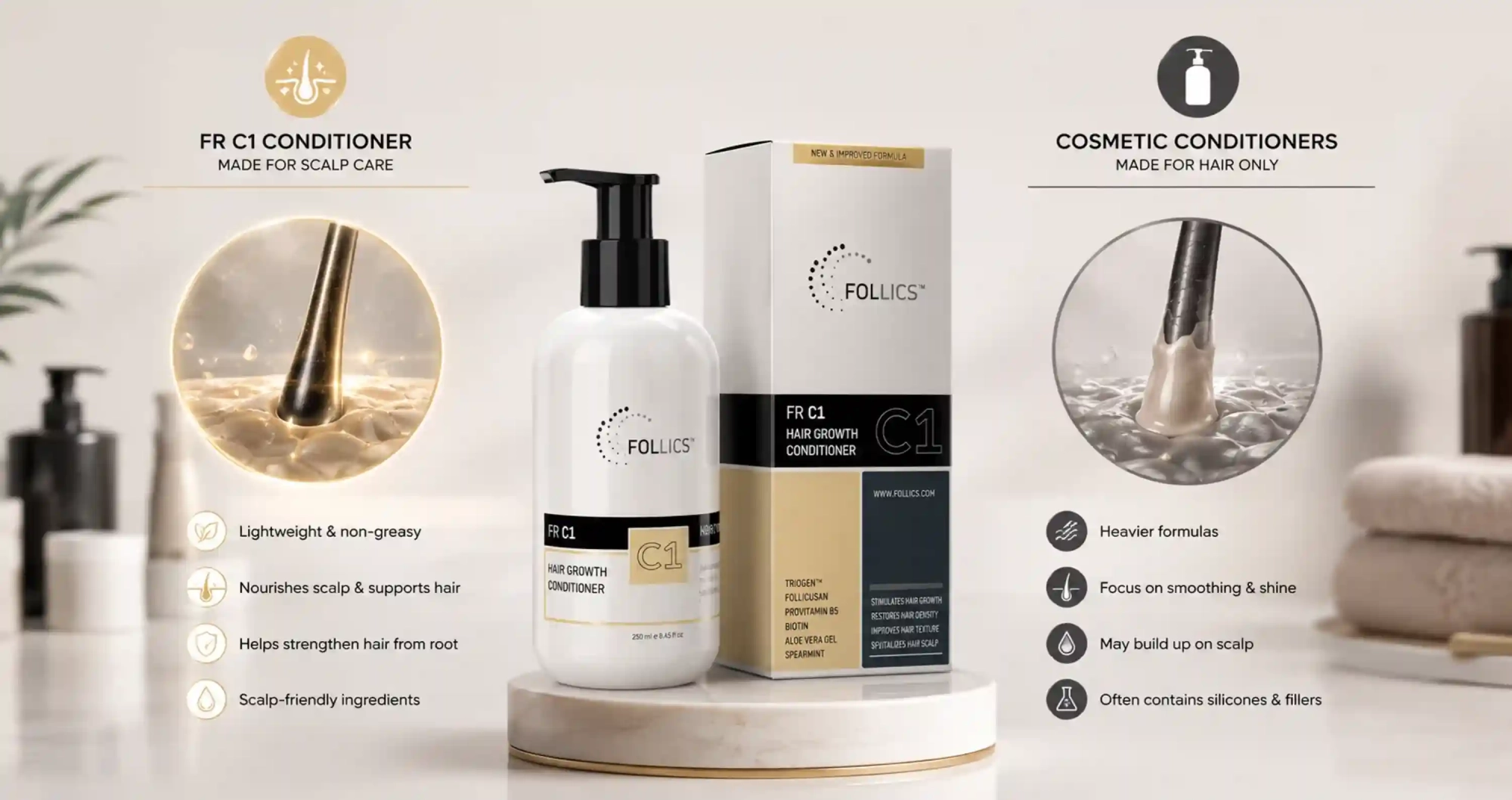
The FR C1 conditioner on scalp instruction is intentional: Follics tells users to apply the product directly to the scalp, massage it into the skin and hair for one to two minutes, then rinse it out. That makes FR C1 different from many ordinary cosmetic conditioners, which are generally used mainly on the mid-lengths and ends to smooth the hair shaft and reduce friction.
This does not mean one method is universally correct and the other is universally wrong.
The correct application area depends on:
- Product design
- Complete formula
- Scalp type
- Hair texture
- Rinse instructions
- Individual tolerance
- Reason for use
Direct Answer
Yes, FR C1 conditioner on scalp use is intentional.
Its official direction specifically says:
- Apply to the scalp
- Massage into the skin
- Massage through the hair
- Continue for one to two minutes
- Rinse out
However, the FR C1 conditioner on scalp instruction applies specifically to FR C1.
It should not be converted into:
Every conditioner should be massaged into the scalp.
Unlike FR C1 conditioner on scalp use, many standard conditioners are designed primarily to coat and smooth the hair shaft. Dermatology guidance commonly recommends applying conventional conditioner mainly to the ends, particularly where placing it on the scalp makes fine or oily hair appear greasy.
Why Ordinary Conditioner Is Often Applied to the Lengths
A conventional rinse-out conditioner commonly helps by:
- Coating the hair shaft
- Reducing friction
- Improving combing
- Reducing tangles
- Limiting mechanical breakage
- Smoothing the cuticle
- Reducing frizz
- Improving shine
The NHS explains that conditioner protects hair by coating the shaft and creating a smoother surface, which reduces friction, breakage, frizz and split ends. The American Academy of Dermatology similarly recommends conditioner to reduce breakage in fragile or thinning hair.
These are primarily hair-fibre benefits.
They do not require every ordinary conditioner to be rubbed into scalp skin.
Why FR C1 Is Labelled Differently
The FR C1 conditioner on scalp routine is positioned as both:
- A rinse-out hair conditioner
- A short-contact scalp-conditioning product
Its highlighted complexes are marketed toward scalp and follicular biology rather than only cosmetic hair softness.
The intended pathway is:
FR C1 on hair lengths
↓
Conditioning and reduced friction
FR C1 on scalp
↓
Short contact with the supporting complexes
After 1–2 minutes
↓
Complete rinse
FR C1 conditioner on scalp use remains a rinse-out routine.
FR C1 is not:
- A scalp serum
- A leave-on medicine
- A minoxidil replacement
- A finasteride replacement
- A moisturiser that should remain overnight
- A clinically proven treatment for every alopecia
FR C1 Versus a Standard Cosmetic Conditioner
| Factor | FR C1 | Typical cosmetic rinse-out conditioner |
| Main marketed purpose | Scalp and hair conditioning with anti-thinning support | Hair softness, detangling and manageability |
| Official application area | Scalp skin and hair | Commonly mid-lengths and ends |
| Contact time | 1–2 minutes | Follow individual label |
| Rinse required | Yes | Usually yes |
| Leave-in use | No | No, unless specifically formulated as leave-in |
| Highlighted complexes | Trichogen, Follicusan, Pronalen | Formula dependent |
| Complete INCI publicly available | Not on reviewed pages | Formula dependent |
| Finished-product hair-growth trial shown | No | Usually not relevant |
| Risk of scalp residue | Possible | Possible |
| Risk of irritation | Possible | Possible |
FR C1 conditioner on scalp use is rinse-out, and rinse-out and leave-in conditioners use different chemistry and should not be interchanged. Dermatologists warn that leaving a rinse-out conditioner in the hair can cause damage or irritation because it was formulated to be removed.
What “Drug Free” Means Here
FR C1’s official page calls it drug free.
In this context, that means the highlighted formula does not list established pharmaceutical hair-loss medicines such as:
- Minoxidil
- Finasteride
- Dutasteride
- Bimatoprost
- Spironolactone
“Drug free” does not mean:
- Side-effect free
- Allergy free
- Fragrance free
- Interaction free
- Clinically proven
- Suitable for every scalp
- Safe to leave on overnight
- Able to stop androgenetic alopecia
What Trichogen Contributes
Follics positions Trichogen as a complex intended to:
- Support hair strength
- Improve scalp condition
- Reduce the appearance of hair loss
- Support growth-related pathways
The public FR C1 page does not disclose:
- Exact Trichogen grade
- Percentage in FR C1
- Amount per application
- Rinse-off deposition
- A complete-FR-C1 comparator trial
Ingredient-level supplier or manufacturer research cannot establish that one-to-two-minute FR C1 application produces the same outcome as a separate leave-on Trichogen study.
What Follicusan Contributes
The retailer describes Follicusan as a milk-based bioactive containing signalling molecules intended to influence dermal-papilla cells and hair-protein synthesis.
The public product information does not provide:
- Follicusan concentration
- Exact material grade
- Milk-protein residue
- Allergen statement
- Penetration into human scalp
- Finished-product hair-count results
People with a severe milk-protein allergy should verify the physical ingredient panel and allergen information before scalp application.
What Pronalen Fibro-Actif Contributes
Follics markets Pronalen Fibro-Actif around cellular-energy, collagen, elastin and glycosaminoglycan pathways.
The ingredient supplier describes one Pronalen Fibro-Actif material as containing soybean and wheat-germ extracts and positions it for hair-conditioning and hair-loss-related cosmetic claims. The exact grade and concentration used in FR C1 are not disclosed publicly.
Do not convert this into:
- Proven increased scalp oxygenation
- Proven new-follicle formation
- Guaranteed collagen growth
- A treatment for scarring alopecia
- A clinically proven FR C1 regrowth result
Biotin in a Rinse-Out Conditioner
Biotin appears on the current FR C1 package and official page.
Its presence does not prove that one-to-two-minute scalp application:
- Corrects systemic biotin deficiency
- Increases blood biotin
- Reverses androgenetic alopecia
- Creates new follicles
- Replaces an oral deficiency treatment
Biotin should be described as a supporting cosmetic ingredient unless product-specific evidence establishes more.
Lavender and Spearmint
Lavender and spearmint appear in the highlighted product formula and on current packaging.
They may provide:
- Fragrance
- Sensory freshness
- Cosmetic scalp feel
- Botanical positioning
They may also irritate a susceptible scalp.
Fragrances, preservatives and other cosmetic ingredients are recognised triggers of allergic or irritant contact dermatitis in some people.
Do not claim that lavender or spearmint:
- Guarantees scalp soothing
- Treats dermatitis
- Blocks DHT
- Produces new hair growth
- Is safe for every sensitive scalp
Why the Complete INCI Matters
For FR C1 conditioner on scalp use, a key-active list is not the same as a complete formula.
The physical product should disclose:
- Water and base ingredients
- Conditioning agents
- Cationic surfactants
- Fatty alcohols
- Silicones, where present
- Humectants
- Emollients
- Fragrance
- Preservatives
- Colourants
- pH adjusters
- Botanical extracts
- Allergens
- The three proprietary complexes
Without the full INCI, buyers cannot verify claims such as:
- Silicone free
- Fragrance free
- Non-comedogenic
- Hypoallergenic
- Suitable for eczema
- Safe for severe food allergy
- Suitable after hair transplantation
How to Apply FR C1 Correctly
Step 1: Complete the Shampoo Step
The official system directs users to apply FR C1 directly after Follics FR S1 Shampoo. FR S1 should first be rinsed out completely.
Do not place conditioner over active shampoo foam.
Step 2: Remove Excess Running Water
The official direction does not say to towel-dry.
A practical approach is to let excess water drain so that the conditioner is not immediately washed away or excessively diluted.
Do not rub the scalp aggressively with a towel.
Step 3: Use the Physical Label’s Amount
The reviewed public pages do not provide:
- Pump count
- Millilitres
- Grams
- Coin-sized amount
- Walnut-sized amount
- Different amounts by hair length
Do not invent a dose.
Step 4: Distribute Across the Intended Scalp Areas
For FR C1 conditioner on scalp use, part thick hair where necessary so that product reaches the scalp rather than remaining only on the surface of the hair.
Apply gently to:
- Crown
- Mid-scalp
- Part line
- Hair-bearing frontal scalp
- Dry or tight-feeling scalp zones
Avoid:
- Eyes
- Eyelids
- Broken skin
- Actively infected areas
- Freshly microneedled scalp
- Fresh transplant grafts
Step 5: Massage Into Skin and Hair
Use fingertip pads rather than fingernails.
The goal is:
- Even distribution
- Scalp contact
- Hair-length conditioning
The manufacturer’s direction does not prove that vigorous massage increases penetration or blood flow.
Step 6: Continue for One to Two Minutes
The official FR C1 conditioner on scalp contact time is one to two minutes.
Do not extend it to:
- Five minutes
- Ten minutes
- Thirty minutes
- Overnight
without specific product guidance.
Step 7: Rinse Thoroughly
After FR C1 conditioner on scalp use, continue rinsing until obvious residue is removed.
Incomplete rinsing may contribute to:
- Greasy roots
- Flat-looking hair
- Scalp buildup
- Hairline bumps
- Itching
- Fragrance irritation
Step 8: Style Gently
After rinsing:
- Avoid aggressive towel rubbing
- Use a wide-tooth comb where needed
- Reduce excessive heat
- Avoid pulling fragile wet hair
Conditioner can reduce friction and breakage, but it cannot prevent damage from every styling practice.
Should FR C1 Be Applied to Every Part of the Scalp?
The FR C1 conditioner on scalp direction does not publish a zone-by-zone application map.
A sensible approach is to distribute it evenly rather than concentrating a heavy layer in one area.
Do not use extra conditioner only on:
- The hairline
- One temple
- A smooth bald patch
- An inflamed patch
- A transplant site
because no evidence shows that a larger amount creates better follicular results.
Should It Go on the Hair Lengths Too?
Yes.
The official direction says to massage it into the skin and hair.
Hair-length application may support:
- Detangling
- Softness
- Reduced friction
- Better manageability
- Reduced mechanical breakage
It is inaccurate to describe FR C1 conditioner on scalp use as a scalp-only routine because the product is also applied to the hair.
Can It Make Fine Hair Look Flat?
Possibly.
Any conditioner can weigh down fine hair when:
- Too much is applied
- The roots are not rinsed thoroughly
- The base is too rich for the hair type
- Styling products are layered afterward
The public product information does not provide controlled volume or weight testing across fine, thick, straight and curly hair.
Fine-haired users should follow the minimum labelled amount once confirmed and evaluate the result after full rinsing.
Can It Make an Oily Scalp Greasier?
Possibly.
Cleveland Clinic advises that conventional conditioner applied to the scalp can make hair look greasy, although FR C1 is specifically designed for scalp contact.
The FR C1 conditioner on scalp instruction does not guarantee that every oily scalp will prefer the formula.
Watch for:
- Faster root oiliness
- Flatness
- Wax-like residue
- Increased itching
- Hairline bumps
- A coated feeling
Can Conditioner Cause Scalp Buildup?
Yes.
With FR C1 conditioner on scalp use, conditioner and styling-product residue may accumulate when products are overused or not rinsed thoroughly.
Buildup does not prove:
- Follicles are blocked permanently
- Hair is suffocating
- Hair loss has accelerated
- A clarifying shampoo is always required
It means the product amount, rinse quality and routine may need review.
Can FR C1 Cause Hairline Acne?
Hair-care products, including conditioners, can cause acne-like bumps around the hairline, forehead and neck in susceptible people. The AAD calls this acne cosmetica.
Reduce risk by:
- Rinsing the hairline thoroughly
- Avoiding excess product
- Cleaning conditioner from the forehead
- Washing pillowcases
- Avoiding heavy overlapping styling products
Persistent bumps should be assessed rather than treated by increasing shampoo frequency.
FR C1 and Scalp Eczema
A hospital dermatology guide notes that conditioners are designed to adhere to hair and may irritate an eczematous scalp when residue remains.
Someone with active scalp eczema should not assume that FR C1 conditioner on scalp positioning guarantees suitability.
Seek advice after:
- Persistent redness
- Burning
- Weeping
- Crusting
- Severe itch
- Spreading rash
FR C1 and Dandruff
FR C1 is not currently presented as an antifungal or anti-dandruff medicine.
It should not replace a dandruff shampoo containing a recognised active such as:
- Ketoconazole
- Selenium sulphide
- Zinc pyrithione
- Salicylic acid
- Coal tar
when one is appropriate.
A conditioner may help offset dryness after a medicated shampoo, but FR C1 has no public finished-product trial proving treatment of dandruff or seborrhoeic dermatitis. Dermatologists advise following the exact directions of the selected dandruff shampoo because contact times and frequencies differ.
FR C1 and Psoriasis
Conditioner may improve hair softness and reduce dryness around a psoriasis routine, but it does not treat the underlying immune-mediated disease.
Do not apply it automatically over:
- Thick inflamed plaques
- Bleeding skin
- Cracked areas
- Secondary infection
Can It Replace Minoxidil?
No.
FR C1 does not publicly list minoxidil.
Its rinse-out conditioning complexes do not have the same pharmaceutical evidence, dosing or application time as topical minoxidil.
For a proper strength and safety comparison, use the cause-based hair-loss plan rather than replacing treatment with a conditioner.
Can It Replace Finasteride?
No.
FR C1 is drug free and does not publicly list finasteride.
It does not provide established 5-alpha-reductase inhibition or the evidence base of pharmaceutical finasteride.
Readers with DHT-driven pattern thinning should use the androgenetic alopecia treatment guide rather than expecting conditioner to control the complete condition.
Does FR C1 Make Minoxidil Absorb Better?
No public FR C1 study proves that it increases:
- Minoxidil penetration
- Follicular minoxidil concentration
- Minoxidil conversion
- Hair counts
- Response speed
After FR C1 conditioner on scalp use, the conditioner should be rinsed thoroughly before a measured leave-on treatment is applied.
Can a Leave-On Treatment Be Applied Immediately After FR C1?
Only after:
- FR C1 is fully rinsed.
- The scalp is dried according to the leave-on product’s instructions.
- There is no significant irritation.
- The measured medicine can reach the scalp accurately.
Do not apply a leave-on scalp treatment over:
- Conditioner foam
- Conditioner residue
- Wet scalp
- Active irritation
The FR S1 Pairing Conflict for Women
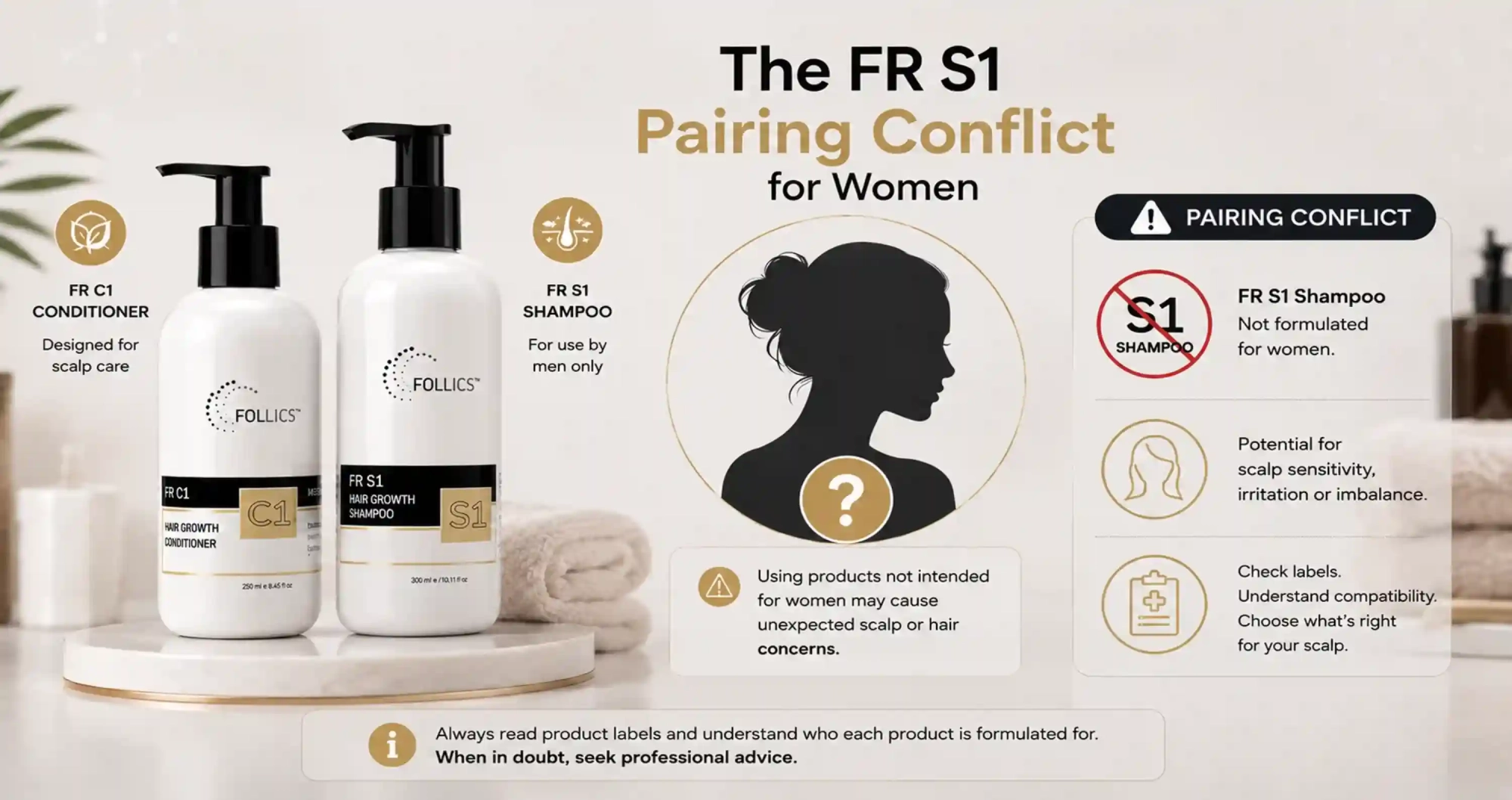
FR C1 is described by Follics as developed for men and women.
However, its directions specify following FR S1, while current official FR S1 packaging clearly says “Not for Women.”
The manufacturer must clarify:
- Whether women can use FR C1 independently
- Whether it can follow another shampoo
- Whether the paired system is men only
- Whether different market formulations exist
Until clarified, women should not assume that the FR S1–FR C1 paired routine is appropriate merely because FR C1 itself is described for both sexes.
Daily Use Requires Clarification
The official FR C1 page says it was developed for daily use.
Its directions also tie it directly to FR S1, whose publicly available page does not provide a clear daily-use frequency.
The website should clarify whether FR C1 is intended:
- After every FR S1 wash
- Daily after any shampoo
- Only on selected wash days
- Independently of FR S1
“Developed for daily use” does not obligate every user to shampoo and condition daily.
Hair-washing frequency should match:
- Hair texture
- Scalp oiliness
- Activity
- Scalp disease
- Styling routine
- Product tolerance
Pregnancy and Breastfeeding
FR C1 is drug free and marketed for men and women, but the reviewed public pages do not provide product-specific:
- Pregnancy testing
- Breastfeeding guidance
- Lavender concentration
- Spearmint concentration
- Full allergen information
- Complete ingredient panel
Do not use:
- Pregnancy safe
- Breastfeeding safe
- Hormone free
without current label or professional confirmation.
Hair Transplant Use
Do not use FR C1 conditioner on scalp over fresh transplant grafts without surgeon approval.
Timing depends on:
- Graft stability
- Crust resolution
- Wound healing
- Shampoo permissions
- Massage restrictions
- Ingredient sensitivity
There is no public FR C1 post-transplant protocol.
Microneedling
Do not use FR C1 conditioner on scalp immediately after microneedling or on bleeding or significantly inflamed skin.
Microneedling may increase exposure to:
- Fragrance
- Botanical extracts
- Preservatives
- Proprietary complexes
- Conditioning agents
A drug-free conditioner is not automatically safe on a disrupted skin barrier.
Allergy and Irritation Precautions
Stop use and seek assessment after:
- Persistent burning
- Widespread redness
- Swelling
- Blistering
- Severe itching
- Weeping skin
- Facial swelling
- Breathing difficulty
Breathing difficulty or facial and throat swelling requires urgent medical attention.
UAE Heat and Humidity Routine
UAE conditions can influence how a scalp conditioner feels because users may experience:
- More sweating
- More frequent washing
- Headwear occlusion
- Greater product layering
- Faster root oiliness
- Air-conditioning-related dryness
A practical routine is:
Wash according to scalp and hair needs
↓
Rinse shampoo completely
↓
Apply FR C1 as labelled
↓
Massage for 1–2 minutes
↓
Rinse thoroughly
↓
Dry scalp before headwear
↓
Apply leave-on treatment only after full drying
Do not compensate for sweating by:
- Applying extra conditioner
- Leaving it on longer
- Using it as a leave-in
- Combining several scalp conditioners
- Shampooing aggressively multiple times daily
Who May Find FR C1 Useful?
FR C1 conditioner on scalp use may appeal to someone who:
- Wants a conditioner labelled for scalp and hair
- Uses the paired Follics routine appropriately
- Has fragile or tangling hair
- Wants reduced friction after shampooing
- Accepts a drug-free supportive product
- Understands that it is rinse out
- Can tolerate lavender and spearmint
- Has checked the complete physical label
- Has realistic hair-growth expectations
Who Should Use Extra Caution?
Assessment is sensible where:
- Scalp eczema is active
- Psoriasis is flaring
- Folliculitis is present
- Hairline acne occurs easily
- A severe milk, soy or wheat allergy is relevant
- Fragrance allergy is known
- The scalp is broken
- Microneedling was recently performed
- Hair transplantation is recent
- Pregnancy or breastfeeding is relevant
- Sudden or patchy hair loss is occurring
Evidence Hierarchy for FR C1
Level 1 — Strongest
Randomised controlled trial of complete FR C1
Level 2
FR C1 versus identical conditioner without active complexes
Level 3
Human scalp-deposition and rinse-off study
Level 4
Clinical study using the same ingredient concentrations
and one-to-two-minute contact
Level 5
Human studies of the individual proprietary complexes
Level 6
Supplier in vitro or ex vivo ingredient data
Level 7
General evidence for conditioner reducing hair friction
Level 8
Manufacturer finished-product claims
Level 9 — Weakest
Testimonials and retailer timelines
The current evidence position is:
- FR C1 is specifically directed onto the scalp and hair for one to two minutes.
- Its packaging shows a 250 ml rinse-out conditioner with six highlighted ingredients or complexes.
- General conditioners can reduce friction, breakage and tangling.
- Standard conditioners are often applied mainly to hair lengths to avoid greasy roots.
- Scalp application can cause irritation, residue or acne in susceptible users.
- No exact FR C1 randomised hair-growth trial is displayed publicly.
- Ingredient concentrations and full INCI are not displayed.
- The current UAE product page has no customer reviews.
Questions to Ask Before Buying FR C1
- Does the current bottle confirm 250 ml?
- Does the physical label say apply to scalp and hair?
- Is the correct contact time one to two minutes?
- How many pumps should be used?
- What is the full INCI?
- What is the Trichogen concentration?
- Which Trichogen grade is used?
- What is the Follicusan concentration?
- Is Follicusan milk derived?
- Does finished FR C1 contain residual milk protein?
- What Pronalen Fibro-Actif grade is used?
- Does that material contain soy or wheat-derived ingredients?
- What is the biotin concentration?
- What is the lavender concentration?
- What is the spearmint concentration?
- Does the formula contain fragrance?
- Does it contain silicones?
- Does it contain sulfates?
- Does it contain parabens?
- Does it contain phthalates?
- Has the complete product been clinically tested?
- Has scalp deposition been measured after rinsing?
- Can women use it without FR S1?
- Can it follow a different shampoo?
- What is the verified daily or weekly frequency?
- Is it suitable for eczema or psoriasis?
- What pregnancy guidance applies?
- Can it be used after hair transplantation?
- Can it be used after microneedling?
- What is its UAE regulatory classification?
Frequently Asked Questions
Should conditioner touch the scalp?
It depends on the product. FR C1 conditioner on scalp use is specifically directed onto the scalp, skin and hair, while many ordinary conditioners are applied mainly to the lengths and ends.
Is FR C1 conditioner on scalp use correct?
Yes. The official Follics direction tells users to apply it to the scalp and massage it into the skin and hair for one to two minutes.
How long should FR C1 remain on the scalp?
FR C1 conditioner on scalp contact time is one to two minutes according to the current official directions.
Should FR C1 be left for three to five minutes?
No. That timing appears in an existing site review but conflicts with the current official one-to-two-minute direction.
Can FR C1 be left overnight?
No. It is a rinse-out conditioner.
Can FR C1 be used as a leave-in conditioner?
No. Rinse-out and leave-in conditioners are formulated differently.
Should FR C1 be applied to the hair lengths?
Yes. The official direction says to massage it into both the skin and hair.
Is FR C1 applied before or after shampoo?
After shampoo.
Which shampoo does Follics recommend before FR C1?
The official direction pairs it with FR S1 Shampoo.
How long should FR S1 remain on before FR C1?
The current FR S1 directions state three to four minutes before rinsing and following with FR C1.
Can FR C1 follow another shampoo?
The public direction specifically names FR S1. The manufacturer should clarify independent use before the website recommends other pairings.
Is FR C1 for men and women?
The official FR C1 page says it was developed for men and women.
Can women use FR S1 before FR C1?
Current FR S1 packaging says “Not for Women,” creating a pairing conflict that requires manufacturer clarification.
Is FR C1 a drug?
It is marketed as a drug-free conditioner.
Does FR C1 contain minoxidil?
Minoxidil is not listed among the highlighted FR C1 ingredients.
Does FR C1 contain finasteride?
Finasteride is not listed among the highlighted ingredients.
Does FR C1 contain caffeine?
Caffeine appears in an existing review but not in the current official headline formula or front package.
Does FR C1 contain copper peptides?
Copper peptides are not shown in the current verified key-active list.
Does FR C1 contain keratin?
Keratin is not shown in the current official key-active list.
What ingredients are highlighted?
Trichogen, Follicusan, Pronalen, biotin, lavender and spearmint are shown on current packaging.
What size is FR C1?
Current official images show 250 ml, approximately 8.4 fl oz.
Does FR C1 stop hair loss?
No controlled finished-product trial is displayed publicly proving that FR C1 stops hair loss.
Does FR C1 regrow hair?
Its complexes are marketed for anti-thinning support, but exact FR C1 clinical regrowth has not been established publicly.
Does FR C1 block DHT?
No verified pharmaceutical DHT-blocking ingredient is listed in FR C1.
Can FR C1 replace minoxidil?
No.
Can FR C1 replace finasteride?
No.
Does FR C1 improve minoxidil absorption?
No FR C1 study publicly demonstrates improved minoxidil absorption.
Can minoxidil be applied after FR C1?
Rinse FR C1 thoroughly and allow the scalp to dry according to the minoxidil product’s instructions before application.
Can FR C1 make roots greasy?
FR C1 conditioner on scalp use may make roots greasy if too much is used, the formula is too rich for the user or it is not rinsed thoroughly.
Can FR C1 cause scalp buildup?
Yes, as can other conditioners when overused or incompletely rinsed.
Can FR C1 cause acne around the hairline?
Hair products can contribute to acne cosmetica in susceptible users.
Is FR C1 suitable for oily scalp?
Possibly, but tolerance varies. The scalp should be monitored for greasiness, flatness, itching and bumps.
Is FR C1 suitable for dry scalp?
FR C1 conditioner on scalp use may provide conditioning, but dry scalp can have several causes and the product is not a treatment for every scalp disorder.
Is FR C1 suitable for eczema?
Not automatically. Conditioners and fragrance ingredients may irritate an eczematous scalp.
Is FR C1 suitable for dandruff?
It is not a verified antifungal or anti-dandruff medicine.
Is FR C1 suitable after microneedling?
Do not apply it to freshly microneedled or broken scalp without professional guidance.
Can FR C1 be used after a hair transplant?
Only after the surgeon confirms that scalp massage and the formula are appropriate.
Is FR C1 safe during pregnancy?
Product-specific pregnancy evidence and complete ingredient information are not publicly provided.
Is FR C1 FDA approved?
No. FDA facility registration is not finished-product approval.
Is FR C1 clinically proven?
Ingredient-level claims are presented, but a controlled trial of the complete finished FR C1 product is not displayed publicly.
Is FR C1 silicone free?
The full INCI is not publicly shown, so this should be verified on the physical label.
Is FR C1 fragrance free?
Lavender and spearmint are highlighted, and the complete fragrance composition is not published.
How should FR C1 be stored in Dubai?
The official direction says to keep it in a cool, dry place away from direct sunlight, freezing and excessive heat. Do not leave it inside a parked vehicle.
Final Perspective
FR C1 differs from many ordinary conditioners because its label intentionally includes scalp application:
Ordinary cosmetic conditioner
↓
Often focused on lengths and ends
↓
Softness, detangling and reduced friction
FR C1
↓
Applied to scalp skin and hair
↓
Massaged for 1–2 minutes
↓
Rinsed completely
The strongest verified reasons to consider it are:
- Product-specific scalp directions
- Short one-to-two-minute rinse-out routine
- Hair-length conditioning
- Three highlighted supporting complexes
- 250 ml pump format
- Drug-free positioning
- Intended use by men and women
Its important limitations are:
- No complete public INCI
- No active-complex concentrations
- No measured amount per application
- No exact finished-product clinical trial
- No public scalp-deposition study
- No proof that lipospheres reach the dermal papilla
- No evidence that it replaces minoxidil or finasteride
- Potential greasiness, irritation, buildup or hairline acne
- A pairing conflict between women’s FR C1 use and men-only FR S1 packaging
- Unsupported “first,” “only,” “pharmaceutical grade” and fixed-result claims on existing site content
The responsible conclusion is:
FR C1 should touch the scalp because the manufacturer specifically designed and labelled it for scalp-and-hair application. Massage it gently for one to two minutes and rinse it thoroughly. This product-specific direction does not mean every cosmetic conditioner should be applied to the roots, nor does scalp contact prove that FR C1 independently stops hair loss or produces new growth.
CTA: Review the current Follics FR C1 Conditioner, confirm the physical ingredient list and one-to-two-minute directions, and compare hair conditioners according to whether the product is designed for the scalp, hair lengths or leave-in use. Persistent or patterned thinning should follow a cause-based hair-loss plan rather than relying on conditioner alone.