
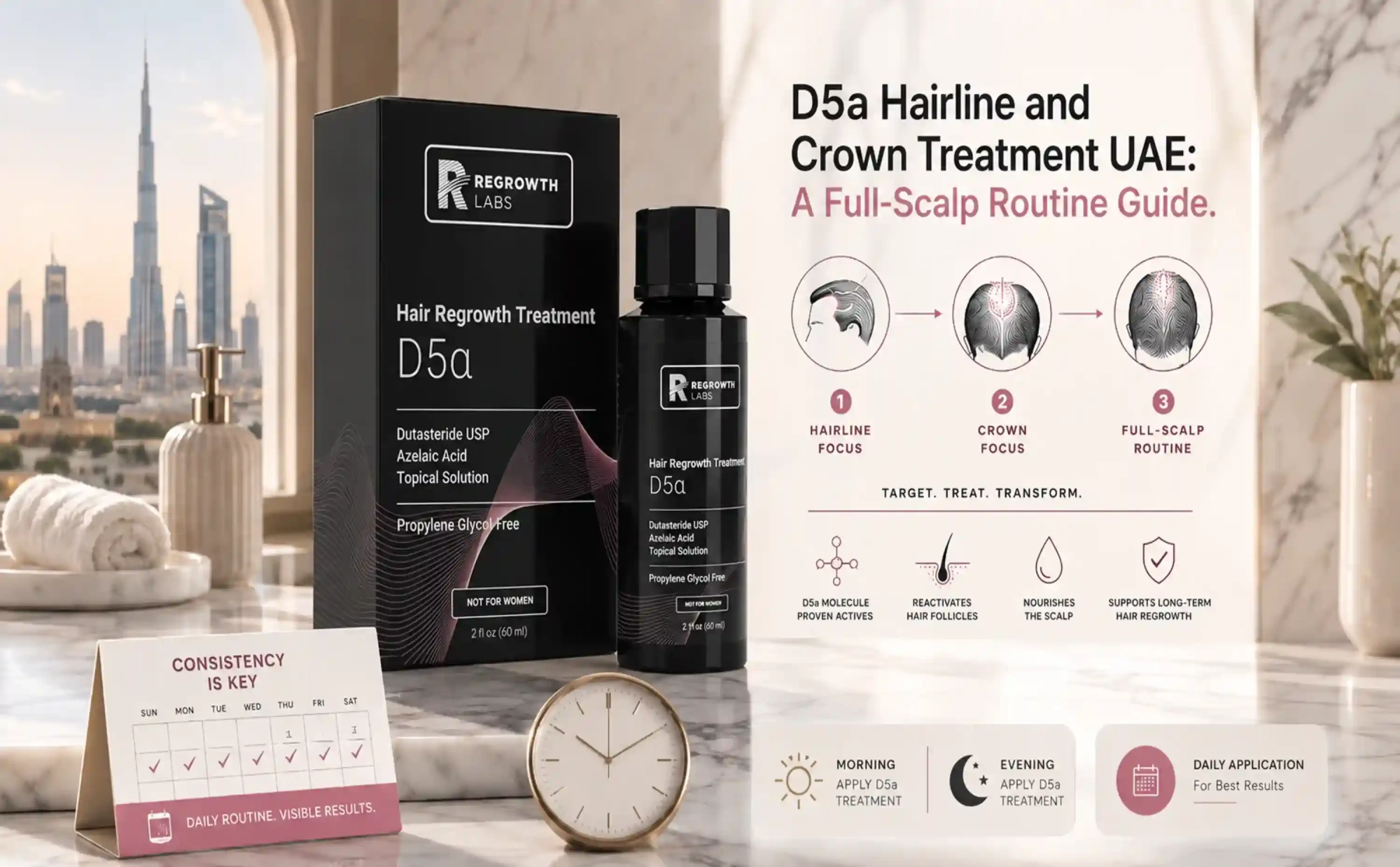
People researching D5a hairline and crown treatment UAE are usually dealing with more than one visible concern. The temples may be gradually receding, the frontal hairline may look less defined, or the crown may show more scalp under bright lighting. In many cases, more than one of these areas is changing at the same time.
D5a Hair Regrowth Treatment is listed by Hims n Hers UAE as a topical formula containing Dutasteride USP 0.5% and azelaic acid in a propanediol-based vehicle. Its product page positions the formula for use across the scalp, including both the frontal hairline and vertex or crown.
That positioning does not mean everyone with a receding hairline or visible crown should automatically use it.
The first step is determining whether the thinning is consistent with androgenetic alopecia, whether a DHT-targeting topical treatment is suitable, and whether the product can be incorporated into a safe and consistent routine.
Direct Answer
D5a is positioned as a full-scalp topical DHT-targeting treatment for hair loss affecting the hairline, crown or both. Its main active ingredient is Dutasteride USP 0.5%, supported by azelaic acid and a propanediol-based delivery vehicle.
Dutasteride inhibits the 5-alpha-reductase enzymes involved in converting testosterone into dihydrotestosterone, or DHT. DHT contributes to progressive follicular miniaturisation in genetically susceptible pattern hair loss.
However, the strongest recent topical dutasteride trial evaluated concentrations of 0.01%, 0.02% and 0.05%—not D5a’s listed 0.5% concentration. Evidence from the 0.05% trial should not be presented as direct proof of the effectiveness, absorption or safety of a 0.5% commercial formula.
D5a should therefore be considered an advanced medicated option requiring product-label verification and professional assessment, rather than a routine cosmetic serum.
D5a Hairline and Crown Treatment UAE: Who Is It Intended For?
D5a is most relevant to adults researching treatment for gradual, pattern-related thinning that may be influenced by DHT.
A potential user may notice:
- Gradual temple recession
- A less defined frontal hairline
- Reduced frontal density
- Thinning through the mid-scalp
- A widening crown or vertex
- Finer and shorter hairs in affected areas
- A similar pattern among close relatives
Androgenetic alopecia is a progressive, non-scarring form of hair loss involving the miniaturisation of genetically susceptible hair follicles. DHT-related signalling shortens productive growth cycles and causes terminal hairs to become progressively finer and more vellus-like.
Location alone does not confirm the diagnosis.
D5a should not be self-selected merely because hair is falling from the hairline or crown. Sudden shedding, circular bald patches, scalp pain, inflammation, scarring, illness-related loss and nutritional or hormonal conditions may require a different diagnostic approach.
What Is D5a Hair Regrowth Treatment?
The current D5a product page lists:
- Dutasteride USP 0.5%
- Azelaic acid
- Propanediol
- Trichogen
- Nanosome encapsulation technology
- Transdermal enhancers
It describes D5a as a topical formula for the full scalp, including the vertex and hairline. The product page also states that the formula does not contain propylene glycol, mineral oil, fragrance, sulphates or parabens.
Each element of that formula should be interpreted according to its evidence level.
Dutasteride
Dutasteride is the primary pharmacological ingredient. It inhibits type I and type II 5-alpha-reductase, reducing the conversion of testosterone into DHT.
The current D5a product page describes dutasteride as acting on type II and type III enzymes. That wording should be reviewed before publication because standard pharmacological references describe dutasteride as inhibiting type I and type II 5-alpha-reductase.
Azelaic Acid
Azelaic acid is widely used in dermatology and is included in D5a as a potential supporting ingredient. It has been discussed in relation to anti-inflammatory activity and laboratory 5-alpha-reductase inhibition.
Its hair-loss evidence is substantially less established than the evidence for recognised androgenetic-alopecia treatments. It should not be described as independently proven to regrow hair or as clinically equivalent to dutasteride.
A fuller explanation belongs in the dedicated guide on how dutasteride and azelaic acid work together.
Propanediol
Propanediol functions as part of the formula’s carrier system. The product page positions it as an alternative to propylene glycol and states that it supports ingredient delivery and cosmetic feel.
The carrier may be relevant to someone who dislikes propylene-glycol-based solutions, but “propylene-glycol-free” does not mean:
- Irritation is impossible
- Absorption is predictable for every user
- Systemic exposure cannot occur
- The formula suits every sensitive scalp
- Propanediol has been proven clinically superior for D5a
The finished product contains several components, and individual reactions may still occur.
How DHT Contributes to Pattern Hair Thinning
The basic pathway can be illustrated as follows:
Testosterone
↓
5-alpha-reductase enzymes
↓
Dihydrotestosterone — DHT
↓
Androgen signalling in genetically susceptible follicles
↓
Shorter growth phases and progressive follicular miniaturisation
↓
Finer, shorter and less-visible hair
Dutasteride intervenes earlier in this pathway:
Testosterone
↓
5-alpha-reductase
✕ Dutasteride inhibits type I and type II enzymes
↓
Reduced formation of DHT
↓
Reduced androgen pressure on susceptible follicles
This simplified diagram explains the intended mechanism. It does not mean every thinning follicle will recover or that DHT is the only factor involved in every case.
For a deeper mechanism discussion, readers should be directed to the site’s topical dutasteride and azelaic acid guide rather than repeating the entire mechanism in this article.
The Important 0.5% Versus 0.05% Distinction
One of the most important accuracy checks for D5a content is the difference between:
- D5a’s listed concentration: Dutasteride USP 0.5%
- The strongest recent phase II topical study concentration: Dutasteride 0.05% w/v
A 0.5% concentration is numerically ten times a 0.05% concentration.
That does not prove that D5a produces ten times the scalp exposure, ten times the DHT reduction or ten times the hair-growth response. Vehicle, application amount, treatment area, frequency, penetration, scalp condition and systemic absorption can all affect actual exposure.
The 2025 randomised phase II study evaluated topical dutasteride solutions at 0.01%, 0.02% and 0.05% over 24 weeks. The 0.05% group showed the strongest results in the studied male population and produced more modest serum hormonal changes than oral finasteride under those trial conditions.
The trial did not evaluate:
- D5a
- Dutasteride 0.5%
- D5a’s propanediol vehicle
- D5a combined with azelaic acid
- D5a’s nanosome system
- The exact amount delivered by the commercial pump
- Women or all causes of hair loss
- Long-term outcomes beyond the study period
The study supports interest in topical dutasteride as a treatment format. It should not be used as direct proof of D5a’s finished formula.
What the 0.5% Label Tells Us—and What It Does Not
| The label tells us | The label does not prove |
| Dutasteride is listed at 0.5% | Exact amount delivered per pump |
| D5a is a high-concentration topical formula | Greater results than every lower concentration |
| The product is different from 0.05% trial solutions | Equivalent safety to the 0.05% trial |
| Dutasteride is intended to target the DHT pathway | Zero systemic absorption |
| The formula is designed for scalp use | Suitability for every user |
| The product page targets hairline and crown | Guaranteed regrowth in both regions |
Before publishing dosage-related claims, verify whether the physical label states w/w, w/v or another concentration basis.
Why Hairline and Crown Thinning Should Be Evaluated Together
Hairline and crown thinning may look like separate cosmetic concerns, but both can develop within the same androgen-sensitive process.
Someone focused on a receding hairline may overlook early crown thinning. A person concerned about a visible crown may not recognise gradual miniaturisation across the frontal scalp.
A full-scalp assessment considers:
- Frontal hairline
- Left and right temple
- Frontal density
- Mid-scalp
- Crown or vertex
- Areas between the frontal scalp and crown
- Hair-shaft thickness variation
- Scalp symptoms
Trichoscopy can help identify signs such as variation in hair-shaft diameter, increased vellus hairs and other patterns associated with androgenetic alopecia.
This does not mean D5a must be spread indiscriminately across areas with normal density. The intended treatment zone and application amount should be determined by the product directions and professional advice.
Hairline Application Versus Crown Application
The hairline and crown require different practical techniques even when the same product is intended for both areas.
| Application factor | Hairline and temples | Crown and vertex |
| Visibility | Easy to see in a mirror | Difficult to see directly |
| Common mistake | Formula running onto forehead | Product landing mainly on hair |
| Best preparation | Lift frontal hair and create small partings | Use mirrors or a phone camera |
| Coverage shape | Narrow and irregular | Wider and circular |
| Transfer concern | Face, eyebrows and forehead | Hair shafts, pillows and headwear |
| Progress tracking | Frontal and temple photographs | Top-down crown photographs |
Applying Around the Hairline
The objective is controlled scalp placement.
The user should expose the target area rather than spraying across the front of the hairstyle. Care is needed to prevent the liquid from running onto the forehead, eyebrows, face or eyes.
The formula should not be spread beyond the identified thinning area merely to create a wider-looking treatment zone.
Applying Around the Crown
The crown is curved and difficult to inspect.
A phone camera, hand mirror or two-mirror setup can help reveal the actual thinning region. Dividing the crown into small sections may make it easier to reach the scalp rather than coating the surrounding hair.
Do not increase the amount independently because the crown appears larger than the hairline. Application volume affects exposure and should follow verified directions.
How to Build a Full-Scalp D5a Routine
The publicly visible product page reviewed for this article does not provide enough information to create a reliable personalised dose, pump count or application frequency.
This article therefore does not invent:
- A number of pumps
- A millilitre amount
- Once-daily or twice-daily directions
- A specific massage duration
- A fixed drying period
- A missed-dose protocol
These details must be verified from the physical D5a packaging, supplied insert or qualified healthcare professional.
The routine framework below focuses on consistency and safe placement rather than dosage.
Step 1: Begin With a Correct Diagnosis
Confirm that the pattern is consistent with androgenetic alopecia.
DHT-targeting treatment is unlikely to solve every form of hair loss. Sudden, patchy, inflamed or scarring loss should be assessed before starting a medicated topical formula.
Step 2: Identify the Treatment Zones
Use consistent lighting to inspect:
- Both temples
- Frontal hairline
- Frontal density
- Mid-scalp
- Crown
Marking the intended zones mentally or through photographs can reduce random or inconsistent application.
Step 3: Use a Clean, Dry Scalp
A dry scalp usually provides more controlled placement than a wet scalp.
Heavy oil, wax, hair fibres, dry shampoo or styling residue may make it harder to see where the formula has landed. “Clean” does not necessarily mean shampooing before every application; it means the intended scalp area should not be heavily coated with residue.
Step 4: Expose the Scalp
Part or lift the hair before applying the product.
D5a is intended for scalp contact. Applying it mainly to the hair shafts may increase waste and residue without producing controlled coverage.
Step 5: Follow the Verified Amount
Use only the amount stated on the current physical label or prescribed by the relevant healthcare professional.
A larger treatment area does not justify an unlimited increase in medication. Applying more does not automatically improve follicular delivery and may increase local or systemic exposure.
Step 6: Prevent Run-Off and Transfer
After application:
- Keep the product away from the face and eyes
- Wash the hands thoroughly
- Allow the formula to dry as directed
- Avoid contact with wet treated skin
- Do not immediately place the head on a pillow
- Avoid sharing a recently used towel
- Prevent contact with children
- Follow pregnancy-related handling precautions
Step 7: Keep the Rest of the Routine Stable
Starting several new medicated products simultaneously makes irritation and results difficult to interpret.
Do not casually combine D5a with:
- Oral dutasteride
- Oral finasteride
- Topical finasteride
- Another topical dutasteride product
- Medicated retinoids
- Strong scalp acids
- Additional anti-androgens
- Microneedling immediately before application
Combination treatment may be used in professionally designed plans, but it should not be assembled through guesswork.
Fitting D5a Into a UAE Lifestyle
The UAE climate does not change the mechanism of dutasteride, but it may influence routine consistency and product handling.
Heat and Sweat
Applying a topical formula immediately before outdoor activity or a gym session may increase sweating before the product has settled.
Choose an application window that allows the scalp to remain dry for the period stated on the physical instructions.
Frequent Showering
People who shower after commuting, exercise or outdoor work need to plan the application around those showers.
A topical treatment applied immediately before washing is unlikely to follow its intended contact-time instructions.
Headwear and Helmets
Caps, ghutras, hijabs, hard hats and sports helmets are part of many UAE routines.
The concern is not the head covering itself. The concern is transfer from a wet medicated scalp onto fabric or another surface.
Allow the product to dry fully according to the verified instructions before covering the scalp.
Air Conditioning
Extended air-conditioned environments may make some scalps feel dry.
Do not respond by adding multiple oils, acids or medicated serums without checking whether they are compatible with D5a.
Storage in UAE Heat
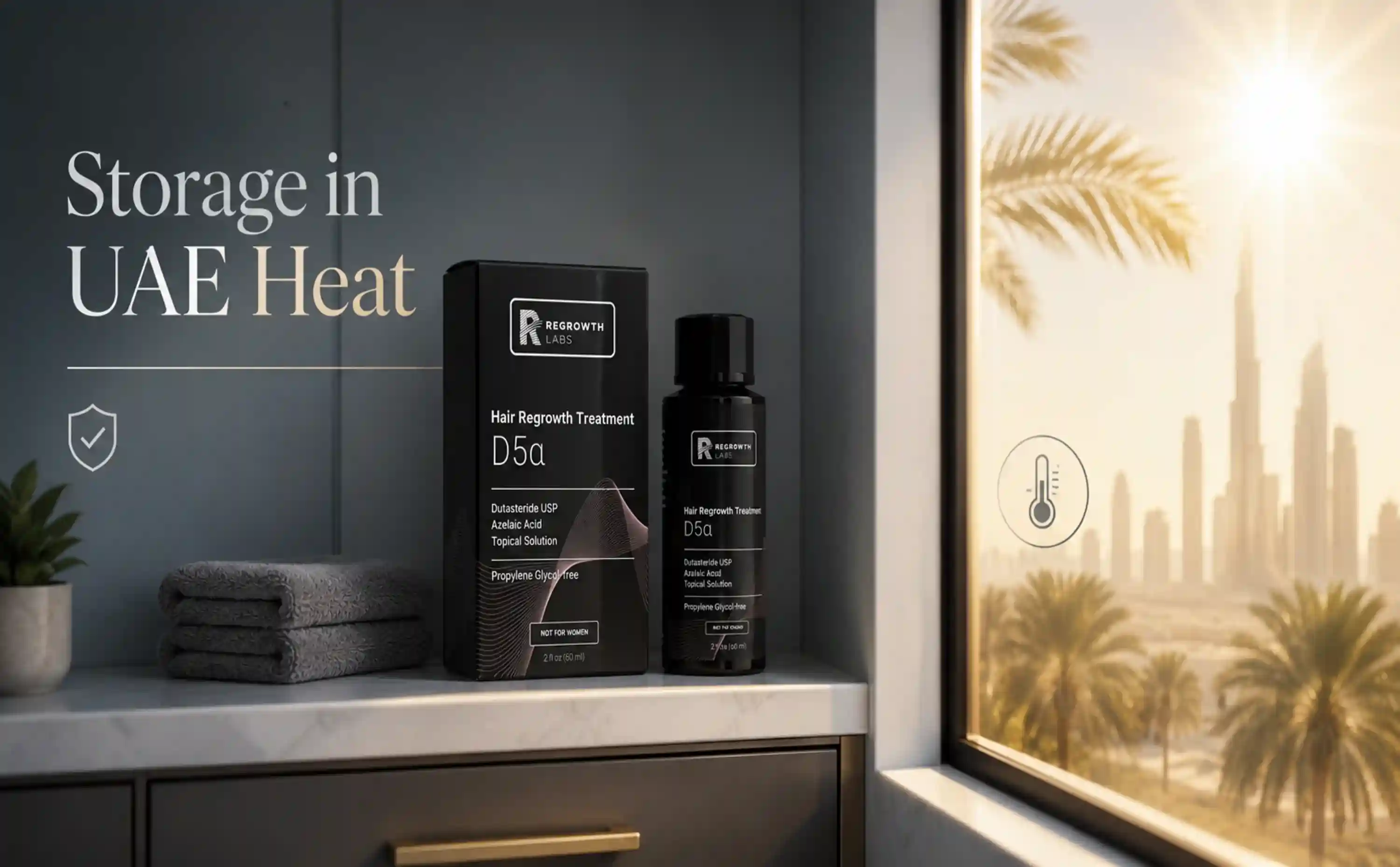
Do not leave D5a:
- Inside a parked vehicle
- On a sunny windowsill
- On a balcony
- Near cooking appliances
- In direct sunlight
- In an unlabelled travel container
Follow the temperature range printed on the physical packaging. The product page’s public text does not provide a complete storage range, so a specific temperature should not be added until it is verified.
Evidence Hierarchy for D5a Content
The evidence should be presented in layers rather than blending every claim together.
Level 1 — Strongest direct evidence
Randomised clinical trials of a specific finished product
Level 2
Randomised trials of topical dutasteride at other concentrations
Level 3
Clinical evidence for oral dutasteride in androgenetic alopecia
Level 4
Laboratory, formulation and delivery-system research
Level 5
Manufacturer formulation claims
Level 6 — Weakest
Customer reviews, before-and-after images and anecdotes
For D5a:
- There is emerging randomised evidence for topical dutasteride at concentrations up to 0.05%.
- There is established clinical evidence for oral dutasteride in male androgenetic alopecia, including comparisons with finasteride.
- The reviewed D5a product page provides formulation and product-positioning information.
- The reviewed public product page does not present an independent randomised clinical trial of the exact D5a 0.5% finished formula.
This distinction must remain visible throughout the article.
Does Topical Mean No Systemic Absorption?
No.
Topical application means the product is placed on the scalp. It does not guarantee that the active ingredient remains entirely local.
The amount absorbed may depend on:
- Concentration
- Application volume
- Treatment area
- Vehicle
- Skin condition
- Frequency
- Contact time
- Use on broken or recently microneedled skin
- Individual physiology
A review of topical dutasteride research describes the treatment as promising but emphasises that topical formulations, delivery systems and systemic exposure still require further study.
The 2025 topical trial reported more modest serum hormonal changes with the tested 0.05% solution than with oral finasteride. That result should not be converted into a “zero systemic absorption” claim for D5a 0.5%.
Pregnancy and Accidental-Transfer Warning
Dutasteride may cause harm to a developing male fetus.
The FDA-approved oral dutasteride label states that dutasteride is absorbed through the skin and that women who are pregnant or could become pregnant should not handle leaking dutasteride capsules. If contact occurs, the affected area should be washed immediately with soap and water.
A topical product creates a more direct skin-contact scenario than an intact capsule.
Practical precautions include:
- Pregnant individuals should not apply or handle the product
- Prevent contact with wet treated skin
- Wash the hands after application
- Clean spills immediately
- Keep the bottle away from children
- Avoid shared towels after application
- Allow the scalp to dry before close skin contact
- Discuss household pregnancy exposure with a qualified professional
This article does not assume that pregnancy-related guidance for an oral capsule fully defines exposure from D5a. It uses the established skin-absorption warning to support a cautious handling approach.
Possible Side Effects and Warning Signs
The exact side-effect frequency of D5a’s finished 0.5% formula cannot be established from the public product page.
Possible local reactions from a medicated scalp solution may include:
- Redness
- Dryness
- Scaling
- Itching
- Stinging
- Burning
- Contact dermatitis
- Increased sensitivity
Systemic dutasteride exposure has been associated with sexual, reproductive, breast and allergic effects in oral-treatment information. These oral data cannot be applied directly as a frequency estimate for D5a, but possible systemic absorption means relevant symptoms should not be dismissed automatically.
Seek professional advice for:
- Persistent or severe scalp irritation
- Facial, lip or tongue swelling
- Breathing difficulty
- A severe or spreading rash
- Breast tenderness, enlargement or nipple discharge
- New sexual or reproductive symptoms
- Marked mood changes
- Accidental eye or mouth exposure
- Pregnancy-related contact
- Any serious or unexpected reaction
A severe allergic reaction, breathing problem or significant facial swelling requires urgent medical attention.
Who Should Obtain Assessment Before Using D5a?
Professional assessment is especially important when:
- Hair loss began suddenly
- Hair is falling in circular patches
- The scalp is painful or burning
- There is heavy scaling or discharge
- Areas appear smooth, shiny or scarred
- Eyebrows or body hair are also being lost
- Hair loss followed fever, surgery or major illness
- There has been rapid weight change
- A new medicine was recently started
- The person has liver disease
- Fertility is a current concern
- Another DHT-targeting medicine is already being used
- The person is pregnant or could become pregnant
- The person is a child or teenager
Dutasteride is metabolised through the hepatic CYP3A system, and oral drug references identify potential interactions and precautions in significant liver impairment. Product-specific advice is necessary before extending those concerns to an individual topical routine.
What Results Should Users Expect?
Hair-cycle treatments are evaluated over months rather than days.
The recent topical dutasteride phase II study assessed results over 24 weeks. That timeframe shows why a few days or weeks are not enough to judge a DHT-targeting treatment. It does not create a guaranteed D5a result timeline.
Results may vary according to:
- Correct diagnosis
- Duration of hair loss
- Degree of miniaturisation
- Follicle viability
- Age
- Genetics
- Application consistency
- Treatment area
- Other medical conditions
- Concurrent treatment
- Individual absorption and response
Avoid promises such as:
- Guaranteed regrowth
- Complete hairline restoration
- Permanent results
- Visible improvement in a fixed number of weeks
- Identical hairline and crown response
- No systemic effects
- No shedding
- No irritation
A more accurate expectation is that D5a is designed to reduce DHT-related pressure on susceptible follicles, but the degree of maintenance or visible improvement cannot be predicted for every user.
How to Track Hairline and Crown Progress
Daily mirror checking is unreliable.
Hair can appear different because of:
- Lighting
- Oil
- Humidity
- Styling
- Hair length
- Camera exposure
- Wetness
- Hair fibres
- Parting position
Take progress photographs approximately once every four weeks using:
- Straight frontal hairline view
- Left temple
- Right temple
- Top-down mid-scalp
- Crown or vertex
- Optional side profiles
Use:
- The same room
- The same light
- The same camera
- Similar hair length
- Dry hair
- No hair fibres
- No styling products
- Similar camera distance
Record treatment interruptions, scalp reactions, illness, major stress, medication changes and haircuts.
Photographs can support follow-up discussions. They cannot confirm diagnosis or prove that one ingredient caused a change.
D5a Versus an Ordinary Cosmetic Scalp Serum
| Factor | D5a | Cosmetic scalp serum |
| Main purpose | DHT-targeting medicated treatment | Appearance, hydration or scalp conditioning |
| Key active | Dutasteride USP 0.5% | Varies; often cosmetic ingredients |
| Professional assessment | Strongly advisable | Depends on formula |
| Pregnancy precautions | Important | Product-specific |
| Accidental transfer | Medically relevant | Usually cosmetic |
| Systemic absorption concern | Cannot be excluded | Usually lower but ingredient-dependent |
| Results claim | Must remain evidence-based | Usually cosmetic appearance claims |
| Routine changes | Should be planned carefully | Often easier to change |
D5a should not be treated like a styling serum that can be used casually, doubled, mixed or replaced without considering pharmacological exposure.
Questions to Ask Before Buying D5a
Before purchasing, confirm:
- Has the cause of the hair loss been assessed?
- Is the pattern consistent with androgenetic alopecia?
- Is treatment intended for the hairline, crown or both?
- Does the physical label confirm Dutasteride USP 0.5%?
- Is the concentration expressed as w/w, w/v or another basis?
- What exact amount should be applied?
- What is the recommended frequency?
- How long should the formula remain on the scalp?
- What is the verified bottle size?
- What storage temperature is stated?
- Does the complete label list the azelaic acid concentration?
- Are there pregnancy-related handling concerns?
- Is another finasteride or dutasteride treatment already being used?
- What side effects require discontinuation?
- When should progress and safety be reviewed?
These questions are more useful than asking whether D5a is simply “stronger.”
Frequently Asked Questions
What is D5a Hair Regrowth Treatment?
D5a is listed as a topical hair-regrowth formula containing Dutasteride USP 0.5%, azelaic acid and a propanediol-based carrier. Its product page positions it for hair loss affecting both the frontal hairline and crown.
Can D5a be used on both the hairline and crown?
The current product page states that D5a is intended for the entire scalp, including the vertex and hairline. The actual treatment zone and amount should follow the physical instructions and professional guidance.
Does D5a contain minoxidil?
Minoxidil is not listed in the reviewed D5a product-page formula. The current headline ingredients are Dutasteride USP 0.5% and azelaic acid. Always verify the physical label because product information can change.
Is topical dutasteride 0.5% the same as oral dutasteride 0.5mg?
No. A topical percentage and an oral milligram dose are different measurements delivered through different routes. They should not be compared directly.
Is D5a the same as the topical dutasteride used in the 2025 trial?
No. The phase II study evaluated topical concentrations up to 0.05% w/v. D5a is listed as 0.5%, and its finished vehicle and supporting ingredients are different.
Is D5a FDA approved for hair loss?
Do not describe D5a as FDA approved unless exact product-specific regulatory evidence is available. The US dutasteride capsule label relates to benign prostatic hyperplasia, while topical dutasteride for androgenetic alopecia remains an emerging treatment area.
Does topical D5a stay only in the scalp?
That cannot be guaranteed. Topical application may reduce systemic exposure under some formulations, but absorption depends on concentration, dose, vehicle, treatment area and skin condition.
Is D5a suitable for women?
This requires specialist assessment. Dutasteride presents a serious pregnancy-exposure concern because it may harm a developing male fetus. Anyone who is pregnant or could become pregnant should not use or handle it without explicit specialist guidance.
Does azelaic acid block DHT?
Azelaic acid has laboratory and theoretical relevance to 5-alpha-reductase activity, but its role as a clinically established stand-alone hair-loss treatment remains limited. It should not be described as equivalent to dutasteride.
Is propanediol guaranteed not to irritate the scalp?
No. Propanediol is used as an alternative carrier, but no vehicle guarantees that every user will avoid irritation.
Can D5a be combined with minoxidil?
Combination treatment may be considered in some professional plans, but timing, total exposure and tolerability should be reviewed before products are layered.
Can D5a be combined with oral finasteride or dutasteride?
Do not combine multiple DHT-targeting medicines without professional guidance. Doing so may increase overall exposure and make adverse effects harder to interpret.
Can D5a be applied after microneedling?
Applying a potent topical medicine to recently microneedled or damaged skin may alter absorption and irritation. Obtain product-specific professional advice rather than applying it immediately by assumption.
How quickly does D5a work?
There is no verified universal D5a timeline. Topical dutasteride studies assess changes over months, and results from lower concentrations cannot be used to promise a fixed outcome from D5a 0.5%.
Should more D5a be used on a large crown?
No independent dose increase should be made. More product may increase exposure without proving greater benefit.
What happens after a missed application?
Do not double the next amount unless the official product instructions explicitly advise it. Follow the physical label or contact the supervising professional.
How should D5a be stored in Dubai?
Follow the physical bottle’s stated temperature range. Protect it from excessive heat and direct sunlight, and do not leave it inside a parked vehicle.
Final Perspective
D5a is positioned as an advanced full-scalp treatment containing Dutasteride USP 0.5% and azelaic acid for thinning affecting the hairline, crown or both. Its topical format, propanediol carrier and full-scalp positioning make it commercially distinct from oral dutasteride, standard minoxidil and cosmetic scalp serums.
Its evidence must still be communicated carefully.
Topical dutasteride has emerging clinical support, including a 2025 randomised phase II study. That study evaluated concentrations up to 0.05% rather than D5a’s listed 0.5%. It supports topical dutasteride as a research-backed treatment format, but it does not directly prove the effectiveness or safety profile of the finished D5a formula.
The strongest potential buyer fit is an adult with gradual pattern-related thinning who:
- Has obtained an appropriate assessment
- Understands the DHT-targeting purpose
- Needs coverage across the hairline, crown or both
- Can follow verified directions consistently
- Can prevent accidental transfer
- Understands pregnancy-related precautions
- Has realistic expectations
- Will monitor tolerability and progress
- Will not increase the amount independently
- Recognises that topical does not mean risk-free
For UAE users, the practical routine also needs to account for heat, sweat, showering, exercise, headwear, drying time, travel and storage.
The correct next step is not automatically to purchase the strongest-looking concentration. It is to verify the label, clarify the intended application, review relevant medical risks and decide whether D5a matches the diagnosed type of hair loss.
Suggested CTA: Review the current D5a Hair Regrowth Treatment formula, packaging and UAE availability, then discuss whether a topical Dutasteride USP 0.5% treatment is appropriate for your hair-loss pattern and medical history.