
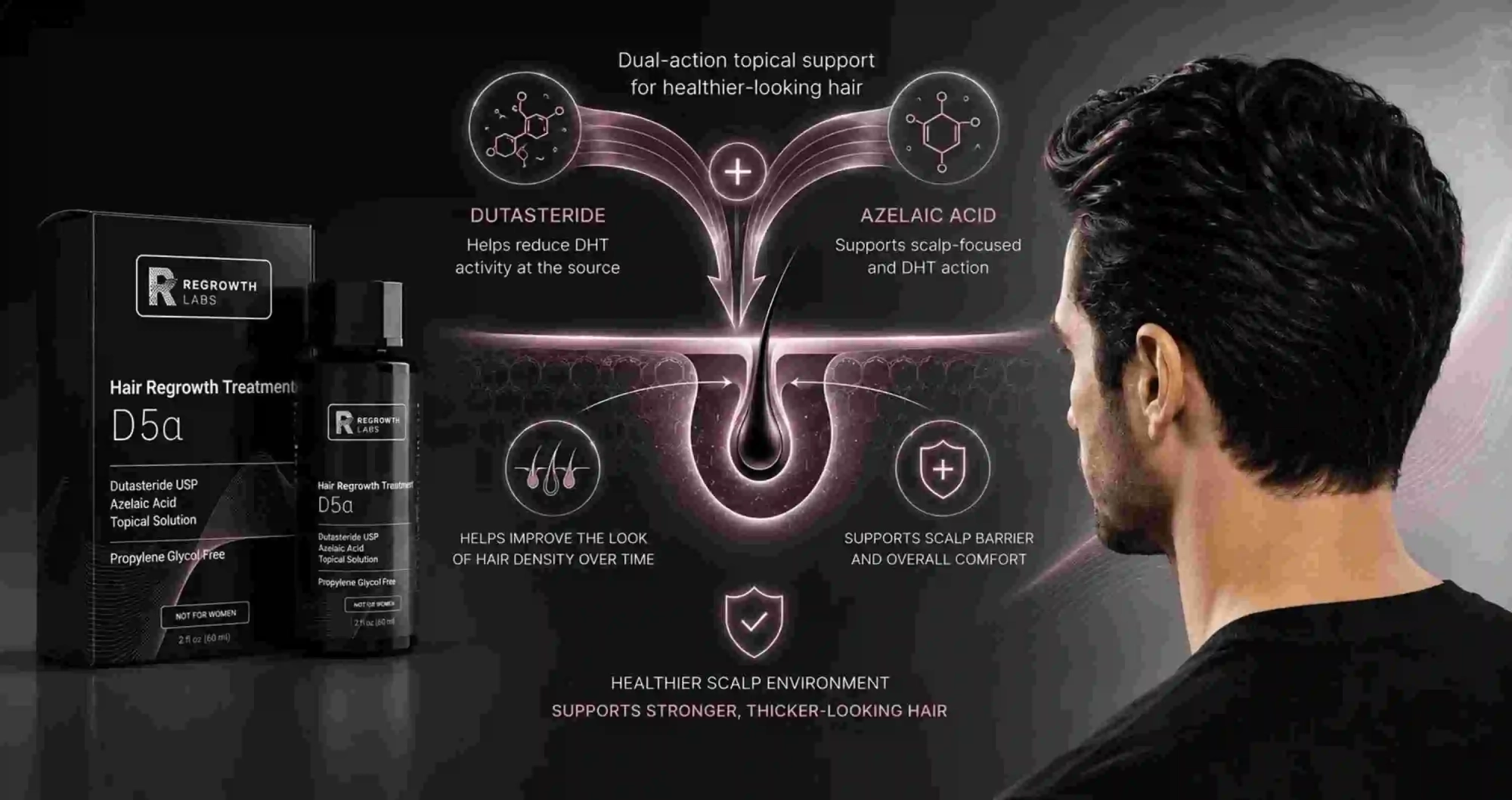
How does a dutasteride and azelaic acid hair treatment work to promote hair growth, and is the science actually strong enough to justify the approach? If you are dealing with androgenetic alopecia, you already know the frustration: the hair keeps thinning, the treatments feel limited, and most options seem to address only one piece of a much bigger puzzle. A dutasteride and azelaic acid hair treatment is gaining clinical attention precisely because it takes aim at the problem from two different biological angles simultaneously. This article breaks down the science behind both ingredients, explains why their mechanisms complement each other, and gives you an honest picture of what the evidence actually supports at this stage.
This is an evidence-informed explainer, not a product endorsement. It is worth being specific about what “solid” means here: topical dutasteride has human Phase II RCT data behind it, while azelaic acid’s hair-related evidence is largely in vitro and animal-based, credible mechanistically, but not yet proven in large-scale human trials. Understanding that distinction clearly is the best starting point for any conversation with a clinician about whether this approach makes sense for you.
How a dutasteride and azelaic acid hair treatment works
Androgenetic alopecia is driven largely by dihydrotestosterone, or DHT. Testosterone is converted into DHT by enzymes called 5-alpha reductase, which come in two main types: Type I, found predominantly in skin and sebaceous glands, and Type II, concentrated in hair follicles and the prostate. Finasteride blocks only Type II. Dutasteride blocks both, making it roughly three times more potent against Type II and approximately 100 times more potent against Type I than finasteride.
How DHT miniaturises hair follicles
Follicles in the vertex and frontal scalp zones are genetically sensitive to androgens. When DHT binds to androgen receptors within these follicles, it progressively shortens the anagen (active growth) phase of the hair cycle. Over successive cycles, the follicle produces finer, shorter hair until it effectively stops producing visible hair altogether. By blocking both 5-alpha reductase isoenzymes, dutasteride removes more of the hormonal signal driving this miniaturisation than finasteride can manage.
Topical versus oral: what the absorption data actually shows
The Phase II randomised controlled trial on topical dutasteride, often referenced in the literature as the ARIA2004 programme, is the most important piece of clinical evidence here. The 0.05% topical solution outperformed 1 mg per day oral finasteride in total hair count improvement (p=0.0083). Critically, this came with a very different systemic exposure profile: topical application at 0.05% produced only an 8.9% reduction in serum DHT at week 12 and 11% at week 24, compared to the greater than 90% suppression seen with oral dutasteride. Measured serum dutasteride concentrations from a gel formulation were 1.54 ng/mL versus 28.1 ng/mL for the oral tablet.
Lower systemic exposure does not mean zero exposure. Based on the trial’s adverse-event data, this reduced systemic load is associated with a lower observed incidence of hormonal side effects, though long-term risk data for topical use remain limited, and no definitive proof exists that systemic risks are eliminated entirely.
How azelaic acid supports hair follicle health beyond DHT
Azelaic acid is not simply another DHT blocker. Its contribution to hair follicle biology works through two distinct mechanisms that operate further downstream: protecting stem cells from oxidative damage, and activating a signalling pathway that drives follicles back into active growth.
Protecting follicle stem cells from oxidative damage
A 2020 in vitro study using mouse vibrissae follicles found that azelaic acid significantly upregulated catalase activity in bulge cells at both 2.5 mM and 25 mM concentrations (p<0.05). Catalase is an enzyme that neutralises hydrogen peroxide, a reactive oxygen species that accumulates particularly after UVB exposure and can damage the stem cells responsible for initiating new hair growth. The same concentrations produced no significant change in catalase activity in bulb cells, the lower portion of the follicle. The protective effect is specific to the bulge, where hair follicle stem cells reside, which is precisely where that protection matters most.
Activating the Hedgehog pathway to restart follicle growth
The Sonic Hedgehog signalling pathway regulates some of the most fundamental decisions a hair follicle makes, including when to leave its resting phase (telogen) and re-enter active growth (anagen). The ligand Shh binds to the receptor PTCH1, which releases its inhibition of SMO, allowing GLI1 and GLI2 transcription factors to activate genes that drive follicle cell proliferation and differentiation.
The same 2020 study found that azelaic acid at 25 mM upregulated Gli1 and Gli2 mRNA expression in bulge cells. A separate animal study found that topical azelaic acid was capable of triggering the telogen-to-anagen transition directly. Beyond these pathway effects, azelaic acid also shows documented anti-inflammatory properties and a mild 5-alpha reductase inhibitory effect in preclinical studies, though these findings have not yet been confirmed in human clinical trials and should not be taken as evidence of clinical anti-androgen efficacy in humans.
Why a dutasteride and azelaic acid hair treatment may be complementary
The mechanistic case for a dutasteride and azelaic acid hair treatment is coherent, but no published RCT has yet tested the pair directly. That gap matters, and it shapes how confidently any claims about the combination can be made.
Complementary mechanisms working on different fronts
Dutasteride addresses the hormonal trigger: it reduces scalp DHT by blocking both isoforms of 5-alpha reductase, cutting off the primary androgenic signal that drives follicle miniaturisation. Azelaic acid addresses what happens downstream at the follicle itself, defending the stem cell population from oxidative stress via catalase upregulation, and activating the GLI1/GLI2 transcription programme that signals the follicle to grow. That is the central rationale behind a dutasteride and azelaic acid hair treatment: targeting both the hormonal cause and the follicle’s biological readiness to respond makes logical sense. If DHT levels are suppressed but the follicle’s stem cells are oxidatively damaged or stuck in telogen, the hormonal intervention alone may deliver less than its potential benefit.
What the current evidence actually says
To be direct: as of the date of this article, no published human RCT has specifically tested the dutasteride-plus-azelaic-acid combination. The closest indirect evidence involves azelaic acid combined with minoxidil, which showed some improved hair-growth markers in preclinical work, though one study found no advantage over minoxidil alone. Topical dutasteride at 0.05% has strong standalone RCT data. Azelaic acid’s mechanisms are supported by in vitro and animal work. This is a mechanistically logical combination that is already being used in practice ahead of formal combined trial data. A dutasteride and azelaic acid hair treatment therefore requires professional oversight rather than being treated as a routine cosmetic purchase.
Formulations, concentrations, and what responsible use looks like
This combination does not come as an approved pharmaceutical product. It exists as an compounded formulation prepared by specialised pharmacies, typically prescribed through telehealth or dermatology platforms. Understanding what these formulations look like in practice helps you ask the right questions before committing to one.
Common strengths and delivery formats used in practice
For dutasteride, compounded topical concentrations typically start at 0.05% as a conservative entry point, with 0.1% commonly cited in studies and some pharmacies offering up to 0.3%. The most clearly documented combined formulation in published compounding references is a topical foam containing minoxidil 5%, azelaic acid 1.5%, and dutasteride 0.05%. Standalone azelaic acid for scalp use ranges from 5% to 20%, with lower concentrations favoured initially for tolerability.
Solution and serum vehicles are the most documented for dutasteride; foam formats are also used. Compounding formulation guidance generally recommends leaving the product on the scalp for at least 4 hours, and preferably 8 to 12 hours, to balance efficacy against systemic exposure. If you are sourcing compounded products, ask your prescribing clinician or pharmacist for the specific reference or validated protocol behind these parameters.
A relevant topical product example and how to compare it responsibly
Hims n Hers UAE lists the D5a dutasteride and azelaic acid hair treatment, described on its product page as a topical formula containing Dutasteride USP 0.5% and azelaic acid. This is the closest direct product match for the mechanism discussed in this article. However, it is important not to assume that the evidence for topical dutasteride 0.05% automatically proves the same efficacy, absorption, or tolerability for a 0.5% product or for the exact combined formula.
The concentration difference is substantial: 0.5% is ten times the 0.05% concentration discussed in the Phase II topical-dutasteride trial referenced earlier. Formulation vehicle, application amount, frequency, scalp condition, and contact time can also affect exposure. Readers should therefore treat the product page as formulation information, not as proof that the specific commercial product reproduced the trial outcome.
When comparing this option with the wider hair-loss treatment collection, check whether each formula is topical or oral, identify every active ingredient, compare percentages with like-for-like topical products, and review whether clinician supervision is required. A credible dutasteride and azelaic acid hair treatment should disclose its strength, directions, warnings, intended user, and storage information clearly.
No robust published stability or shelf-life study was identified for the exact dutasteride-plus-azelaic-acid combination discussed here. Product quality therefore depends on manufacturing controls, the delivery vehicle, packaging, storage conditions, and validated expiry or beyond-use dating.
How to evaluate a dutasteride and azelaic acid hair treatment before buying
Before choosing a dutasteride and azelaic acid hair treatment, confirm the exact dutasteride concentration, the azelaic acid concentration if stated, the vehicle, application frequency, bottle size, expected monthly usage, contraindications, and whether the formula is intended for clinician-supervised use. Avoid comparing an oral milligram dose directly with a topical percentage because they measure different things.
Also check whether the seller distinguishes evidence for an individual ingredient from evidence for the finished combination. Topical dutasteride has standalone human data, while azelaic acid’s hair-growth rationale remains mainly preclinical. A responsible product page should not present that mechanistic evidence as if the exact combined product has already completed a large human randomised trial.
Finally, inspect the seal, batch information, expiry date, storage instructions, and leaflet when the product arrives. Do not use a topical treatment that is unsealed, damaged, materially different from the listing, or missing essential directions.
Safety profile, contraindications, and realistic expectations
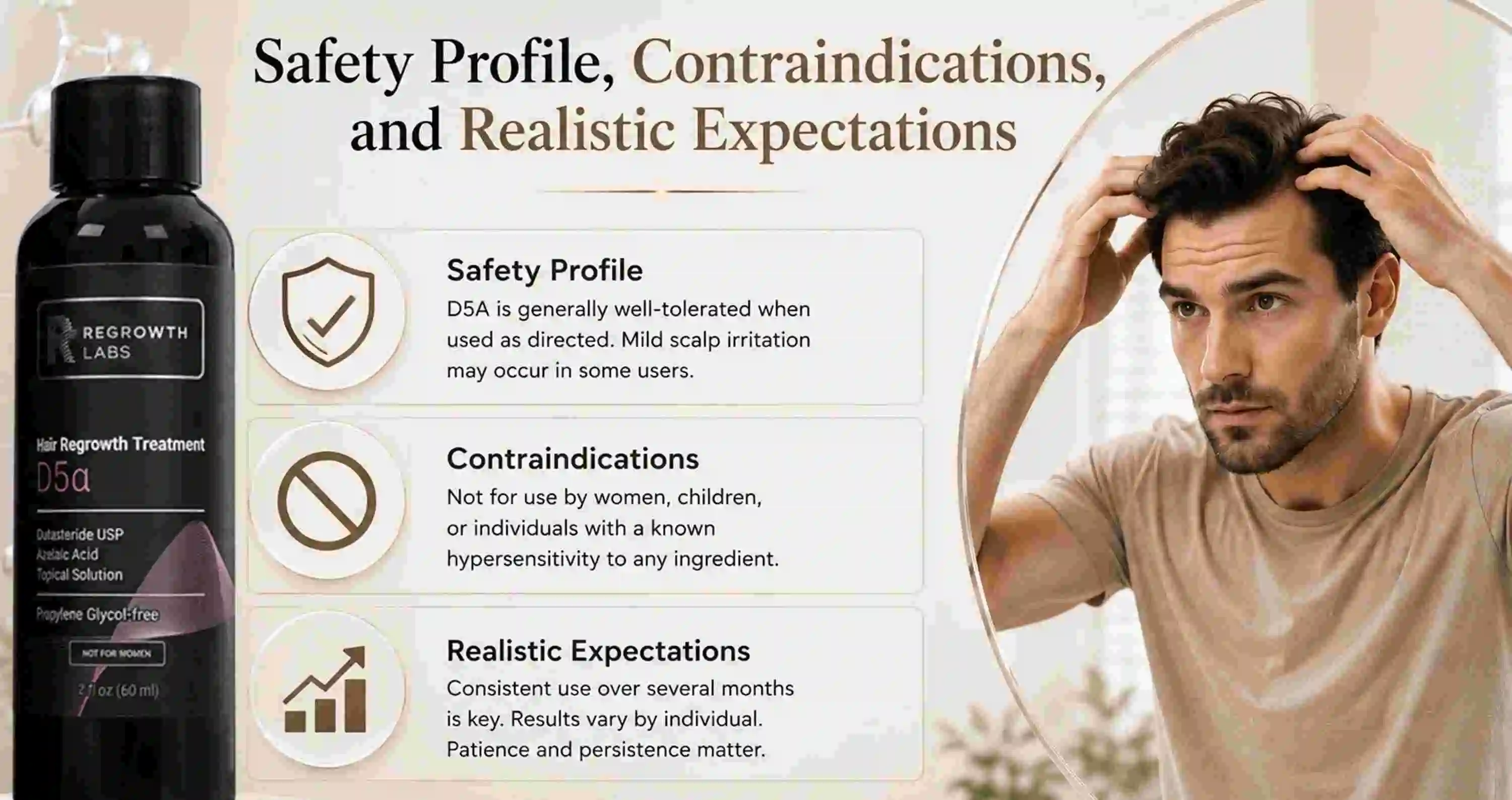
A dutasteride and azelaic acid hair treatment may reduce systemic exposure compared with oral dutasteride, but topical application does not eliminate it. Anyone considering this treatment needs a clear-eyed understanding of the risks alongside the potential benefits.
Systemic absorption risks and reported side effects
As noted, topical dutasteride produces measurable serum levels, approximately 1.54 ng/mL compared to 28.1 ng/mL for the oral tablet, based on the Phase II trial’s pharmacokinetic data. Potential side effects mirror oral dutasteride at lower observed incidence: sexual dysfunction, breast tenderness or enlargement, and mood changes. These are less frequent given the lower systemic exposure, but they are not negligible. Azelaic acid’s side effects are typically local: burning, stinging, dryness, and redness. In combination products with multiple actives, local irritation risk may increase, though the Phase II RCT on topical dutasteride (ARIA2004) reported no irritation in active treatment groups, based on its published safety outcomes. Individual skin tolerance still varies considerably.
Contraindications, realistic outcomes, and next steps
Dutasteride carries a hard contraindication for pregnancy. Pregnant individuals, or anyone who could become pregnant, should not handle the product at all, as skin absorption presents a foetal risk. Topical dutasteride is currently off-label for androgenetic alopecia; no regulatory approval exists for topical use. On timelines: the Phase II RCT produced meaningful hair count changes at 12 to 24 weeks. This is gradual improvement measured over months, not a rapid recovery of lost hair. Treating this as a long-term intervention, not a quick fix, is the only realistic frame.
FAQ: how does a dutasteride and azelaic acid hair treatment support growth?
The short answer is that a dutasteride and azelaic acid hair treatment is intended to work through two parallel biological mechanisms. Dutasteride suppresses scalp DHT by blocking both Type I and Type II 5-alpha reductase, the dual-block that removes more of the androgenic signal driving follicle miniaturisation than finasteride can. Azelaic acid then operates on the follicle’s own biology: protecting bulge stem cells from oxidative damage via catalase upregulation, and activating the GLI1/GLI2 Hedgehog signalling programme that supports the follicle’s return to active growth. Together, they address both the hormonal driver and the follicle’s capacity to respond to treatment.
The honest caveat is this: the combined evidence is mechanistically sound but clinically thin. No randomised controlled trial has tested this pair directly in humans. That does not make the combination wrong; it makes professional guidance essential. Placing a compounding pharmacy order without a clinician’s assessment of your individual hair-loss pattern, health history, and suitability is not the right starting point.
What to do before you take the next step
A dermatologist or trichologist consultation is the appropriate first step. They can assess your androgenetic alopecia pattern, review your medical history for contraindications, and determine whether a topical formulation is appropriate and at what concentration. If you are asking whether a dutasteride and azelaic acid hair treatment is right for you, that question is best answered through a clinical assessment rather than from a product claim alone.
The evidence supports a plausible and potentially useful strategy, but it does not yet establish the exact combined product as a universally proven treatment. The most responsible next step is to confirm the diagnosis, compare the formulation with the available evidence, and monitor both scalp response and possible systemic effects over time.