
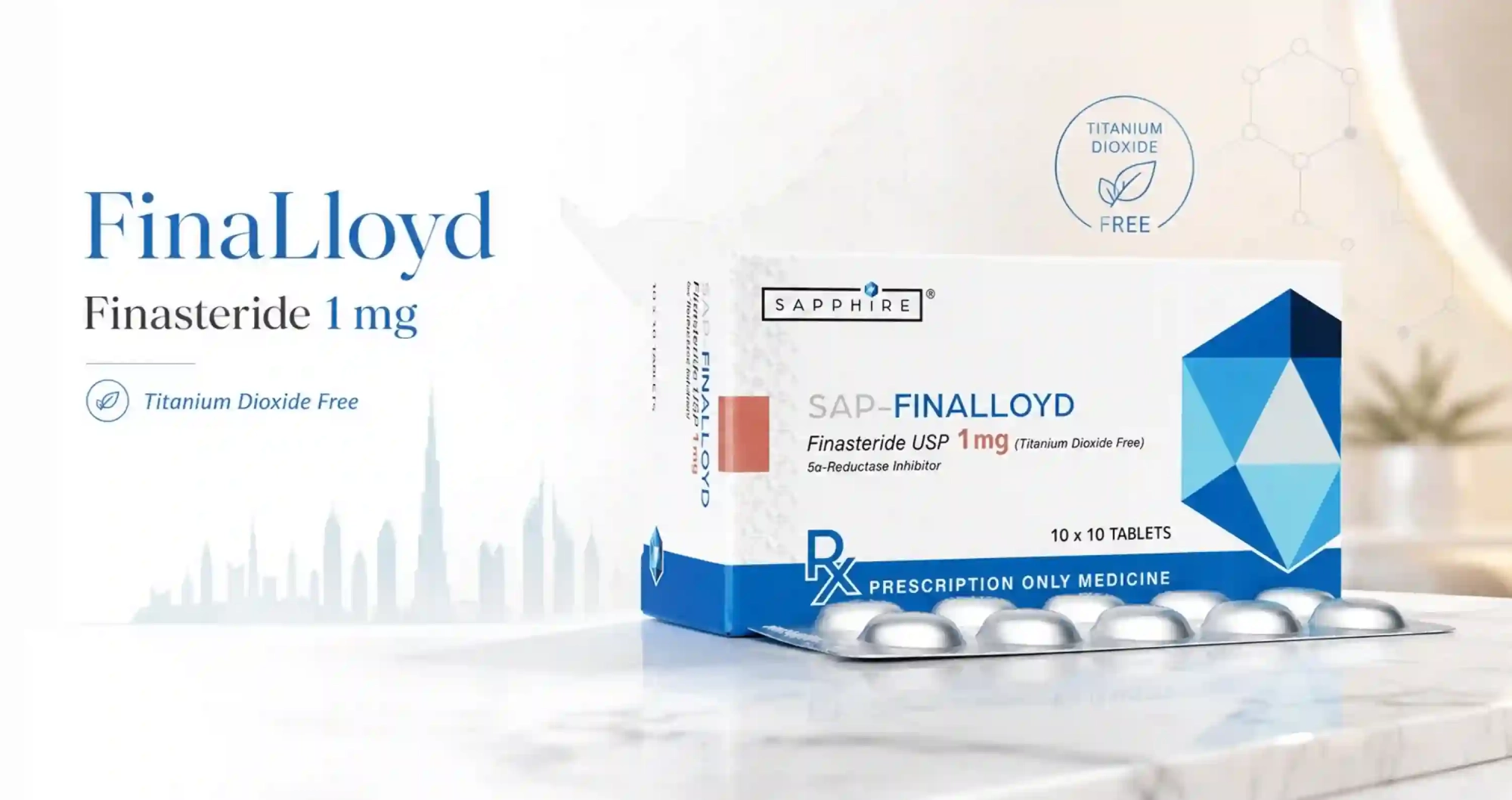
Men researching titanium dioxide free finasteride 1mg UAE are not necessarily searching for a different hair-loss medicine. In most cases, they are searching for the established active ingredient finasteride in a tablet that avoids one particular coating excipient.
FinaLloyd Finasteride 1 mg Titanium Dioxide Free is listed as a film-coated tablet containing 1 mg finasteride. Its product title states that the formulation is free from titanium dioxide, and the page links the active ingredient with the treatment of androgenetic alopecia in men. The public listing does not, however, display the complete tablet-core and film-coating composition required to independently verify the titanium dioxide-free claim.
Titanium dioxide is an inactive ingredient rather than the medicine that blocks DHT. Its presence or absence does not change finasteride’s pharmacological mechanism.
A buyer may still prefer a titanium dioxide-free tablet because of:
- A personal excipient preference
- Advice from a clinician or pharmacist
- A desire to minimise unnecessary colourants
- Concern created by changes to food-additive rules
- A previous reaction to a specific tablet coating
- A preference for a more transparent ingredient list
Those reasons are legitimate topics for discussion.
They should not be converted into unsupported statements that titanium dioxide-free finasteride is automatically safer, cleaner, more natural or more effective.
Direct Answer
FinaLloyd appeals to some UAE buyers because its product title identifies it as a 1 mg finasteride tablet without titanium dioxide.
Titanium dioxide is commonly used as a colourant in medicinal products. As of the European Commission’s August 2025 review, it continues to be permitted in medicines following updated European Medicines Agency analysis. The fact that titanium dioxide is no longer authorised as a food additive in the European Union does not mean that it has been prohibited in medicinal tablets.
Choosing a tablet without titanium dioxide may satisfy a formulation preference, but it does not prove:
- Better hair regrowth
- Lower finasteride exposure
- Fewer sexual side effects
- Lower psychiatric risk
- Better absorption
- Bioequivalence to Propecia
- Regulatory approval in the UAE
- Absence of all other colourants
- Absence of all potential allergens
The clinically important medicine remains finasteride 1 mg. The clinically appropriate hair-loss dose is generally one 1 mg tablet once daily—not two tablets twice daily.
Titanium Dioxide Free Finasteride 1mg UAE: What the Product Page Confirms
The current FinaLloyd listing confirms or claims:
- Each film-coated tablet contains finasteride 1 mg.
- The product is titanium dioxide free.
- The product does not contain quinoline yellow.
- It is intended for men.
- Tablets should not be split or crushed.
- Pregnant women or women who may be pregnant should not handle broken or crushed tablets.
- A healthcare professional should supervise use.
- PSA-testing clinicians should be told that the patient is taking finasteride.
- Pack options currently include 30 or 100 tablets.
The visible public page does not provide:
- Complete tablet-core excipients
- Complete film-coating excipients
- Titanium dioxide’s absence in a manufacturer-issued ingredient table
- Product-registration number
- Market-authorisation details
- Bioequivalence documentation
- Dissolution data
- Manufacturing batch specifications
- Official patient leaflet
- Full adverse-effect section
- Complete contraindications
- Correct unambiguous dosage instructions
- Storage temperature
- Manufacturer contact details within the visible product description
These missing items should be obtained before the article presents FinaLloyd as equivalent to a regulated generic product.
What Is Titanium Dioxide in a Tablet?
Titanium dioxide, also written as TiO₂ or E171, is an inactive ingredient used as a colourant in many medicines. It may be present in a tablet coating or capsule shell to create opacity and a consistent appearance. EMA guidance continues to address its use as a pharmaceutical colourant.
Titanium dioxide is not:
- Finasteride
- A DHT blocker
- A preservative that makes finasteride active
- A hair-growth ingredient
- Titanium metal placed inside the tablet
- Proof that a medicine is branded or generic
Its main relevance in this article is formulation preference.
Why Is Titanium Dioxide Used in Medicines?
Tablet coatings can serve more than one purpose.
Depending on the product, a coating may:
- Help identify the tablet
- Create a uniform appearance
- Make swallowing easier
- Reduce direct handling of the active ingredient
- Protect the tablet from moisture or light
- Support manufacturing consistency
Titanium dioxide has been used extensively as a white colourant and opacifying ingredient in medicinal products. Its removal can require reformulation, stability testing and changes to product appearance rather than a simple deletion from an ingredient list.
A titanium dioxide-free tablet may use:
- Another pigment
- A transparent coating
- An uncoloured film
- Iron oxides
- A different coating system
The exact alternative used in FinaLloyd is not shown on the current public product page.
Why Do Some Buyers Avoid Titanium Dioxide?
Confusion Between Food and Medicine Rules
The European Union stopped authorising titanium dioxide as a food additive after safety concerns could not be ruled out in the food-additive assessment.
Medicines were treated separately. The European Commission initially maintained titanium dioxide for medicinal use to prevent medicine shortages, and its August 2025 working document confirmed that it should continue to be allowed in medicines following updated EMA analysis.
The correct distinction is:
Food additive decision
↓
Titanium dioxide no longer authorised as an EU food additive
Medicinal-product decision
↓
Titanium dioxide continues to be allowed in medicines
A food-additive decision should not be presented as proof that every medicine containing titanium dioxide is unsafe.
Preference for Fewer Colourants
Some buyers prefer tablets with shorter or simpler excipient lists.
That preference may be especially important for a medicine expected to be taken daily over a long period.
A shorter list can make comparison easier, but it does not automatically establish:
- Better manufacturing
- Better tolerability
- Better bioavailability
- Better regulatory quality
- Lower side-effect risk
Previous Coating Sensitivity
Someone who previously experienced a reaction to a tablet may search for an alternative formulation.
The reaction could have involved:
- A colourant
- A binder
- Lactose
- A preservative
- A printing ink
- Another coating component
- The active medicine itself
Avoiding only titanium dioxide does not guarantee avoidance of the actual trigger.
A full ingredient comparison and professional allergy assessment are more reliable than choosing a product based on one “free-from” statement.
Marketing and Online Discussion
“Free-from” claims can become prominent online because they offer a simple point of difference.
The claim may be factually correct while still having limited clinical importance.
For FinaLloyd, the titanium dioxide-free claim should be treated as:
A tablet-formulation distinction that may matter to selected buyers.
It should not be treated as:
A reason the medicine works better or causes fewer finasteride-related side effects.
What Titanium Dioxide-Free Does Not Mean
A titanium dioxide-free finasteride tablet is not necessarily:
- Colourant free
- Film-coating free
- Lactose free
- Preservative free
- Gluten free
- Vegan
- Hypoallergenic
- Free from every nanoparticle
- More bioavailable
- Faster acting
- Lower dose
- Non-hormonal
- Free from sexual side effects
- Free from psychiatric warnings
- Safe during pregnancy
- Approved by the FDA, EMA or MOHAP
Each claim requires separate evidence.
Does Removing Titanium Dioxide Change Finasteride’s Mechanism?
No.
Finasteride inhibits type II 5-alpha-reductase, reducing the conversion of testosterone into dihydrotestosterone, or DHT. DHT contributes to progressive follicular miniaturisation in genetically susceptible male pattern hair loss.
The pathway can be simplified as:
Testosterone
↓
Type II 5-alpha-reductase
↓
Dihydrotestosterone — DHT
↓
Androgen signalling in susceptible follicles
↓
Progressive miniaturisation
Finasteride intervenes here:
Testosterone
↓
Type II 5-alpha-reductase
✕ Finasteride inhibits the enzyme
↓
Reduced DHT formation
↓
Reduced androgen pressure on susceptible follicles
Titanium dioxide is not part of this pathway.
Readers needing a broader explanation of male pattern hair loss should use the androgenetic alopecia treatment guide.
Does FinaLloyd Contain the Same Active Ingredient as Propecia?
The FinaLloyd page states that each tablet contains 1 mg finasteride, the same active ingredient and strength associated with Propecia for male pattern hair loss.
That establishes a claimed active-ingredient similarity.
It does not independently establish:
- Identical inactive ingredients
- Identical tablet coating
- Identical dissolution
- Identical absorption
- Identical manufacturing controls
- Identical shelf life
- Identical regulatory approval
- Demonstrated bioequivalence
- Interchangeability in every jurisdiction
Approved generic medicines are normally required to meet product-specific quality and bioequivalence standards. The current FinaLloyd page does not display the documentation needed to confirm its regulatory or bioequivalence status.
Use:
FinaLloyd is labelled as containing the same active ingredient and strength as Propecia.
Do not use:
FinaLloyd is proven identical to Propecia.
FinaLloyd Versus a Fully Documented Finasteride 1 mg Product
| Comparison factor | Current FinaLloyd public listing | Fully documented regulated finasteride 1 mg |
| Active ingredient | Finasteride 1 mg claimed | Finasteride 1 mg confirmed |
| Titanium dioxide | Product title says absent | Depends on exact manufacturer |
| Complete excipient list | Not publicly displayed | Listed in official leaflet |
| Hair-loss dose | Current page contains an incorrect instruction | One 1 mg tablet once daily |
| Bioequivalence data | Not displayed | Required where approved as a generic |
| Authorised indication | Public wording is inconsistent | Stated clearly in product information |
| Contraindications | Partial | Full official section |
| Adverse effects | Incomplete and minimised | Full official warnings |
| Storage | Not clearly displayed | Product-specific storage listed |
| Batch and registration verification | Must be checked physically | Product-specific records available |
| Can efficacy be assumed identical? | Not from the public page alone | Based on authorised product evidence |
This table is not intended to label FinaLloyd as counterfeit or ineffective.
It identifies the documentation that should be checked before making equivalence claims.
The Correct Finasteride 1 mg Dose
For male pattern hair loss, official finasteride 1 mg prescribing information states:
One tablet
↓
1 mg finasteride
↓
Taken once daily
↓
With or without food
Taking more than once daily has not been shown to make finasteride work faster or better.
The Current FinaLloyd Dose Error
The current page says “1 mg (2 tablets) twice daily.”
If each tablet contains 1 mg, this wording mathematically describes:
2 tablets per dose
×
2 doses per day
=
4 tablets daily
4 tablets
×
1 mg each
=
4 mg per day
That is not the standard hair-loss dose.
The instruction must not remain live.
Correct Editorial Wording
Until the physical FinaLloyd leaflet is verified, use:
Finasteride 1 mg for male pattern hair loss is generally prescribed as one 1 mg tablet once daily. Follow the patient-specific prescription and the verified product leaflet. Do not follow the current website wording stating two tablets twice daily.
Missed Dose
Official patient information advises that a missed dose should not be replaced with an extra tablet. The user should take the next tablet according to the normal schedule rather than doubling the dose.
Tablet Splitting
The FinaLloyd page says not to split or crush the tablet. This also reduces the risk of exposing other people to the active ingredient through broken-tablet powder.
What Evidence Supports Finasteride 1 mg?
Finasteride 1 mg has established evidence for male androgenetic alopecia.
Clinical studies involving large groups of men found that oral finasteride can promote scalp hair growth and reduce continued hair loss in a meaningful proportion of users. Its role is strongest as a long-term treatment that slows progression and may support partial improvement rather than as a guaranteed cure.
This evidence supports the active ingredient and dose.
It does not automatically prove the quality, bioequivalence or manufacturing consistency of every 1 mg tablet sold internationally.
Evidence Hierarchy for FinaLloyd Claims
Level 1 — Strongest
Product-specific regulatory approval and bioequivalence data
Level 2
Clinical trials of the exact FinaLloyd finished tablet
Level 3
Clinical trials of approved finasteride 1 mg products
Level 4
General finasteride pharmacology and safety evidence
Level 5
Manufacturer or reseller formulation statements
Level 6 — Weakest
Testimonials, reviews and unverified online claims
For this article:
- Strong clinical evidence supports finasteride 1 mg as an active treatment for male pattern hair loss.
- The Hims n Hers page supports the claim that FinaLloyd contains finasteride 1 mg and is marketed as titanium dioxide free.
- The public page does not display product-specific bioequivalence or a full official ingredient leaflet.
- “Same active ingredient” should not be upgraded to “identical finished medicine.”
- No customer reviews are currently displayed on the product page.
Who May Consider FinaLloyd?
FinaLloyd may be researched by an adult man who:
- Has a diagnosis consistent with androgenetic alopecia
- Has been advised to consider oral finasteride 1 mg
- Specifically prefers a tablet without titanium dioxide
- Understands that the excipient claim does not change the active medicine
- Can follow once-daily oral treatment
- Has reviewed sexual and psychiatric risks
- Can keep tablets away from pregnant household members
- Is prepared for long-term treatment
- Will inform clinicians before PSA testing
- Can verify the product’s batch, expiry, leaflet and source
This describes a potential buyer profile—not an individual prescription.
Who Should Not Self-Select FinaLloyd?
Professional assessment is important where:
- The cause of hair loss has not been diagnosed
- Hair loss is sudden or patchy
- The scalp is inflamed, painful or scarred
- The person is under 18
- The person is a woman
- Pregnancy is possible
- There is a history of depression or suicidal thoughts
- Sexual or fertility concerns are already present
- There is significant liver disease
- A prostate condition is being investigated
- A PSA test is planned
- Finasteride or dutasteride is already being used
- The product’s authenticity cannot be verified
Finasteride 1 mg official information identifies it for men with male pattern hair loss and not for women or children.
Finasteride Sexual Side Effects
Recognised adverse effects include:
- Reduced sexual desire
- Difficulty achieving or maintaining an erection
- Ejaculation-related changes
- Reduced semen volume
These effects occurred more often with finasteride than placebo in the original product trials, although the absolute percentages were relatively low.
The appropriate message is neither:
Everyone develops sexual side effects.
Nor:
The side effects are too rare to matter.
A buyer should understand the risk, establish a baseline and report meaningful changes.
Persistent Sexual Symptoms
UK safety guidance states that sexual dysfunction has been reported to persist after finasteride was stopped in some patients. The precise probability for an individual user cannot be predicted from these reports.
Persistent symptoms should not be dismissed.
They should also not be presented as inevitable for every user.
Mood Changes and Suicidal Thoughts
In 2025, the European Medicines Agency confirmed suicidal ideation as a side effect of oral finasteride 1 mg and 5 mg tablets, with frequency unknown. Most reviewed reports involved people using 1 mg finasteride for androgenetic alopecia. EMA advises that users taking 1 mg finasteride who develop mood changes should stop treatment and seek medical advice.
The UK MHRA strengthened related warnings again in May 2026 and emphasised monitoring for psychiatric and sexual adverse effects.
Seek immediate support for:
- Suicidal thoughts
- Thoughts of self-harm
- Severe depression
- A marked change in mental state
A previous history of depression or suicidal ideation should be discussed before treatment begins.
Breast and Testicular Symptoms
Finasteride safety information includes reports of:
- Breast tenderness
- Breast enlargement
- Breast lumps
- Nipple discharge
- Testicular pain
A breast lump, nipple discharge or persistent testicular pain requires medical assessment rather than routine observation.
Allergic Reactions
Possible allergic symptoms can include:
- Rash
- Itching
- Hives
- Swelling of the lips or face
- Swelling of the tongue or throat
- Breathing difficulty
Severe facial swelling or breathing difficulty requires urgent medical care.
A titanium dioxide-free claim does not eliminate the possibility of an allergic reaction to another tablet ingredient or to finasteride itself.
Pregnancy Handling Warning
Finasteride can affect development of the external genitalia of a male fetus.
Official patient information states that women who are pregnant or may become pregnant should not handle crushed or broken finasteride tablets. Intact film-coated tablets reduce direct contact with the active ingredient during ordinary handling. If contact occurs with a broken tablet, the area should be washed with soap and water and medical advice obtained.
Practical precautions include:
- Keep tablets in their original blister.
- Do not crush or split them.
- Do not transfer tablets into an unlabelled container.
- Keep broken tablets away from pregnant individuals.
- Clean tablet fragments safely.
- Wash exposed skin with soap and water.
- Store the medicine away from children.
- Do not share the prescription.
The titanium dioxide-free coating does not remove the pregnancy warning.
Finasteride and PSA Testing
Finasteride lowers prostate-specific antigen, or PSA, measurements.
A clinician interpreting a PSA result needs to know that the patient is taking finasteride. Any confirmed rise from the lowest PSA value during treatment may require evaluation, even when the measured result appears within a standard range.
The FinaLloyd page correctly advises users to tell the clinician before prostate-cancer screening, but this should be expanded into a clear visible warning rather than remaining inside a product tab.
Liver and Medication Review
Official finasteride information advises users to tell the prescriber about other medical conditions, including liver or prostate problems, and to disclose all medicines and supplements being taken.
A buyer should not assume that finasteride has no interaction or monitoring considerations simply because it is taken once daily.
FinaLloyd Versus Topical Finasteride
An oral tablet and a topical spray should not be compared only by convenience.
| Factor | FinaLloyd oral finasteride | Topical finasteride |
| Route | Swallowed | Applied to scalp |
| Headline dose | 1 mg per tablet | Percentage and applied volume |
| Application technique | Simple | Requires accurate scalp coverage |
| Systemic exposure | Expected | Lower with some formulas, but not zero |
| Scalp irritation | No topical vehicle | Possible |
| Transfer while wet | No | Relevant |
| Pregnancy handling | Broken-tablet warning | Wet-product transfer warning |
| Evidence | Established oral evidence | Growing and formulation-specific |
| Daily consistency | One tablet | May require one or more applications |
| Titanium dioxide relevance | Tablet coating | Usually not applicable |
The full topical-versus-oral decision belongs in a separate article. This page remains focused on the titanium dioxide-free oral formulation.
FinaLloyd Versus Minoxidil
Finasteride and minoxidil address different treatment pathways.
Finasteride reduces DHT formation. Minoxidil is primarily used as a follicular growth stimulant.
Readers deciding between these treatment categories should use the dedicated Finasteride vs Minoxidil guide.
Avoiding titanium dioxide does not make FinaLloyd a substitute for minoxidil, and using minoxidil does not reproduce finasteride’s DHT-targeting mechanism.
FinaLloyd Versus Dutasteride
Dutasteride inhibits a broader range of 5-alpha-reductase activity than finasteride and has a different potency, evidence and regulatory profile.
Readers comparing DHT inhibitors should use the Finasteride vs Dutasteride guide.
The absence of titanium dioxide is not a clinically meaningful basis for comparing finasteride with dutasteride. The active drug, dose, diagnosis and safety profile matter more.
When Should Results Be Assessed?
Official finasteride 1 mg information states that daily treatment for three months or more is generally needed before benefit becomes visible. Continued use is recommended to sustain the effect, and stopping treatment leads to reversal of benefit over time.
This article should not expand into a full month-by-month timeline.
Readers can use the dedicated FinaLloyd results guide after its dose and safety wording has been corrected.
Do not promise:
- Reduced shedding in an exact number of weeks
- Visible regrowth for every user
- Complete hairline restoration
- Permanent results after stopping
- Faster results from taking more than 1 mg
- Better results because titanium dioxide is absent
Hairline Versus Crown Expectations
Finasteride is indicated for male pattern hair loss, but official patient information states that efficacy in bitemporal recession has not been established.
That means a buyer should not assume that:
- A receded temple will definitely regrow
- A lost juvenile hairline will return
- Crown and temple response will be identical
The practical goal may be maintenance, slowing further progression and achieving partial improvement in responsive areas.
Tracking Progress
Take standardised photographs approximately every four weeks:
- Straight frontal hairline
- Left temple
- Right temple
- Top-down mid-scalp
- Crown or vertex
Keep consistent:
- Room
- Lighting
- Camera
- Distance
- Head angle
- Hair length
- Dry hair
- No hair fibres
- No styling products
Record:
- Start date
- Missed tablets
- Sexual symptoms
- Mood changes
- Other medicines
- Illness
- Major stress
- Haircuts
- Treatment discontinuation
Photographs can document appearance. They cannot prove tablet authenticity, bioequivalence or systemic safety.
Authenticity and Label Verification in the UAE
Before taking FinaLloyd, inspect:
- Outer-carton seal
- Blister condition
- Correct product spelling
- Finasteride 1 mg statement
- Complete manufacturer name
- Batch or lot number
- Manufacturing date
- Expiry date
- Storage instructions
- Patient leaflet
- Complete active and inactive ingredients
- Titanium dioxide-free wording
- Tablet appearance
- Pack quantity
The listing states that FinaLloyd is associated with Lloyd Laboratories Inc., but the public page does not show the full manufacturer-issued leaflet or registration documentation required for independent verification.
Do not rely only on:
- Tablet colour
- Low price
- Seller photographs
- A barcode image
- Online testimonials
- “Same as Propecia” wording
Use a licensed source and obtain professional guidance before beginning systemic treatment.
Storage in UAE Conditions
A regulated finasteride 1 mg label generally instructs users to store tablets at controlled room temperature, protect them from moisture and keep them in a closed container. The exact FinaLloyd storage instruction should be taken from its physical packaging rather than copied automatically from another brand.
In the UAE:
- Do not leave tablets inside a parked vehicle.
- Avoid storing them on a sunny windowsill.
- Keep them away from bathroom humidity.
- Keep tablets inside the original blister.
- Do not place them in an unlabelled pill bag.
- Keep them out of reach of children.
- Do not use tablets from a damaged or wet blister.
Questions to Ask Before Buying FinaLloyd
- Does the physical label confirm finasteride 1 mg?
- Does the full excipient list confirm that titanium dioxide is absent?
- What ingredients replace titanium dioxide in the coating?
- Does the leaflet identify FinaLloyd for androgenetic alopecia?
- Is the recommended dose one tablet once daily?
- Has the incorrect website instruction been removed?
- Is the product registered or authorised for sale through the intended UAE channel?
- Is product-specific bioequivalence information available?
- Is the batch number verifiable?
- Is a complete patient leaflet included?
- Has male pattern hair loss been diagnosed?
- Has sexual health been discussed?
- Has mood history been reviewed?
- Is pregnancy exposure relevant within the household?
- Is a PSA test planned?
- Are liver or prostate conditions present?
- Is another finasteride or dutasteride product already being used?
- What symptoms require stopping treatment?
- When will results and safety be reviewed?
- What should happen after a missed dose?
Frequently Asked Questions
What is FinaLloyd?
FinaLloyd is listed as a film-coated tablet containing finasteride 1 mg and marketed as titanium dioxide free. It is positioned for adult men researching treatment related to androgenetic alopecia.
Is FinaLloyd really titanium dioxide free?
The product title and ingredient tab state that it is titanium dioxide free. The complete manufacturer-issued excipient list is not displayed publicly, so the physical carton and leaflet should be checked.
What is titanium dioxide used for in medicine?
Titanium dioxide is used as a colourant and opacifying ingredient in many medicinal-product coatings and capsules.
Is titanium dioxide banned in medicines?
No. The European Commission confirmed in August 2025 that titanium dioxide should continue to be allowed in medicines following updated EMA analysis.
Was titanium dioxide banned in food?
It is no longer authorised as a food additive in the European Union. Medicinal products were assessed separately.
Is titanium dioxide-free finasteride safer?
No product-specific evidence reviewed here proves that removing titanium dioxide reduces finasteride’s sexual, psychiatric, reproductive or hormonal adverse effects.
Does titanium dioxide affect DHT?
No. Titanium dioxide is an inactive coating ingredient. Finasteride is the active medicine that inhibits DHT formation.
Does FinaLloyd contain the same active ingredient as Propecia?
The product page states that each FinaLloyd tablet contains finasteride 1 mg, the same active ingredient and strength associated with Propecia. That does not alone prove identical excipients, bioequivalence or regulatory status.
Is FinaLloyd proven bioequivalent to Propecia?
The current product page does not display product-specific bioequivalence documentation. This must not be assumed from the active ingredient alone.
What is the correct finasteride 1 mg dose?
The established hair-loss dose is one 1 mg tablet once daily, with or without food.
Should two FinaLloyd tablets be taken twice daily?
No. The current website instruction appears erroneous and could imply 4 mg daily. It must not be followed without immediate verification from a qualified prescriber and the official leaflet.
Does more finasteride work better?
Official product information states that there is no evidence an increased dose improves efficacy for male pattern hair loss.
What happens after a missed dose?
Do not take an extra tablet. Continue with the next dose according to the normal schedule.
Can FinaLloyd tablets be split?
The current FinaLloyd page says not to split or crush the tablet. Follow the verified physical leaflet.
Can women take FinaLloyd?
Finasteride 1 mg is not indicated for women. It is particularly important to prevent pregnancy exposure.
Can pregnant women touch FinaLloyd?
Pregnant women or women who may be pregnant should not handle broken or crushed finasteride tablets. Intact coated tablets reduce direct contact with the active ingredient.
Can finasteride cause sexual side effects?
Yes. Recognised effects include decreased libido, erectile dysfunction and ejaculation-related changes.
Can sexual side effects continue after stopping?
Persistent sexual dysfunction has been reported after discontinuation in some patients, although the individual probability is uncertain.
Can finasteride affect mood?
Yes. EMA confirmed suicidal ideation as a side effect of oral finasteride tablets with an unknown frequency. Users taking 1 mg who develop mood changes should stop and seek medical advice.
Does finasteride affect PSA tests?
Yes. Finasteride can lower PSA measurements. Tell the clinician before testing.
Can FinaLloyd regrow a receding hairline?
Finasteride may help slow progression, but official information states that efficacy for bitemporal recession has not been established.
How long does finasteride take to work?
Official information states that three months or more may be required before benefit is observed. Visible results vary and often require longer assessment.
What happens when finasteride is stopped?
Continued use is generally required to maintain benefit, and treatment effects can reverse after discontinuation.
Can FinaLloyd be combined with topical finasteride?
Combining oral and topical finasteride may increase overall exposure. Do not combine them without medical guidance.
Can FinaLloyd be combined with dutasteride?
Finasteride and dutasteride both inhibit 5-alpha-reductase. Combining them should not be done without specialist guidance.
Can FinaLloyd be combined with minoxidil?
Finasteride and minoxidil are sometimes used within the same treatment plan because they address different pathways. The routine should be planned professionally.
How should FinaLloyd be stored in Dubai?
Follow the physical FinaLloyd label. Keep tablets dry, inside the original packaging and away from excessive heat, sunlight and parked vehicles.
Final Perspective
FinaLloyd’s titanium dioxide-free claim gives the tablet a genuine formulation point of difference.
Some UAE buyers may prefer to avoid titanium dioxide because of personal excipient preferences, prior coating reactions or confusion created by European food-additive changes. That preference should be respected and supported with accurate label information.
It should not be exaggerated.
Titanium dioxide continues to be permitted in medicinal products in the European Union as of the European Commission’s August 2025 review. Its absence does not make a finasteride tablet automatically safer, more effective, more natural or more bioavailable.
The most clinically important facts are:
- Does the tablet genuinely contain finasteride 1 mg?
- Is the complete excipient list available?
- Is the product authentic?
- Is it appropriately authorised or supplied?
- Is one tablet taken once daily?
- Has the buyer been assessed for male androgenetic alopecia?
- Have sexual and psychiatric risks been discussed?
- Can pregnancy exposure be prevented?
- Will PSA testing clinicians be informed?
- Is long-term treatment realistic?
The current product page contains a major dose error and incomplete formulation information. It must be corrected before this article is published or used to support product sales.
The responsible conclusion is:
FinaLloyd may suit an adult man who has been advised to use finasteride 1 mg and specifically prefers a titanium dioxide-free tablet. The excipient distinction may matter personally, but it does not change finasteride’s established dose, DHT-targeting mechanism or recognised safety requirements.
CTA: Review the current FinaLloyd Finasteride 1 mg Titanium Dioxide Free, read the broader Finasteride 1 mg UAE Buyer’s Guide, and compare other hair-loss treatments available in the UAE before beginning systemic treatment.