
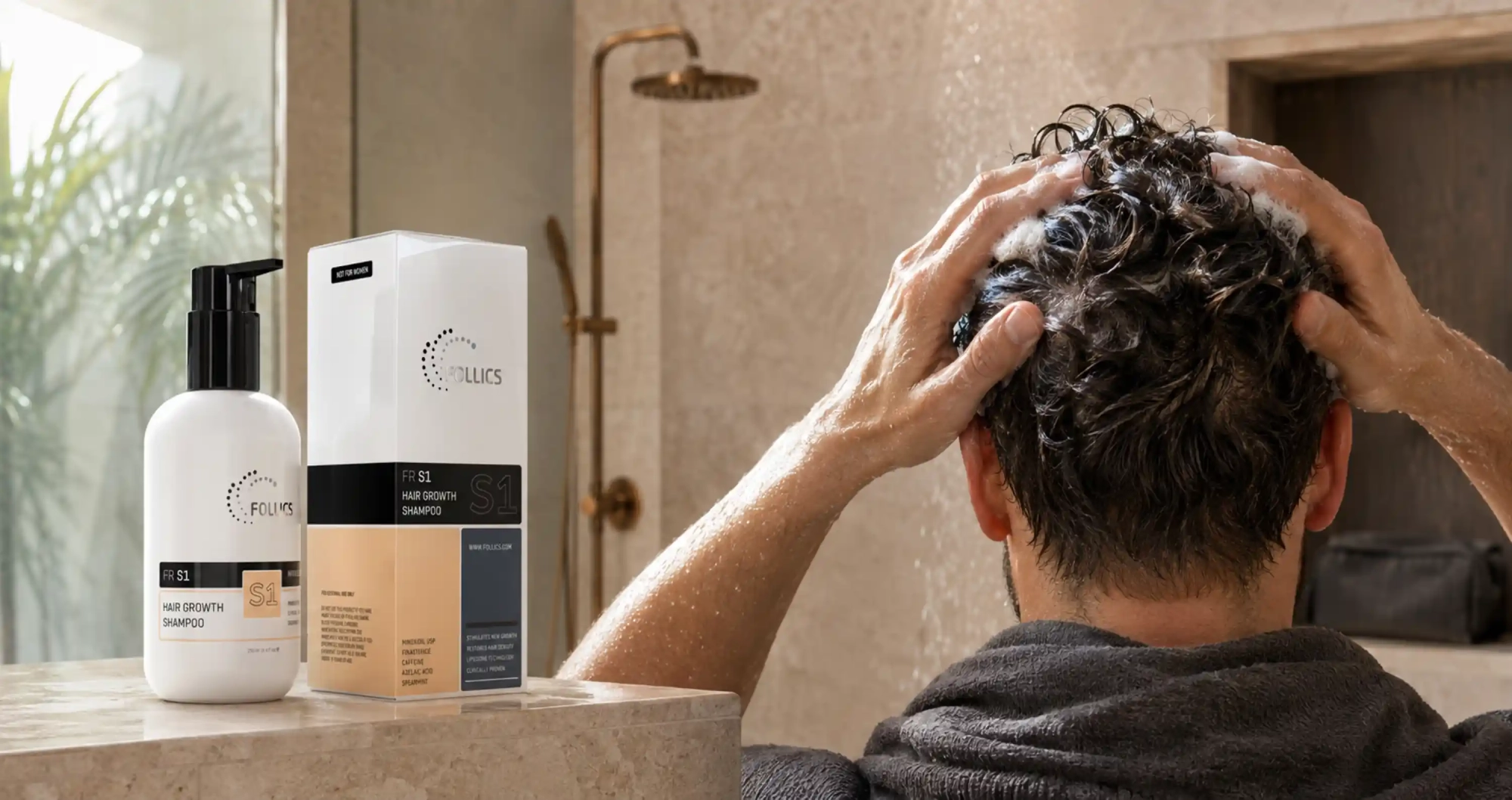
The FR S1 caffeine azelaic acid shampoo combines two supporting ingredients commonly associated with androgen-related scalp care, but the evidence behind them is not equal.
Caffeine has laboratory evidence in human hair follicles, penetration research using shampoo formats and limited clinical shampoo studies. Azelaic acid has older laboratory evidence showing inhibition of 5-alpha-reductase activity in human skin, but that evidence was produced in vitro—not in people using an azelaic-acid hair-loss shampoo.
The live Follics FR S1 Shampoo page lists caffeine and azelaic acid alongside minoxidil, finasteride and spearmint. It directs users to apply the shampoo to damp hair, massage it into the scalp, allow it to soak for three to four minutes, rinse and follow with FR C1 Conditioner. The page does not publicly disclose the concentration of any active ingredient or the recommended number of weekly washes.
The safest evidence-based conclusion for FR S1 caffeine azelaic acid shampoo is:
Caffeine and azelaic acid give FR S1 a plausible DHT-supporting formulation rationale, but neither ingredient has been shown to provide a clinically proven additional benefit inside the finished FR S1 shampoo.
Direct Answer
What does FR S1 caffeine azelaic acid shampoo add to DHT-focused care?
Caffeine may support the formula by:
- Penetrating hair follicles during short shampoo contact in experimental research.
- Stimulating cultured human hair follicles under laboratory conditions.
- Counteracting testosterone-related growth suppression in an ex-vivo follicle model.
- Providing a supportive—not guaranteed—anti-thinning role.
Azelaic acid may support the formula by:
- Inhibiting 5-alpha-reductase in a human-skin laboratory assay.
- Supporting the manufacturer’s broader DHT-focused formulation concept.
- Potentially contributing scalp-related antimicrobial or keratinisation effects, although those effects have been studied mainly in dermatological skin conditions rather than androgenetic alopecia.
The two ingredients should not be described as equivalent to finasteride.
Is FR S1 a caffeine-and-azelaic-acid shampoo only?
No. The current product page also lists minoxidil and finasteride, which materially change its medical and safety profile.
Does the three-to-four-minute soak make the ingredients clinically effective?
The soak follows the manufacturer’s directions. A separate penetration study found that caffeine from another shampoo formulation entered follicles after two minutes, but that does not verify FR S1’s caffeine concentration, delivery or clinical effectiveness.
What the FR S1 caffeine azelaic acid shampoo Product Page Actually Confirms
The live FR S1 page describes the product as a hair-growth shampoo for men.
Publicly listed ingredients
- Minoxidil.
- Finasteride.
- Caffeine.
- Azelaic acid.
- Spearmint.
- Liposphere delivery technology.
- Unidentified supporting ingredients within the full shampoo base.
Verified directions
The product page instructs users to:
- Apply the shampoo to damp hair.
- Massage it into the scalp.
- Allow it to soak for three to four minutes.
- Rinse it out.
- Follow with Follics FR C1 Hair Growth Conditioner.
Verified storage directions
The page instructs users to keep FR S1:
- In a cool, dry place.
- Away from direct sunlight.
- Protected from freezing.
- Protected from excessive heat.
What the public page does not confirm
| Missing Information | Why It Matters |
| Minoxidil concentration | Needed to assess exposure and compare established products |
| Finasteride concentration | Needed for hormonal, transfer and PSA-related counselling |
| Caffeine concentration | Clinical and laboratory studies use defined formulations |
| Azelaic-acid concentration | Laboratory enzyme inhibition is concentration-dependent |
| Spearmint concentration | Required before making an anti-androgen claim |
| Shampoo quantity per wash | Needed for exposure and bottle-duration calculations |
| Weekly use frequency | Prevents inventing daily or three-times-weekly directions |
| Full inactive ingredients | Needed for allergy and irritation assessment |
| Sulphate content | Relevant to cleansing strength and scalp tolerance |
| Fragrance content | Relevant to sensitive scalps |
| Contact-allergy warnings | Important for a multi-active formula |
| Finished-product clinical trial | Required for FR S1-specific efficacy claims |
| Systemic absorption data | Required for minoxidil and finasteride safety claims |
| Pregnancy-transfer directions | Essential for a finasteride-containing product |
| PSA disclosure warning | Potentially relevant if finasteride is systemically absorbed |
| Approved age group | Needed before recommending it to younger users |
For FR S1 caffeine azelaic acid shampoo, the physical bottle, carton and supplied leaflet must be checked before publication.
FR S1 Caffeine Azelaic Acid Shampoo: What the Ingredients Actually Do
Caffeine and azelaic acid are often grouped together under “natural DHT blocker” language.
That description is too broad.
The ingredients have different evidence:
| Ingredient | Evidence Type | Evidence-Safe Position |
| Caffeine | Human-follicle laboratory studies, penetration research and limited shampoo trials | May support follicle activity; clinical certainty remains limited |
| Azelaic acid | Human-skin enzyme assay performed in vitro | Can inhibit 5-alpha-reductase under laboratory conditions; clinical hair-loss benefit is unproven |
| Finasteride | Established 5-alpha-reductase inhibitor with clinical treatment evidence | The formula’s more established DHT-targeting medicine |
| Minoxidil | Established topical hair-growth medicine | Growth-stimulation component rather than direct finasteride-like DHT inhibition |
In FR S1 caffeine azelaic acid shampoo, the two supporting ingredients should not be presented as if they offer the same clinical DHT reduction as finasteride.
What Does Caffeine Do to Hair Follicles?
A 2007 laboratory study cultured scalp hair follicles taken from men with androgenetic alopecia.
Researchers found that:
- Testosterone suppressed hair-follicle growth in the model.
- Caffeine at specific low concentrations counteracted that suppression.
- Caffeine alone stimulated follicle growth and keratinocyte proliferation.
This was an ex-vivo laboratory study, not a shampoo trial in people.
A later human-follicle laboratory study reported that caffeine:
- Enhanced hair-shaft elongation.
- Prolonged the growth phase in cultured follicles.
- Stimulated hair-matrix keratinocyte proliferation.
- Influenced several growth-cycle signals.
Again, the follicles were studied outside the human body.
What these studies support for FR S1 caffeine azelaic acid shampoo
They support describing caffeine as:
A biologically active ingredient with plausible follicle-stimulating effects under laboratory conditions.
What they do not support
They do not prove that:
- Every caffeine shampoo regrows hair.
- FR S1 delivers the same concentration used in the laboratory.
- A three-minute wash produces the same exposure as continuous culture.
- Caffeine clinically blocks scalp DHT.
- Caffeine can replace minoxidil or finasteride.
- More caffeine creates better results.
- Drinking coffee has the same effect as topical caffeine.
Can Caffeine Penetrate During a Short Shampoo Contact?
A penetration study applied a caffeine-containing shampoo for two minutes and measured caffeine entering through hair follicles and the surrounding skin.
The researchers found that:
- Caffeine penetrated after the two-minute contact.
- Follicular entry was faster than entry through the surrounding skin during the early period.
- Hair follicles formed an important rapid-delivery route.
This makes short-contact caffeine exposure in FR S1 caffeine azelaic acid shampoo biologically plausible.
It does not prove FR S1 effectiveness because the study used:
- A different shampoo.
- A known experimental caffeine formulation.
- A penetration endpoint rather than hair-regrowth outcomes.
- A controlled protocol rather than ordinary home use.
Evidence-safe conclusion for FR S1 caffeine azelaic acid shampoo
The FR S1 three-to-four-minute soak may provide enough time for some caffeine exposure to occur.
The amount reaching follicles and whether it produces a meaningful clinical result remain unknown because FR S1’s caffeine concentration and pharmacokinetic data are not public.
What Do Clinical Caffeine-Shampoo Studies Show?
A double-blind trial studied a phyto-caffeine shampoo in women with androgenetic alopecia for six months.
Compared with the control shampoo, the caffeine group had:
- Fewer hairs removed in a hair-pull test.
- Improvements in several secondary assessments.
- Good tolerability.
The product, population and formula were different from FR S1.
A 2025 systematic review identified nine clinical studies involving topical caffeine products. Although all studies reported favourable conclusions, the reviewers rated much of the evidence as medium, low or very low quality because of issues such as missing control groups, weak randomisation and undisclosed caffeine concentrations.
What this means for FR S1 caffeine azelaic acid shampoo
Caffeine has more than purely theoretical support.
However, the evidence is not strong enough to state:
- FR S1 clinically stops androgenetic alopecia.
- Its caffeine is equivalent to 5% minoxidil.
- Its shampoo format produces a known hair-count increase.
- It works in every user.
- It provides independently proven additional benefit alongside minoxidil and finasteride.
Is Caffeine a DHT Blocker?
For FR S1 caffeine azelaic acid shampoo, the phrase needs qualification.
Caffeine is not an established 5-alpha-reductase inhibitor in the same clinical category as finasteride.
Laboratory research suggests that caffeine may counteract some testosterone-related inhibitory effects inside cultured hair follicles. That is different from proving that it lowers scalp or blood DHT in FR S1 users.
Safer wording
Use:
Caffeine may help support follicle activity under androgen-related stress.
Avoid:
- “Caffeine blocks DHT.”
- “Caffeine removes DHT from the scalp.”
- “Caffeine is natural finasteride.”
- “Caffeine prevents all hormonal hair loss.”
- “Caffeine makes finasteride unnecessary.”
What Is Azelaic Acid Doing in FR S1?
The most frequently cited azelaic-acid DHT evidence comes from a 1988 laboratory study.
Researchers measured 5-alpha-reductase activity in human skin samples and found that:
- Azelaic acid inhibited the enzyme in vitro.
- The effect depended on the concentration.
- Complete enzyme inhibition occurred at a high laboratory concentration.
- The authors explicitly stated that the effect needed confirmation in vivo.
For FR S1 caffeine azelaic acid shampoo, this supports a biochemical rationale.
It does not establish a clinical hair-loss treatment.
The crucial evidence distinction
The study was:
- Conducted in a laboratory assay.
- Performed on human skin material.
- Not a trial in people with androgenetic alopecia.
- Not a shampoo study.
- Not an FR S1 study.
- Not based on a three-to-four-minute rinse-off routine.
Evidence-safe description for FR S1 caffeine azelaic acid shampoo
Azelaic acid may be described as:
An ingredient that has inhibited 5-alpha-reductase activity in a human-skin laboratory model.
It should not be described as:
- A clinically proven natural DHT blocker for hair loss.
- Equivalent to finasteride.
- Proven to reduce scalp DHT in FR S1 users.
- Proven to regrow hair.
- Proven to work in a rinse-off shampoo.
- A replacement for medical treatment.
Does Azelaic Acid Have Direct Hair-Loss Clinical Trials?
No directly applicable randomised clinical trial was identified showing that an azelaic-acid shampoo improves androgenetic alopecia.
Azelaic acid has established dermatological uses in conditions such as acne and pigmentation disorders, but those uses do not verify its effectiveness for patterned hair loss.
Why skin evidence cannot be transferred automatically
A scalp shampoo differs from a leave-on azelaic-acid cream in:
- Concentration.
- Vehicle.
- Contact time.
- Skin area.
- Rinsing.
- Frequency.
- Absorption.
- Treatment objective.
Do not use acne evidence to promise hair growth.
Do Caffeine and Azelaic Acid Work Synergistically in FR S1 caffeine azelaic acid shampoo?
No FR S1 synergy study is publicly displayed.
The formula contains:
- Caffeine.
- Azelaic acid.
- Finasteride.
- Minoxidil.
- Spearmint.
- A shampoo vehicle.
- Claimed Liposphere delivery technology.
The FR S1 caffeine azelaic acid shampoo formula may be designed to address several pathways.
That does not prove:
- Additive efficacy.
- Synergy.
- Faster results.
- Lower adverse effects.
- Better DHT suppression.
- Greater follicle penetration.
- Superiority over separate treatments.
- That every active reaches a clinically useful concentration.
Correct formulation statement for FR S1 caffeine azelaic acid shampoo
Caffeine and azelaic acid broaden the scientific rationale of FR S1, but their individual contribution to the finished shampoo has not been isolated.
The FR S1 caffeine azelaic acid shampoo Rinse-Off Question: Can a Shampoo Treat Hair Loss?
A shampoo has less scalp-contact time than a leave-on solution.
FR S1 is directed to remain for three to four minutes and then be rinsed.
A leave-on product may remain for several hours.
This creates an important distinction:
| Feature | FR S1 Shampoo | Typical Leave-On Scalp Treatment |
| Contact | Three to four minutes | Often several hours |
| Removal | Rinsed | Left on |
| Vehicle | Cleansing shampoo | Solution, foam, cream or serum |
| Exposure | Short and repeated | Longer and sustained |
| Amount reaching scalp | Not publicly measured | Depends on dose and formulation |
| Systemic exposure | Unknown for FR S1 | May be measured in product trials |
| Clinical evidence | No finished FR S1 trial displayed | Available for some licensed treatments |
A rinse-off format is not automatically ineffective. Caffeine penetration has been detected after short shampoo exposure.
It is also not automatically equivalent to a leave-on medicine.
Why Minoxidil and Finasteride Cannot Be Ignored
This article focuses on caffeine and azelaic acid, but FR S1 also lists minoxidil and finasteride.
These are not ordinary cosmetic additions.
Their presence means users need to consider:
- Total exposure from other hair-loss products.
- Potential scalp irritation.
- Pregnancy and household-transfer precautions.
- Cardiovascular symptoms associated with minoxidil.
- Hormonal and PSA considerations associated with finasteride.
- Whether a medicated rinse-off shampoo is appropriate for their diagnosis.
- Whether the physical formula is authorised and correctly labelled.
The public page does not disclose the concentrations of either medicine.
With FR S1 caffeine azelaic acid shampoo, do not assume rinse-off means risk-free
The amount absorbed from FR S1 has not been published.
A phase III trial of a separate leave-on topical finasteride spray found much lower plasma exposure than oral finasteride, but serum DHT still decreased. That result proves topical finasteride can have systemic effects; it does not quantify exposure from FR S1 shampoo.
Can FR S1 Replace a Leave-On Minoxidil or Finasteride Treatment?
For FR S1 caffeine azelaic acid shampoo, that replacement claim is not supported.
FR S1’s public page does not provide:
- Active concentrations.
- Daily drug exposure.
- Hair-count outcomes.
- Comparison with leave-on treatment.
- Non-inferiority data.
- Long-term response rates.
A shampoo may be used as:
- A supportive scalp-care step.
- A medically planned component of a larger routine.
- A rinse-off format for users specifically advised to use it.
It should not automatically replace:
- A prescribed topical treatment.
- Oral finasteride.
- Standard minoxidil.
- A dermatologist’s treatment plan.
Do not stop another prescribed medicine merely because FR S1 contains the same ingredient names.
Can FR S1 Be Used With FR10, FR12 or FR16?
Do not combine them automatically.
FR S1 lists minoxidil and finasteride.
FR10 lists high-strength minoxidil.
FR12 and FR16 list both minoxidil and finasteride.
Using these products together may increase:
- Total minoxidil exposure.
- Total finasteride exposure.
- Scalp irritation.
- Dryness.
- Cardiovascular risk.
- Hormonal effects.
- Transfer risk.
- Difficulty identifying which product caused a reaction.
A clinician needs the full concentrations before deciding whether a combination is reasonable.
Do not assume that rinsing FR S1 removes all medicinal exposure.
Can FR S1 Be Used With FIN25 or Finasteride Tablets?
FIN25 topical finasteride and oral finasteride add further exposure to the same drug class.
Before combining them, a clinician should review:
- FR S1 finasteride concentration.
- FIN25 concentration and dose.
- Oral dose, when applicable.
- Other DHT blockers.
- Sexual symptoms.
- Fertility plans.
- Mood history.
- PSA testing.
- Pregnancy exposure.
- Scalp tolerance.
Do not combine finasteride products based only on the idea that shampoo exposure is “too small to matter.”
Correct FR S1 caffeine azelaic acid shampoo Application Routine
The verified product-page routine is:
Wet or damp hair
│
▼
Apply FR S1 to scalp and hair
│
▼
Massage into the scalp
│
▼
Allow 3–4 minutes of contact
│
▼
Rinse thoroughly
│
▼
Follow with FR C1 Conditioner
The three-to-four-minute contact period should not be shortened to one or two minutes unless the physical label differs.
How Much Shampoo Should Be Used?
The live page does not provide:
- Millilitres.
- Pumps.
- Teaspoons.
- Coin-size guidance.
- Dose by hair length.
Do not invent a quantity.
Use enough to follow the physical instructions and cover the intended scalp area without:
- Pouring excessive shampoo.
- Concentrating it only on hair lengths.
- Allowing it to run into the eyes.
- Repeating the wash as an extra dose.
- Leaving residue after rinsing.
The required amount may depend on:
- Hair length.
- Hair density.
- Scalp size.
- Product dispenser.
- Whether the first wash removes heavy oil or styling residue.
The physical packaging should provide controlling directions.
How Often Should FR S1 caffeine azelaic acid shampoo Be Used?
The current product page does not state a weekly frequency.
Therefore, this article must not instruct users to apply it:
- Daily.
- Every other day.
- Twice weekly.
- Three to four times weekly.
- With every shower.
Frequency matters because FR S1 contains medicinal ingredients.
The correct frequency should come from:
- Physical product label.
- Supplied leaflet.
- Qualified clinician or pharmacist.
- Manufacturer confirmation.
For missing frequency instructions, contact Hims & Hers UAE before use.
Why the Three-to-Four-Minute Timer Matters for FR S1 caffeine azelaic acid shampoo
A timer helps users follow the verified contact period accurately.
Too short
Rinsing immediately may reduce contact with the scalp.
Too long
Leaving the shampoo far beyond the labelled period may increase:
- Dryness.
- Irritation.
- Eye or facial runoff.
- Uncontrolled medicinal exposure.
- Confusion with leave-on products.
Do not interpret “longer contact” as “better results.”
Simple routine
- Start the timer after the shampoo has been distributed and massaged.
- Keep the product away from the eyes.
- Rinse when three to four minutes have passed.
- Do not let the shampoo dry onto the scalp.
Should FR S1 Be Used Before or After the Gym?
Use it during the planned post-workout shower when the physical instructions and prescribed frequency allow.
A practical sequence is:
Workout → cool down → wet hair → apply FR S1 → massage → wait three to four minutes → rinse → conditioner.
This removes:
- Sweat.
- Excess oil.
- Dust.
- Styling residue.
Do not add an extra medicated wash after every workout when that exceeds the verified frequency.
A body shower does not necessarily require an FR S1 wash.
Should FR S1 Be Used Before a Leave-On Treatment?
When a clinician has approved both products, the general sequence is usually:
- Complete the FR S1 wash.
- Rinse thoroughly.
- Use conditioner as directed.
- Rinse the conditioner.
- Dry the scalp completely.
- Apply the approved leave-on treatment according to its label.
Do not mix FR S1 into a leave-on serum or apply a scalp treatment while shampoo remains present.
Because FR S1 itself contains minoxidil and finasteride, combination use requires a treatment-specific decision.
Following With FR C1 Conditioner
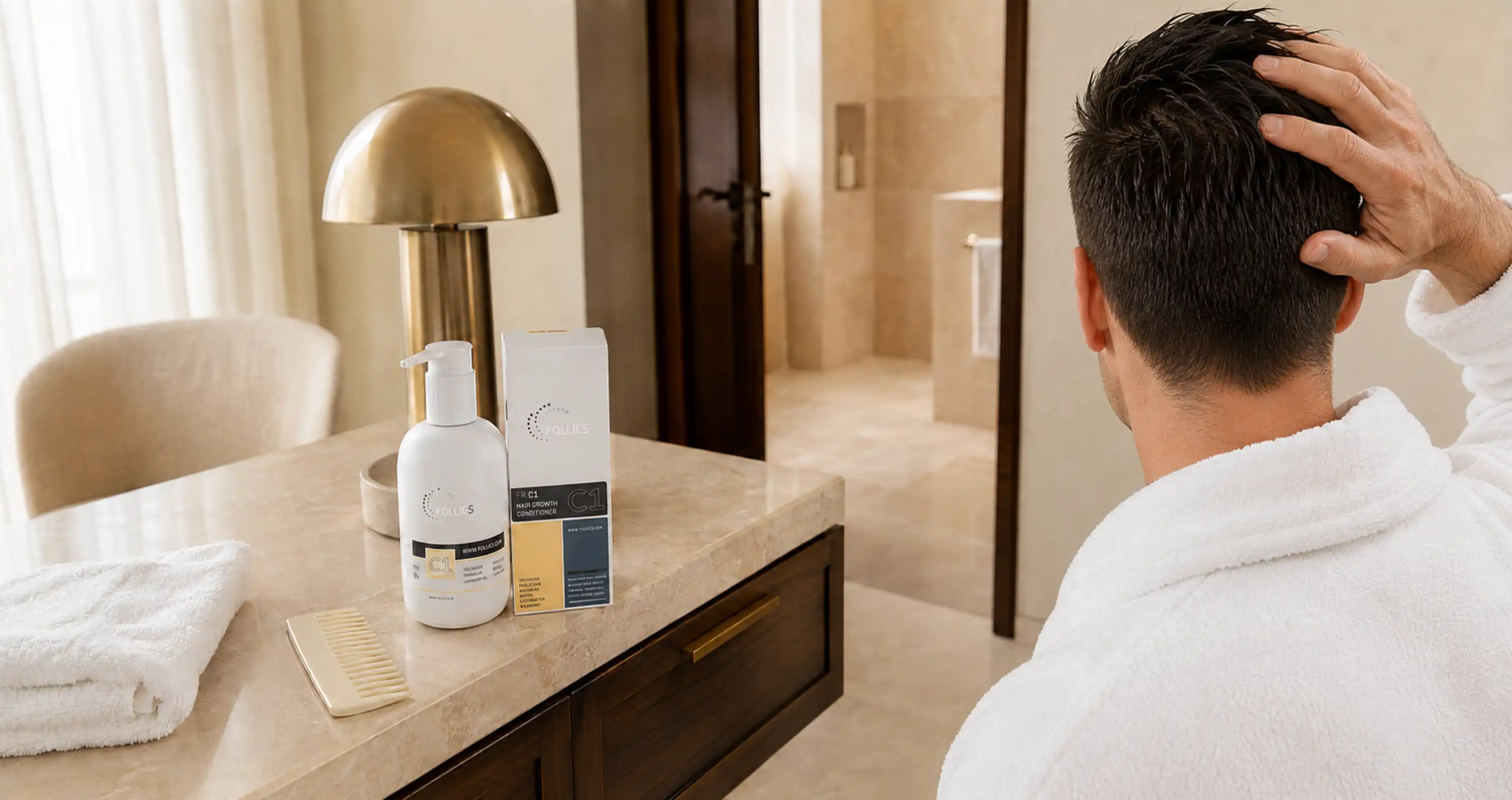
The FR S1 page specifically directs users to follow with Follics FR C1 Conditioner.
The FR C1 page directs users to:
- Apply it after Follics shampoo.
- Massage it into the skin and hair for one to two minutes.
- Rinse and style.
Keep the routines separate
FR S1:
- Massage.
- Three-to-four-minute soak.
- Rinse.
FR C1:
- Apply afterwards.
- Massage for one to two minutes.
- Rinse.
Do not combine both products in the hand.
Conditioner evidence boundary
FR C1’s page makes broad claims about Trichogen, Follicusan and Pronalen.
Those ingredients and claims belong to the separate FR C1 content cluster and should not be used as evidence that FR S1 works better.
Customers comparing non-medicated conditioning options can browse other conditioners available from Hims & Hers UAE.
Does Conditioner Reduce FR S1’s Effect?
No FR S1 study publicly answers this question.
Following with FR C1 is part of the manufacturer’s recommended sequence.
To avoid unnecessary interference:
- Rinse FR S1 fully.
- Apply conditioner according to its own directions.
- Rinse fully where directed.
- Avoid leaving a heavy conditioner layer on the scalp before another medicated treatment.
- Dry the scalp before any approved leave-on medicine.
Do not assume that conditioner “seals in” shampoo medicine after rinsing.
FR S1 caffeine azelaic acid shampoo Evidence Hierarchy
Level 1 — Verified FR S1 product information
The live page confirms:
- Caffeine.
- Azelaic acid.
- Minoxidil.
- Finasteride.
- Spearmint.
- Three-to-four-minute contact.
- Rinse-off use.
- FR C1 follow-up.
Level 2 — Human-hair-follicle caffeine research
Laboratory studies support caffeine’s capacity to stimulate cultured human follicles and counteract androgen-related suppression under specific experimental conditions.
Level 3 — Caffeine shampoo penetration
A two-minute shampoo study demonstrated rapid caffeine entry through follicles.
Level 4 — Caffeine shampoo clinical evidence
A controlled female study reported favourable hair-pull outcomes after six months, but it tested another formula and population.
Level 5 — Azelaic-acid enzyme evidence
An in-vitro human-skin assay found concentration-dependent 5-alpha-reductase inhibition and called for in-vivo confirmation.
Level 6 — FR S1 uncertainty
No public evidence provides:
- A randomised FR S1 trial.
- FR S1 hair-count data.
- FR S1 caffeine concentration.
- FR S1 azelaic-acid concentration.
- FR S1 scalp-DHT measurement.
- FR S1 systemic finasteride exposure.
- FR S1 systemic minoxidil exposure.
- Proof that the ingredients act synergistically.
- Comparison with a non-medicated shampoo.
- Comparison with leave-on treatment.
- Long-term product-specific safety data.
Manufacturer Claims Versus Independent Evidence
| Topic | Product-Page Positioning | Evidence-Safe Interpretation |
| Caffeine | Counteracts DHT miniaturisation and stimulates metabolism | Laboratory follicle evidence is promising; direct FR S1 clinical proof is absent |
| Azelaic acid | DHT inhibitor | 5-alpha-reductase inhibition was shown in vitro; clinical shampoo efficacy remains unproven |
| “Natural DHT blockers” | Caffeine and azelaic acid presented as powerful blockers | Neither has finasteride-level clinical DHT evidence |
| Minoxidil and finasteride combination | Positioned as uniquely powerful | Concentrations and finished-product trial are missing |
| Liposphere technology | Claimed to improve depth and duration | FR S1 penetration data are not publicly displayed |
| Global hair-loss approach | Claims to address every known cause | Hair loss has many causes, and one shampoo cannot be assumed to treat all of them |
| Three-to-four-minute soak | Verified direction | Caffeine penetration is plausible; overall active exposure is unknown |
| Supporting cleanse | Multi-active shampoo | Should not be treated as a proven replacement for leave-on therapy |
Scalp and Hair Safety
Possible local reactions may include:
- Redness.
- Burning.
- Itching.
- Dryness.
- Flaking.
- Increased sensitivity.
- Rash.
- Eye irritation.
- Hair-texture changes.
- Reaction to fragrance or preservatives.
- Irritation from active ingredients.
Stop use and seek professional advice when:
- Burning is severe.
- Redness persists.
- The scalp becomes swollen.
- Blisters appear.
- The rash spreads.
- Hair loss suddenly worsens.
- Facial swelling occurs.
- Breathing becomes difficult.
- Eye pain continues after rinsing.
- Unexpected systemic symptoms develop.
Minoxidil Safety Context
Standard topical-minoxidil labels advise users to stop and seek medical advice for symptoms such as:
- Chest pain.
- Rapid heartbeat.
- Dizziness or faintness.
- Sudden unexplained weight gain.
- Swelling of hands or feet.
- Persistent scalp irritation.
- Unwanted facial hair.
These warnings come from leave-on topical minoxidil products—not FR S1 shampoo.
They should be treated as a safety framework because FR S1 lists minoxidil but does not disclose its concentration or absorption.
Do not claim that the shampoo’s rinse-off format eliminates cardiovascular risk.
Finasteride Safety Context
Topical-finasteride research has demonstrated that systemic exposure may be lower than oral exposure while serum DHT can still decrease. The measured findings depend heavily on the exact formulation and dose.
FR S1 does not publish comparable data.
A user should report:
- New sexual symptoms.
- Reduced libido.
- Erectile problems.
- Ejaculation changes.
- Testicular pain.
- Fertility concerns.
- Breast tenderness or enlargement.
- Breast lumps or nipple discharge.
- New or worsening mood symptoms.
- Any persistent unexpected reaction.
The shampoo should not be marketed as free of finasteride-related concerns.
Pregnancy and Household Transfer Precautions
Official finasteride labelling warns that finasteride exposure during pregnancy can pose a risk to development of a male fetus.
The official warning concerns tablets, not FR S1 shampoo.
However, because FR S1 contains finasteride in a wet topical product, conservative precautions are appropriate until product-specific instructions are available.
Avoid transfer through:
- Shampoo-covered hands.
- Splashes.
- Shared washcloths.
- Towels.
- Shower surfaces.
- A leaking bottle.
- A child handling the product.
- Another person massaging the shampoo.
- Unrinsed scalp contact.
Safer handling
- Apply the product yourself where practical.
- Keep it away from the face and eyes.
- Wash the hands thoroughly after rinsing.
- Rinse the shower or sink if product spills.
- Store the bottle away from children.
- Do not allow a pregnant person to apply the shampoo without specialist advice.
- Follow any stricter physical-label warning.
Pregnancy and breastfeeding
FR S1 should not be self-used during pregnancy or breastfeeding without explicit medical advice because it lists minoxidil and finasteride.
Eye and Accidental-Ingestion Precautions
Avoid eye contact.
If shampoo enters the eyes:
- Rinse with plenty of cool, clean water.
- Remove contact lenses where appropriate and easy.
- Do not rub.
- Seek medical advice if pain, redness or visual symptoms continue.
Keep the product out of reach of children.
If swallowed:
- Do not induce vomiting unless instructed by a medical professional.
- Obtain prompt medical or poison-control advice.
- Provide the physical ingredient label.
Do Not Use on a Damaged Scalp
Avoid applying FR S1 over:
- Open cuts.
- Fresh microneedling channels.
- Active infection.
- Severe dermatitis.
- Sunburn.
- Bleeding skin.
- Recent transplant sites.
- Unhealed scalp procedures.
- Painful unexplained rash.
A damaged barrier may increase irritation and alter absorption.
Do not combine FR S1 with microneedling unless a qualified clinician has designed the protocol.
Who Might Consider FR S1 caffeine azelaic acid shampoo?
FR S1 may deserve professional consideration for an adult man who:
- Has a confirmed diagnosis of androgenetic alopecia.
- Wants a rinse-off medicated scalp-care format.
- Understands that it contains minoxidil and finasteride.
- Can follow the three-to-four-minute contact time.
- Can follow the verified frequency from the physical label.
- Has a healthy, intact scalp.
- Is not independently combining several medicated products.
- Understands that caffeine evidence is promising but limited.
- Understands that azelaic-acid hair-loss evidence is primarily laboratory based.
- Accepts that FR S1 lacks a public finished-product trial.
- Can follow pregnancy and household-transfer precautions.
Who Should Not Self-Start FR S1?
Professional assessment is particularly important for:
- People without a confirmed diagnosis.
- People with sudden or patchy hair loss.
- People with an inflamed or infected scalp.
- People under 18.
- Pregnant or breastfeeding individuals.
- People trying to conceive where finasteride exposure is a concern.
- People using oral finasteride.
- People using FIN25, FR12 or FR16.
- People using dutasteride.
- People using oral minoxidil.
- People with heart disease.
- People with low blood pressure.
- People taking blood-pressure medicines.
- People with previous minoxidil or finasteride reactions.
- People planning microneedling or transplant procedures.
Readers comparing medically supervised alternatives can browse other hair-loss treatments available in the UAE.
UAE Routine Considerations
Post-gym washing
Use FR S1 during the post-workout shower only when that wash fits the verified product frequency.
Do not add extra medicated washes solely because the scalp feels sweaty.
Hard-water and buildup
Rinse thoroughly to avoid shampoo residue.
This article does not claim that FR S1 removes mineral buildup or “detoxifies” the scalp.
Hot water
Very hot water may worsen dryness or sensitivity.
Use a comfortable water temperature.
Hair styling
Rinse both shampoo and conditioner fully before styling.
Allow the scalp to dry before an approved leave-on treatment.
UAE heat
Store FR S1 away from:
- Parked vehicles.
- Direct sunlight.
- Hot windows.
- Balconies.
- Wet gym bags.
- Bathroom steam where possible.
The official page requires cool, dry storage and protection from excessive heat.
Product-Label Verification Checklist
Product identity
- Product name states Follics FR S1.
- Bottle and outer packaging match.
- Batch number is visible.
- Expiry date is visible.
- Manufacturer details are present.
Active ingredients
- Minoxidil is listed.
- Minoxidil concentration is stated.
- Finasteride is listed.
- Finasteride concentration is stated.
- Caffeine concentration is stated.
- Azelaic-acid concentration is stated.
- Spearmint ingredient and form are stated.
Directions
- Damp-hair application is confirmed.
- Three-to-four-minute contact is confirmed.
- Rinsing directions are confirmed.
- Weekly frequency is stated.
- Quantity per wash is stated.
- Missed-use or extra-wash guidance is checked.
- FR C1 follow-up direction is confirmed.
Formula
- Complete shampoo base is listed.
- Sulphates are identified.
- Fragrance is identified.
- Preservatives are identified.
- Colourants are identified.
- Propylene glycol is identified.
- Potential allergens are identified.
Safety
- Pregnancy warning is visible.
- Breastfeeding warning is visible.
- Finasteride-transfer warning is visible.
- Minoxidil cardiovascular warning is visible.
- Eye-contact instructions are visible.
- Broken-skin warning is visible.
- Age restriction is visible.
- Combination-treatment warning is visible.
- Accidental-ingestion instructions are visible.
Storage
- Cool, dry storage is confirmed.
- Direct-sunlight warning is confirmed.
- Freezing warning is confirmed.
- Excessive-heat warning is confirmed.
- Container-closure instructions are confirmed.
For missing concentrations or unclear directions, contact Hims & Hers UAE before use.
Buyer Decision Checklist
Before purchasing FR S1, confirm:
- My hair-loss pattern has been assessed.
- I understand that this is a medicated shampoo.
- I know it contains minoxidil and finasteride.
- The physical label shows all concentrations.
- The weekly frequency is clear.
- I can follow the three-to-four-minute contact time.
- I will not use more often than directed.
- My scalp is not inflamed or damaged.
- My other minoxidil, finasteride and dutasteride products have been reviewed.
- I understand that caffeine evidence is not FR S1-specific.
- I understand that azelaic-acid DHT evidence is in vitro.
- I understand that synergy is not proven.
- Household transfer can be prevented.
- I know which symptoms require medical advice.
Buyer Decision Flowchart
Confirmed androgenetic alopecia?
│
┌────┴────┐
│ │
No Yes
│ │
Seek diagnosis Do you already use minoxidil,
finasteride or dutasteride?
┌────┴────┐
Yes No
│ │
Clinical review Is the full FR S1
before combining label available?
┌────┴────┐
No Yes
│ │
Do not start Can the verified
contact time and
frequency be followed?
┌────┴────┐
No Yes
│ │
Choose another Discuss FR S1
routine suitability
Final Verdict: What Do Caffeine and Azelaic Acid Add to FR S1?
Caffeine gives FR S1 a credible follicle-support rationale.
Its evidence includes:
- Stimulation of cultured human hair follicles.
- Counteraction of testosterone-related growth suppression in laboratory models.
- Rapid follicular penetration from a separate shampoo formulation.
- Limited positive clinical shampoo data.
Azelaic acid gives FR S1 a plausible enzyme-inhibition rationale.
Its strongest relevant evidence is:
- Concentration-dependent 5-alpha-reductase inhibition in an in-vitro human-skin assay.
- An explicit need for confirmation in living patients.
The two ingredients should be positioned as:
- Supporting components.
- Scientifically plausible.
- Relevant to an androgen-focused formulation.
- Less clinically established than finasteride.
- Unproven as an FR S1 combination.
They should not be positioned as:
- Clinically proven natural DHT blockers.
- Replacements for minoxidil or finasteride.
- Proven to work synergistically.
- Proven to regrow hair within a three-minute wash.
- Guaranteed to stop shedding.
- Effective for every cause of hair loss.
FR S1’s product identity also includes minoxidil and finasteride. Those medicines make complete concentration, frequency, safety and transfer information essential.
Review the live Follics FR S1 Shampoo page and physical packaging before use.
Follow the verified routine:
Apply to damp hair → massage → allow three to four minutes → rinse → follow with FR C1 Conditioner.
Readers can also review:
- Follics FR C1 Conditioner
- The wider Follics hair-loss product range
- Other shampoos available from Hims & Hers UAE
- Other men’s hair-care products available in the UAE
- The full collection of hair-loss treatments available in the UAE
- Ordering information in the Hims & Hers UAE FAQs
For missing concentrations, unclear frequency, damaged packaging, unexpected reactions or website-to-label discrepancies, contact Hims & Hers UAE before continuing use.
Frequently Asked Questions
What ingredients are confirmed in Follics FR S1?
The current product page lists minoxidil, finasteride, caffeine, azelaic acid and spearmint. It does not publicly state their concentrations.
What does caffeine do in FR S1?
Caffeine has stimulated cultured human hair follicles and counteracted testosterone-related suppression in laboratory studies. Its exact contribution to FR S1 has not been clinically isolated.
Is caffeine a proven DHT blocker?
Not in the same established clinical sense as finasteride. Laboratory evidence suggests caffeine can counteract some androgen-related effects on follicles, but FR S1 has no published scalp-DHT study.
Can caffeine penetrate during shampooing?
A separate study detected caffeine penetration through hair follicles after a two-minute shampoo application. This supports plausibility but does not prove FR S1 effectiveness.
Are caffeine shampoos clinically studied?
Yes, but the evidence is limited and product-specific. A controlled study in women reported improved hair-pull outcomes with a different phyto-caffeine shampoo.
Does azelaic acid block DHT?
Azelaic acid inhibited 5-alpha-reductase in an in-vitro human-skin assay. Clinical DHT reduction from an azelaic-acid shampoo has not been established.
Is azelaic acid clinically proven for androgenetic alopecia?
No directly applicable clinical shampoo trial was identified.
Do caffeine and azelaic acid work better together?
No FR S1 study has demonstrated additive or synergistic benefit.
Does FR S1 contain minoxidil?
Yes, according to the current product page, but its concentration is not publicly stated.
Does FR S1 contain finasteride?
Yes. The public page lists finasteride but does not show its concentration.
How long should FR S1 remain on the scalp?
The live directions state three to four minutes before rinsing.
How often should FR S1 be used?
The current webpage does not state a frequency. Follow the physical label or qualified professional instructions.
Should FR S1 be applied to dry hair?
No. The product page directs users to apply it to damp hair.
Should I massage FR S1 into the scalp?
Yes. Massage it into the damp scalp, then allow the stated three-to-four-minute contact period.
Should FR S1 be followed with conditioner?
The manufacturer directs users to follow it with Follics FR C1 Conditioner.
Can FR S1 replace leave-on minoxidil?
No product-specific evidence establishes FR S1 as an equivalent replacement for a prescribed leave-on treatment.
Can FR S1 be used with FR10?
Do not combine them automatically because both list minoxidil, and the FR S1 concentration is unknown.
Can FR S1 be used with FR12 or FR16?
Do not combine them without clinical review because FR12 and FR16 contain minoxidil and finasteride, which FR S1 also lists.
Can FR S1 be used with oral finasteride?
A clinician should review the complete finasteride exposure before combining them.
Does rinsing remove all finasteride exposure?
The amount absorbed from FR S1 has not been publicly measured, so zero exposure should not be assumed.
Can pregnant women use or handle FR S1?
FR S1 should not be self-used during pregnancy. Pregnant or potentially pregnant individuals should avoid exposure to its finasteride-containing wet formula without specialist guidance.
Can FR S1 cause cardiovascular symptoms?
FR S1-specific rates are not public. Standard topical-minoxidil warnings include chest pain, rapid heartbeat, dizziness, swelling and unexplained weight gain.
Can FR S1 irritate the scalp?
Yes. A multi-active shampoo may cause redness, burning, dryness, itching or contact dermatitis.
Can FR S1 be used after microneedling?
Do not use it over freshly microneedled, bleeding or damaged scalp unless a qualified clinician has provided a specific protocol.
How should FR S1 be stored in the UAE?
Keep it in a cool, dry place away from direct sunlight, freezing and excessive heat. Do not leave it in a parked vehicle.