
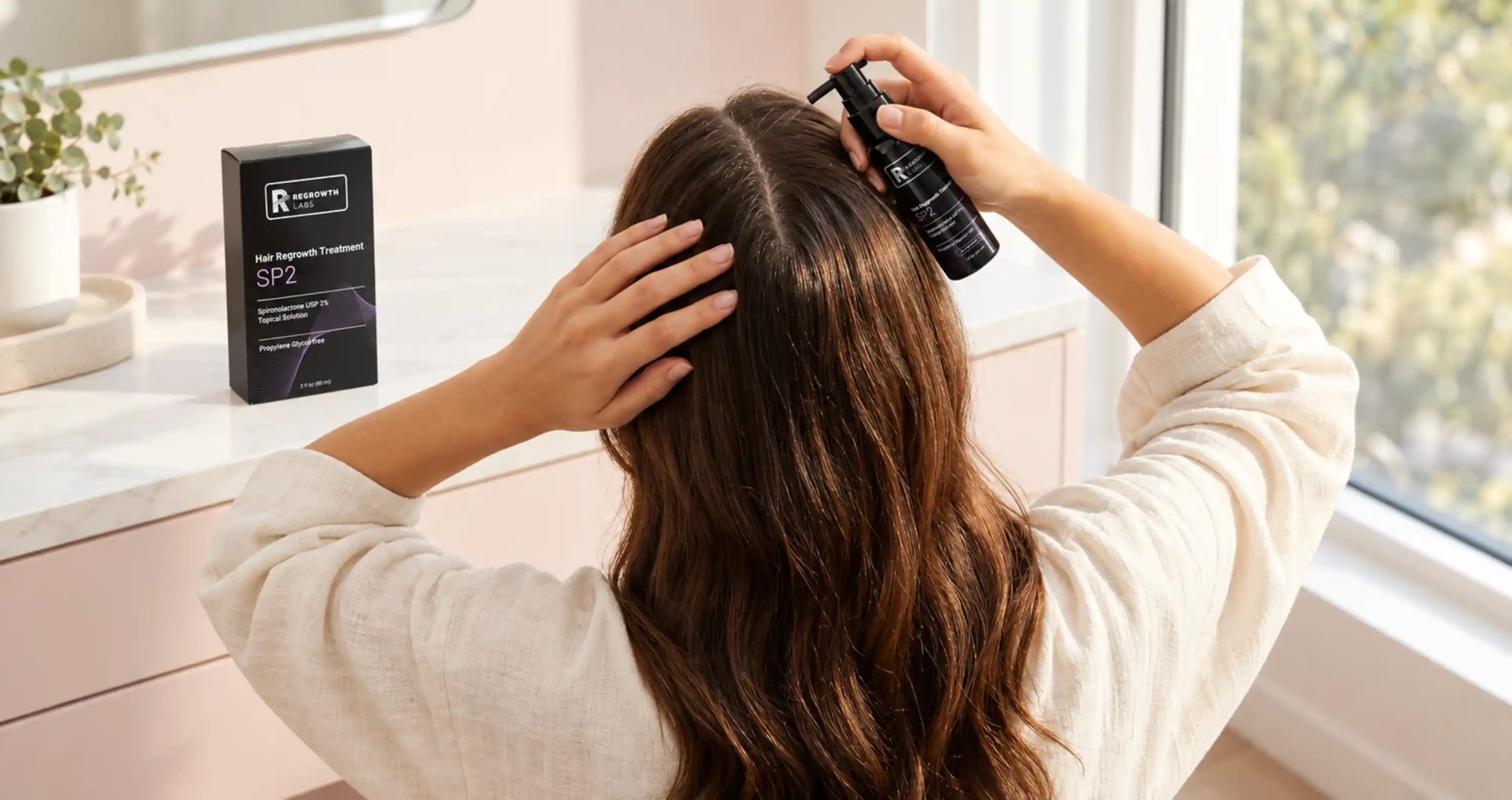
An SP2 hairline vertex treatment buyer is usually trying to answer a practical question: does the product belong only on the crown, or can it also be used across frontal and central thinning?
The live SP2 Hair Regrowth Treatment page gives a direct manufacturer answer. It describes SP2 as a women’s topical treatment containing Spironolactone USP 2% in a propanediol-based vehicle and states that it treats the entire scalp against hair loss, including both the vertex and hairline. The product is listed under Regrowth Labs, Treatments, and Women.
The SP2 hairline vertex treatment claim should be interpreted carefully.
“Entire scalp” should not automatically mean:
- Coat every unaffected area.
- Apply more product when several zones are thinning.
- Use a separate full dose on the hairline and vertex.
- Treat the sides and back without a diagnosis.
- Assume every form of diffuse loss is androgen-related.
- Apply to smooth, scarred or completely bald skin.
- Use SP2 without confirming the physical label’s application amount.
The safest evidence-based interpretation is:
SP2 is positioned for patterned thinning affecting more than one upper-scalp zone, but treatment should be directed to diagnosed affected areas using the exact physical-label dose—not spread indiscriminately over the whole head.
Direct Answer
Is SP2 intended for the hairline?
Yes. The live product page explicitly states that SP2 treats the hairline as well as the vertex.
That may include:
- Reduced density immediately behind the frontal edge.
- A widening frontal part.
- Miniaturised hairs across the front.
- Patterned bitemporal thinning when properly diagnosed.
- Central-frontal density loss.
It does not prove that SP2 can:
- Recreate a completely lost juvenile hairline.
- Restore scarred follicles.
- Reverse traction alopecia after permanent follicle damage.
- Treat every cause of temple recession.
- Produce the same response at the hairline and crown.
Is SP2 intended for the vertex?
Yes. The product description specifically names the vertex as part of its full-scalp positioning.
The vertex refers to the upper-back or crown region where patterned thinning may appear as:
- A widening whorl.
- Greater scalp visibility.
- Reduced density.
- Progressive miniaturisation.
- A broader area of thinning across the upper scalp.
Does full-scalp coverage mean SP2 hairline vertex treatment should be applied everywhere?
No.
It should mean coverage of the affected, diagnosed treatment zones within the product’s approved use—not automatic application to normal-density scalp.
The current webpage does not publish:
- Amount per application.
- Number of pumps or sprays.
- Maximum treatment surface.
- Frequency.
- Hairline-versus-vertex dose allocation.
- Massage time.
- Drying time.
- Leave-in period.
No regional dose should be invented.
Does SP2 hairline vertex treatment work equally well at the hairline and vertex?
That has not been demonstrated.
A 2025 comparative study evaluated topical spironolactone 1% gel in women with female-pattern hair loss and reported clinical and trichoscopic improvement over six months. The study did not directly test SP2 hairline vertex treatment SP2, Spironolactone 2%, its propanediol vehicle or equal response across separately measured hairline and vertex zones.
SP2 Hairline Vertex Treatment: Mapping the Upper Scalp
Women’s patterned thinning does not always follow one shape.
Research reviews describe female-pattern hair loss as progressive miniaturisation that commonly reduces density across frontal, central and vertex scalp regions. The frontal hairline may remain relatively preserved, but frontal accentuation, bitemporal recession, and other patterns can also occur.
A useful SP2 hairline vertex treatment scalp map includes five areas.
Zone 1: Frontal edge
For SP2 hairline vertex treatment mapping, the frontal edge is the forward border of the scalp hair.
Changes may include:
- Finer hairs directly behind the border.
- Reduced frontal density.
- Increased scalp visibility.
- Difficulty maintaining previous styling.
- A wider visible forehead.
- Shorter miniaturised hairs.
In many women with classic female-pattern loss, the frontal edge remains partly preserved while density behind it decreases. That is why a “hairline treatment” may refer to the frontal zone behind the edge rather than drawing a completely new lower hairline.
Zone 2: Temporal corners
In an SP2 hairline vertex treatment scalp map, the temporal corners sit at the front sides of the scalp.
Thinning here can be associated with:
- Female-pattern hair loss.
- Traction from tight hairstyles.
- Frontal fibrosing alopecia.
- Alopecia areata.
- Hormonal or medical conditions.
- Normal variation in hairline shape.
Temple recession should not automatically be labelled androgen-driven.
Warning signs requiring dermatology assessment include:
- Smooth shiny skin.
- Loss of follicular openings.
- Redness or scaling around individual hairs.
- Eyebrow loss.
- Burning, pain or itching.
- Rapid progression.
- A sharply defined patch.
Zone 3: Frontal and central part
A widening central part is one of the most recognisable female-pattern presentations.
It may appear as:
- A broader visible line.
- Reduced density beside the part.
- A triangular “Christmas tree” pattern that is wider toward the forehead.
- More scalp visibility under overhead light.
- Reduced styling volume.
Female-pattern hair loss can involve central and frontal scalp density even when the forward hairline remains present.
Zone 4: Mid-scalp
In an SP2 hairline vertex treatment map, the mid-scalp lies between the frontal area and vertex.
Thinning may appear as:
- Diffuse reduced density.
- Greater scalp visibility.
- A merging of frontal and crown thinning.
- Miniaturised hairs.
- Reduced coverage without a completely bald patch.
SP2’s “entire scalp” positioning may reasonably include the affected mid-scalp, but the manufacturer should publish precise treatment-surface and dose directions before this is converted into a specific application map.
Zone 5: Vertex or crown
For SP2 hairline vertex treatment, the vertex is the upper-back region of the scalp.
Female-pattern thinning here may involve:
- A wider whorl.
- Reduced crown density.
- Increased visibility under direct light.
- Fine hairs replacing thicker terminal hairs.
- Gradual expansion across the upper scalp.
SP2’s product page explicitly names this zone.
Full-Scalp Map
FRONTAL EDGE
┌──────────────────┐
│ Temporal corners │
└────────┬─────────┘
│
FRONTAL / CENTRAL PART
│
▼
MID-SCALP
│
▼
VERTEX / CROWN
How to interpret the map
| Zone | SP2 Positioning | Evidence-Safe Interpretation |
| Frontal edge | Hairline explicitly named | Apply only when physical directions and diagnosis support the area |
| Temporal corners | Potentially part of hairline coverage | Rule out traction, scarring and autoimmune loss |
| Central part | Consistent with common female-pattern distribution | No SP2-specific regional response data |
| Mid-scalp | Potentially included in “entire scalp” wording | Maximum treatment area and dose are not public |
| Vertex | Explicitly named | No finished-product vertex trial is displayed |
| Sides and back | Not specifically discussed | Diffuse loss here may require investigation for another cause |
What the Live SP2 Hairline Vertex Treatment Page Confirms
The current canonical product page is:
The older /product/sp-2-hair-regrowth-treatment/ address redirects to the current canonical URL.
Verified product identity
The live SP2 hairline vertex treatment page confirms:
- Spironolactone USP 2%.
- Topical hair-regrowth-treatment format.
- Propanediol as the stated carrier alternative.
- Women-focused positioning.
- Hairline coverage.
- Vertex coverage.
- Regrowth Labs classification.
- Treatments classification.
- Women category classification.
Manufacturer mechanism claim
The page describes spironolactone as an anti-androgen that:
- Blocks androgen action.
- Is intended to reduce DHT-related effects at the follicle.
- Acts locally where applied.
- Does not affect overall hormone levels.
The first two statements reflect a plausible anti-androgen rationale.
The final claim—that overall hormone levels are unaffected—requires SP2 hairline vertex treatment specific evidence such as:
- Plasma spironolactone levels.
- Active-metabolite levels.
- Serum potassium.
- Blood pressure.
- Serum androgen measurements.
- Menstrual or reproductive outcomes.
- Long-term topical safety monitoring.
No such data are displayed on the product page.
Manufacturer carrier claim
The page describes propanediol as:
- Plant based.
- Skin friendly.
- An alternative to propylene glycol.
- A carrier that enhances absorption.
- Non-irritating.
“Non-irritating” is too absolute for a topical product unless supported by finished-product tolerance testing.
A more accurate statement is:
Propanediol may be selected as an alternative carrier for users concerned about propylene-glycol-containing vehicles, but SP2 can still cause irritation or allergy depending on the complete formula and individual sensitivity.
Critical Information Missing From the SP2 Page
| Missing Information | Why It Matters |
| Amount per application | Required to use the product safely |
| Pump, spray or drop count | Prevents over-application |
| Application frequency | Essential for routine planning |
| Maximum daily amount | Required for exposure control |
| Maximum scalp surface | Needed for “full-scalp” use |
| Hairline-versus-vertex allocation | Prevents separate full doses on each zone |
| Massage instructions | Required for consistent distribution |
| Dry-scalp wording | Important for controlled placement |
| Drying time | Important for pillows and head coverings |
| Leave-in period | Needed before washing or swimming |
| Missed-dose instructions | Prevents doubling |
| Full ingredient list | Required for allergy assessment |
| Propanediol concentration | Needed to understand the vehicle |
| Alcohol content | Relevant to dryness and irritation |
| Preservative system | Relevant to contact dermatitis |
| Fragrance declaration | Relevant to sensitive scalps |
| Product-specific systemic exposure | Needed to support “local only” claims |
| Serum potassium data | Needed before ruling out systemic pharmacology |
| Blood-pressure data | Needed before dismissing hypotension concerns |
| Pregnancy warning | Essential for an anti-androgen |
| Breastfeeding guidance | Currently absent |
| Child-use restriction | Currently absent |
| Finished-product clinical trial | Required for SP2-specific efficacy claims |
| Storage temperature | Important for UAE heat |
| Expiry after opening | Required for product stability |
For missing application and safety information, contact Hims & Hers UAE before using SP2.
What Does Topical Spironolactone Aim to Do?
Spironolactone is an anti-androgen with activity at the androgen receptor.
When used systemically, it also has aldosterone-antagonist and potassium-sparing effects.
In female-pattern hair loss, the anti-androgen rationale is to reduce androgen signalling that may contribute to follicular miniaturisation in susceptible women.
A topical format aims to concentrate exposure in scalp skin while potentially reducing systemic exposure compared with oral treatment.
The key word is potentially.
Without SP2 pharmacokinetic data, it cannot be claimed that the product:
- Remains entirely local.
- Creates no hormonal effect.
- Cannot alter potassium.
- Cannot lower blood pressure.
- Cannot affect menstrual patterns.
- Is equivalent to oral treatment.
- Is safer than oral spironolactone.
What Does Independent Evidence Show for SP2 Hairline Vertex Treatment?
A prospective randomised comparative study included 80 women with female-pattern hair loss.
Participants received either:
- Topical spironolactone 1% gel.
- Topical minoxidil 5% gel.
Treatment continued for six months, with outcomes evaluated using clinical grading and trichoscopy.
Both groups showed improvements, and the authors reported that topical spironolactone demonstrated treatment activity in the studied population.
Why this matters
The study supports the idea that topical spironolactone deserves clinical research as a women’s hair-loss treatment.
Why It Does Not Prove SP2 Hairline Vertex Treatment Outcomes
The study did not test:
- SP2.
- Spironolactone USP 2%.
- SP2’s propanediol vehicle.
- The Hims & Hers UAE bottle.
- Full-scalp dosing.
- Hairline-versus-vertex response.
- Product-specific systemic absorption.
- Pregnancy safety.
- Long-term use beyond six months.
The concentration difference also matters:
Studied topical gel: 1%
SP2 listed concentration: 2%
Higher concentration
does not automatically mean
greater efficacy or equal safety
Can Oral Spironolactone Evidence Be Applied to SP2?
No.
Oral spironolactone has a larger evidence base in women with female-pattern hair loss, including recent randomised and observational studies. Oral trials have measured frontal and vertex hair outcomes, but they assess systemic tablets—not a topical 2% product.
Oral evidence may support the broader anti-androgen concept.
It cannot determine:
- SP2 scalp penetration.
- SP2 blood exposure.
- SP2 regional results.
- SP2 adverse-event rates.
- SP2 dose.
- SP2 treatment frequency.
- SP2 pregnancy risk magnitude.
SP2 Hairline Vertex Treatment: What Is Realistic for Hairline Coverage?
The phrase “hairline treatment” can create unrealistic expectations.
More realistic treatment goals
For a professionally diagnosed, recently thinning frontal area with visible miniaturised hairs, a topical anti-androgen may be considered to:
- Support remaining follicles.
- Reduce further miniaturisation.
- Improve density where follicles remain active.
- Complement another clinician-approved treatment.
Less realistic expectations
SP2 should not be advertised as guaranteed to:
- Lower a naturally high hairline.
- Rebuild a completely lost hairline.
- Restore smooth scarred skin.
- Reverse permanent traction damage.
- Treat frontal fibrosing alopecia.
- Produce dense terminal hair in every temple corner.
- recreate teenage hairline geometry.
Why remaining follicles matter
Visible fine miniaturised hairs
↓
Potentially treatable follicle population
Smooth shiny scalp with no openings
↓
Requires specialist diagnosis;
topical regrowth is less predictable
SP2 Hairline Vertex Treatment: What Is Realistic for Vertex Coverage?
The vertex is a common area of patterned miniaturisation.
A woman may notice:
- A widening crown.
- More visible scalp.
- Fine short hairs.
- Reduced density under overhead lighting.
- A loss of styling volume.
SP2 is explicitly positioned for this region.
However, no finished-product study provides:
- Vertex hair-count change.
- Hair-shaft-diameter change.
- Percentage of responders.
- Comparison with placebo.
- Comparison with minoxidil.
- Time to visible change.
- Results after discontinuation.
- Long-term maintenance outcomes.
The SP2 hairline vertex treatment target-area statement should not be converted into a guaranteed result.
SP2 Hairline Vertex Treatment: Central-Part and Mid-Scalp Coverage
Female-pattern loss frequently affects the central scalp and may create a widening part or Christmas-tree pattern.
Clinical reviews describe reduced density across frontal, central, parietal and vertex areas, with considerable pattern variation between women.
SP2’s full-scalp positioning may be relevant when diagnosed thinning crosses:
- Frontal scalp.
- Central part.
- Mid-scalp.
- Crown.
The missing question is dosage.
The website does not state whether one application amount is intended to cover:
- One small area.
- The entire upper scalp.
- Hairline and crown together.
- Several separate partings.
With SP2 hairline vertex treatment, do not apply separate guessed doses to each region.
Should SP2 Be Applied to the Sides and Back?
Not automatically.
The sides and occipital scalp are often relatively preserved in female-pattern hair loss.
Loss across the entire scalp—including the sides and back—may suggest:
- Telogen effluvium.
- Nutritional deficiency.
- Thyroid disease.
- Medication-related shedding.
- Autoimmune loss.
- Scalp inflammation.
- Diffuse alopecia areata.
- Hair-shaft breakage.
- Another diagnosis.
“Full scalp” should not be used as a substitute for diagnostic assessment.
When Hairline Thinning May Not Be Female-Pattern Hair Loss
Traction alopecia
Consider traction when there is:
- Tight braiding.
- Tight ponytails.
- Extensions.
- Repeated tension under head coverings.
- Broken hairs along the edge.
- Fringe-sign patterns.
- Tenderness after styling.
Early traction may improve when tension stops.
Long-standing scarring traction may not respond adequately to a topical anti-androgen.
Frontal fibrosing alopecia
Warning features include:
- A smooth band of recession.
- Loss of follicular openings.
- Eyebrow loss.
- Redness around hairs.
- Burning or itching.
- Progressive scarring.
This requires dermatologist assessment.
Alopecia areata
Warning features include:
- Sudden smooth patches.
- Exclamation-mark hairs.
- Eyebrow or eyelash loss.
- Nail changes.
Telogen effluvium
This may involve:
- Diffuse shedding.
- A trigger several months earlier.
- Illness.
- Surgery.
- Childbirth.
- nutritional deficiency.
- Weight loss.
- Medication change.
- Major stress.
SP2 should not be self-selected merely because hair shedding is occurring.
SP2 Hairline Vertex Treatment Coverage Does Not Mean Full-Scalp Dose Multiplication
The most important practical rule is:
With SP2 hairline vertex treatment, never multiply an unknown dose by the number of affected regions.
The current page does not state an application amount.
Do not invent:
Hairline dose
+
Central-part dose
+
Vertex dose
=
Three separate full applications
That could increase:
- Local irritation.
- Systemic exposure.
- Product runoff.
- Facial contact.
- Routine inconsistency.
- Risk during pregnancy exposure.
- Difficulty identifying adverse effects.
The physical label must clarify whether the stated dose—when obtained—is:
- Total per application.
- Total per treatment area.
- Adjustable by surface.
- Limited by a maximum daily amount.
Safe Treatment-Zone Principles Without Inventing Directions
Until full instructions are verified:
- Obtain a diagnosis.
- Confirm the physical bottle states Spironolactone USP 2%.
- Confirm the exact amount per application.
- Confirm the use frequency.
- Confirm the approved scalp zones.
- Treat scalp skin rather than coating only the hair.
- Keep the product away from the eyes and face.
- Do not exceed the total labelled amount.
- Do not use a separate full dose on every zone.
- Wash hands unless the physical directions state an alternative.
- Prevent wet-product transfer.
- Stop when significant irritation or systemic symptoms develop.
- Do not apply to broken or inflamed skin.
- Do not use during pregnancy without explicit medical approval.
These are safety principles—not a substitute for missing manufacturer directions.
SP2 Versus FR02: Different Full-Scalp Strategies
Follics FR02 Minoxidil 2% treatment is another women-category topical positioned for both the hairline and vertex.
Its formula and directions differ substantially from SP2.
SP2
- Spironolactone USP 2%.
- Anti-androgen positioning.
- Propanediol vehicle.
- Hairline and vertex positioning.
- Application directions absent from the public page.
FR02
- Minoxidil USP 2%.
- Adenosine.
- Procapil.
- Azelaic acid.
- Procyanidin B2.
- Biotin.
- Five pumps twice daily.
- Two-to-four-minute massage.
- Four-hour-or-longer leave-in.
- Hairline and vertex positioning.
What the comparison does not establish
It does not show:
- SP2 is better for hormonal loss.
- FR02 is better for diffuse loss.
- Both should be combined.
- SP2 should replace minoxidil.
- FR02 should be used when SP2 fails.
- One formula is safer in pregnancy.
- Both products have equivalent full-scalp doses.
A complete product comparison belongs to a separate article.
Can SP2 and FR02 Be Used Together?
Do not combine them independently.
A clinician would need to review:
- Diagnosis.
- Total treated surface.
- Application frequency.
- Scalp tolerance.
- Potential systemic absorption.
- Pregnancy plans.
- Blood pressure.
- Kidney function where relevant.
- Other medicines.
- Whether combination therapy has a justified benefit.
The SP2 page provides insufficient dosing information to calculate a combination safely.
Can SP2 Be Used With Oral Spironolactone?
Do not add topical SP2 to oral spironolactone without professional review.
The clinician should know:
- Oral dose.
- Kidney history.
- Blood pressure.
- Potassium level.
- Other medicines.
- Menstrual symptoms.
- Pregnancy plans.
- Total treated scalp area.
- SP2 application amount.
- Whether any systemic symptoms occur.
Official oral spironolactone labelling includes risks such as hyperkalemia, hypotension, renal-function changes and effects on male fetal sex differentiation based on animal data. Those warnings apply directly to tablets, not automatically to SP2, but they demonstrate why topical systemic exposure should be measured rather than assumed absent.
Can SP2 Be Used With Finasteride or Dutasteride?
Do not combine multiple topical or oral anti-androgens without specialist oversight.
This includes:
- FIN25.
- FR12.
- FR16.
- D5a.
- 5HP.
- 7HP.
- Finasteride tablets.
- Dutasteride capsules.
- Compounded topical finasteride.
- Compounded topical dutasteride.
Combination may increase:
- Hormonal exposure.
- Pregnancy-transfer complexity.
- Scalp irritation.
- Difficulty identifying the responsible ingredient.
- Uncertainty around long-term safety.
Pregnancy and Pregnancy Planning
The SP2 page does not provide pregnancy instructions.
Oral spironolactone labelling states that, based on animal data and its anti-androgenic mechanism, exposure may affect sex differentiation of a male embryo.
That is not a direct topical SP2 pregnancy study.
However, SP2 contains Spironolactone USP 2%, and its systemic absorption has not been published.
A conservative approach is necessary.
Do not self-start SP2 during:
- Pregnancy.
- Pregnancy planning.
- A period when pregnancy is possible without reliable medical guidance.
- Breastfeeding, until product-specific advice is obtained.
Household precautions
Until complete directions are available:
- Prevent another person from touching wet treatment.
- Wash hands after application.
- Clean spills.
- Avoid wet-product transfer through pillows and towels.
- Keep the container away from children.
- Replace leaking or damaged packaging.
Does Topical SP2 Affect Potassium or Blood Pressure?
The product page claims SP2 acts locally without affecting overall hormone levels. It does not publish potassium or blood-pressure testing.
No SP2-specific evidence was identified showing:
- Zero blood absorption.
- No active metabolites.
- No potassium change.
- No blood-pressure effect.
- No interaction with oral spironolactone.
- No interaction with kidney disease.
- No risk when used over a large surface.
Do not assume oral-class risks will occur at the same rate.
Do not assume they are impossible.
Seek professional advice when the user has:
- Kidney disease.
- Adrenal disease.
- Low blood pressure.
- High potassium.
- A history of fainting.
- Oral spironolactone use.
- Potassium supplements.
- ACE-inhibitor or ARB treatment.
- Other potassium-sparing medicine.
Local Scalp-Reaction Risk
SP2 may cause a local reaction through:
- Spironolactone.
- Propanediol.
- Preservatives.
- Fragrance.
- Alcohol where present.
- Other undisclosed ingredients.
Possible local symptoms include:
- Burning.
- Itching.
- Redness.
- Dryness.
- Scaling.
- Rash.
- Swelling.
- Tenderness.
- Runoff irritation around the forehead, ears or neck.
The claim that propanediol causes “no irritation” should not be treated as a universal guarantee.
Stop and seek advice for:
- Severe burning.
- Widespread rash.
- Blistering.
- Facial swelling.
- Hives.
- Breathing difficulty.
- Persistent scalp inflammation.
- Symptoms that recur after each application.
Do Not Apply SP2 to Damaged Skin
Avoid application over:
- Fresh microneedling.
- Open wounds.
- Bleeding scalp.
- Severe dermatitis.
- Infection.
- Sunburn.
- Fresh transplant sites.
- Painful lesions.
- Scarring inflammation.
- A widespread unexplained rash.
A disrupted skin barrier may increase:
- Irritation.
- Uncontrolled absorption.
- Systemic exposure.
- Allergy risk.
- Product runoff.
The public SP2 page does not provide a microneedling interval.
UAE Routine Considerations
Heat and sweating
Do not apply immediately before:
- Outdoor exercise.
- A gym session.
- A long walk in intense heat.
- A hot commute.
- A planned shower.
- Swimming.
Heavy sweating may increase runoff and facial transfer.
Hijab and head coverings
A head covering should not press against wet treatment.
Where practical:
- Complete the final period of tight head-covering use.
- Wash or dry the scalp as needed.
- Apply SP2 according to the verified physical directions.
- Allow it to dry.
- Prevent transfer to fabric.
The product page does not publish a drying time, so none should be invented.
Hair styling
Apply treatment to scalp skin—not mainly to:
- Hair extensions.
- Braids.
- Wig bases.
- Styling fibres.
- Hair shafts.
- Heavy oil layers.
Tight styles should be reviewed when hairline traction is suspected.
UAE storage
The SP2 page does not publish storage temperature.
Until the physical label is confirmed:
- Do not leave it in a parked vehicle.
- Avoid direct sunlight.
- Keep the container closed.
- Avoid hot balconies.
- Do not store in a wet gym bag.
- Keep away from children.
- Follow the exact bottle instructions.
Treatment-Zone Troubleshooting Table
| Problem | Possible Issue | Safer Response |
| Product mainly coats hair | Scalp not parted | Create clear partings without increasing dose |
| Solution runs onto forehead | Excess amount or poor placement | Stop runoff and confirm labelled quantity |
| Hairline is smooth and shiny | Possible advanced or scarring loss | Obtain dermatologist assessment |
| Temple loss follows tight styling | Traction may be contributing | Reduce tension and seek diagnosis |
| Crown and hairline both need treatment | Total dose is unclear | Do not double; obtain regional instructions |
| Entire scalp is shedding | May not be patterned loss | Investigate other causes |
| Scalp burns after application | Irritation or allergy | Stop and seek advice |
| User already takes spironolactone | Potential duplicate exposure | Clinician review required |
| User is pregnant or planning pregnancy | Anti-androgen concern | Do not self-start |
| No directions are present | Public page is incomplete | Check physical label and contact support |
| Product is applied over microneedling | Barrier is disrupted | Stop until clinician-approved interval |
| Sides and back are thinning | Pattern may be atypical | Obtain diagnostic assessment |
Product-Label Verification Checklist
Product identity
- Product name states SP2 Hair Regrowth Treatment.
- Spironolactone USP 2% is listed.
- Bottle and carton match.
- Batch number is visible.
- Expiry date is visible.
- Manufacturer is identified.
- Product is clearly intended for women.
- Total bottle volume is stated.
Treatment areas
- Hairline use is confirmed.
- Frontal-central use is confirmed.
- Mid-scalp use is confirmed.
- Vertex use is confirmed.
- Temple use is clarified.
- Maximum treatment surface is stated.
- Unaffected scalp application is addressed.
- Multi-zone dose distribution is explained.
Dose and routine
- Amount per application is stated.
- Pump, spray or drop count is stated.
- Application frequency is stated.
- Maximum daily amount is stated.
- Massage time is stated.
- Dry-scalp wording is included.
- Hand-washing instructions are included.
- Drying time is stated.
- Leave-in time is stated.
- Shower and swimming interval is stated.
- Missed-dose instructions are included.
- Early-washing instructions are included.
Formula
- Complete INCI list is available.
- Propanediol concentration is stated.
- Alcohol presence or absence is stated.
- Preservatives are declared.
- Fragrance is declared.
- Colourants are declared.
- Potential allergens are declared.
- pH information is available where relevant.
- Product stability is documented.
Systemic safety
- Topical absorption information is available.
- Plasma spironolactone data are available.
- Active-metabolite data are available.
- Potassium guidance is included.
- Blood-pressure guidance is included.
- Kidney-disease guidance is included.
- Oral-spironolactone combination warning is included.
- Drug-interaction guidance is included.
Reproductive safety
- Pregnancy warning is visible.
- Pregnancy-planning guidance is included.
- Breastfeeding guidance is included.
- Wet-product transfer precautions are included.
- Child-use restriction is included.
- Accidental exposure instructions are included.
Local safety
- Irritated-scalp warning is included.
- Broken-skin warning is included.
- Microneedling warning is included.
- Hair-transplant guidance is included.
- Eye-contact instructions are included.
- Accidental-ingestion instructions are included.
- Allergy and rash guidance is included.
Storage
- Storage temperature is stated.
- Direct-sunlight warning is stated.
- Excessive-heat guidance is stated.
- Freezing guidance is stated.
- Container-closure instructions are stated.
- Expiry after opening is stated.
- Flammability status is clarified.
Evidence Hierarchy
Level 1 — Verified SP2 product facts
The live page confirms:
- Spironolactone USP 2%.
- Propanediol-based positioning.
- Women-category placement.
- Hairline coverage.
- Vertex coverage.
- Regrowth Labs and Treatments classification.
Level 2 — Topical spironolactone clinical evidence
A comparative study reported improvements with a tested topical spironolactone 1% gel over six months in women with female-pattern hair loss.
Level 3 — Oral spironolactone evidence
Oral studies support spironolactone’s broader anti-androgen role in women’s patterned hair loss, but they cannot establish the safety or regional efficacy of SP2.
Level 4 — Female-pattern distribution evidence
Clinical reviews confirm that female-pattern loss commonly affects frontal, central and vertex regions, with variation in frontal-hairline preservation and temple involvement.
Level 5 — Missing SP2 clinical bridge
No public evidence currently provides:
- SP2 hairline hair-count outcomes.
- SP2 vertex hair-count outcomes.
- SP2 central-part outcomes.
- Equal regional-response data.
- SP2 dose per area.
- SP2 pharmacokinetics.
- SP2 blood-pressure data.
- SP2 potassium data.
- SP2 hormone-level data.
- SP2 pregnancy safety.
- SP2 long-term adverse-event rates.
- A finished-product randomised trial.
Manufacturer Claims Versus Independent Evidence
| Topic | SP2 Product-Page Positioning | Evidence-Safe Interpretation |
| Spironolactone 2% | Pharmaceutical-grade topical anti-androgen | Concentration is verified; product-specific efficacy is not |
| Hairline coverage | Explicitly stated | No SP2 hairline trial is displayed |
| Vertex coverage | Explicitly stated | No SP2 vertex hair-count trial is displayed |
| Entire scalp | Broad coverage claim | Apply only to diagnosed affected areas within labelled dose |
| Local DHT blocking | Manufacturer mechanism | Plausible anti-androgen rationale; scalp-DHT reduction is not measured |
| No overall hormone effect | Strong safety claim | No SP2 hormone or pharmacokinetic data are displayed |
| Propanediol | Alternative carrier | May change tolerability, but finished-product comparison is absent |
| No irritation | Absolute manufacturer wording | Individual irritation and allergy remain possible |
| Optimum absorption | Carrier-delivery claim | No SP2 skin-penetration comparison is displayed |
| Women with androgen-related loss | Product positioning | Many women with patterned loss have normal measured androgen levels |
| Full-scalp suitability | Hairline and vertex named | Dose, frequency and maximum area remain unpublished |
Who Might Discuss SP2 Hairline Vertex Treatment With a Clinician?
SP2 may deserve professional consideration for an adult woman who:
- Has confirmed female-pattern hair loss.
- Has frontal, central or vertex miniaturisation.
- Has remaining follicles in the target area.
- Has reviewed topical spironolactone.
- Understands that SP2 evidence is limited.
- Can obtain the complete physical directions.
- Is not pregnant or planning pregnancy.
- Is not independently using oral spironolactone.
- Is not using another topical anti-androgen.
- Has an intact scalp.
- Can monitor local and systemic symptoms.
- Understands that “entire scalp” does not mean unlimited application.
- Can follow one verified total dose across affected zones.
Who Should Not Self-Start SP2?
Professional assessment is especially important for:
- Anyone without a confirmed diagnosis.
- Women with sudden or severe shedding.
- Women with patchy hair loss.
- Women with eyebrow loss.
- Women with scarring or shiny skin.
- Women with painful or inflamed scalp.
- Women using oral spironolactone.
- Women with kidney disease.
- Women with high potassium.
- Women with low blood pressure.
- Women taking potassium-affecting medicines.
- Pregnant women.
- Women planning pregnancy.
- Breastfeeding women.
- Children and adolescents.
- People planning microneedling.
- People with recent hair transplantation.
- People unable to obtain complete directions.
- People tempted to use separate full doses on the hairline and vertex.
Buyer Decision Checklist
Before purchasing or using SP2 hairline vertex treatment, confirm:
- My hair loss has been diagnosed.
- I know which zones are affected.
- I understand the difference between hairline, central and vertex thinning.
- I have ruled out obvious traction or scarring signs.
- The physical product states Spironolactone USP 2%.
- I know the exact amount per application.
- I know the application frequency.
- I know whether one dose covers multiple zones.
- I will not multiply the dose by the number of areas.
- I have the complete ingredient list.
- I understand that propanediol does not guarantee no irritation.
- I understand that systemic exposure has not been ruled out.
- I am not using oral spironolactone without medical review.
- I am not combining another anti-androgen.
- Pregnancy and breastfeeding do not apply or have been medically reviewed.
- My scalp is intact.
- I know which symptoms require stopping treatment.
- I have realistic expectations for a long-standing receded area.
Buyer Decision Flowchart
Considering SP2 for full-scalp thinning?
│
▼
Has female-pattern hair loss been confirmed?
┌─────┴─────┐
No Yes
│ │
Seek diagnosis Which zones are affected?
│
┌───────────┼───────────┐
│ │ │
Hairline Central scalp Vertex
│ │ │
└───────────┼───────────┘
▼
Are follicles still visible and scalp intact?
┌────┴────┐
No Yes
│ │
Specialist review Is the exact total
dose and frequency known?
┌────┴────┐
No Yes
│ │
Clarify before Can pregnancy,
starting interaction and
safety rules be met?
┌────┴────┐
No Yes
│ │
Reassess plan Consider with
professional oversight
Final Verdict: What Does SP2 Hairline Vertex Treatment Full-Scalp Coverage Mean?
SP2 is explicitly positioned for women with hair loss affecting both:
- The hairline.
- The vertex.
That broad positioning may also be relevant to diagnosed central and mid-scalp thinning.
However, “full-scalp coverage” must not be interpreted as permission to:
- Coat unaffected scalp.
- Apply separate full doses to each zone.
- Treat the sides and back without diagnosis.
- Use SP2 for every form of diffuse shedding.
- Ignore scarring or traction signs.
- Assume equivalent hairline and vertex results.
- Assume topical spironolactone creates zero systemic exposure.
The independent topical evidence is encouraging but preliminary. A study of topical spironolactone 1% gel reported clinical and trichoscopic improvements in women, but it did not test SP2’s 2% formula, propanediol vehicle or regional full-scalp claims.
The public SP2 page also lacks critical information, including:
- Amount per application.
- Frequency.
- Maximum daily dose.
- Hairline-versus-vertex allocation.
- Complete ingredients.
- Drying and leave-in instructions.
- Pregnancy precautions.
- Blood-exposure data.
- Finished-product clinical results.
The most accurate conclusion is:
SP2 is marketed as a women’s topical anti-androgen for affected hairline and vertex zones, but the exact full-scalp routine must come from a verified physical label and clinician—not from an invented regional dose.
Review the live SP2 Hair Regrowth Treatment page and physical packaging before use.
A women’s minoxidil-based alternative is:
Readers may also browse:
- The wider Regrowth Labs hair-care range
- Other women’s hair-care products available in the UAE
- Other hair-loss treatments available in the UAE
- Ordering and delivery information in the Hims & Hers UAE FAQs
For missing dosage, application frequency, pregnancy guidance, systemic-exposure questions or website-to-label discrepancies, contact Hims & Hers UAE before using SP2.
Frequently Asked Questions
Is SP2 hairline vertex treatment intended for the hairline?
Yes. The current product page states that SP2 treats both the hairline and vertex.
Is SP2 hairline vertex treatment intended for the vertex?
Yes. Vertex coverage is explicitly included in the product description.
Does SP2 treat the entire scalp?
The manufacturer uses “entire scalp” wording, but this should mean diagnosed affected areas within the verified total dose—not automatic application to unaffected scalp.
Can SP2 be applied to a widening central part?
Its full-scalp positioning may include diagnosed central thinning, but the exact approved areas and total application amount should be confirmed from the physical label.
Can SP2 be applied to temple recession?
Only after ruling out traction, frontal fibrosing alopecia, alopecia areata and other causes of temple loss.
Can SP2 restore a completely lost hairline?
No finished-product evidence shows that SP2 can reconstruct smooth, scarred or long-standing bald scalp.
What is the active ingredient in SP2?
The current product page lists Spironolactone USP 2%.
Does SP2 contain minoxidil?
The current SP2 product page identifies spironolactone—not minoxidil—as its principal active.
What carrier does SP2 use?
The product page describes propanediol as its propylene-glycol alternative.
Is propanediol guaranteed not to irritate the scalp?
No. The manufacturer describes it as non-irritating, but individual reactions to the full formula remain possible.
How much SP2 should be applied?
The current public product page does not publish a pump count, spray count, millilitre amount or maximum daily dose.
How often should SP2 be applied?
The current public page does not provide a verified application frequency.
Can separate full doses be used on the hairline and crown?
Do not do so unless the physical label or prescribing clinician specifically confirms it.
Is topical spironolactone clinically studied?
Yes. A comparative study evaluated topical spironolactone 1% gel for six months in women with female-pattern hair loss. It did not test SP2 2%.
Is SP2 proven better because it contains 2% spironolactone?
No. A higher concentration does not automatically establish greater effectiveness or equal safety.
Does SP2 lower scalp DHT?
The product is positioned as a local anti-androgen, but no SP2 scalp-DHT measurement is publicly displayed.
Does SP2 affect overall hormone levels?
The manufacturer says it acts locally without affecting overall hormone levels, but no SP2 pharmacokinetic or hormone study is displayed.
Can SP2 raise potassium?
SP2-specific potassium data are not public. Oral spironolactone can cause hyperkalemia, but the risk from the topical product cannot be quantified without absorption data.
Can SP2 lower blood pressure?
SP2-specific blood-pressure data are not displayed. Users with low blood pressure or relevant medication should seek medical advice.
Can SP2 be used with oral spironolactone?
Do not combine them without a clinician reviewing total exposure, potassium, kidney function, blood pressure and pregnancy plans.
Can SP2 be used with FR02?
Do not combine topical treatments independently. SP2 and FR02 use different active strategies and have different public directions.
Can SP2 be used during pregnancy?
Do not self-start it during pregnancy or pregnancy planning. Oral spironolactone labelling warns of potential effects on male fetal sex differentiation based on animal data, while SP2-specific pregnancy exposure has not been studied.
Can SP2 be used while breastfeeding?
The public SP2 page provides no breastfeeding guidance. Seek qualified medical advice.
Can SP2 be used after microneedling?
Do not apply it over freshly microneedled, bleeding or damaged scalp without a clinician-designed protocol.
Can SP2 irritate the scalp?
Yes. Burning, itching, redness, dryness, rash or swelling may occur with topical ingredients.
What is the biggest problem with the SP2 product page?
It confirms the active and treatment zones but does not publish the dose, frequency, complete formula, systemic-exposure data or reproductive-safety instructions.