
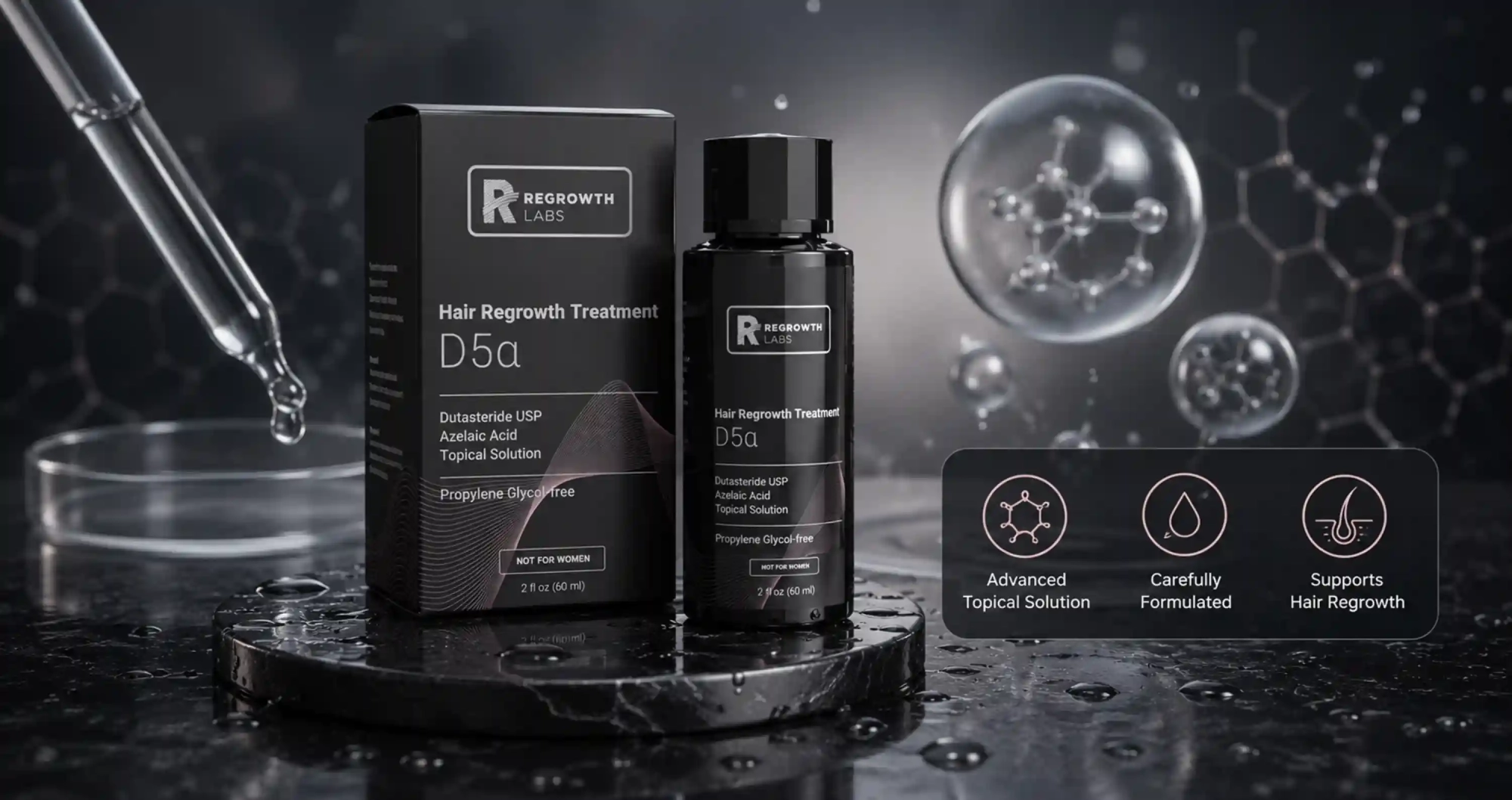
A propanediol dutasteride solution UAE such as D5a Hair Regrowth Treatment is more than a mixture of dutasteride and water.
Dutasteride is difficult to formulate as an effective leave-on scalp treatment. The vehicle must:
- Keep the active ingredient dissolved or uniformly dispersed
- Remain stable inside the bottle
- Spread over the scalp
- Release the active after application
- Support contact with follicular skin
- Dry within a practical period
- Avoid excessive residue
- Remain tolerable enough for repeated use
In a propanediol dutasteride solution UAE such as D5a, propanediol replaces propylene glycol but remains only one part of the complete vehicle. The official formula also contains ethanol, dimethyl isosorbide, polysorbate 20, glycerin and other ingredients involved in solubility, spread and cosmetic feel. (regrowthlabs.com)
This makes the central question more nuanced than:
Is propanediol better than propylene glycol?
The responsible questions are:
- How does the complete vehicle behave?
- Does it keep dutasteride stable?
- Does it deliver a consistent dose?
- Is it better tolerated in actual users?
- Does it change systemic absorption?
- Does it improve clinical outcomes?
- Which ingredient is causing irritation when a reaction occurs?
Direct Answer
D5a’s propanediol-containing base may be relevant to someone who has experienced irritation or allergy from propylene-glycol-containing topical products.
However, D5a is not:
- Alcohol free
- Irritation free
- Hypoallergenic
- Proven more effective than every propylene-glycol formula
- Proven to have zero systemic absorption
- Proven to deliver dutasteride only to follicles
- Suitable for every person with a sensitive scalp
The formulation contains ethanol and several additional solvents, enhancers, conditioning agents and biological complexes.
The correct conclusion is:
Removing propylene glycol changes one part of the vehicle. It does not by itself determine the product’s comfort, absorption, efficacy or safety.
What Is a Topical Vehicle?
In a propanediol dutasteride solution UAE, the vehicle is the complete base that carries the active ingredients.
In D5a, the vehicle affects:
- Dutasteride solubility
- Azelaic-acid distribution
- Spray consistency
- Drying time
- Scalp spread
- Residue
- Skin hydration
- Ingredient release
- Follicular deposition
- Irritation potential
- Systemic exposure
The delivery pathway is:
Dutasteride inside the bottle
↓
Must remain stable and uniformly distributed
↓
Must leave the vehicle after application
↓
Must cross or enter the scalp barrier
↓
Must reach relevant follicular tissue
↓
May also enter systemic circulation
A large concentration printed on the bottle does not prove that the active reaches the intended tissue in a predictable amount.
D5a’s Published Formula
Active Ingredients
- Dutasteride USP 0.5%
- Azelaic Acid 1%
Other Ingredients
- Ethanol SDA 40B 190 Proof
- Propanediol
- Polysorbate 20
- Glycerin
- Aloe barbadensis leaf extract
- Cetyl trimethyl ammonium chloride
- Dimethicone PEG-7 isostearate
- Dimethyl isosorbide
- Copper Peptide GHK-Cu
- Trichogen blend
- Sodium metabisulfite
The Trichogen blend additionally contains ingredients including ginseng extract, arginine, acetyl tyrosine, burdock extract, hydrolysed soy protein, niacinamide, zinc gluconate and biotin. (regrowthlabs.com)
A propanediol dutasteride solution UAE such as D5a is not a simple two-ingredient solution.
Propanediol vs Propylene Glycol
| Formulation factor | Propanediol | Propylene glycol |
| Chemical identity | Commonly 1,3-propanediol | Commonly 1,2-propanediol |
| Typical role | Solvent, humectant and sensory modifier | Solvent, humectant and delivery vehicle |
| Present in D5a | Yes | Not listed |
| Can support active solubility | Yes, formulation dependent | Yes, formulation dependent |
| Can support skin hydration | Potentially | Potentially |
| Can irritate | Possible | Possible |
| Allergic contact dermatitis | Less extensively characterised | Well documented in a minority of users |
| Guarantees better absorption | No | No |
| Guarantees zero irritation | No | No |
| Clinical winner in D5a | Not established | No direct comparison performed |
The compounds are not interchangeable names for the same ingredient.
They have different molecular arrangements and may create different:
- Solubility
- Viscosity
- evaporation
- Humectancy
- Scalp feel
- Penetration profiles
- Irritation profiles
These differences must be measured in the finished formula.
Why Propylene Glycol Is Used in Topical Treatments
Propylene glycol is widely used in topical medicines and cosmetics as:
- A solvent
- A humectant
- A vehicle
- A formulation stabiliser
- An ingredient that can influence skin delivery
It is useful because many active ingredients do not dissolve adequately in water alone.
Removing propylene glycol can therefore create formulation challenges:
- The drug may crystallise
- The spray may become inconsistent
- A different solvent may be required
- Drying time may change
- Skin delivery may change
- Stability may change
A propanediol dutasteride solution UAE that is propylene-glycol free still needs to solve all of these formulation problems.
Propylene Glycol and Contact Dermatitis
Propylene glycol can cause both irritant and allergic contact dermatitis.
Published dermatology reviews describe it as a weak sensitiser that can also act as an irritant, which can make patch-test interpretation difficult. Studies of patch-tested patients show that true positive reactions occur in a minority, and topical medicines are an important source of relevant exposure. (PubMed)
Possible symptoms include:
- Itching
- Burning
- Redness
- Scaling
- Eczema-like rash
- Swelling
- Worsening after repeated application
A previous reaction to a propylene-glycol product does not prove that propylene glycol was the cause.
Other possible causes include:
- The active medicine
- Ethanol
- Fragrance
- Preservatives
- Another solvent
- Existing dermatitis
- Multiple products used together
Patch testing may be needed when the reaction is persistent or severe.
Does Propylene-Glycol Allergy Make D5a Automatically Suitable?
No.
A propylene-glycol-free formula may be useful for a person with confirmed propylene-glycol allergy, but tolerance is not guaranteed.
Research involving topical minoxidil reactions found that propylene glycol was a frequent cause among affected patients and suggested alternative solvent formulations for some users. The same publication cautioned that identifying an allergen does not ensure that every alternative preparation will be tolerated. (PubMed)
D5a could still cause a reaction through:
- Ethanol
- Propanediol
- Azelaic acid
- Sodium metabisulfite
- Polysorbate 20
- Botanicals
- Hydrolysed soy protein
- The active dutasteride
- Another excipient
“Propylene-glycol free” is one useful product attribute—not a universal sensitive-scalp guarantee.
Is Propanediol Plant Based?
The manufacturer describes propanediol as a natural, plant-based alternative to petroleum-derived propylene glycol. (regrowthlabs.com)
Propanediol can be manufactured through different processes, including bio-based fermentation routes.
However, the public D5a page does not provide:
- Raw-material supplier
- Manufacturing route
- Bio-based content certificate
- Sustainability certification
- Country of origin
- Finished-product traceability
Use:
D5a contains propanediol, which the manufacturer describes as plant based.
Do not use:
The finished product is independently certified fully plant derived.
Is Propylene Glycol Always Petroleum Based?
Propylene glycol is commonly manufactured from petrochemical feedstocks, but the source route does not by itself determine:
- Purity
- Allergy risk
- Irritation
- Efficacy
- Environmental performance
- Clinical suitability
“Plant based” and “petroleum based” are sourcing descriptions.
They are not substitutes for:
- Purity specifications
- Toxicology
- Finished-product testing
- Patch testing
- Pharmacokinetic evidence
The product page should not imply that propylene glycol is unsafe merely because it may be petroleum derived.
What Does Propanediol Do in D5a?
Propanediol may contribute to:
- Solubilising or carrying ingredients
- Water retention
- Scalp feel
- Spread
- Drying characteristics
- Ingredient distribution
- Preservative support
Its exact function depends on its concentration and interaction with the other vehicle ingredients.
The public page does not disclose:
- Propanediol percentage
- Whether it is the primary solvent after ethanol
- Its effect on dutasteride solubility
- Its effect on azelaic-acid solubility
- Its contribution to penetration
- Its contribution to systemic exposure
- A head-to-head comparison with propylene glycol
Do not state that propanediol independently delivers “optimum absorption.”
The Role of Ethanol
Ethanol is listed first among D5a’s other ingredients, suggesting it may be a substantial component of the vehicle, although the exact percentage is not disclosed. (regrowthlabs.com)
Ethanol may help:
- Dissolve active ingredients
- Reduce viscosity
- Spread the solution
- Speed evaporation
- Influence skin penetration
- Produce a lighter finish
It may also cause:
- Dryness
- Stinging
- Burning
- Barrier irritation
- Increased discomfort on damaged skin
- Flaking with repeated use
This is why D5a must not be marketed as automatically suitable for every sensitive scalp.
Ethanol Plus Propanediol Is a Combined Vehicle
D5a should not be visualised as:
Dutasteride
+
Propanediol
The more accurate formulation model is:
Dutasteride 0.5%
+
Azelaic Acid 1%
+
Ethanol
+
Propanediol
+
Dimethyl Isosorbide
+
Polysorbate 20
+
Glycerin
+
Conditioning and biological ingredients
The final behaviour comes from the entire system.
A person may tolerate propanediol well but react to the ethanol or azelaic acid.
Another person may dislike the sensory feel without having a true allergy.
Dimethyl Isosorbide and Delivery
Dimethyl isosorbide is commonly used in topical formulations as a solvent and delivery-support ingredient.
In D5a, it may help:
- Maintain active ingredients in solution
- Improve ingredient compatibility
- Influence release from the vehicle
- Alter skin deposition
Its presence does not prove:
- Deep follicular delivery
- Greater clinical efficacy
- Zero systemic absorption
- Better results than a propylene-glycol formula
Human delivery data for the exact propanediol dutasteride solution UAE used in D5a are still required.
Polysorbate 20
Polysorbate 20 is a surfactant and solubilising ingredient.
It may help:
- Disperse oil-soluble materials
- Stabilise the solution
- Improve ingredient mixing
- Reduce separation
A user can still develop irritation or contact sensitivity to a surfactant-containing formula.
Glycerin
Glycerin is a humectant that may help retain water at the skin surface.
Its presence may partially offset the drying feel of ethanol for some users.
It does not guarantee that:
- The scalp will remain moisturised
- Flaking will not occur
- Dermatitis cannot develop
- The formula is suitable for eczema
The final effect depends on ingredient ratios, climate and individual skin condition.
Dimethicone PEG-7 Isostearate
This ingredient can contribute to:
- Emulsification
- Spread
- Conditioning
- Reduced friction
- Cosmetic feel
It should not be marketed as evidence that the medicine penetrates deeper.
Aloe Extract
Aloe is included in the published inactive list.
Although aloe is often associated with soothing cosmetic products, its presence does not prove that the full D5a solution is non-irritating.
The ethanol, azelaic acid, solvents and preservatives remain clinically relevant.
Sodium Metabisulfite
Sodium metabisulfite is included in the official formula. (regrowthlabs.com)
It may function as an antioxidant or stability-support ingredient.
Sulfite sensitivity is especially relevant to some people with asthma or previous sulfite reactions.
The product page should clearly disclose:
- Sulfite presence
- Allergy warning
- Action after wheezing, swelling or severe reaction
A “sulfate-free” marketing claim must not be confused with “sulfite-free.” Sulfates and sulfites are different chemical categories.
Hydrolysed Soy Protein
The Trichogen blend contains hydrolysed soy protein.
The product should therefore not be marketed as soy free without further evidence.
Someone with severe soy allergy should review:
- Residual protein content
- Allergen statement
- Manufacturing controls
- Medical advice
The degree of allergy risk from a hydrolysed topical ingredient depends on the final composition and residual proteins, which are not disclosed.
Does the Base Make Dutasteride Work Better?
Not proven.
The base is essential because dutasteride cannot act unless it is:
- Stable
- Released
- Delivered to relevant tissue
- Used consistently
However, a direct claim of improved efficacy would require a trial such as:
| Trial group | Formula |
| Group 1 | Dutasteride 0.5% in D5a propanediol vehicle |
| Group 2 | Dutasteride 0.5% in propylene-glycol vehicle |
| Group 3 | Vehicle without dutasteride |
| Group 4 | Placebo or standard comparator |
The trial would need to evaluate:
- Hair counts
- Hair diameter
- Scalp DHT
- Serum DHT
- Plasma dutasteride
- Local irritation
- Discontinuation rates
- Patient satisfaction
No such D5a comparison is presented publicly.
Does the Base Make D5a Safer?
Not automatically.
A potentially better-tolerated vehicle can improve adherence for some users.
But safety also depends on:
- Dutasteride dose
- Application area
- Frequency
- Systemic absorption
- Pregnancy exposure
- Scalp integrity
- Other medicines
- Sexual or mood symptoms
- Individual allergy history
Changing the solvent does not remove dutasteride’s pharmacology.
D5a 0.5% Is Not the Same as Studied 0.05% Topical Dutasteride
A 2025 randomised study evaluated a specific topical dutasteride solution at strengths up to 0.05% w/v. The 0.05% study formula showed promising efficacy in the tested protocol. (PubMed)
D5a lists dutasteride at 0.5%.
Numerically:
0.5%
÷
0.05%
=
10
D5a’s displayed percentage is ten times the percentage of the 0.05% study formula.
That does not prove:
- Ten times the efficacy
- Ten times the DHT reduction
- Ten times the systemic absorption
- Ten times the adverse-effect risk
- Better scalp penetration
- Better clinical outcomes
The formulations also differ in:
- Vehicle
- Applied volume
- Frequency
- Treatment area
- Supporting ingredients
- Delivery technology
The lower-strength study supports topical dutasteride as an emerging concept, but it does not validate the exact dose or basis of this propanediol dutasteride solution in the UAE.
Concentration Is Not the Same as Applied Dose
D5a lists dutasteride at 0.5%, but the public page does not state whether this is:
- w/v
- w/w
- Another basis
The dose calculation requires:
Verified concentration basis
×
Verified application volume or weight
=
Amount of dutasteride applied
If—but only if—the formula were confirmed as 0.5% w/v, one millilitre would theoretically contain 5 mg of dutasteride.
That calculation must not be published as the actual D5a dose until the label confirms the unit basis.
The website must disclose:
- Percentage basis
- Milligrams per millilitre
- Milligrams per spray
- Five-spray total
- Maximum daily amount
Five Sprays Versus One Millilitre
The official page presents:
- One millilitre
- Five sprays
as equivalent application units. (regrowthlabs.com)
The physical pump should still be verified for:
- Priming requirements
- Volume per spray
- Consistency from first to last use
- Total volume from five complete sprays
- Leakage
- Partial pump output
- Bottle duration
Do not assume every replacement pump produces the same dose.
One Dose or One Dose Per Area?
The wording “on each targeted area” requires urgent clarification.
Consider a user treating:
- Frontal scalp
- Left temple
- Right temple
- Crown
If the user applies one millilitre to each zone twice daily, total exposure could become several times higher than if one millilitre is divided across the complete scalp.
The product page should state one of the following explicitly:
Apply one millilitre total across all affected areas.
or:
Apply a specified amount to each zone, up to a stated maximum daily dose.
Do not leave users to interpret this independently.
How a Propanediol Dutasteride Solution UAE May Affect Scalp Feel
A propanediol-containing formula may feel different from a propylene-glycol formula in terms of:
- Stickiness
- Greasiness
- Drying time
- Spread
- Hair residue
- Scalp hydration
- Styling compatibility
The scalp feel of a propanediol dutasteride solution UAE cannot be predicted solely from the name “propanediol.”
D5a also contains ethanol and several other vehicle ingredients, so any sensory result comes from the whole formula.
Claims such as:
- Non-greasy
- Fast drying
- Lightweight
- Residue free
- Suitable under every hairstyle
require user or instrumental testing.
Who May Benefit From a Propylene-Glycol-Free Formula?
D5a’s vehicle may be relevant to a man who:
- Has diagnosed androgenetic alopecia
- Has been advised to consider topical dutasteride
- Has reacted to a confirmed propylene-glycol product
- Dislikes sticky propylene-glycol solutions
- Understands that D5a still contains ethanol
- Can monitor the scalp for irritation
- Can prevent household transfer
- Understands topical dutasteride is formulation specific
- Has reviewed sexual and psychiatric warnings
- Will not exceed the verified dose
This is a potential research profile—not an individual prescription.
Who Should Not Self-Select D5a?
Professional assessment is especially important where:
- Hair loss is sudden
- Hair loss is patchy
- The scalp is painful or inflamed
- Smooth or scarred areas are present
- The cause is unknown
- The user is under 18
- Pregnancy exposure is possible in the household
- There is a history of depression or suicidal thoughts
- Sexual or fertility concerns are present
- Another finasteride or dutasteride product is used
- Significant dermatitis is active
- There is a known sulfite or severe soy allergy
- Microneedling is part of the routine
The diagnosis-first pathway is covered in the Androgenetic Alopecia Treatment Guide.
Topical Dutasteride Can Still Have Systemic Effects
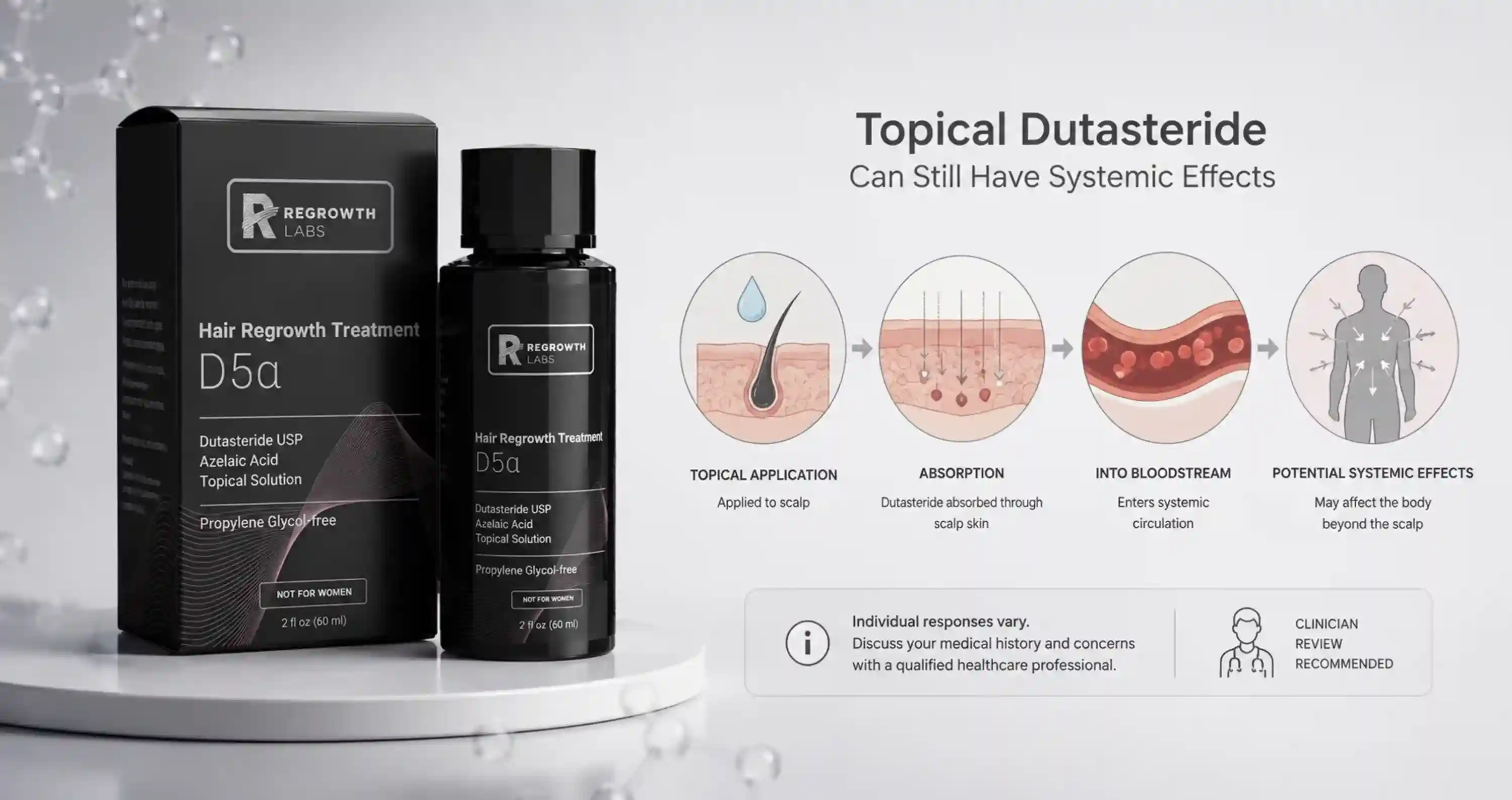
Applying dutasteride to the scalp does not prove that it remains entirely local.
The amount entering circulation may depend on:
- Concentration
- Vehicle
- Applied volume
- Scalp area
- Frequency
- Barrier damage
- Occlusion
- Microneedling
- Individual skin permeability
The exact D5a formula does not provide public:
- Plasma dutasteride results
- Serum DHT results
- Testosterone measurements
- Semen-parameter data
- Long-term systemic monitoring
Use:
Topical use may aim to reduce systemic exposure compared with an oral route.
Do not use:
D5a has no systemic absorption.
Sexual and Psychiatric Safety Boundary
Dutasteride belongs to the 5-alpha-reductase-inhibitor medicine class.
The UK MHRA strengthened safety information in May 2026 and advises users of dutasteride to seek medical advice for sexual dysfunction, depression or suicidal thoughts. (GOV.UK)
Report:
- Reduced libido
- Erectile difficulty
- Ejaculation changes
- Testicular symptoms
- Breast tenderness
- Breast enlargement
- Significant depression
- Severe anxiety
- Suicidal thoughts
The exact rate after topical D5a is unknown.
Suicidal thoughts or risk of self-harm require urgent assistance.
Pregnancy and Transfer Precautions
Official oral dutasteride labelling warns that the medicine can be absorbed through skin and may harm development of a male fetus. Pregnant individuals should not handle leaking dutasteride capsules. (DailyMed)
A wet topical solution creates additional possible transfer surfaces:
- Hands
- Fingernails
- Forehead
- Wet treated hair
- Pillows
- Towels
- Caps
- Helmets
- Bathroom counters
- Spray nozzle
- Mobile phones touched during application
Practical precautions include:
- Pregnant individuals should not apply D5a.
- Wash hands thoroughly after use.
- Clean beneath the fingernails.
- Wipe accidental forehead run-off.
- Let the scalp dry before close contact.
- Do not share recently used towels.
- Clean spills immediately.
- Keep the bottle away from children.
- Store the nozzle closed.
- Obtain medical advice after pregnancy-related exposure.
The transfer risk from finished D5a has not been quantified publicly.
Local Irritation
Possible local reactions include:
- Burning
- Stinging
- Redness
- Itching
- Scaling
- Dryness
- Contact dermatitis
- Follicular bumps
- Worsening scalp inflammation
- Hair-texture changes
Possible causes include:
- Ethanol
- Propanediol
- Azelaic acid
- Sodium metabisulfite
- Polysorbate 20
- Botanicals
- Soy-derived material
- Dutasteride itself
- Another scalp treatment
A propylene-glycol-free claim does not rule out any of these possibilities.
Azelaic Acid and Scalp Irritation
Azelaic acid has established dermatological uses, particularly in acne and rosacea, but it can cause local burning, stinging, dryness or irritation. (DermNet®)
D5a’s official page lists azelaic acid at 1%.
Do not interpret discomfort as proof of:
- DHT inhibition
- Better penetration
- Treatment success
- Hair growth
Persistent or severe irritation requires review.
D5a’s Azelaic-Acid DHT Claim
The product pages state that azelaic acid inhibits DHT and prevents hair loss.
A more accurate statement is:
Azelaic acid is included for a complementary scalp-support and laboratory 5-alpha-reductase-related rationale. Its independent clinical contribution to the exact D5a formula has not been established.
Dutasteride remains the formula’s principal pharmaceutical DHT inhibitor.
Microneedling and Vehicle Absorption
Do not apply D5a immediately after microneedling unless an appropriately qualified professional has provided exact instructions.
Microneedling may alter exposure to:
- Dutasteride
- Azelaic acid
- Ethanol
- Propanediol
- Dimethyl isosorbide
- Sodium metabisulfite
- Trichogen ingredients
This may change:
- Local irritation
- Systemic absorption
- Applied dose
- Pregnancy-transfer risk
- Adverse-effect risk
Avoid D5a on:
- Freshly punctured skin
- Bleeding scalp
- Open cuts
- Active dermatitis
- Infection
- Severe sunburn
- Painful inflammation
Hairline and Crown Use
The official introductory copy says D5a is designed for frontal and vertex thinning, while its indication section specifically names the vertex. The UAE page markets the entire scalp. (regrowthlabs.com)
The physical label should clarify:
- Vertex-only indication
- Frontal-scalp use
- Temple use
- Total dose across several zones
- Maximum treated surface area
Do not increase the amount simply because both the crown and hairline are treated.
Confirmed Application Framework
Current manufacturer directions state:
- Apply one millilitre or five sprays.
- Apply twice daily.
- Massage for two to four minutes.
- Wash hands after application.
- Leave the solution on for four or more hours.
- Continue use to achieve and maintain the intended benefit.
- Do not apply more than directed. (regrowthlabs.com)
Until the multi-zone wording is corrected, publish:
Use the verified total dose stated on the physical label and do not multiply it independently for every scalp zone.
Missed Application
The public page does not provide a missed-dose instruction.
Do not:
- Use ten sprays next time
- Apply two millilitres together
- Shorten the dosing interval
- Add an extra late application
- Increase the following day’s dose
Resume the verified schedule unless a prescriber directs otherwise.
Can D5a Be Combined With Oral Dutasteride?
Combining topical and oral dutasteride may increase overall exposure.
This can complicate:
- Sexual-symptom assessment
- Mood-symptom assessment
- Pregnancy precautions
- Fertility discussions
- Serum DHT interpretation
- Adverse-effect attribution
Do not combine them casually.
Can D5a Be Combined With Finasteride?
Finasteride and dutasteride both inhibit 5-alpha-reductase.
Combining D5a with:
- Oral finasteride
- Topical finasteride
- FIN25
- FR12
- FR16
may increase DHT-inhibitor exposure without a clear finished-product evidence base.
The broader medicine comparison belongs in the Finasteride vs Dutasteride guide.
Can D5a Be Combined With Minoxidil?
Minoxidil acts through a different treatment pathway, and combination plans may be used professionally.
However, layering a minoxidil solution with D5a can change:
- Total solvent exposure
- Scalp irritation
- Drying time
- Spread
- Product residue
- Adherence
- Ability to identify the cause of a reaction
The application order and spacing should not be improvised.
UAE Heat and Storage
The manufacturer instructs users to store D5a at 20°C to 25°C with the container closed. Slight darkening is described as a possible appearance variation. (regrowthlabs.com)
Do not store it:
- Inside a parked UAE vehicle
- On a balcony
- In direct sunlight
- Near a cooker
- In an unlabelled bottle
- With the nozzle open
- Where children can reach it
Seek supplier guidance after:
- Heavy precipitation
- Crystallisation
- Separation
- Leakage
- Pump failure
- Broken seal
- Missing batch information
- Missing expiry information
- Major unexpected smell or texture change
Sweat and Headwear
Applying D5a immediately before exercise may cause:
- Forehead run-off
- Eye exposure
- Product loss
- Transfer to headwear
- Increased irritation
- Uneven scalp contact
Allow the treatment to dry before:
- Outdoor exercise
- Helmet use
- Wearing tight caps
- Wearing a ghutra
- Lying down
Do not assume that rapid ethanol evaporation means every active has fully dried or stopped transferring.
Showering
The current directions require four or more hours of contact.
Do not apply D5a shortly before:
- Showering
- Swimming
- Heavy exercise
- Hair washing
The four-hour instruction is a manufacturer’s direction—not proof that complete absorption occurs at exactly four hours. (regrowthlabs.com)
Evidence Hierarchy for D5a’s Vehicle
Level 1 — Strongest
Randomised trial of exact D5a finished formula
Level 2
D5a pharmacokinetic, scalp-DHT and serum-DHT study
Level 3
Direct D5a propanediol-versus-propylene-glycol comparison
Level 4
Trials of the same dutasteride concentration in another vehicle
Level 5
Clinical trials of lower-strength topical dutasteride
Level 6
Dermatology evidence on propylene-glycol irritation and allergy
Level 7
General propanediol solvent and humectant evidence
Level 8
Manufacturer nanosome, delivery and sensory claims
Level 9 — Weakest
Testimonials and before-and-after photographs
The current evidence position is:
- Propylene glycol can cause irritant or allergic dermatitis in a minority of users.
- Alternative vehicles may benefit selected propylene-glycol-sensitive users.
- Alternative solvents do not guarantee tolerance.
- Topical dutasteride is an emerging, formulation-specific treatment concept.
- A 0.05% topical dutasteride trial cannot validate D5a 0.5%.
- Exact D5a absorption and comparative vehicle data are not displayed.
- The UAE product listing currently shows no customer reviews. (PubMed)
Questions to Ask Before Buying D5a
- Does the physical label confirm Dutasteride USP 0.5%?
- Is 0.5% expressed as w/v or w/w?
- Does it confirm Azelaic Acid 1%?
- What is the dutasteride amount per millilitre?
- What is the dutasteride amount per spray?
- Do five sprays consistently equal one millilitre?
- Is one millilitre the total scalp dose?
- Is one millilitre intended for every separate area?
- What is the maximum daily dose?
- What is the bottle volume?
- What is the propanediol concentration?
- What is the ethanol concentration?
- Is the propanediol bio-based?
- Does the formula contain any propylene glycol?
- What is the dimethyl-isosorbide concentration?
- What nanosome technology is used?
- Has particle size been measured?
- Has follicular deposition been tested?
- Have plasma dutasteride levels been measured?
- Have serum and scalp DHT been measured?
- Has D5a been compared with a propylene-glycol vehicle?
- Does the label disclose sodium metabisulfite?
- Does it include a soy-allergy warning?
- Is hairline use part of the physical indication?
- What is the UAE regulatory classification?
Frequently Asked Questions
What is D5a?
D5a is a topical scalp treatment listing Dutasteride USP 0.5% and Azelaic Acid 1% in a vehicle containing ethanol, propanediol and other delivery ingredients. (regrowthlabs.com)
Is D5a propylene-glycol free?
Propylene glycol does not appear in the current official ingredient list.
Is D5a alcohol free?
No. The official formula lists Ethanol SDA 40B 190 Proof. (regrowthlabs.com)
Does D5a contain propanediol?
Yes. Propanediol appears in the official inactive-ingredient list.
Are propanediol and propylene glycol the same?
No. They are different chemical compounds used for overlapping formulation roles.
Is propanediol always less irritating?
No. It may offer a different tolerability profile, but no ingredient is guaranteed non-irritating.
Can propylene glycol cause scalp allergy?
Yes. Propylene glycol can cause irritant or allergic contact dermatitis in a minority of users. (PubMed)
Does a propylene-glycol allergy mean D5a will be tolerated?
Not necessarily. D5a contains ethanol, azelaic acid, sulfite and multiple other possible irritants or allergens.
Is D5a suitable for sensitive scalp?
It may be considered by selected users who cannot tolerate propylene glycol, but sensitive-scalp suitability is not guaranteed.
Does propanediol improve dutasteride absorption?
The manufacturer positions propanediol as a carrier, but no D5a human comparison proves superior absorption.
Does D5a use nanosome technology?
The manufacturer says it uses proprietary nanosome encapsulation and transdermal enhancers. Public human delivery measurements are not shown. (regrowthlabs.com)
Is D5a clinically proven as a finished formula?
The reviewed public pages do not present a randomised controlled trial of exact D5a.
Is topical dutasteride clinically studied?
Yes. A 2025 trial studied specific topical formulations up to 0.05% w/v. Those findings cannot be directly transferred to D5a 0.5%. (PubMed)
Is 0.5% ten times stronger than 0.05%?
The displayed percentage is numerically ten times higher. That does not mean ten times more effective or ten times more absorbable.
Does D5a contain azelaic acid 1%?
The current official page lists Azelaic Acid 1%. The physical UAE label should confirm the current market formula. (regrowthlabs.com)
Does azelaic acid clinically block scalp DHT?
The reviewed D5a pages do not present a human scalp-DHT study proving its independent contribution.
Does D5a inhibit type III 5-alpha-reductase?
The product’s type III wording should be corrected. Dutasteride is clinically described as inhibiting type I and type II enzymes.
How much D5a should be applied?
The manufacturer states one millilitre or five sprays twice daily. (regrowthlabs.com)
Is one millilitre used on every treatment area?
The wording is ambiguous. The maximum total dose must be clarified before multiplying the amount across different zones.
How long should D5a remain on the scalp?
The current directions state four or more hours.
Can extra D5a improve results?
No. The manufacturer says using more than directed will not increase effectiveness. (regrowthlabs.com)
Can D5a cause local irritation?
Yes. Ethanol, azelaic acid, solvents, sulfite, botanicals or the active medicine may cause irritation.
Can D5a cause sexual side effects?
Systemic exposure from exact D5a is unknown. Dutasteride carries class-related sexual-function warnings that should not be dismissed merely because use is topical. (GOV.UK)
Can D5a affect mood?
Regulators advise people using dutasteride to seek medical advice after depression or suicidal thoughts. The frequency after topical D5a is unknown. (GOV.UK)
Can pregnant women touch wet D5a?
Pregnant individuals should avoid contact with dutasteride-containing treatment because dutasteride can be absorbed through skin and may harm a developing male fetus. (DailyMed)
Can D5a be used by women?
The current official product is positioned for men. It contains dutasteride and should not be promoted to women—especially during pregnancy—without specialist guidance.
Can D5a be used after microneedling?
Do not apply it to freshly microneedled or damaged scalp without explicit professional instructions.
Can D5a be combined with oral dutasteride?
This may increase overall exposure and should not be done casually.
Can D5a be combined with finasteride?
Combining two 5-alpha-reductase inhibitors requires professional assessment.
Can D5a be combined with minoxidil?
It may appear within an individually designed treatment plan, but application timing and combined solvent exposure need review.
How should D5a be stored in Dubai?
Store it at 20°C to 25°C with the container closed, away from direct sunlight and parked vehicles. (regrowthlabs.com)
Final Perspective
This propanediol dutasteride solution UAE vehicle matters because the active ingredients cannot work independently of the base that carries them.
Dutasteride 0.5%
+
Azelaic Acid 1%
↓
Ethanol
+
Propanediol
+
Dimethyl Isosorbide
+
Polysorbate 20
+
Glycerin
+
Additional ingredients
↓
Finished D5a delivery system
Its most relevant formulation advantage is:
Propylene glycol is not listed.
That may help selected users who have confirmed propylene-glycol irritation or allergy.
Its important limitations are:
- It still contains ethanol.
- Propanediol does not guarantee zero irritation.
- Azelaic acid may sting or dry the scalp.
- Sodium metabisulfite introduces a sulfite consideration.
- Hydrolysed soy protein appears within the Trichogen blend.
- Exact propanediol and ethanol percentages are undisclosed.
- The nanosome system is not publicly characterised.
- Human D5a absorption data are not shown.
- The dose-per-treatment-area instruction is ambiguous.
- A 0.05% topical study cannot validate D5a 0.5%.
The strongest potential buyer fit is an adult man who:
- Has diagnosed androgenetic alopecia
- Has reviewed standard treatment options
- Has been advised to consider topical dutasteride
- Has difficulty with propylene-glycol products
- Understands that D5a contains ethanol
- Can prevent pregnancy-related transfer
- Can monitor sexual, mood and scalp symptoms
- Will not multiply the dose across several zones
- Will not combine overlapping DHT inhibitors casually
- Has realistic expectations
The responsible conclusion is:
D5a is a propylene-glycol-free—but not alcohol-free—topical dutasteride solution. Propanediol may change scalp feel and tolerability for some users, but the complete ethanol–propanediol vehicle determines drug release, irritation and absorption. No public evidence proves that the base delivers optimum absorption, causes no irritation or makes D5a clinically superior to a well-formulated propylene-glycol product.
CTA: Review the current D5a Hair Regrowth Treatment, learn how its active fits the broader Topical Dutasteride 0.5 guide and compare other Regrowth Labs products before choosing a topical DHT-inhibitor vehicle.