
People researching Ketocolost ketoconazole colostrum shampoo UAE are usually looking for more than a basic anti-dandruff cleanser. They want to understand why an established antifungal medicine has been combined with an animal-derived milk ingredient that is marketed around inflammation, nutrients and growth factors.
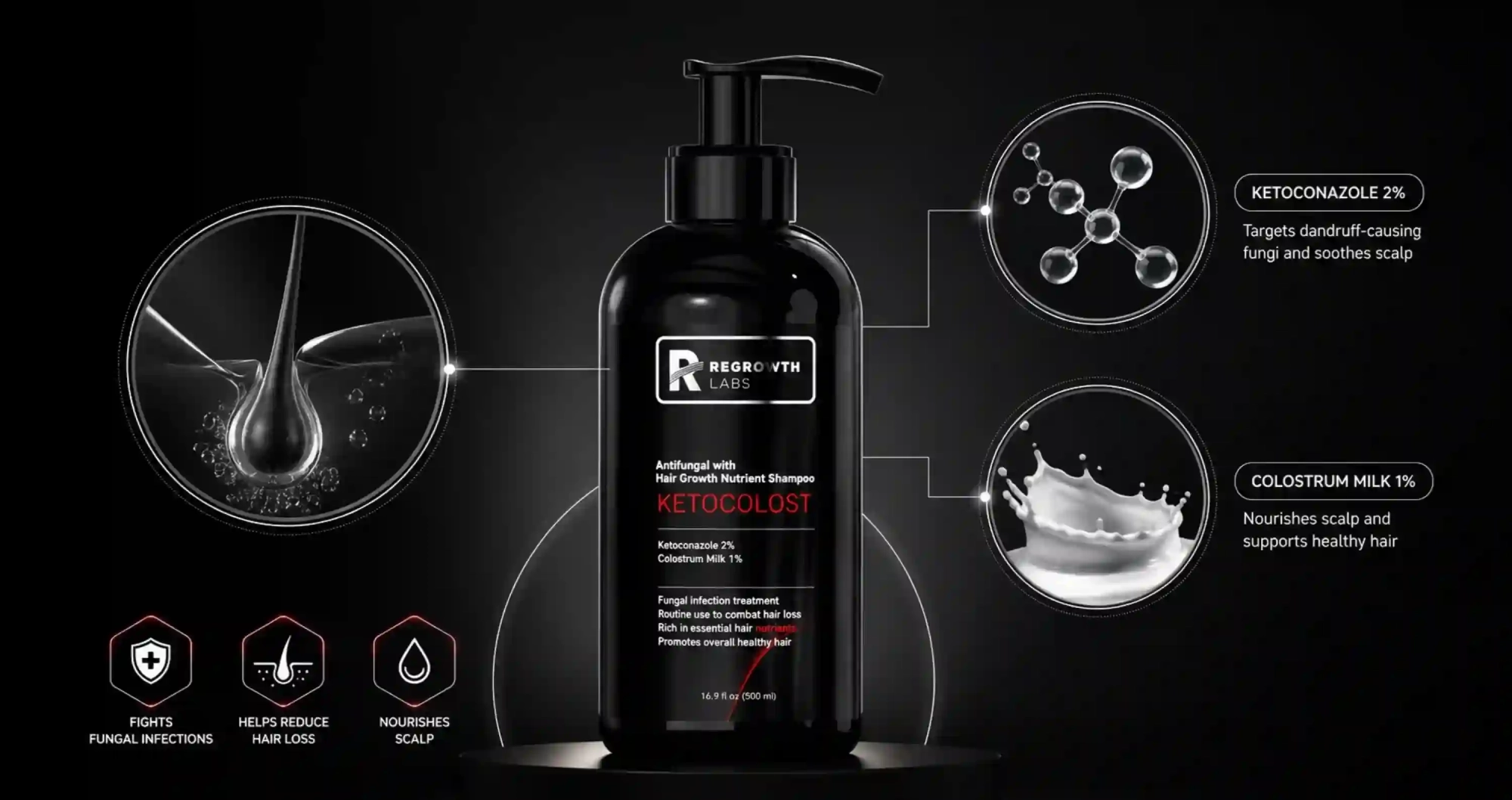
Ketocolost Anti-Fungal Hair Growth Shampoo is listed by its manufacturer as containing:
- Ketoconazole 2%
- Colostrum Milk 1% (regrowthlabs.com)
These two ingredients have very different roles and very different evidence levels.
Ketoconazole 2% is an established topical antifungal concentration. It interferes with fungal-cell-membrane production and has clinical evidence for Malassezia-related conditions, including dandruff and seborrhoeic dermatitis. (dailymed.nlm.nih.gov)

Umer AzherumerseoEdit Profile
Colostrum is the nutrient- and antibody-rich early milk produced after birth. It contains proteins, immunoglobulins and growth-related compounds. Experimental research supports potential skin-repair and cell-culture applications, but this does not establish that colostrum milk 1% inside Ketocolost clinically reverses scalp hair loss. (pmc.ncbi.nlm.nih.gov)
The appropriate interpretation is:
Ketoconazole provides the established antifungal action. Colostrum is included as a supporting biological ingredient with a plausible skin-conditioning and growth-factor rationale, but substantially weaker direct scalp-hair evidence.
Direct Answer
Ketocolost uses ketoconazole 2% to address fungal and yeast-related scalp conditions and colostrum milk 1% as a supporting biological ingredient.
Ketoconazole can reduce organisms such as Malassezia that contribute to dandruff and seborrhoeic dermatitis. Improving an inflamed, flaky or heavily scaling scalp may reduce scratching, irritation and hair breakage and may make an existing hair-loss routine easier to maintain. (pubmed.ncbi.nlm.nih.gov)
Colostrum is included because it contains proteins, immunoglobulins, peptides and growth factors associated with tissue and skin biology. However:
- Colostrum is not an established antifungal medicine.
- It should not be described as proven to regrow scalp hair.
- It should not be said to reverse androgenetic alopecia.
- Its animal source creates allergy, ethical and religious-verification questions.
- The exact finished Ketocolost formula has not been shown on the reviewed pages to have an independent randomised clinical trial.
Ketocolost should therefore be understood primarily as a ketoconazole 2% antifungal shampoo with a 1% colostrum-support component, not as a clinically proven dual-drug hair-regrowth treatment. A ketocolost ketoconazole colostrum shampoo UAE buyer should understand that the two ingredients have different proposed roles and different levels of supporting evidence.
Ketocolost Ketoconazole Colostrum Shampoo UAE: What the Label Confirms
The official Regrowth Labs page identifies:
Ketoconazole 2%
+
Colostrum Milk 1%
The same page positions the formula for:
- Fungal infection treatment
- Routine scalp use
- Dandruff
- Seborrhoeic dermatitis
- Fungal overgrowth
- General scalp and hair support (regrowthlabs.com)
The current Hims n Hers UAE product page confirms the same two headline ingredients but does not display their percentages in its visible product description. (himsnhers.ae). When reviewing a ketocolost ketoconazole colostrum shampoo UAE product, the physical label should remain the final source for concentrations, directions and ingredient verification.
What the Public Pages Do Not Confirm
The reviewed product information does not show:
- Whether 2% and 1% are w/w, w/v or another basis
- Full inactive ingredients
- Surfactant system
- Fragrance
- Preservatives
- Colourants
- Bottle volume on the currently parsed page
- Shampoo amount per wash
- Contact time
- Treatment frequency
- Treatment duration
- Intended age group
- Pregnancy instructions
- Milk-protein allergen warning
- Colostrum source species on the UAE page
- Country of colostrum origin
- Halal status
- Product-specific absorption data
- Finished-product clinical trial
These details must be checked from the physical bottle, outer packaging and manufacturer documentation before use instructions are published.
What Ketoconazole 2% Does
Ketoconazole is a synthetic imidazole antifungal medicine.
It interferes with the production of ergosterol, an essential component of fungal-cell membranes. This disrupts membrane function and inhibits susceptible fungi and yeasts. (dailymed.nlm.nih.gov)
A simplified pathway is:
Susceptible fungus or yeast
↓
Needs ergosterol for cell-membrane function
↓
Ketoconazole interferes with ergosterol synthesis
↓
Fungal growth and membrane function are impaired
Ketoconazole has activity against several dermatophytes and yeasts, including Malassezia species associated with dandruff and seborrhoeic dermatitis. (dailymed.nlm.nih.gov)
This is the strongest and most established part of Ketocolost’s formula. In a ketocolost ketoconazole colostrum shampoo UAE formula, ketoconazole is the established antifungal component intended to target susceptible scalp fungi.
What Is Malassezia?
Malassezia is a group of yeasts naturally found on human skin.
It is not automatically an infection simply because it is present. In susceptible individuals, interactions among Malassezia, sebum, the scalp barrier and immune response can contribute to dandruff and seborrhoeic dermatitis.
Symptoms may include:
- Flaking
- Greasy scales
- Itching
- Redness
- Scalp discomfort
- Recurrent irritation
Ketoconazole shampoo helps by reducing susceptible yeast populations and the inflammation-associated environment rather than by “sterilising” the scalp completely.
Do not describe Malassezia as:
- A parasite that eats the hair root
- Proof of poor hygiene
- A dangerous scalp fungus in every person
- Something that must be permanently eliminated
- The cause of every form of dandruff or hair loss
Understanding Malassezia helps explain why ketoconazole is included in a ketocolost ketoconazole colostrum shampoo UAE routine for dandruff-related scalp concerns.
Ketoconazole Evidence for Dandruff and Seborrhoeic Dermatitis
Ketoconazole shampoo has controlled clinical evidence for scalp seborrhoeic dermatitis and dandruff.
In a double-blind, placebo-controlled study, 16 of 18 patients using ketoconazole shampoo improved or became free of seborrhoeic-dermatitis lesions, compared with eight of 18 receiving placebo. (pubmed.ncbi.nlm.nih.gov)
Other comparative trials have found ketoconazole 2% shampoo effective for dandruff and seborrhoeic dermatitis. (pubmed.ncbi.nlm.nih.gov)
This evidence supports statements such as:
- Ketoconazole 2% is an established antifungal concentration.
- It can help control Malassezia-related scalp conditions.
- It may reduce flaking, itching and inflammation in appropriate users.
- It can be useful within a diagnosed seborrhoeic-dermatitis routine.
It does not prove that Ketocolost:
- Cures every dandruff condition
- Prevents all recurrence
- Regrows hair directly
- Treats psoriasis
- Treats every fungal infection
- Replaces oral antifungal treatment
- Treats tinea capitis alone
The strongest evidence relevant to a ketocolost ketoconazole colostrum shampoo UAE formula relates to ketoconazole’s use for dandruff and seborrhoeic dermatitis.
Ketoconazole and Hair-Loss Evidence
Ketoconazole has also been studied as an adjunctive treatment in androgenetic alopecia.
A small long-term study reported improvements in hair density, hair size and the proportion of follicles in anagen among people using 2% ketoconazole shampoo. The findings were considered promising, but the study did not establish ketoconazole shampoo as equivalent to standard first-line hair-loss medicines. (pubmed.ncbi.nlm.nih.gov)
A later systematic review concluded that topical ketoconazole is a promising adjunct for androgenetic alopecia but that larger randomised trials are needed. (pubmed.ncbi.nlm.nih.gov)
Therefore, the evidence hierarchy is:
- Stronger evidence for antifungal and anti-dandruff use
- Limited adjunctive evidence for pattern hair loss
- No direct proof that Ketocolost’s exact finished formula regrows hair
Use:
Ketoconazole may support a healthier scalp and has limited adjunctive evidence in androgenetic alopecia.
Do not use:
Ketoconazole 2% is proven to reverse male and female pattern baldness. Evidence involving a ketocolost ketoconazole colostrum shampoo UAE should not treat antifungal scalp improvement as direct proof of hair regrowth.
How Treating Scalp Inflammation May Help Hair
Scalp disease can influence the appearance and management of hair.
Persistent inflammation, scaling and itching may contribute to:
- Scratching
- Hair-shaft breakage
- Increased manipulation
- Poor adherence to leave-on treatments
- Difficulty reaching the scalp
- Visible shedding during washing
- Discomfort under headwear
- Reduced confidence
Treating a diagnosed scalp condition may therefore support a hair-loss routine indirectly.
A simplified relationship is:
Dandruff or seborrhoeic dermatitis
↓
Flaking, itch and inflammation
↓
Scratching, breakage and difficult scalp care
↓
Antifungal control
↓
More manageable scalp environment
This should not be rewritten as:
Ketoconazole
↓
Guaranteed new hair growth
A healthier scalp environment is supportive. It is not proof of follicular regeneration. A ketocolost ketoconazole colostrum shampoo UAE may support a cleaner, less inflamed scalp environment without proving that it independently reverses pattern hair loss.
What Is Colostrum Milk?
Colostrum is the first milk produced by mammals after giving birth.
It generally contains higher concentrations of certain proteins, immunoglobulins and bioactive compounds than mature milk. Colostrum research often discusses components such as:
- Immunoglobulins
- Lactoferrin
- Growth factors
- Cytokines
- Peptides
- Proteins
- Lipids
- Vitamins
- Minerals (pmc.ncbi.nlm.nih.gov)
The manufacturer refers to “Colostrum Milk 1%” but does not provide detailed public information about:
- Species
- Processing
- Standardisation
- Growth-factor concentrations
- Immunoglobulin levels
- Heat treatment
- Microbiological testing
- Milk-protein content
- Allergen declaration
- Retained bioactivity after shampoo manufacturing
Without that information, ingredient-level claims must remain cautious. In the ketocolost ketoconazole colostrum shampoo UAE concept, colostrum is the supporting animal-derived ingredient rather than the primary antifungal medicine.
Why Include Colostrum in a Shampoo?
The formulation rationale may include:
- Skin-conditioning support
- Protein and peptide content
- Potential soothing properties
- Growth-factor-related skin research
- Marketing differentiation
- A biological-support concept alongside the antifungal active
Experimental research has investigated colostrum for fibroblast and keratinocyte activity and potential wound- or skin-repair applications. (pmc.ncbi.nlm.nih.gov)
That creates biological plausibility.
It does not prove that colostrum milk 1% in a rinse-off shampoo:
- Reaches the hair bulb
- Remains active after formulation
- Penetrates the scalp
- Increases scalp-hair density
- Reverses miniaturisation
- Reduces DHT
- Reverses alopecia
- Produces clinically visible regrowth
The rationale for including colostrum in a ketocolost ketoconazole colostrum shampoo UAE formula relates to nutritional and growth-factor positioning, not established antifungal action.
Colostrum Growth Factors: What Can Be Said Responsibly?
Colostrum may contain growth-related factors such as IGF-associated and epidermal-growth-related compounds, depending on source and processing. (pmc.ncbi.nlm.nih.gov)
A responsible explanation is:
Colostrum contains bioactive compounds that are being investigated for skin, barrier and tissue-repair applications.
An irresponsible explanation is:
Colostrum growth factors rebuild damaged follicles and reverse hair loss.
The second claim assumes:
- The compounds remain active
- The amount is sufficient
- They survive the shampoo matrix
- They reach the relevant scalp tissue
- They cause a beneficial rather than unintended biological effect
- Human clinical trials confirm the result
Those assumptions are not supported by the current public Ketocolost evidence. Claims about growth factors in a ketocolost ketoconazole colostrum shampoo UAE must remain limited to ingredient rationale unless finished-product clinical evidence is available.
Ketoconazole Versus Colostrum
| Comparison factor | Ketoconazole 2% | Colostrum Milk 1% |
| Main role | Antifungal medicine | Supporting biological ingredient |
| Primary target | Susceptible fungi and yeasts | Skin-conditioning and bioactive-support concept |
| Established scalp evidence | Strong for dandruff and seborrhoeic dermatitis | Limited |
| Hair-loss evidence | Limited adjunctive evidence | No established finished-product scalp-regrowth evidence |
| Concentration disclosed | Yes, 2% | Yes, 1% |
| Measurement basis disclosed | No | No |
| Mechanism | Disrupts fungal membrane synthesis | Depends on retained proteins, peptides and growth factors |
| Allergy consideration | Ketoconazole or excipient sensitivity | Milk or animal-protein sensitivity may be relevant |
| Vegan suitable | Depends on full formula | No, animal derived |
| Halal status confirmed | Not from public page | Not confirmed |
| Finished Ketocolost trial shown | No | No |
This table explains why the two ingredients should not be presented as equal medical actives. A ketocolost ketoconazole colostrum shampoo UAE combines two ingredients with different functions: ketoconazole for antifungal treatment and colostrum for supporting formulation claims.
Evidence Hierarchy for Ketocolost
Level 1 — Strongest
Randomised clinical trial of the exact Ketocolost finished formula. Every claim made about a ketocolost ketoconazole colostrum shampoo UAE should be assessed through this evidence hierarchy.
Level 2
Ketocolost-specific absorption, microbiology and safety studies
Level 3
Controlled trials of ketoconazole 2% shampoo
Level 4
Systematic reviews of ketoconazole for scalp conditions
Level 5
Human studies of topical colostrum products
Level 6
Cell, skin and wound-related colostrum research
Level 7
Manufacturer ingredient claims
Level 8 — Weakest
Testimonials and before-and-after photographs
The current evidence position is:
- Ketoconazole 2% has controlled clinical evidence.
- Ketoconazole is well supported for dandruff and seborrhoeic dermatitis.
- Hair-growth evidence for ketoconazole is promising but limited.
- Colostrum has experimental skin and cell research.
- Direct colostrum scalp-hair evidence is not established.
- The exact Ketocolost finished-product trial is not shown.
- The current UAE product listing has no customer reviews. (himsnhers.ae)
Ketocolost Is Not a Shampoo-Only Treatment for Tinea Capitis
Tinea capitis is a fungal infection involving scalp hair and follicles.
It commonly requires systemic oral antifungal treatment because shampoo alone does not reliably reach infection inside the hair shaft and follicle.
A medicated shampoo may sometimes be used as an adjunct to:
- Reduce surface spores
- Limit transmission
- Support a prescribed treatment plan
It should not be marketed as a complete self-treatment for:
- Circular scaly patches
- Broken hairs
- Black-dot alopecia
- Painful inflammatory swellings
- Pus
- Lymph-node enlargement
- Patchy hair loss in a child
The existing article recommending Ketocolost for diagnosed tinea capitis should be corrected.
Who May Research Ketocolost?
Ketocolost may be relevant to an adult who:
- Has persistent dandruff
- Has a diagnosed or suspected Malassezia-related scalp condition
- Experiences itching and greasy scaling
- Has seborrhoeic dermatitis
- Wants a ketoconazole 2% shampoo
- Understands that the colostrum evidence is supportive rather than definitive
- Can follow a verified contact time and frequency
- Has no known ketoconazole or milk-protein allergy
- Is willing to seek diagnosis for patchy or severe hair loss
- Uses other hair treatments and needs routine sequencing guidance
This describes a potential research profile rather than a diagnosis. A ketocolost ketoconazole colostrum shampoo UAE may interest adults researching an antifungal scalp formula that also contains a supporting colostrum ingredient.
Who Should Obtain Assessment First?
Professional assessment is especially important when there is:
- Sudden patchy hair loss
- Broken hairs
- Scalp pain
- Pus or discharge
- Thick crusting
- Fever
- Swollen lymph nodes
- A boggy or tender scalp swelling
- Smooth or scarred areas
- Hair loss in a child
- Widespread facial or body rash
- Severe psoriasis-like scaling
- Known immune suppression
- No improvement after appropriate antifungal use
- A severe allergic history
- Pregnancy or breastfeeding concerns
Not every flaky scalp is fungal.
Possible alternatives include:
- Psoriasis
- Contact dermatitis
- Atopic dermatitis
- Dry scalp
- Product irritation
- Tinea capitis
- Bacterial folliculitis
- Scarring alopecia
- Seborrhoeic dermatitis
- Mixed conditions
Contact Time Must Be Verified
Standard ketoconazole 2% shampoo labels often instruct users to leave the product in place for approximately five minutes before rinsing. NHS guidance describes a three-to-five-minute scalp contact period for ketoconazole shampoo. (dailymed.nlm.nih.gov)
However, Ketocolost’s current public product and manufacturer pages do not display a contact time.
Do not automatically assign:
- Three minutes
- Three to five minutes
- Five minutes
- Ten minutes
to Ketocolost until its physical label is checked.
Standard ketoconazole instructions support a general reference point, but the finished product may have different directions because it includes colostrum and a different shampoo vehicle. Correct use of a ketocolost ketoconazole colostrum shampoo UAE depends on verifying how long the formula should remain on the scalp before rinsing.
Frequency Must Be Verified
Ketoconazole frequency varies according to:
- Product strength
- Diagnosis
- Acute-treatment phase
- Maintenance phase
- Age
- Local regulatory label
- Clinician instructions
The Ketocolost public pages do not state a frequency.
Do not publish:
- Daily
- Every other day
- Twice weekly
- Two to three times weekly
- Every three to four days
- Indefinitely
without checking the actual bottle.
The existing site article’s two-to-three-times-weekly instruction should therefore be removed or clearly labelled as general ketoconazole guidance rather than verified Ketocolost directions. The use frequency of a ketoconazole colostrum shampoo UAE should come from the physical label or qualified professional rather than being invented.
How Ketocolost Should Be Applied
Until the physical directions are verified, the article can give only a cautious framework:
- Wet the scalp and hair.
- Apply only the amount stated on the product label.
- Work the lather into the affected scalp rather than only the hair lengths.
- Avoid aggressive scratching with fingernails.
- Leave it on only for the verified contact time.
- Rinse thoroughly.
- Wash the hands.
- Avoid the eyes, mouth and broken skin.
- Follow only the verified weekly frequency.
- Stop and seek advice after a significant reaction.
Do not create a personalised medical regimen from general ketoconazole labels.
Eye and Mucous-Membrane Precautions
Ketoconazole shampoo may irritate the eyes and mucous membranes.
Official labelling advises avoiding eye contact. (dailymed.nlm.nih.gov)
If Ketocolost enters the eyes:
- Rinse immediately with clean water.
- Remove contact lenses where appropriate.
- Continue rinsing if irritation persists.
- Seek medical advice for pain, marked redness or vision changes.
Do not use the shampoo on:
- Eyelashes
- Eyebrows
- Inside the ears
- Mouth
- Genital skin
- Open wounds
unless a healthcare professional gives product-specific instructions.
Possible Scalp and Hair Reactions
Reported effects with ketoconazole 2% shampoo include:
- Itching
- Burning
- Irritation
- Dry skin
- Contact dermatitis
- Rash
- Urticaria
- Hair-texture changes
- Hair discolouration
- Increased normal hair loss
- Oiliness or dryness (dailymed.nlm.nih.gov)
The frequency from another ketoconazole formula cannot be applied directly to Ketocolost because its complete vehicle is different.
Possible Ketocolost reactions may come from:
- Ketoconazole
- Colostrum
- Milk proteins
- Fragrance
- Surfactants
- Preservatives
- Colourants
- Another scalp product
- Overuse
Users of a ketocolost ketoconazole colostrum shampoo UAE should monitor for dryness, irritation, texture changes or worsening scalp symptoms.
Allergic Reactions
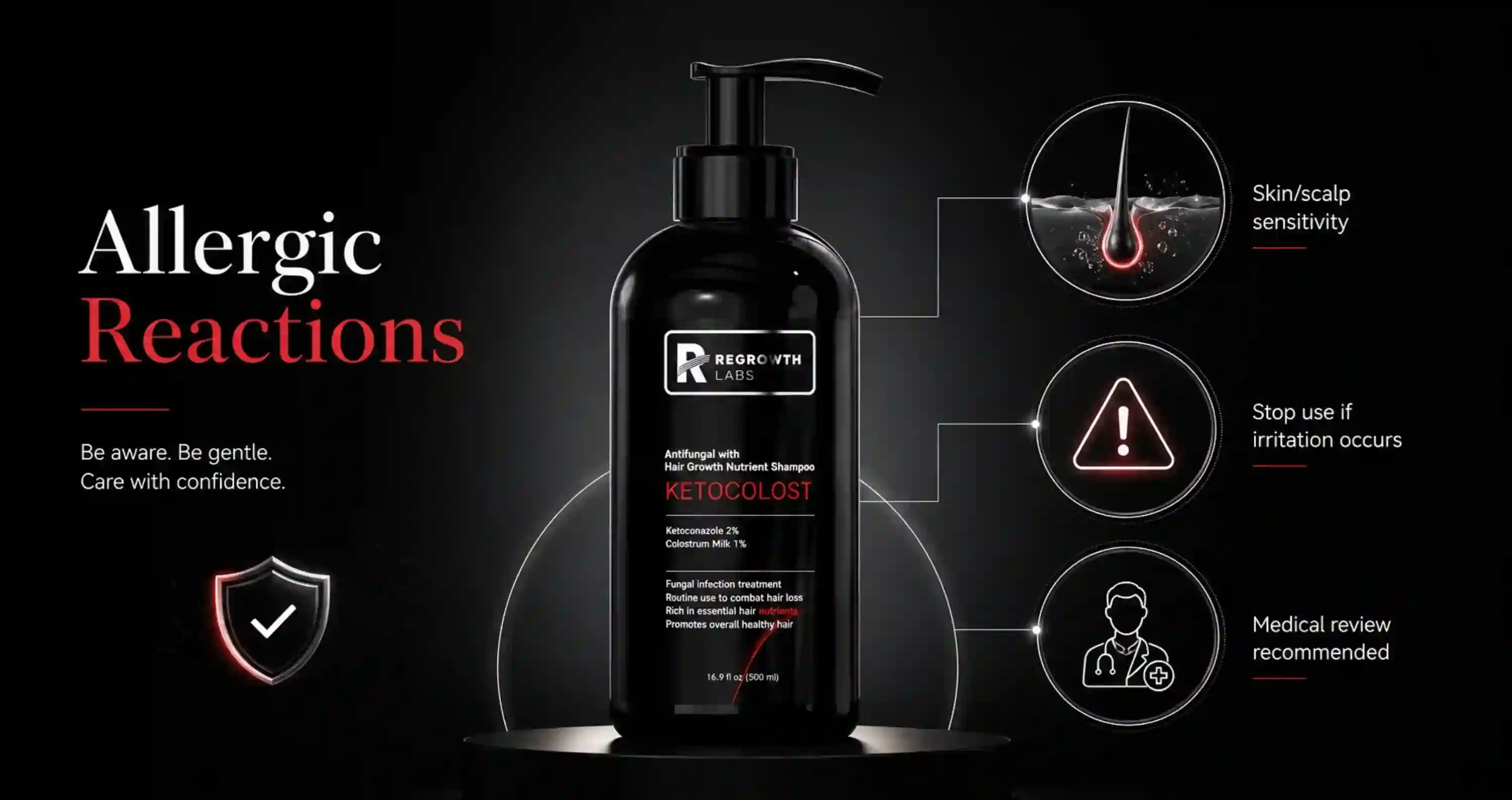
Severe hypersensitivity, including anaphylaxis and angioedema, has been reported with ketoconazole shampoo. (dailymed.nlm.nih.gov)
Stop use and obtain urgent assistance for:
- Breathing difficulty
- Swelling of the lips, tongue or throat
- Severe facial swelling
- A rapidly spreading rash
- Fainting
- Widespread hives
A colostrum-containing shampoo may also require caution in someone with a severe milk-protein allergy, even though topical exposure differs from eating dairy.
The complete allergen statement should be obtained from the manufacturer. Because a ketocolost ketoconazole colostrum shampoo UAE contains both medicinal and milk-derived components, allergy history should be reviewed carefully.
Milk Allergy, Lactose Intolerance and Colostrum
Milk allergy and lactose intolerance are different. The colostrum component of a ketocolost ketoconazole colostrum shampoo UAE makes milk-protein allergy more relevant than lactose intolerance alone.
Milk-Protein Allergy
A milk-protein allergy involves immune reactions to proteins such as casein or whey components. A topical colostrum product may be relevant to someone with severe sensitivity, especially on inflamed or broken skin.
Lactose Intolerance
Lactose intolerance is primarily a digestive inability to process lactose after ingestion. It does not automatically predict a skin reaction to shampoo.
However, the public Ketocolost pages do not state:
- Residual lactose
- Casein content
- Whey proteins
- Allergen testing
- Hydrolysis
- Purification method
A user with a serious milk allergy should obtain product-specific advice before use.
Vegan, Cruelty-Free and Halal Claims
Ketocolost contains colostrum, an animal-derived milk material.
Therefore, it should not be described as vegan.
The current shampoo category page broadly states that products are cruelty free and vegan. That category-level statement conflicts with Ketocolost’s colostrum ingredient and must be corrected. (himsnhers.ae)
Do not claim:
- Vegan
- Plant based
- Dairy free
- Cruelty free
- Halal certified
- Ethically sourced
without product-specific documentation.
For halal verification, obtain:
- Certification body
- Certificate number
- Validity date
- Species
- Collection method
- Processing information
- Manufacturing-site coverage
Pregnancy and Breastfeeding
An official ketoconazole 2% shampoo label states that ketoconazole was not detected in plasma after chronic scalp shampooing in studied users, but it still advises caution because adequate controlled pregnancy and nursing studies are lacking. (dailymed.nlm.nih.gov)
Those findings relate to a specific ketoconazole shampoo formulation.
Ketocolost also contains colostrum and a different inactive base.
Do not state:
- Safe during pregnancy
- Safe during breastfeeding
- No systemic absorption
- No infant-exposure concern
without product-specific review.
Pregnant or breastfeeding users should check the physical label and seek appropriate professional advice.
Children
Official prescription ketoconazole 2% labelling states that safety and effectiveness in children have not been established. Other country- or product-specific ketoconazole shampoos may have different age instructions. (dailymed.nlm.nih.gov)
Ketocolost’s public page does not provide an age threshold.
Do not recommend it to children without:
- Diagnosis
- Verified product age instructions
- Professional guidance
- Consideration of tinea capitis and other conditions needing systemic treatment
Can Ketocolost Replace Minoxidil?
No such equivalence is established.
Ketoconazole and minoxidil have different primary purposes.
| Treatment factor | Ketocolost | Standard topical minoxidil |
| Primary medicine | Ketoconazole 2% | Minoxidil |
| Main established role | Antifungal scalp treatment | Hair-growth treatment |
| Formula format | Rinse-off shampoo | Leave-on solution or foam |
| Main target | Malassezia and susceptible fungi | Follicular growth pathway |
| Hair-loss evidence | Limited adjunctive evidence | Stronger direct evidence |
| Contact time | Must be verified | Usually left on for hours |
| Can one replace the other? | Not established | Not established |
Ketocolost may support scalp health within a broader routine. It should not be positioned as a direct replacement for a prescribed or evidence-based minoxidil treatment. A ketocolost ketoconazole colostrum shampoo UAE should not be presented as a direct replacement for a proven minoxidil treatment plan.
Can Ketocolost Replace Finasteride?
No.
Ketoconazole is not equivalent to finasteride.
Although ketoconazole has been discussed in relation to inflammation and possible local androgen-related effects, the evidence does not support describing a ketoconazole shampoo as a substitute for oral or topical finasteride.
Do not state:
- Natural finasteride
- Shampoo-based DHT blocker equivalent to finasteride
- No-hormone alternative with the same outcome
- Proven replacement for finasteride
Can Ketocolost Be Used With Minoxidil?
A medicated shampoo may be incorporated into a routine with leave-on minoxidil, but sequencing matters.
A practical framework is:
Ketocolost wash
↓
Rinse completely
↓
Dry scalp fully
↓
Apply separately prescribed leave-on treatment
according to its own directions
This is not a recommendation to combine them automatically.
Consider:
- Scalp dryness
- Irritation
- Total routine burden
- Diagnosis
- Contact time
- Treatment frequency
- Whether minoxidil itself is causing flaking
- Whether another medicated shampoo is already used
Can Ketocolost Be Used With Another Anti-Dandruff Shampoo?
Combining Ketocolost with:
- Selenium sulphide
- Zinc pyrithione
- Ciclopirox
- Salicylic acid
- Coal tar
- Climbazole
- Piroctone olamine
may increase dryness or irritation.
Multiple shampoos may be used within a professionally designed rotation, but they should not be layered or alternated randomly.
The correct approach depends on diagnosis and scalp tolerance.
UAE Routine Planning
Heat and Sweat
Heat and sweating can make a scalp feel greasy or itchy, but this does not prove fungal infection.
Do not increase Ketocolost frequency simply because:
- The weather is hot
- The user exercised
- The scalp feels oily
- A helmet was worn
Follow the verified treatment schedule. Using a ketocolost ketoconazole colostrum shampoo UAE in local conditions may require planning around heat, sweat, frequent washing and headwear.
Headwear
Caps, ghutras, hijabs, work helmets and sports helmets may trap sweat and increase discomfort.
Helpful routine measures can include:
- Allowing the scalp to dry
- Cleaning headwear regularly
- Avoiding prolonged use of damp fabric
- Following the labelled shampoo schedule
- Seeking assessment for persistent inflammation
Do not describe headwear itself as a cause of fungal hair loss.
Frequent Showering
Someone showering more than once daily should not necessarily use a medicated 2% ketoconazole shampoo at every wash.
A gentle cleanser may be used for additional washes where appropriate.
Air Conditioning
Air conditioning may contribute to a dry-feeling scalp, but it does not directly cause fungal infection.
Overusing an antifungal shampoo on a dry non-fungal scalp may worsen irritation.
Storage in Dubai and the UAE
A regulated ketoconazole 2% shampoo label commonly specifies controlled room-temperature storage around 20°C to 25°C and protection from light. (dailymed.nlm.nih.gov)
The exact Ketocolost storage instructions must be taken from its own physical packaging.
In the UAE:
- Do not leave it inside a parked vehicle.
- Do not store it on a balcony.
- Avoid direct sunlight.
- Keep the cap securely closed.
- Do not dilute it into another bottle.
- Do not mix it with another shampoo.
- Keep it away from children.
- Do not use a product with a broken seal or missing expiry date.
What Results Should Buyers Expect?
Results depend on what is being treated. Results from a ketocolost ketoconazole colostrum shampoo UAE should be assessed separately for scalp symptoms and hair appearance.
For Dandruff or Seborrhoeic Dermatitis
A user may monitor:
- Flake reduction
- Itch reduction
- Redness
- Greasiness
- Scale thickness
- Recurrence after treatment
For Hair Shedding
Hair changes are more difficult to interpret.
Improved scalp comfort may reduce scratching or breakage, but Ketocolost should not be expected to reverse every cause of shedding.
Do not promise:
- Dandruff reduction by 80%
- Hair fall reduction by 25% in four weeks
- Visible regrowth in one month
- Reversal of androgenetic alopecia
- Restoration of lost follicles
- Permanent cure
- Prevention of every recurrence
- Better minoxidil absorption
- Colostrum-driven follicle rebuilding
Tracking Scalp Progress
Use consistent photographs approximately every two to four weeks:
- Frontal hairline
- Crown
- Left scalp parting
- Right scalp parting
- Close-up of scaling
- Close-up of red or irritated areas
Record:
- Start date
- Contact time
- Use frequency
- Itch severity
- Flake severity
- Scalp oiliness
- Dryness
- Hair shedding
- Other shampoos
- Leave-on treatments
- Allergic symptoms
- Headwear
- Swimming
- Product changes
Photographs can monitor appearance.
They cannot prove:
- Fungal eradication
- Colostrum absorption
- Hair-follicle regeneration
- Product purity
- Long-term safety
Questions to Ask Before Buying Ketocolost
- Does the physical label confirm ketoconazole 2%?
- Does it confirm colostrum milk 1%?
- Are the percentages w/w or w/v?
- What animal species is the colostrum from?
- What is the full inactive-ingredient list?
- Is a milk-allergen warning present?
- Is fragrance included?
- Are sulphates present?
- Are parabens present?
- Is the product vegan?
- Is halal certification available?
- What amount should be used?
- What is the contact time?
- How often should it be used?
- How long is the initial treatment course?
- Is maintenance use recommended?
- What is the age restriction?
- Can it be used during pregnancy?
- Can it be used while breastfeeding?
- Can it be combined with minoxidil?
- Can it be combined with another antifungal shampoo?
- What symptoms require stopping?
- What is the storage temperature?
- Is there a product-specific clinical study?
- Are batch-level microbiological tests available?
Frequently Asked Questions
What is Ketocolost?
Ketocolost is an anti-fungal shampoo containing ketoconazole 2% and colostrum milk 1%, according to the official Regrowth Labs product page. (regrowthlabs.com)
Why does Ketocolost contain ketoconazole?
Ketoconazole is an antifungal medicine used to manage susceptible fungal and yeast-related skin conditions, including Malassezia-associated dandruff and seborrhoeic dermatitis.
Why does Ketocolost contain colostrum?
Colostrum is included as a supporting biological ingredient because it contains proteins, immunoglobulins, peptides and growth-related compounds. Its direct contribution to scalp-hair regrowth has not been clinically established.
Is the colostrum concentration disclosed?
Yes. The official manufacturer page states Colostrum Milk 1%. It does not publicly state whether this is w/w, w/v or another basis. (regrowthlabs.com)
Is the ketoconazole concentration disclosed?
Yes. The official manufacturer page states ketoconazole 2%. (regrowthlabs.com)
Is Ketocolost clinically proven?
Ketoconazole 2% has clinical evidence for antifungal scalp conditions. The reviewed pages do not present a randomised trial of the exact finished Ketocolost formula.
Does Ketocolost cure dandruff?
Ketoconazole can control dandruff and seborrhoeic dermatitis, but these conditions may recur. “Permanent cure” language should be avoided.
Can Ketocolost treat seborrhoeic dermatitis?
Ketoconazole 2% is an established treatment option for Malassezia-related seborrhoeic dermatitis. Diagnosis and treatment frequency should be confirmed professionally.
Can Ketocolost treat tinea capitis?
Shampoo alone is generally not sufficient for tinea capitis. Oral antifungal treatment is commonly required, with shampoo used only as an adjunct where prescribed.
Does Ketocolost regrow hair?
Ketoconazole has limited adjunctive evidence in androgenetic alopecia, but the exact Ketocolost formula has not been shown publicly to produce confirmed regrowth.
Does colostrum regrow hair?
Direct human evidence showing colostrum milk 1% in Ketocolost regrows scalp hair is not established.
Does Ketocolost block DHT?
It should not be described as equivalent to finasteride or another established DHT-targeting medicine.
How long should Ketocolost remain on the scalp?
The current public Ketocolost pages do not show a contact time. Standard ketoconazole shampoos commonly use a three-to-five-minute or five-minute contact period, but the physical Ketocolost label must be followed.
How often should Ketocolost be used?
The current public product pages do not state a frequency. Do not rely on an invented two-to-three-times-weekly schedule without label confirmation.
Can Ketocolost be used every day?
Daily use should not be assumed. Follow the physical product instructions or professional guidance.
Is Ketocolost suitable for men and women?
The product is categorised for both men and women on the UAE site. Individual suitability still depends on diagnosis, allergy history, pregnancy status and the physical label.
Can Ketocolost be used during pregnancy?
Product-specific pregnancy guidance is not displayed publicly. Seek professional advice before use.
Can Ketocolost be used while breastfeeding?
Product-specific breastfeeding guidance is not displayed publicly. Use should be reviewed professionally.
Can children use Ketocolost?
The public Ketocolost pages do not provide an age instruction. Children with scaling or patchy hair loss require assessment.
Can Ketocolost cause hair loss?
Ketoconazole shampoo labelling includes increased normal hair loss and alopecia among reported reactions, although these effects are uncommon and may be difficult to distinguish from the underlying condition. (dailymed.nlm.nih.gov)
Can Ketocolost dry the hair?
Dryness, altered hair texture and scalp irritation can occur with ketoconazole shampoos.
Can Ketocolost cause an allergy?
Yes. Ketoconazole and other shampoo ingredients may cause hypersensitivity. Colostrum may also be relevant to users with milk-protein allergy.
Is Ketocolost vegan?
No. Colostrum is animal derived.
Is Ketocolost halal certified?
The reviewed public pages do not display a halal certificate. Do not make the claim without documentation.
Is Ketocolost sulphate free?
The public pages do not provide a full inactive-ingredient list. The claim must be verified from the physical label.
Is Ketocolost paraben free?
This is not established by the reviewed public product information.
Can Ketocolost be used with minoxidil?
It may be incorporated into a professionally planned routine, but the shampoo should be rinsed out and the scalp dried before a separate leave-on treatment is applied according to its own directions.
Can Ketocolost replace minoxidil?
No evidence establishes it as an equivalent replacement for standard leave-on minoxidil.
Can Ketocolost replace finasteride?
No. Ketoconazole shampoo is not equivalent to finasteride.
Can Ketocolost be used with another dandruff shampoo?
Combining medicated shampoos may increase irritation. A rotation should be planned according to diagnosis and tolerance.
How should Ketocolost be stored in Dubai?
Follow the physical label. Keep it away from excessive heat, direct sunlight and parked vehicles, and keep the bottle securely closed.
Final Perspective
Ketocolost combines an established antifungal medicine with a less-established biological support ingredient.
Ketoconazole 2% is the clinically stronger part of the formula. It has controlled evidence for dandruff, seborrhoeic dermatitis and susceptible fungal or yeast-related scalp conditions. It also has limited but promising adjunctive evidence in androgenetic alopecia. (pubmed.ncbi.nlm.nih.gov)
Colostrum Milk 1% gives Ketocolost a distinctive formulation concept. Colostrum contains proteins, immunoglobulins, peptides and growth-related compounds, and experimental studies have explored skin and cell-repair applications. That does not establish direct scalp-hair regrowth from a rinse-off 1% shampoo. (pmc.ncbi.nlm.nih.gov)
The two ingredients should therefore be described as:
Ketoconazole 2%
↓
Established antifungal action
Colostrum Milk 1%
↓
Supporting biological and skin-conditioning rationale
with limited direct scalp-hair evidence
The most appropriate potential buyer is an adult who:
- Has dandruff or a suspected Malassezia-related condition
- Has obtained assessment for severe or unusual symptoms
- Wants a ketoconazole 2% shampoo
- Understands the limits of the colostrum claims
- Can verify contact time and frequency
- Has no known relevant allergy
- Does not expect shampoo to reverse every form of hair loss
- Will not use it as shampoo-only treatment for tinea capitis
- Can monitor dryness and irritation
- Will seek medical help after a serious reaction
The responsible conclusion is:
Ketocolost uses ketoconazole for proven antifungal scalp activity and colostrum as a supporting bioactive ingredient. The combination may be useful within a scalp-care routine, but only ketoconazole has established direct evidence for fungal and dandruff-related scalp treatment. Colostrum should not be promoted as clinically proven to rebuild follicles or reverse hair loss. The main conclusion for a ketocolost ketoconazole colostrum shampoo UAE is that ketoconazole provides the established antifungal role, while colostrum remains a supporting ingredient with more limited product-specific evidence.
CTA: Review the current Ketocolost Anti-Fungal Hair Growth Shampoo, read the broader fungal hair loss and dandruff guide after its medical corrections, and compare other hair-loss shampoos available in the UAE before beginning a medicated scalp routine.