
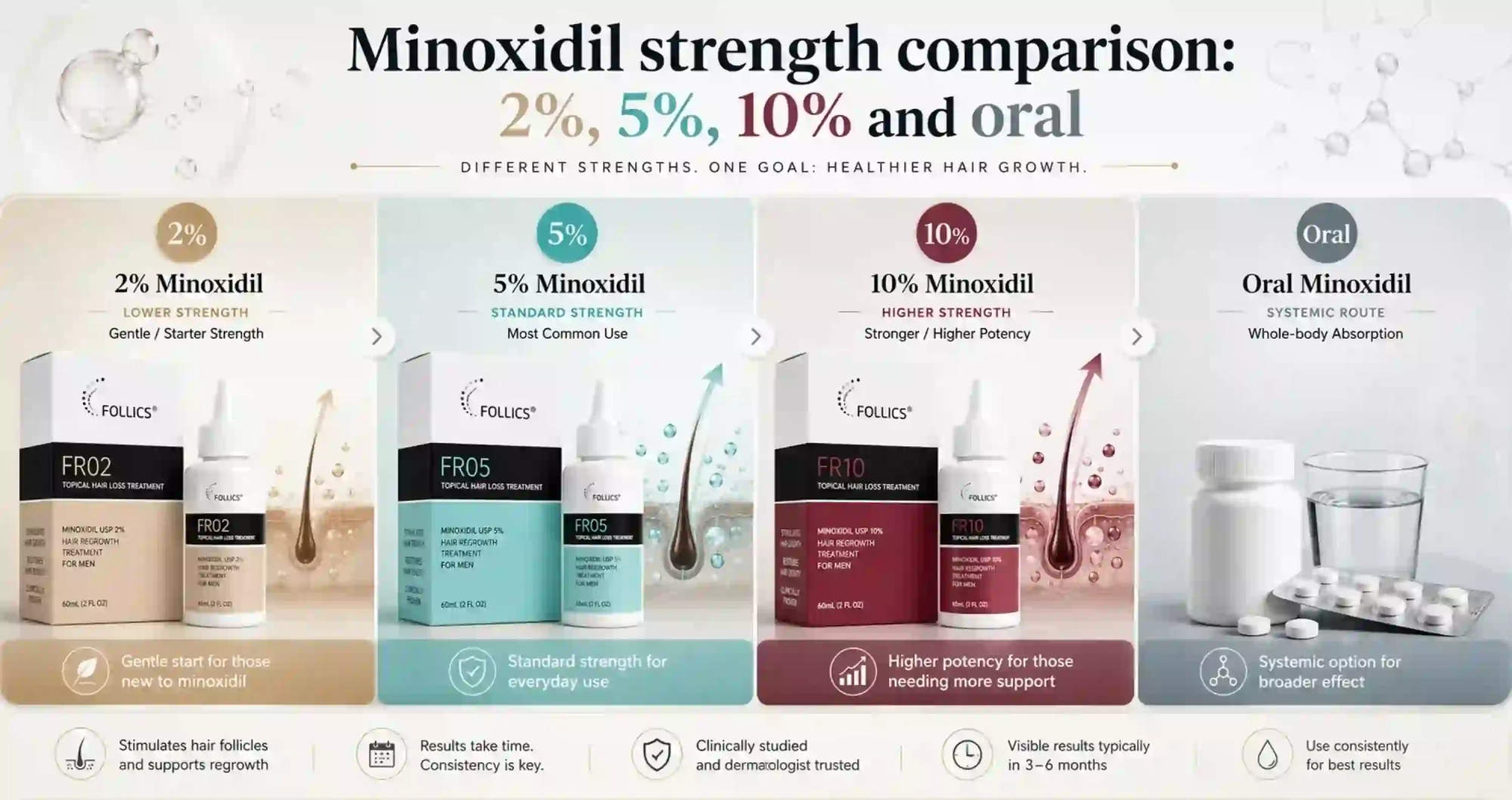
Choosing the right concentration matters more than most people realize. This minoxidil strength comparison covers the full range, 2%, 5%, 10%, and oral, so you can match the right formula to your situation instead of defaulting to whatever the pharmacy happens to stock. Minoxidil is one of the most clinically proven hair regrowth treatments available. Extensive trial data, regulatory approvals across multiple markets, and a well-understood mechanism of action place it ahead of most alternatives. Yet most people choose their concentration by grabbing whatever is on the shelf. In the UAE, that usually means 2% or 5%, and the decision often comes down to availability. That’s not how you should be making this call.
The clinical picture for topical minoxidil concentrations is more detailed than the pharmacy shelf suggests. There’s meaningful evidence separating each tier, and the differences in results, side effects, and formulation type matter. This minoxidil dosage guide covers the full concentration range, from standard OTC options through to the high-strength formulas most UAE pharmacies don’t stock, so you can make an informed decision rather than a convenient one.
Minoxidil strength comparison: how concentration affects hair regrowth
Minoxidil works by extending the anagen phase, the active growth stage of the hair cycle, and by widening blood vessels around the follicle to improve nutrient delivery. At lower concentrations, this effect is mild. As the dose increases, the follicular stimulus strengthens. The relationship between concentration and outcome, however, is not a straight line upward.
A 36-week randomized controlled trial comparing 5% and 10% topical minoxidil in men with androgenetic alopecia found that 5% produced superior vertex hair count improvement, with a change from baseline of 0.47 versus just 0.05 in the 10% group. The stronger formula caused significantly more local irritation without delivering additional regrowth. This finding is the most important baseline for understanding the entire concentration ladder: more does not always mean better.
2% topical minoxidil: the starting point for women
The 2% solution is FDA-approved for women and remains the clinical standard for female pattern hair loss. The 5% foam formulation also received FDA approval for women in 2014, making it a valid alternative when appropriate. For first-line treatment without specialist input, 2% remains the safest starting point for most women. Those with diffuse thinning at the crown respond well at this concentration, particularly in earlier stages of the condition.
For men, 2% is rarely the right choice. A 48-week double-blind RCT (Olsen et al.) found that 5% topical minoxidil produced 45% more hair regrowth than 2% in men with male androgenetic alopecia. The 5% group also experienced an earlier treatment response across four of six efficacy measures. If you’re a man using 2% because it’s cheaper or more available, you’re leaving results on the table.
Initial shedding in the first four to eight weeks is normal at this concentration, affecting roughly 18 to 30% of new users. This reflects dormant follicles being pushed into the active growth cycle, not product failure. Visible regrowth typically begins between months three and six with consistent twice-daily application. Stopping before six months and concluding it doesn’t work is one of the most common reasons people abandon a treatment that was on track to deliver results.
5% topical minoxidil: why it’s still the clinical benchmark
The evidence base for 5% topical minoxidil in men is the strongest of any topical concentration. The Olsen et al. RCT established its superiority over 2%, and no higher concentration has since managed to beat it in a controlled trial setting. It remains the most evidence-supported starting point for men and is widely used off-label in women who haven’t responded adequately to 2%.
Formulation and tolerability
Formulation matters here. The foam version is generally better tolerated than the alcohol-based solution because it eliminates propylene glycol, the vehicle ingredient responsible for most contact dermatitis cases. Scalp irritation occurs in roughly 7 to 14% of solution users, compared to around 5% in foam users. If you have a sensitive scalp or previous skin reactions to topical treatments, starting with the foam format is the smarter move.
Absorption and side effects
Systemic absorption with 5% topical sits at around 1 to 2% of the applied dose, making cardiovascular side effects rare. Local adverse events, including scalp itching, dryness, and flaking, occur but are manageable for most users. The main commitment with 5% is time: results require consistency over months, not weeks, and stopping treatment reverses the gains.
10% and 16% topical minoxidil: when standard strengths aren’t enough
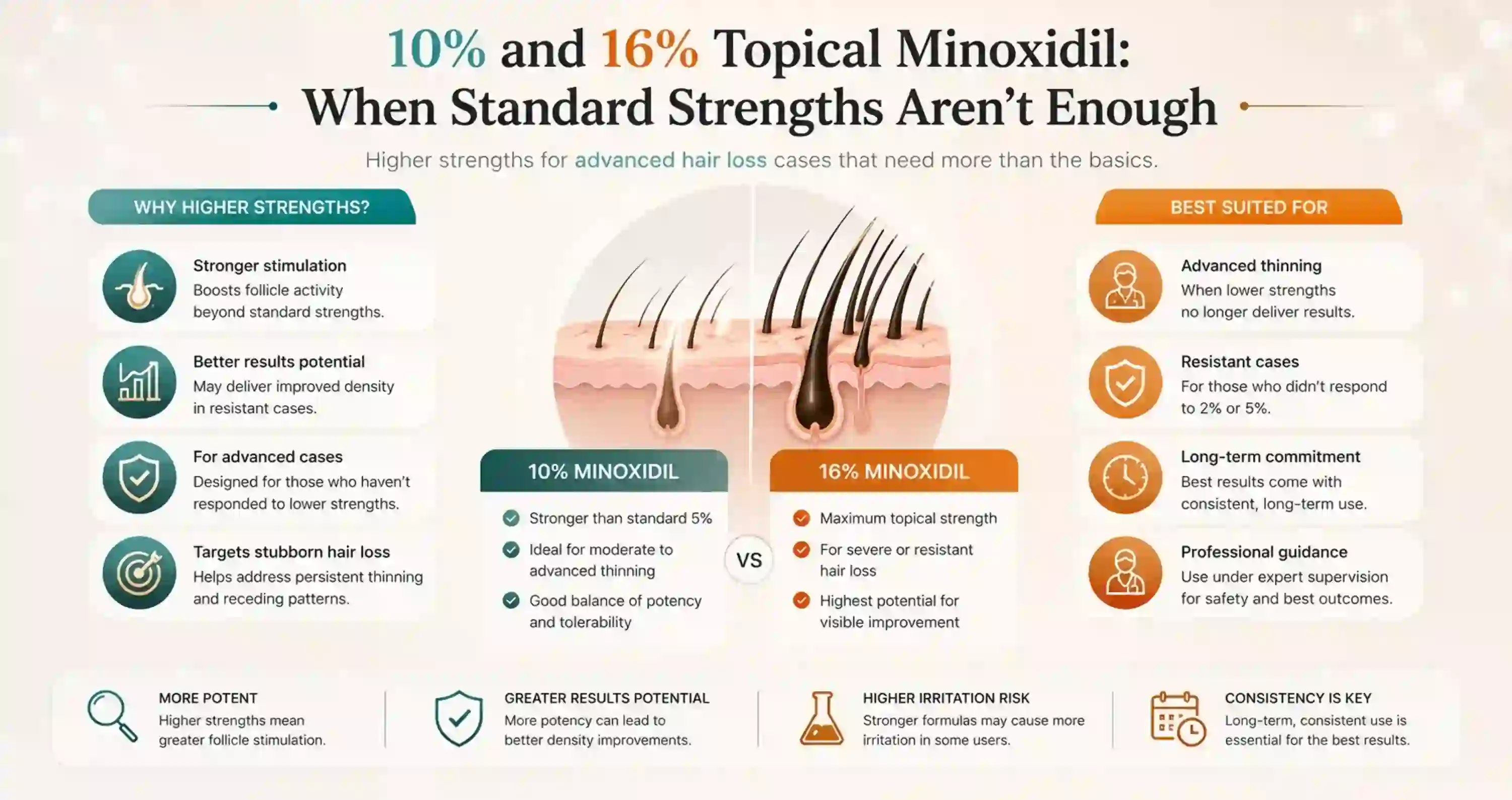
Some men with long-standing androgenetic alopecia or those who have plateaued on 5% after twelve months or more explore higher-concentration compounded formulas. The rationale is delivering a stronger follicular stimulus to miniaturized hair that has become less responsive over time. Clinically, 10% doesn’t consistently outperform 5% in trials. Some dermatologists observe partial responses in follicles that appear less sensitive to standard-dose treatment, a working clinical hypothesis rather than an established finding, and this is the population where higher concentrations are sometimes considered.
The 16% formulation takes this further. There are no published RCTs for 16% in androgenetic alopecia, so any use at this concentration is strictly off-label and requires medical oversight. Its appeal is practical: this concentration level is entirely absent from mainstream UAE pharmacy shelves. The Follics FR16, available through Hims n Hers UAE, is one of the few 16% minoxidil solutions accessible in the UAE without importing (availability subject to change; verify current stock before ordering). It is intended for users who have exhausted the standard concentration range under professional guidance, not as a first-line option.
At 10% and above, local irritation risk increases meaningfully. The 5% vs. 10% minoxidil clinical trial data showed the higher concentration caused marked flaking, itchiness, and dryness compared to the lower concentration. Starting at 5% and stepping up only when evidence from your own scalp justifies it is the recommended path. Don’t reach for the strongest option simply because it’s available.
Low-dose oral minoxidil: a systemic option backed by growing evidence
Low-dose oral minoxidil is off-label for hair loss, but the supporting clinical data has grown substantially. Women typically start at 0.25 to 1 mg daily, while men require 1 to 5 mg for meaningful effect. A 24-week study found oral 5 mg once daily produced comparable overall improvement to topical 5% twice daily, with superior vertex improvement: 70% photographic improvement versus 46% in the topical group. Adherence favored the oral route at 90% versus 80% for topical, largely because it eliminates the scalp irritation problem entirely.
The side effect profile shifts significantly with oral use. At 1 mg, postural hypotension affects around 1% of users and pedal edema around 2 to 4%. At 5 mg, headaches occur in approximately 20% and dizziness in 15%. Hypertrichosis, unwanted body or facial hair, is the most common complaint at any oral dose, affecting up to 49% of men on oral versus 25% on topical. That’s a meaningful trade-off worth factoring into your decision before starting.
Absolute contraindications for oral minoxidil include pheochromocytoma, pericardial disease, pregnancy, and significant cardiovascular history. Anyone in the UAE considering the oral route should get a baseline blood pressure and heart rate check before starting. Self-prescribing at 5 mg without physician oversight is not a reasonable approach at this dose level, given the cardiovascular risk profile. At 1 to 2.5 mg, the risk is considerably lower, but a baseline check remains the responsible step.
Minoxidil strength comparison: choosing the right concentration for your situation
Women with early-stage diffuse thinning should start at 2% topical and consider switching to 5% foam if there’s no visible improvement after six months. Men with moderate crown or vertex loss should start at 5% topical. Men who can’t tolerate scalp application or have struggled with application adherence will find low-dose oral minoxidil (2.5 to 5 mg) a legitimate clinical option worth discussing with a dermatologist. Men with treatment-resistant loss who have plateaued on 5% after twelve months may be candidates for a higher-concentration off-label formula, though it bears repeating that no RCT evidence currently supports 16% over 5%, and any step-up should happen with medical oversight.
The practical challenge in the UAE is minoxidil availability. Standard concentrations are accessible at most pharmacies, but higher tiers and combination formulations are not. Hims n Hers UAE stocks the full range, from 2% women’s formulas through to the Follics FR16 16% solution and combination treatments not readily found elsewhere locally. If you’ve hit a wall sourcing what your situation actually calls for, knowing your supply options before you need them matters.
Before stepping up in concentration, take monthly photos to track progress objectively, a practical approach endorsed by dermatologists for monitoring treatment response. Give any formula a minimum of six months before drawing conclusions. The biggest mistake in minoxidil treatment isn’t choosing the wrong concentration; it’s giving up on the right one too early.
The bottom line
This minoxidil strength comparison comes down to one principle: the goal isn’t the most powerful option, it’s the right match between formula and where your hair loss stands right now. Start at the clinically proven level for your gender and loss pattern, stay consistent, and step up only when your results justify it. The 2% vs. 5% vs. 10% vs. oral decision isn’t arbitrary; each tier has a specific clinical profile, a distinct side effect trade-off, and a defined population it suits best.
Use that evidence, not shelf availability, to guide your choice. If you’re in the UAE and mainstream pharmacies aren’t stocking what you need, the full spectrum is available through providers such as Hims n Hers UAE, but know what you’re buying, understand why you’re using it, and give it the time it takes to work.