
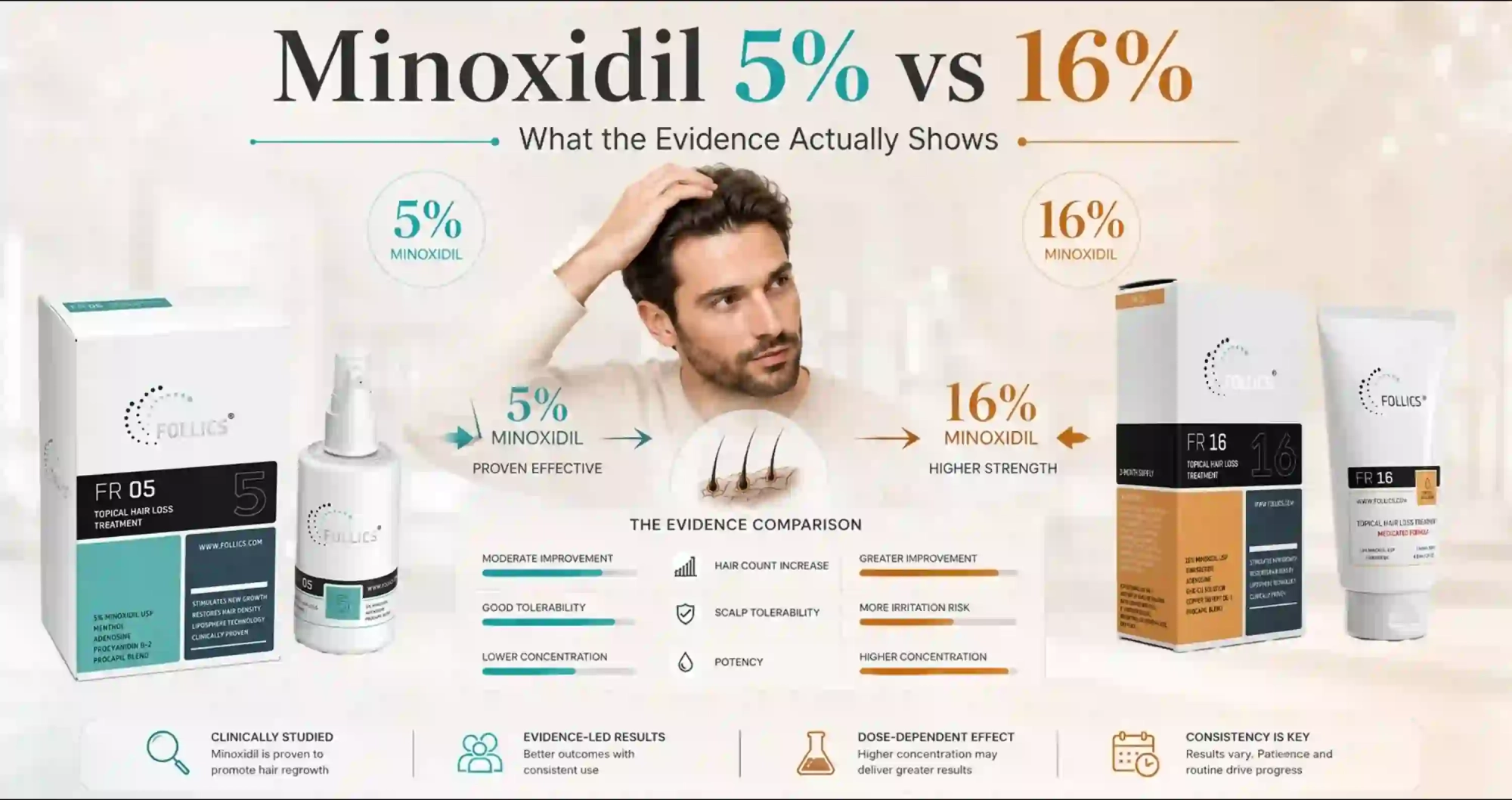
If you’re wondering what is the difference between minoxidil 5 and 16, the short answer is this: more concentration does not mean more results. The clinical evidence on high-strength minoxidil consistently shows that for male pattern baldness, 5% performs as well as or better than higher concentrations in regrowth outcomes, while side effects climb sharply as the percentage goes up. Understanding why requires looking at what minoxidil actually does inside the scalp, not just how much of it you’re applying.
There’s a simple logic behind upgrading your minoxidil concentration: if 5% works, then 16% must work better. It’s the same assumption that leads people to double up on doses when a treatment feels slow, and it’s almost always wrong. The clinical evidence doesn’t support it, at least not for the most common form of hair loss.
For UAE residents curious about a 16% formulation specifically, there’s also a practical context worth knowing upfront. Follics FR16 is available through Hims n Hers UAE, making it one of the very few accessible routes to a 16% compounded formulation in the country outside the standard pharmacy system. Whether that’s worth pursuing is the question this article is designed to answer honestly.
What the difference between minoxidil 5 and 16 comes down to: mechanisms and absorption
Topical minoxidil doesn’t work just by touching your scalp. It has to penetrate through the outer skin layer, reach follicular cells in the outer root sheath, and get converted by an enzyme called SULT1A1 into minoxidil sulfate. That converted form is the active molecule. It functions as a potassium channel opener, which extends the hair follicle’s growth phase and promotes regrowth.
The critical point is that the conversion step is rate-limited by how much SULT1A1 enzyme your scalp produces. If your enzyme activity is fixed, applying three times the concentration doesn’t generate three times the active metabolite. The enzymatic capacity is the ceiling. This is the first, most fundamental reason why simply increasing concentration has a hard limit on its impact.
There’s also a solubility problem. Minoxidil dissolves in propylene glycol up to roughly 7.5% by weight. Above that threshold, it crystallizes. Formulations at 10%, 15%, or 16% require more complex solvent systems to maintain stability, and crystallization on the scalp reduces the amount of drug actually available for absorption. So the gap between a 5% and 16% formulation, in terms of what’s actually reaching your follicles, is considerably smaller than the numbers on the label suggest. This is a key part of understanding the real-world difference between minoxidil 5% and 16%.
What the clinical trials actually found
Two randomized trials have directly compared 5% minoxidil against higher concentrations in male androgenetic alopecia (AGA), and both produced the same counterintuitive result: 5% was either superior or equivalent to the higher concentration in regrowth outcomes, while side effects climbed sharply with concentration.
In the Ghonemy and Alarawi 2019 trial, 90 men were assigned to 5%, 10%, or placebo over 36 weeks. The 5% group showed significantly greater improvements in total vertex and frontal hair count than the 10% group. Scalp irritation occurred in 100% of the 10% group versus 22.2% in the 5% group. The 10% group also experienced higher rates of shedding and hypertrichosis, and reported worse psychosocial outcomes from those effects.
A separate randomized self-comparative trial testing 5% against 15% told a similar story: pull test results were nearly identical (37% vs 37.5% negative rates), but with meaningfully higher local adverse events in the 15% arm, including contact dermatitis and early shedding.
The explanation sits in the enzyme mechanism described above. In AGA, the limiting factor is follicular SULT1A1 activity, not the amount of minoxidil available. Once you’ve saturated that enzymatic capacity at 5%, adding more minoxidil generates more irritation without generating more active sulfate. The numbers don’t translate the way people expect.
There is one exception worth noting. A randomized trial in alopecia areata patients found that 10% minoxidil achieved a 63.2% reduction in SALT score compared to 41.6% for 5%. Alopecia areata has a different mechanism than pattern hair loss, involving immune attack on the follicle rather than DHT sensitivity. This finding doesn’t transfer to AGA use cases. It does suggest the relationship between concentration and efficacy isn’t universally flat, but for pattern hair loss specifically, the higher-concentration argument is weak.
No randomized trial has directly compared 5% to 16% in AGA or alopecia areata, which matters when evaluating the difference between minoxidil 5 and 16 for pattern baldness specifically. The 5% vs 15% data is the closest available proxy, and it did not favor the higher concentration for regrowth in pattern hair loss. That evidence gap is worth factoring into any decision to escalate concentration.
How side effect risk scales with concentration
At 5%, the controlled trial data shows scalp irritation in 7 to 13% of users, contact dermatitis in around 3 to 6%, and systemic cardiovascular effects below 1 to 2%. These numbers are manageable, and most people tolerate standard 5% minoxidil without serious issues. The picture changes as concentration increases.
Higher-concentration formulations require more propylene glycol as a carrier solvent, and propylene glycol is itself a known skin irritant and a common trigger for contact dermatitis. This compounds the irritation risk beyond just the minoxidil concentration itself. The 10% trials recorded 100% scalp irritation incidence, which reflects what the vehicle system contributes at higher doses. Hypertrichosis (unwanted growth of facial or body hair) was also significantly more common in the 10% and 15% treatment arms. It’s also worth noting that minoxidil foam vs liquid formulations differ in their propylene glycol content, which partly explains why foam versions tend to cause less irritation at standard concentrations.
Systemic absorption is the more serious concern at the upper end of the concentration range. Topical minoxidil at 5% produces systemic absorption averaging around 1.4%, and serious cardiovascular effects are rare. With a 16% formulation, the absolute amount of minoxidil delivered transdermally per application is substantially higher, particularly on damaged or inflamed skin where the barrier is compromised. Palpitations, fluid retention, and blood pressure changes are all documented effects of excess systemic minoxidil. They remain uncommon, but the risk is meaningfully greater at 16% than at 5%.
Who is a realistic candidate for a higher-strength formulation
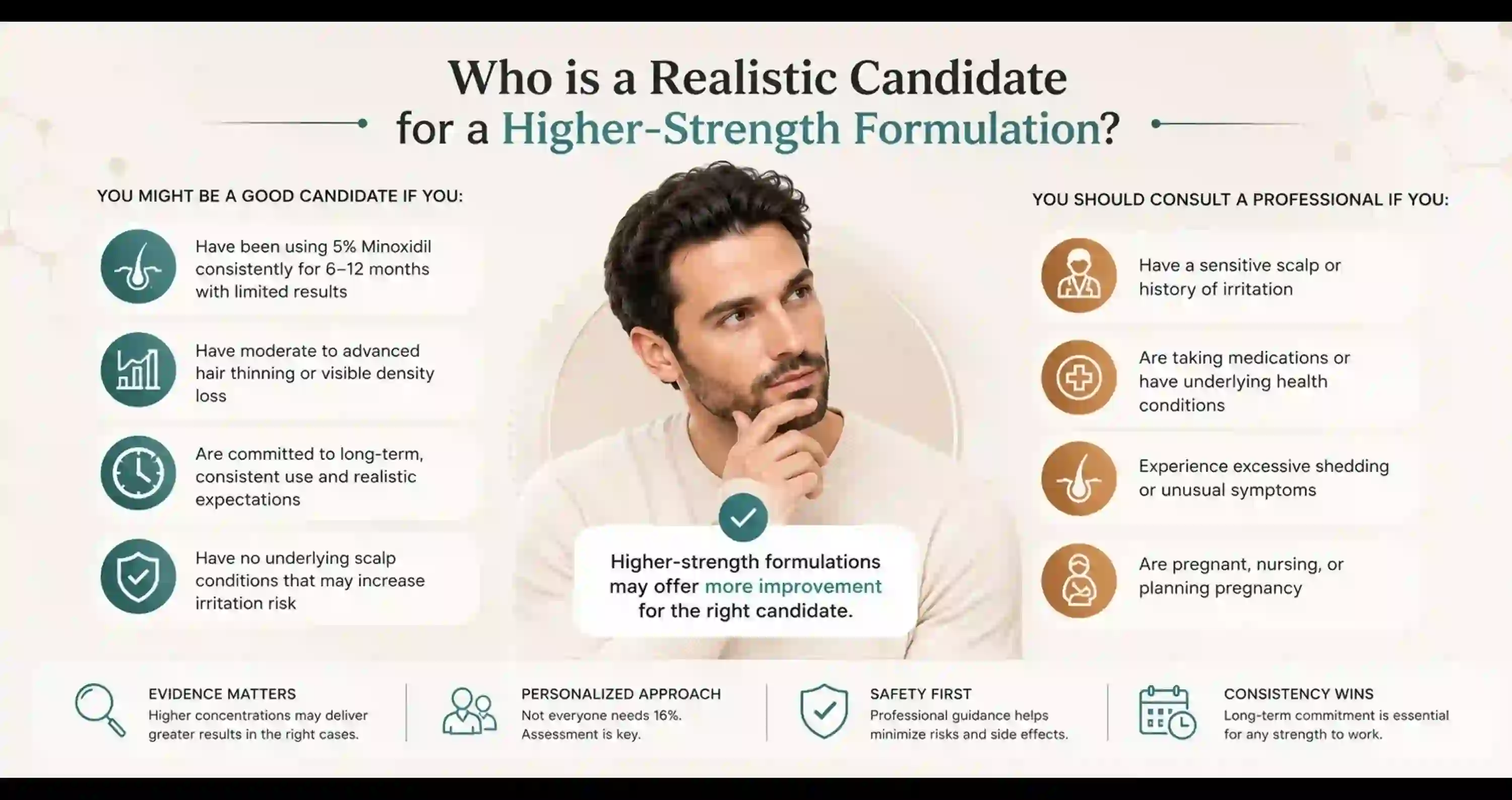
Approximately 30 to 40% of men with AGA see little or no clinically meaningful regrowth from 5% minoxidil after 12 months. Research suggests a significant subset of this group has low SULT1A1 enzyme activity in their scalp tissue. Because their follicles convert less minoxidil to its active sulfate form, they get less therapeutic effect per application. In theory, a higher concentration provides more substrate to work with, which could partially compensate for the enzymatic bottleneck. This is the strongest clinical rationale for trialing a higher-strength formulation, and it’s why some dermatologists consider it after 6 to 12 months of documented non-response to 5% used correctly.
The candidate profile matters. A dermatologist considering a stronger concentration would want to confirm several things first:
- Confirmed androgenetic alopecia diagnosis, not another form of hair loss
- Documented non-response to 5% applied correctly for at least 6 months
- No active scalp inflammation or dermatitis, which increases systemic absorption risk
- No cardiac history that raises concern about higher systemic minoxidil exposure
People who self-escalate to 16% without going through this assessment are taking on side effect risk without any clear evidence of proportional benefit. The avoidable adverse events in minoxidil use tend to come from skipping this step. If you’re currently responding to 5%, there is no clinical case for switching. The evidence doesn’t support chasing a higher number.
Getting a 16% formulation in the UAE
Topical minoxidil in the UAE is a prescription-only medication, and that classification applies to standard concentrations. Non-standard formulations above 5% fall into a more restricted category requiring specific Ministry of Health and Prevention approval for commercial sale. This is why mainstream pharmacies across Dubai and the UAE carry Rogaine 5% vs compounded formulations differently: registered products like Rogaine have marketing authorizations, while a 16% compounded formulation sits entirely outside that framework.
For UAE residents who have gone through the appropriate clinical process and want access to a higher-strength option, Follics FR16 from Hims n Hers UAE is one of the few realistic routes available locally. It removes the primary access barrier for people who are genuine non-responders, have documented their situation, and want to trial a stronger formulation without navigating a pharmacy system that doesn’t carry it.
It’s not positioned as a first-step treatment, and it doesn’t replace a conversation with your dermatologist if you have a complex health background. For men who have completed that process and are looking for a higher-concentration option with UAE delivery, Hims n Hers UAE is one of the only places in the country where that option actually exists.
The bottom line on concentration and results
The relationship between minoxidil concentration and hair regrowth is not linear. At 5%, you’re already working at or near the functional ceiling for most people with pattern hair loss. The trials confirm this: both 10% and 15% formulations failed to outperform 5% in AGA efficacy, while side effect rates climbed substantially. A 16% formulation has no direct trial data in AGA, and the closest proxy evidence doesn’t make a case for it as a general upgrade.
If you’re on 5% and seeing results, stay there. The evidence supports it, and there’s nothing to gain from switching to a higher concentration. If you’ve been applying 5% consistently for 6 to 12 months with no meaningful change, that’s worth discussing with a dermatologist before drawing conclusions. The issue may be enzymatic non-response, or it may be something else entirely that a stronger minoxidil formulation won’t fix regardless of concentration.
For those who have genuinely plateaued and are looking at the 16% option, approach it as a specific clinical tool, not an upgrade. Know your baseline, know your health history, and if you’re in the UAE and ready to access it, Follics FR16 through Hims n Hers UAE is available with direct delivery across the country.
Frequently asked questions
What is the difference between minoxidil 5 and 16?
The primary difference is concentration, but that doesn’t translate directly into better results. At 5%, you’re already near the functional ceiling for most people with pattern hair loss. The enzyme that converts minoxidil into its active form is limited regardless of how much minoxidil you apply. A 16% formulation delivers more substrate, but unless your enzyme activity is low, the extra concentration mostly adds irritation risk rather than regrowth benefit.
Is 16% minoxidil more effective than 5%?
Not for most people with androgenetic alopecia. Clinical trials comparing 5% to 10% and 15% found that 5% matched or outperformed the higher concentrations for regrowth, while producing significantly fewer side effects. No direct trial data exists for 5% vs 16% in AGA, so there’s no evidence base to support 16% as a general upgrade.
Is 16% minoxidil safe?
It carries a higher risk profile than 5%. Side effects including scalp irritation, hypertrichosis, and systemic effects such as palpitations and fluid retention are all more likely at higher concentrations. Systemic absorption increases substantially at 16%, particularly on inflamed or compromised skin. It should only be considered under dermatological supervision, in confirmed non-responders who meet the clinical criteria for escalation.
Can I get 16% minoxidil in the UAE?
Yes, through specific channels. Mainstream pharmacies carry registered 5% products. Follics FR16 is available through Hims n Hers UAE for eligible individuals, making it one of the few accessible routes to a 16% formulation in the country with direct UAE delivery.