
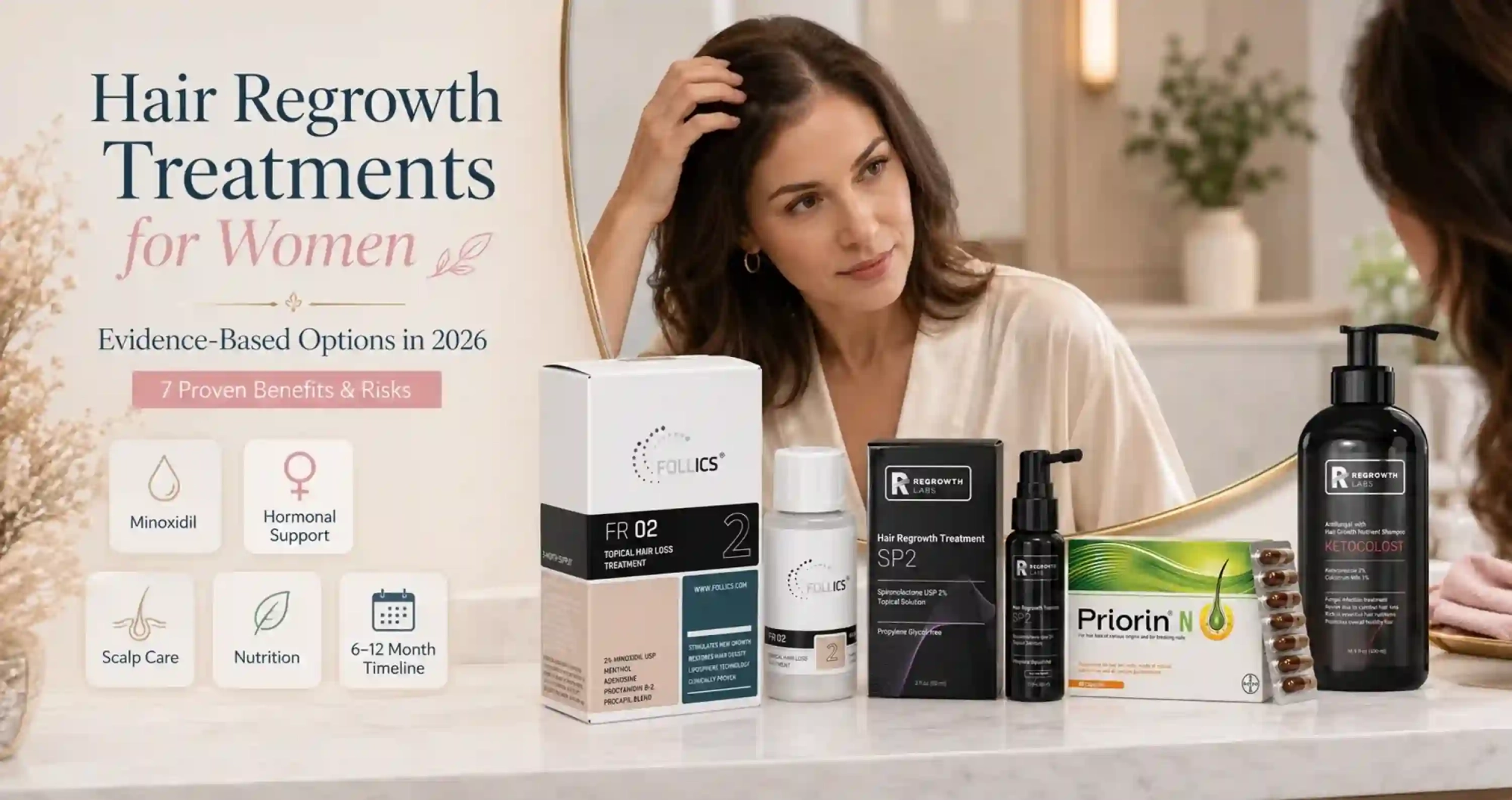
So, what are the best hair regrowth treatments for women? It’s one of the most common questions women ask after noticing their ponytail getting thinner or their part looking wider, and the honest answer is that it depends on what’s actually causing the loss. Hair thinning is something women are quietly told to push through.
A stressful year, hormonal shifts after a baby, or simply “getting older”, these explanations get handed out freely, and the real treatment conversation rarely follows. What makes it more frustrating is that many products on pharmacy shelves have historically been developed with men in mind, leaving women to guess whether any of them actually apply to their situation.
The good news is that the options available to women have genuinely improved. UAE shoppers can begin with the women hair products category, which brings women-focused treatments, shampoos, supplements, and scalp-care options into one place. Women in the UAE now have access to a range of clinically supported treatments, including women-specific formulations, through specialists who understand the difference between a marketing claim and a randomized controlled trial. The challenge is that no single product works for every type of female hair loss, choosing the wrong one wastes months that could be spent on real recovery. A supplement for nutritional deficiency, for example, will not halt androgen-driven miniaturization.
This article walks through the most credible hair regrowth treatments for women, ranked by evidence, with honest timelines and realistic side-effect profiles. The goal is straightforward: help you match the right treatment to your specific type of hair loss so you can start from an informed position rather than guesswork.
Why female hair loss is a different problem than male pattern baldness
Male pattern baldness and female hair loss are not the same condition wearing different hats. In women, the pattern is typically diffuse thinning across the crown rather than a receding hairline, and the underlying causes are more varied. Hormonal shifts, nutritional deficiencies, thyroid dysfunction, and postpartum stress all play roles that simply don’t apply the same way in men. Reaching for a men’s-first treatment without understanding what’s actually driving your loss often leads to wasted money and unnecessary frustration. This is why hair regrowth treatments for women should be matched to diagnosis, pregnancy status, scalp sensitivity, and hormonal profile.
The main types of thinning women experience
Androgenetic alopecia (female pattern hair loss) is the most common type, driven by a genetic sensitivity to androgens that causes hair follicles to gradually miniaturize. Telogen effluvium is different: it’s a stress-triggered mass shedding that usually follows illness, major surgery, crash dieting, or childbirth, and it’s often reversible once the trigger is removed. Traction alopecia develops over time from styling choices that put sustained tension on the hairline; dermatology guidance recognizes it as a distinct diagnosis requiring a different management approach from androgenetic or stress-related shedding. Identifying your type before choosing a treatment is not optional. A supplement that addresses nutritional deficiency-driven shedding won’t do anything for androgen-driven miniaturization.
Why a dermatologist assessment still matters first
Before committing to any long-term treatment, a proper diagnosis rules out reversible causes: thyroid dysfunction, low ferritin, hormonal imbalance from PCOS, or other contributing conditions. These are worth identifying because treating the root cause directly is far more efficient than layering products over an unresolved physiological problem. In the UAE, dermatology consultations are accessible, and this step is worth taking before you start ordering online. Most of the treatments covered in this article perform best when the correct diagnosis is already confirmed.
What is the best hair regrowth treatments for women? Evidence and timelines
Understanding the best option for hair regrowth treatments for women starts with minoxidil, the only topical treatment to have earned FDA approval specifically for women. But the full picture is broader than a single product. Below is a treatment-by-treatment breakdown, ordered from strongest to more situational evidence.
Minoxidil for women: the only FDA-approved topical, explained
Topical minoxidil holds a credibility position that no other treatment for female hair loss currently matches: it is the single FDA-approved treatment specifically for female pattern hair loss. For a lower-strength topical option, FOLLICS FR02 Hair Growth Treatment with 2% Minoxidil is the most direct internal match for women comparing a gentler starting point. That regulatory designation reflects a body of evidence from multiple randomized controlled trials, not just favorable anecdotes. It works by prolonging the anagen (growth) phase of the hair cycle and promoting circulation to follicles, making it a practical first-line option for most women with androgenetic alopecia.
2% vs 5%: which concentration makes more sense for most women
A 48-week multicenter randomized trial of 381 women established the clearest comparison: 5% topical minoxidil outperformed 2% on patient-assessed treatment benefit, and it was superior to placebo on all three primary efficacy measures at week 48. The 2% concentration still beat placebo on nonvellus hair count and investigator assessment, but patients didn’t rate their own improvement as clearly.
The tradeoff is tolerability: 5% caused more scalp irritation, itching, and hypertrichosis (unwanted facial hair growth) than the lower concentration. Women with sensitive scalps or a tendency toward facial hair often do better starting with 2%, while those who can tolerate the 5% formulation may see faster visible improvement. This is one reason hair regrowth treatments for women should be chosen by tolerance as well as evidence strength. Foam formulations are widely preferred for ease of application, though direct foam-versus-liquid comparison data specifically in women remain limited.
What realistic timelines and response rates look like
Some shedding in the first 6 to 8 weeks is normal, this is a telogen shift, not a sign the treatment is failing, and stopping at this point is one of the most common mistakes. Modest changes in density typically begin appearing between months 2 and 4. A meaningful assessment of whether minoxidil is working requires 6 to 12 months of consistent use. Response is common enough to produce statistically significant results across clinical trials, but it is not universal. Setting these expectations clearly from the start prevents premature abandonment of a treatment that simply needs more time.
Hormonal treatments: spironolactone and finasteride for androgen-driven thinning
Both spironolactone and finasteride are used off-label for female hair loss, meaning they carry clinical evidence but are not FDA-approved for this specific indication. For androgen-related thinning, SP2 Hair Regrowth Treatment with Spironolactone USP 2% is the most relevant women-focused topical anti-androgen product on the site. A doctor’s involvement is non-negotiable with either option. Spironolactone is the more commonly prescribed anti-androgen for women, with a better-established safety profile in reproductive-age women when reliable contraception is used. Finasteride is generally reserved for postmenopausal women or highly selected cases.
Spironolactone: dosing, who benefits, and key side effects to know
Spironolactone works by blocking androgen receptors, making it most useful when hair loss has a clear hormonal component, such as elevated androgens, PCOS, or concurrent hirsutism. Among hair regrowth treatments for women, this category needs more medical screening than standard topical minoxidil. Typical effective dosing for hair loss runs 100 to 200 mg per day. Results take 3 to 6 months to become visible. Key side effects include menstrual irregularities, breast tenderness, dizziness, and the risk of elevated potassium (hyperkalemia), particularly relevant for women with kidney issues or those taking potassium supplements. Reliable contraception is required during use because spironolactone can harm a developing male fetus; this is a clinical requirement, not a loose recommendation.
Finasteride in women: when it’s used and why pregnancy risk is absolute
Finasteride at 1 mg per day (the standard men’s dose) showed no benefit in a randomized trial of postmenopausal women. Higher doses of 2.5 to 5 mg per day have shown benefit in some postmenopausal studies and specialist clinical experience, but the evidence base is considerably weaker than it is for men. Finasteride is contraindicated in any woman who could become pregnant: it causes abnormal fetal development in male fetuses, and this is a hard stop with no gray area. For the right candidate, specifically a postmenopausal woman under specialist supervision, it remains a valid option worth discussing.
LLLT and PRP: what clinic-based treatments can and can’t deliver
Low-level laser therapy (LLLT) has earned a solid position in the female hair loss treatment hierarchy. A meta-analysis of randomized controlled studies found a significant increase in hair density (SMD: 1.27) in androgenetic alopecia patients treated with LLLT versus sham controls, with no significant difference in efficacy between sexes. Two studies specifically assessing LLLT in women with androgenetic alopecia met guideline inclusion criteria at grade A2 evidence level. At least one meta-analytic comparison has positioned LLLT efficacy close to that of minoxidil, which makes it a genuine alternative for women who can’t tolerate topical treatments.
Low-level laser therapy: sessions required and realistic results
LLLT requires 2 to 3 sessions per week at 15 to 30 minutes each, typically across 4 to 6 months before new growth becomes visible. Subtle reductions in shedding and improved density often appear after 8 to 12 weeks of consistent use. FDA-cleared home-use devices, including HairMax LaserComb and iGrow, both have randomized controlled trial data specifically in women with androgenetic alopecia. LLLT is non-invasive and has a clean side-effect profile, making it a practical adjunct to a primary treatment or a standalone option for women who want to avoid medication entirely. It is best framed as one of the supportive hair regrowth treatments for women rather than a replacement for diagnosis.
PRP: where the evidence stands in 2026
PRP involves 3 to 4 initial sessions spaced 4 to 6 weeks apart, followed by maintenance every 6 to 12 months. It is commonly offered and marketed in UAE clinics, but high-quality randomized controlled data specifically for women remain limited. Combining PRP with LLLT is currently under clinical investigation. Women considering PRP should treat it as an adjunct to a proven first-line treatment rather than a replacement for one.
Supplements and shampoos with actual clinical support
Not all over-the-counter options are interchangeable, and the evidence gap between them is wider than most product marketing suggests. Supportive hair regrowth treatments for women should strengthen the core plan, not distract from it. Two have the clearest randomized-trial backing for women: ketoconazole shampoo and Viviscal. Others, including biotin and Nutrafol, are widely used but lack strong trial evidence for women without a confirmed deficiency.
Ketoconazole shampoo and topical agents worth considering
Ketoconazole’s antifungal mechanism also appears to carry a mild anti-androgenic effect at the scalp level, which is why it shows up in hair loss treatment evidence. The Ketocolost Anti-fungal Hair Growth Shampoo is the most relevant internal shampoo link for this ketoconazole-focused section. The 2% prescription formulation carries the stronger evidence base, though OTC 1% options are widely available.
It works best as a supporting layer alongside a primary treatment like minoxidil rather than as a standalone regimen. Scalp-focused shampoos formulated specifically for hair loss, including options available through Hims n Hers UAE, can serve as a practical addition for women who want to optimize scalp health as part of a broader treatment routine. They are supportive hair regrowth treatments for women, not standalone replacements for minoxidil or diagnosis.
Viviscal, biotin, and what the trial evidence actually shows
Viviscal is supported by a randomized, placebo-controlled study in women with thinning hair: phototrichogram analysis confirmed a statistically significant increase in terminal hair count after 90 days, with a 6-month trial replicating the finding. For a local supplement option, Priorin N Capsules: Hair Regrowth Supplements can be positioned as nutritional support rather than a replacement for first-line therapy. The methodology was rigorous for a supplement, double-blinded, with defined scalp target areas and standardized hair shedding counts.
Biotin, by contrast, only shows meaningful benefit in women with a confirmed biotin deficiency; taking it without that deficiency has not been shown to improve hair thickness in clinical trials. This is why supplement-based hair regrowth treatments for women should follow bloodwork or a clear nutritional rationale. The same principle applies broadly: supplements should address a real physiological gap, not function as a substitute for treatments with actual clinical evidence behind them.
A UAE product pathway for hair regrowth treatments for women
A practical product pathway should follow the evidence ranking in this article. For female pattern thinning, start by comparing minoxidil-based options such as FR02. For androgen-driven thinning where a prescriber wants an anti-androgen layer, SP2 is the most relevant topical spironolactone option. For scalp support, Ketocolost is the most relevant ketoconazole-style shampoo link. For nutritional support, Priorin N belongs in the supplement layer.
This product pathway keeps hair regrowth treatments for women organised by purpose: treatment, hormonal support, scalp support, and nutritional support. It also avoids the mistake of presenting every product as equal. A shampoo can improve the scalp environment, but it does not replace minoxidil for female pattern hair loss. A supplement can support deficiency-related shedding, but it does not replace hormonal evaluation where androgen sensitivity is the driver.
For UAE shoppers, the women category should be the first browsing path, while the treatments category can be used when a dermatologist has recommended a specific active ingredient or stronger clinical option.
Choosing the best hair regrowth treatments for women by hair loss type
Treatment choice should follow diagnosis, not replace it. The most effective plans are built around a confirmed first-line option, with adjuncts added strategically rather than stacked in the hope that volume compensates for lack of direction.
Matching treatment to your specific hair loss pattern
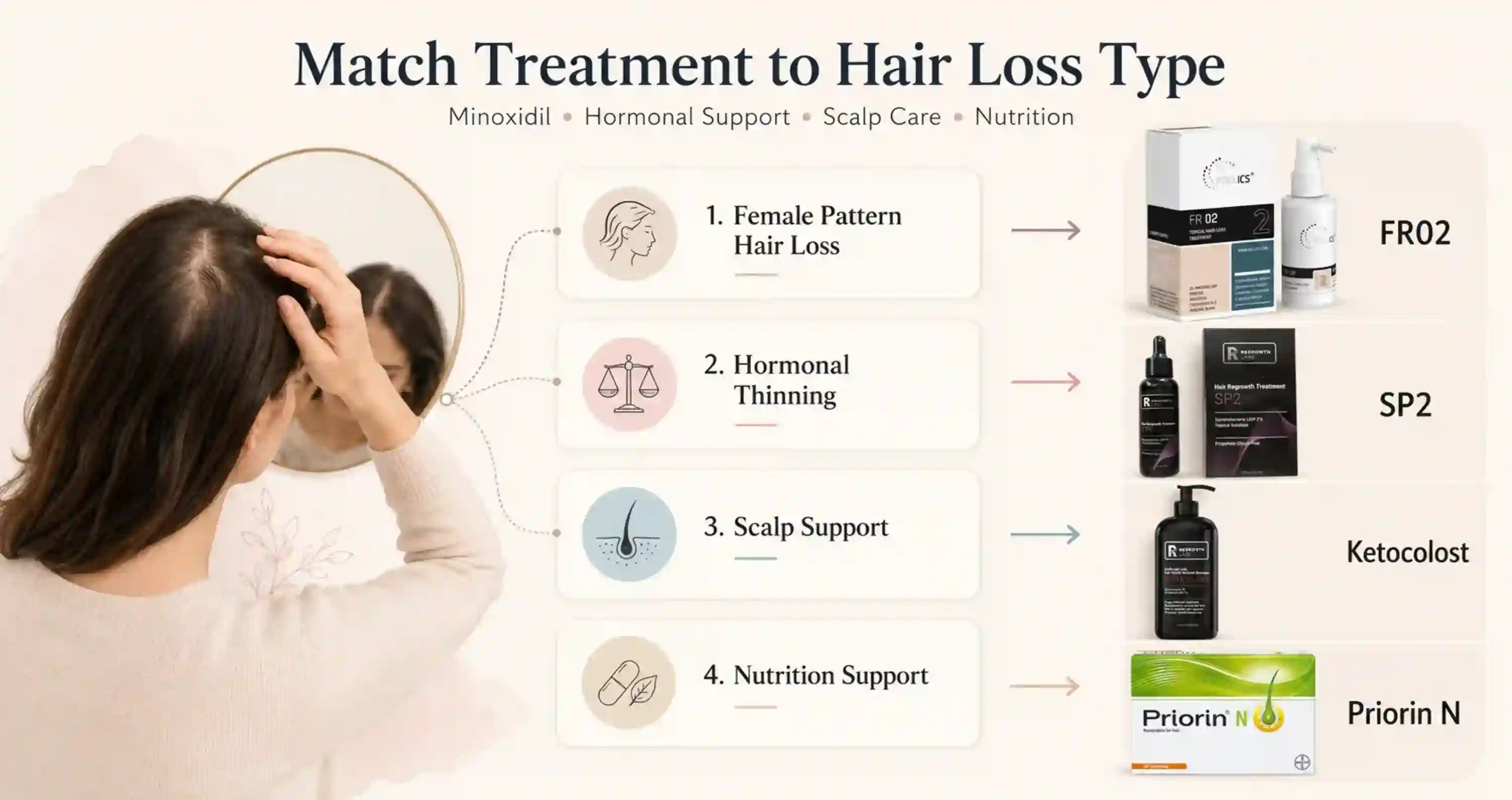
For female pattern hair loss with diffuse crown thinning, topical minoxidil 2% to 5% is the evidence-backed starting point. It should be considered the first product category in most evidence-ranked hair regrowth treatments for women. If androgen levels are elevated and a prescriber agrees, spironolactone is the logical next layer.
For telogen effluvium, addressing the underlying trigger is the primary move, supported by targeted nutrition: Viviscal has the strongest randomized-trial backing among supplements for women in this category. For any type of hair loss, adding a ketoconazole-based shampoo as a low-risk, evidence-backed adjunct to scalp health is worth doing regardless of which primary treatment you’re on. This keeps hair regrowth treatments for women practical: one primary treatment, one scalp support layer, and targeted nutrition only where useful.
Accessing women-specific formulations in the UAE without the friction
For women who have already received a diagnosis from a UAE dermatologist, the next practical challenge is sourcing the right products without hunting across multiple pharmacies or importing at significant cost. Hims n Hers UAE carries a curated range of women-specific hair care and treatment products, including minoxidil solutions, evidence-backed supplements, and scalp-focused shampoos, making it straightforward to build a structured plan from a single source rather than piecing it together over several weeks. You can also compare wider hair loss treatments if a dermatologist recommends a stronger or more specialised option.
The bottom line: what is the best hair regrowth treatments for women?
There is no single universal answer, but there is a clear hierarchy based on evidence. The best hair regrowth treatments for women are the ones matched to cause, safety profile, and realistic follow-up. Topical minoxidil is the best first-line option for most women with female pattern hair loss: it carries the strongest clinical evidence, the only FDA approval for this indication, and a realistic tolerability profile. Hormonal treatments like spironolactone are the logical next step when androgens are confirmed as a factor, under proper medical supervision. Adjuncts including LLLT, ketoconazole shampoo, and evidence-backed supplements like Viviscal strengthen a regimen without replacing its foundation.
The practical next step is concrete: identify your type of hair loss, choose a first-line treatment matched to that cause, commit to a realistic 6 to 12-month timeline, and use a reliable UAE source to access the right formulations. That is the safest way to compare hair regrowth treatments for women without losing time to guesswork. Hims n Hers UAE is a practical starting point, with a women-specific product range and the kind of curated selection that turns a solid dermatologist recommendation into an actionable treatment plan. Start with the women-specific product range when the goal is to compare options made or categorised for female users.
FAQS
Q: What is the most evidence-backed hair regrowth treatment for women?
A: Minoxidil is the only topical treatment that has earned FDA approval specifically for women and is the evidence-backed starting point. That said, the article stresses that the best option depends on the cause of your loss and that a dermatologist assessment should precede long-term use.
Q: How can I tell if my thinning is Androgenetic alopecia, Telogen effluvium, or Traction alopecia?
A: Androgenetic alopecia typically causes diffuse thinning across the crown from genetic androgen sensitivity, Telogen effluvium is mass shedding after stressors like illness or childbirth and is often reversible, and Traction alopecia comes from sustained styling tension at the hairline. A specialist evaluation is important because each diagnosis needs a different treatment approach.
Q: Should I take hair supplements to regrow my hair?
A: Supplements can help when hair loss is driven by a nutritional deficiency, but they won’t stop androgen-driven follicle miniaturization. The article recommends testing for deficiencies (for example low ferritin) and treating confirmed causes rather than using supplements as a blanket solution.
Q: Can I use men’s hair loss products if I’m a woman experiencing thinning?
A: Many hair products were developed with men in mind and may not address the causes of female hair loss, so using men’s-first treatments without a clear diagnosis can waste months. The article advises seeing a specialist and choosing women-specific formulations or treatments backed by clinical evidence when appropriate.
Q: Why is seeing a dermatologist before starting treatment important?
A: A dermatologist can rule out reversible causes such as thyroid dysfunction, low ferritin, or hormonal imbalance from PCOS, and treating the root cause is usually more effective than layering products. In the UAE, the article notes dermatology consultations are accessible and worth taking before ordering treatments online.
Q: How long should I expect to wait before seeing results from regrowth treatments?
A: The article emphasizes that realistic timelines are months rather than weeks and that choosing the wrong treatment can waste that time. It recommends getting a correct diagnosis first and sticking with an appropriately matched, evidence-backed plan long enough to judge effectiveness.
Q: What treatment options are available for women in the UAE?
A: Women in the UAE now have access to a range of clinically supported treatments, including women-specific formulations, through dermatology specialists who can distinguish marketing claims from randomized trials. The piece encourages local specialist assessment to match the right treatment to the specific type of hair loss.