
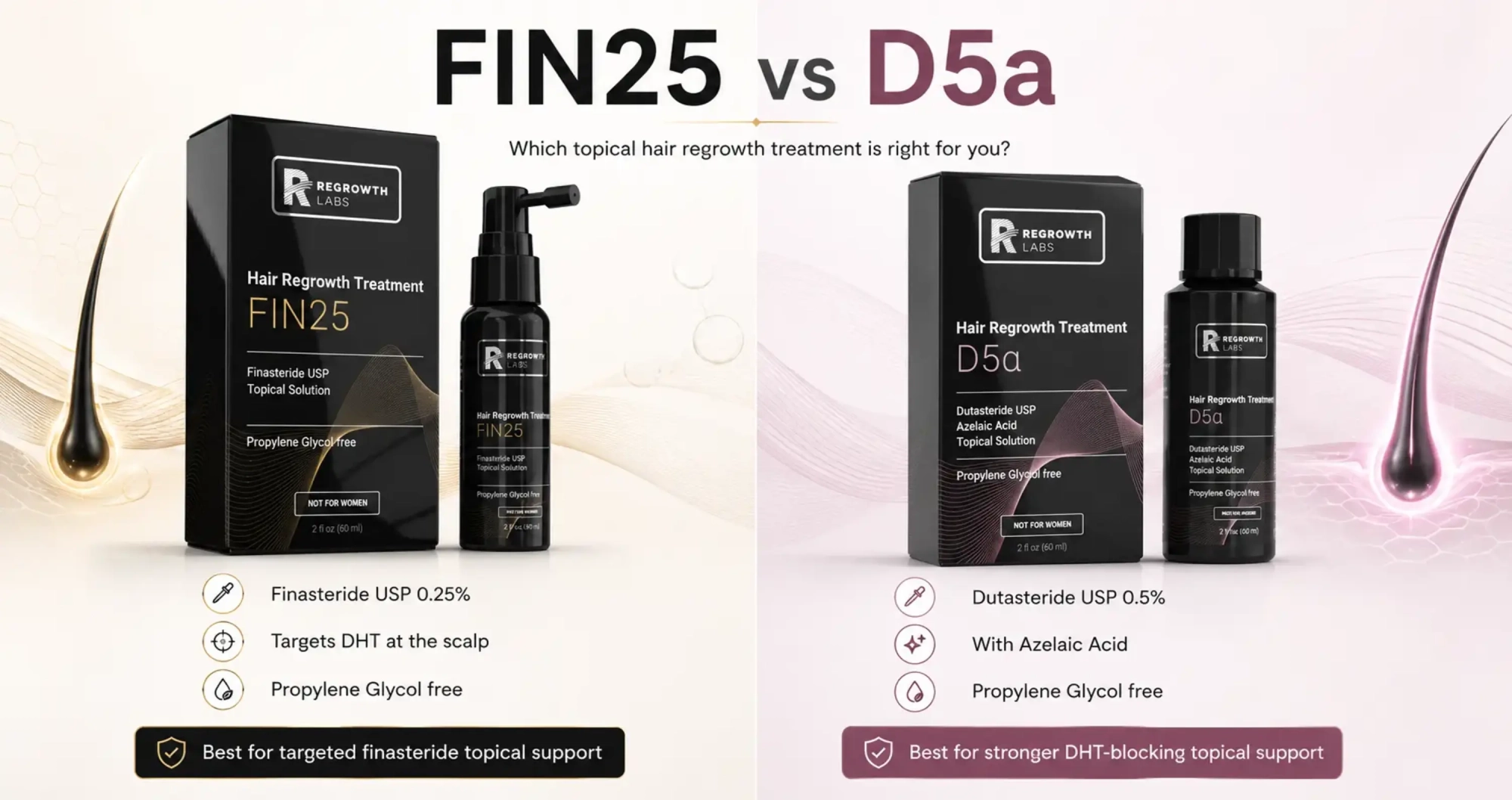
Which is stronger, finasteride vs dutasteride for hair loss? It’s the question that comes up most often at Hims n Hers UAE, and the clinical evidence gives a clear answer on potency. Both drugs belong to the 5-alpha reductase inhibitor (5-ARI) family, both reduce DHT, and both have a legitimate place in androgenetic alopecia treatment. But they are not the same drug, and the trial data separates them decisively on suppression depth, regrowth outcomes, and regulatory standing.
Below is a plain-language breakdown of the biochemistry, the head-to-head clinical trial data, the side-effect profiles, and the practical question of which option fits which situation, everything you need before sitting down with a clinician here in the UAE. Throughout this guide, the finasteride vs dutasteride comparison is assessed in terms of mechanism, effectiveness, tolerability, dosing, and clinical suitability rather than potency alone.
How Both Drugs Block DHT in Androgenetic Alopecia
Dihydrotestosterone (DHT) is the primary driver of follicle miniaturization in androgenetic alopecia. DHT binds to androgen receptors in genetically sensitive hair follicles, progressively shrinking the active growth phase until the follicle stops producing visible hair altogether. Reducing DHT at the scalp level is the pharmacological target shared by both finasteride and dutasteride.
The difference lies in which enzyme subtypes each drug blocks. The 5-alpha reductase enzyme has two relevant isoforms: type I, found mainly in the liver and skin, and type II, concentrated in the scalp and prostate. Finasteride targets type II only. Dutasteride inhibits both type I and type II simultaneously, and that dual-enzyme inhibition is the structural reason its DHT suppression runs significantly deeper. Understanding this mechanism makes the potency numbers in the next section much easier to interpret. This enzyme selectivity is the central biochemical difference in the finasteride vs dutasteride comparison.
Which Is Stronger: Finasteride vs Dutasteride for DHT Suppression?
Dutasteride is approximately three times more potent than finasteride at inhibiting type II 5-alpha reductase, and roughly 100 times more potent at inhibiting type I. Finasteride has little clinically meaningful impact on type I at all. This dual inhibition is why the potency advantage is not marginal, it is structural and measurable in the data.
Translating that into clinical endpoints, dutasteride 0.5 mg per day suppresses serum DHT by approximately 90 to 95 percent. Finasteride 5 mg per day reaches roughly 70 to 71 percent suppression. That 20 to 25 percentage point gap matters at the scalp level: deeper DHT reduction gives follicles more opportunity to re-enter the active growth phase. Importantly, higher DHT suppression does not automatically mean worse tolerability, and the comparative trial data bears that out clearly.
Hair Regrowth: Finasteride vs Dutasteride Outcomes in Clinical Trials
The randomized controlled trial and systematic review evidence points consistently in one direction. Dutasteride 0.5 mg produced significantly greater increases in hair count and hair thickness compared to finasteride 1 mg at 24 weeks, and that superiority held at 12-month assessments. A published systematic review confirmed this pattern across multiple trials, and no published study has reversed the finding.
In the dose-ranging trial by Olsen and colleagues, dutasteride 0.5 mg produced a mean hair count change of +94.6 hairs at 24 weeks compared to +75.6 hairs for finasteride 5 mg. Since finasteride 5 mg exceeds the 1 mg standard dose used for hair loss, the gap favoring dutasteride at clinically standard doses is likely even more pronounced. A separate head-to-head study comparing thrice-weekly dutasteride 0.5 mg to daily finasteride 1 mg reported +17.43 versus +12.81 terminal hairs per cm², again favoring dutasteride, despite that arm not being dosed daily.
Beyond raw hair count, dutasteride consistently outperformed finasteride on investigator global assessment, panel photographic assessment, and patient self-assessment. These endpoints capture what is visually apparent to both the clinician and the patient, not just a magnified hair count. Finasteride still produces meaningful, clinically significant regrowth compared to placebo; the comparison here is between two active treatments, not between treatment and no treatment at all.
Side Effects: What Head-to-Head Studies Actually Report
Sexual and Physical Adverse Events
The side-effect profile of both drugs deserves careful attention, because the clinical anxiety around dutasteride’s greater potency does not translate into greater adverse event rates in controlled trials. In one comparative trial, any adverse event occurred in 17 percent of dutasteride users versus 20 percent of finasteride users. Sexual adverse events occurred in 11 percent versus 14 percent respectively. Impotence was reported at 7 versus 8 percent, decreased libido at 5 versus 6 percent, ejaculatory disorder at 1 versus 1 percent, and gynecomastia at 1 versus 1 percent.
A meta-analysis of three randomized clinical trials found no statistically significant difference between the two drugs for altered libido (p = 0.54), erectile dysfunction (p = 0.07), or ejaculatory disorders (p = 0.58) over 24 weeks. Put plainly, neither drug is clearly worse for sexual function in controlled trial populations. A separate 15-trial meta-analysis reported a relative risk for sexual dysfunction of 1.66 for finasteride and 1.37 for dutasteride versus placebo, showing that both increase sexual adverse events compared with no treatment, but do not separate meaningfully from each other. For patients comparing finasteride vs dutasteride, this means treatment choice should not be based on potency assumptions alone; individual history, monitoring, and clinician guidance remain essential.
Mood-Related Effects and Post-Finasteride Syndrome
The mood-related picture is less balanced between the two drugs. Depressive symptoms have been more prominently reported in connection with finasteride in the published evidence base, though direct comparative head-to-head incidence data for dutasteride versus finasteride on depression or anxiety remains limited.
Post-finasteride syndrome, the term used to describe persistent sexual and mood symptoms after stopping the drug, is a recognized post-marketing concern with a contested evidence base. Dutasteride acts on the same enzyme system and likely carries some class-related risk, but the literature does not support a precise comparative ranking between the two drugs on persistent symptoms. For both medications, the clinical priority is the same: report any mood or sexual changes to your clinician promptly, and do not stop either drug abruptly without guidance.
Regulatory Status, Standard Dosing, and When to Expect Results
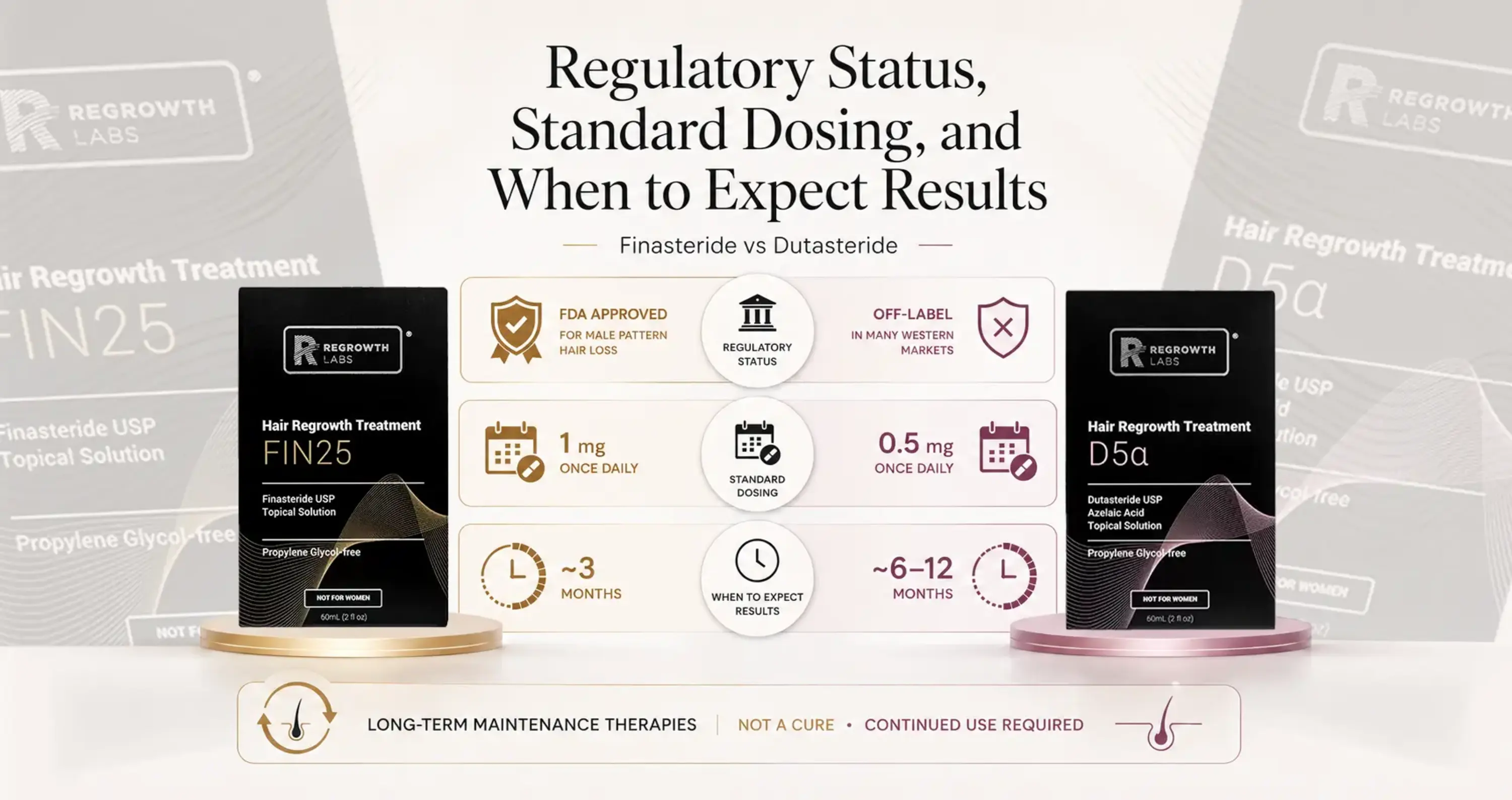
Finasteride 1 mg oral is the only 5-ARI with FDA approval and UK licensing specifically for male androgenetic alopecia. Approved for this indication since 1997, it carries decades of real-world safety data that no other hair loss drug in its class can match. Dutasteride is approved for hair loss in South Korea, Japan, and Taiwan, but remains off-label for androgenetic alopecia in the United States and United Kingdom, where it is licensed only for benign prostatic hyperplasia.
UAE residents should confirm current registration status with a local clinician or pharmacist, as the UAE MOHAP database is the authoritative source; dutasteride is unlikely to be formally registered for androgenetic alopecia in the UAE given its off-label position in the major Western markets.
On dosing, finasteride for hair loss is standardly prescribed at 1 mg once daily. Dutasteride is commonly used off-label at 0.5 mg once daily, and its longer half-life means occasional missed doses matter less pharmacokinetically, though consistent daily use remains the standard approach. Visible response to finasteride typically begins around three months. For dutasteride, the assessment window is similar, though most dermatologists evaluate at six to twelve months before drawing conclusions about response.
Both treatments are maintenance therapies rather than cures, that point needs to be clear before you start either one. Stopping either drug allows DHT levels to recover, and the regrowth benefit reverses gradually over time. In practical use, finasteride vs dutasteride is therefore also a comparison of regulatory status, formulation, follow-up requirements, and long-term treatment expectations.
Long-term safety data for dutasteride at 0.5 mg daily comes from a five-year retrospective study of Korean male patients, which found the drug well tolerated, with sexual adverse event rates dropping from 4.4 percent in year one to 0.6 percent in year five, a trajectory that mirrors long-term finasteride data.
Which Medication Suits You, and How to Access Both in the UAE
Finasteride is the appropriate first-line choice for most men starting treatment for androgenetic alopecia. It has the strongest regulatory track record, long-term safety data going back nearly three decades, and proven regrowth outcomes that establish it as the clinical standard globally. Starting with finasteride is not a compromise; it is the evidence-based decision for the majority of patients.
Dutasteride is a clinically justified option for men who have not responded adequately to finasteride, those with more advanced loss who want the strongest available DHT suppression, or patients working under dermatologist supervision who understand its off-label status and regulatory context. Neither drug is suitable for women who are pregnant or may become pregnant, and both carry a specific contraindication in that population. Women with androgenetic alopecia have separate treatment considerations, primarily centered on 2% minoxidil and appropriate supplements rather than 5-ARIs. This is another reason the finasteride vs dutasteride decision must be individualized rather than treated as a universal recommendation.
At Hims n Hers UAE, both finasteride and dutasteride formulations are available, including the Follics FR high-concentration topical range that combines active ingredients for targeted scalp delivery. Readers exploring a topical finasteride option can also review the topical finasteride solution listed on the website, while keeping in mind that topical and oral formulations are not dose-equivalent.
Topical dutasteride at 0.05% has shown 30 to 40 percent greater hair count improvement than oral finasteride in Phase II trials, with minimal systemic DHT impact, making it a particularly relevant option for men who want potent scalp-level DHT blockade with reduced systemic exposure. The practical next step is confirming which option fits your specific situation with a UAE-based dermatologist or trichologist, then sourcing the right formulation from a specialist who can advise on the correct choice for your case.
The Bottom Line on Finasteride vs Dutasteride for Hair Loss
Dutasteride is the more potent drug by every biochemical and clinical measure: superior DHT suppression across both type I and type II isoforms, stronger hair count and density outcomes in comparative trials, and better results on global assessment by clinicians and patients alike. Finasteride holds the advantage in regulatory approval, decades of safety data, and established first-line status for male androgenetic alopecia. Side effects are comparable in head-to-head trial data, and neither drug comes out clearly worse for sexual function in controlled studies.
If you’re asking which is stronger, Finasteride vs Dutasteride for hair loss, dutasteride demonstrates greater potency on every clinical measure. The more important question, though, is which is right for your specific pattern of loss, your treatment history, and your comfort with off-label use. That conversation belongs with a clinician, not a product page. Both options are accessible to UAE residents through Hims n Hers UAE, a source that understands the pharmacology behind each one and the treatment journey you’re beginning.
FAQS
Q: Which is stronger for hair loss: Finasteride vs Dutasteride?
A: Dutasteride is stronger for hair loss because it inhibits both type I and type II 5-alpha reductase while finasteride targets type II only. Clinical trials show dutasteride 0.5 mg produces greater DHT suppression and larger increases in hair count and thickness than standard finasteride dosing.
Q: How do finasteride and dutasteride reduce hair loss?
A: Both drugs are 5-alpha reductase inhibitors that lower DHT, the androgen that drives follicle miniaturization in androgenetic alopecia. The key difference is enzyme selectivity: finasteride blocks type II, whereas dutasteride blocks both type I and type II, producing deeper DHT suppression.
Q: How much does each drug suppress serum DHT?
A: Dutasteride 0.5 mg per day suppresses serum DHT by roughly 90–95 percent, while finasteride 5 mg per day achieves about 70–71 percent suppression. That roughly 20–25 percentage point gap is meaningful at the scalp level for follicle recovery.
Q: Do clinical trials show better hair regrowth with dutasteride or finasteride?
A: Randomized trials and systematic reviews consistently favor dutasteride for hair count, thickness, and global photographic and patient assessments. For example, Olsen and colleagues reported a mean hair count change of +94.6 hairs at 24 weeks for dutasteride 0.5 mg versus +75.6 for finasteride 5 mg, and other head-to-head studies also favored dutasteride.
Q: Does stronger DHT suppression mean worse side effects with dutasteride?
A: Not necessarily — higher DHT suppression does not automatically mean worse tolerability, and comparative trial data do not show a clear penalty in side-effect profiles solely from deeper suppression. Individual tolerability varies, so clinicians weigh efficacy against personal risk factors during decision-making.
Q: What is the standard finasteride dose for hair loss and how does it compare to doses used in trials?
A: The standard finasteride dose for hair loss is 1 mg daily; some trials use higher doses such as 5 mg to explore dose effects. Even when finasteride was tested at 5 mg, dutasteride 0.5 mg still produced superior hair-count gains in published trials.
Q: If finasteride doesn’t work, should I switch to dutasteride?
A: Dutasteride is a common next option when finasteride produces inadequate response because it provides deeper DHT suppression and better regrowth in trials. However, switching should be done with a clinician — especially at Hims n Hers UAE or similar services — to review benefits, side-effect considerations, and regulatory guidance for your situation.