
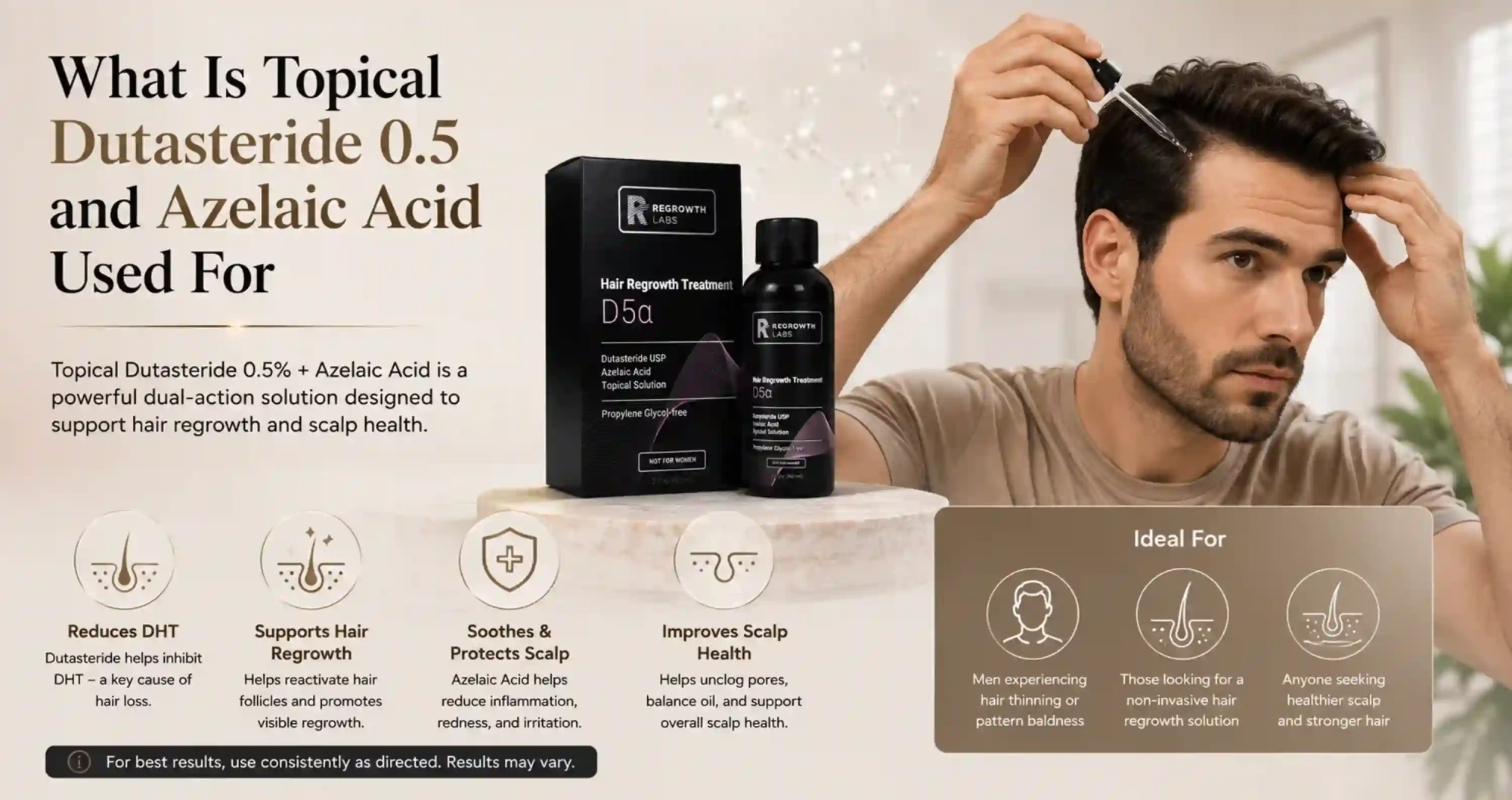
Topical Dutasteride 0.5 is primarily used as a high-strength, scalp-applied treatment for androgenetic alopecia, also known as male or female pattern hair loss. It is intended to reduce the effect of dihydrotestosterone (DHT) at the scalp, where genetically sensitive follicles progressively become smaller and produce finer hair. Some formulas combine dutasteride with azelaic acid to add potential scalp-supporting, anti-inflammatory, and complementary 5-alpha-reductase activity.
The important distinction is that Topical Dutasteride 0.5 is a commercial or compounded concentration, not the same thing as oral dutasteride 0.5 mg. It is also not automatically validated by studies using lower topical concentrations. This guide explains what it is used for, how it works, what the research can reasonably support, how the D5a product fits the topic, and which safety questions should be reviewed before use.
This article is educational rather than a substitute for diagnosis or prescribing advice. Topical dutasteride for hair loss is an off-label treatment in many jurisdictions, and systemic absorption remains possible even when the medicine is applied to the scalp.
What is Topical Dutasteride 0.5 used for?
The main use of Topical Dutasteride 0.5 is the management of androgenetic alopecia. In men, this commonly appears as recession at the temples, thinning through the frontal scalp, or reduced density at the crown. In women, pattern hair loss more often presents as widening of the central part and diffuse thinning while the frontal hairline is relatively preserved.
It is not designed as a universal treatment for every cause of shedding. Telogen effluvium, iron deficiency, thyroid disease, alopecia areata, traction alopecia, inflammatory scalp disorders, medication-related shedding, and scarring alopecias require different investigations and may need completely different treatment. A DHT-targeting formula can be inappropriate if the diagnosis is wrong.
How DHT drives follicle miniaturisation
Testosterone is converted into DHT by 5-alpha-reductase enzymes. In genetically susceptible scalp follicles, DHT binds to androgen receptors and progressively shortens the active growth phase. Over repeated cycles, terminal hairs become finer, shorter, and less visible. Dutasteride inhibits both major 5-alpha-reductase isoenzymes involved in DHT production, whereas finasteride primarily targets type II.
The aim of applying dutasteride topically is to concentrate DHT-blocking activity at the scalp while potentially reducing systemic exposure compared with an oral capsule. “Potentially reducing” is the responsible wording: topical delivery does not guarantee that the medicine remains entirely local.
How Topical Dutasteride 0.5 works
Topical Dutasteride 0.5 is intended to reduce local DHT formation by inhibiting 5-alpha-reductase at or near the follicle. Lower DHT activity may help slow miniaturisation and give susceptible follicles a better chance of maintaining thicker, longer-growing hairs. This does not revive every inactive follicle, and response varies according to the duration and severity of hair loss.
The delivery vehicle matters almost as much as the headline concentration. Alcohol, propanediol, gels, serums, creams, foams, nanosome systems, and other penetration approaches can change spreadability, scalp comfort, evaporation, contact time, and absorption. Two products displaying the same dutasteride percentage may therefore behave differently.
What the research says—and what it does not say
Topical dutasteride is an emerging treatment rather than a fully standardised product category. The International Society of Hair Restoration Surgery overview of dutasteride notes that topical solutions are available through compounding pharmacies, that topical concentrations commonly discussed in practice range from 0.1% to 0.3%, and that more study is needed to establish the effectiveness of topical dutasteride used by itself.
The same medical overview discusses a randomised study in which microneedling plus topical dutasteride 0.01% produced significantly more improvement than microneedling plus saline. That supports topical dutasteride as a biologically active ingredient, but it does not directly validate a 0.5% commercial formula used without microneedling.
Do not confuse 0.5% with 0.05% or 0.5 mg
One of the most common content errors is to describe a study of 0.05% topical dutasteride as if it tested Topical Dutasteride 0.5%. A 0.5% formula is ten times as concentrated as a 0.05% formula. Similarly, an oral 0.5 mg capsule cannot be compared directly with a topical percentage because the measurements and routes of administration are different.
Research involving a lower topical strength may help explain the ingredient’s potential, but it cannot prove that a higher-strength product has identical absorption, effectiveness, or tolerability. Applied volume, frequency, scalp condition, contact time, delivery system, and treatment area all influence exposure.
D5a: the most relevant Topical Dutasteride 0.5 product
Hims n Hers UAE lists D5a Hair Regrowth Treatment with Dutasteride USP 0.5% and Azelaic Acid. The current product page identifies Regrowth Labs D5a as a topical formula containing Dutasteride USP 0.5%, azelaic acid, propanediol, Trichogen, nanosome encapsulation technology, and transdermal enhancers. It is presented for hair loss affecting both the vertex and hairline.
This is the most natural product to feature in an article about Topical Dutasteride 0.5 because its listed concentration directly matches the keyword. The product link should sit beside accurate formulation information rather than beside claims taken from a lower-strength trial.
Readers can also review the wider hair-loss treatment collection to compare D5a with topical finasteride, minoxidil, and multi-active options. Comparison should focus on the treatment goal, active ingredients, strength, route, warnings, and previous response—not simply which product sounds strongest.
What azelaic acid adds to the formula
Azelaic acid is well established as a topical dermatological ingredient for acne and rosacea. The Mayo Clinic azelaic acid monograph describes its topical use and common local reactions, including burning, stinging, dryness, and irritation.
In hair-related formulations, azelaic acid is included because laboratory research suggests anti-inflammatory activity, effects on oxidative stress, and possible 5-alpha-reductase inhibition. A laboratory study of azelaic acid and follicle cells reported changes in catalase activity and signalling markers in mouse follicle models.
These findings create a plausible reason for pairing azelaic acid with Topical Dutasteride 0.5, but they do not establish proven clinical synergy in a large human randomised trial. Dutasteride remains the primary DHT-targeting active in the D5a formulation, while azelaic acid should be described as a potentially complementary ingredient.
Seven potential benefits and limitations
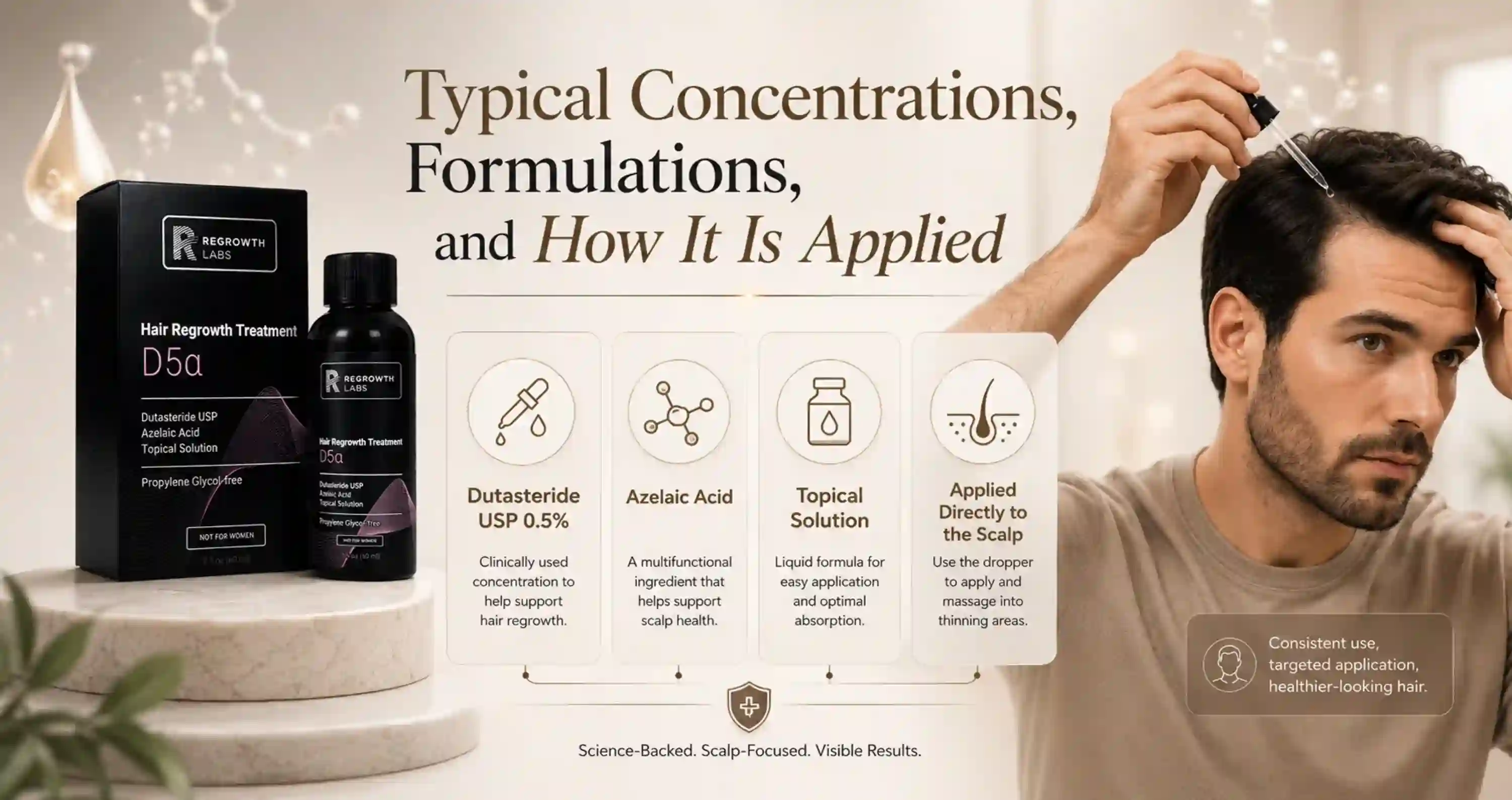
1. It targets the hormonal pathway behind pattern hair loss
Dutasteride blocks both major 5-alpha-reductase isoenzymes and therefore addresses DHT production more broadly than finasteride. This makes it a logical option for DHT-mediated miniaturisation when a clinician believes stronger local inhibition is appropriate.
2. It is applied directly to the scalp
Topical delivery places the medicine at the treatment site and may reduce systemic exposure compared with oral use. However, measurable absorption can still occur, especially with higher concentrations, large application areas, damaged skin, penetration enhancers, or microneedling.
3. The D5a formula does not rely on minoxidil
D5a may be relevant to someone specifically seeking a DHT-focused topical formula rather than a minoxidil-led combination. That does not mean it is automatically better; it means its treatment strategy differs from products combining hormonal control with direct growth stimulation.
4. Azelaic acid may support the scalp environment
Azelaic acid contributes recognised anti-inflammatory and antimicrobial properties and has preclinical hair-related rationale. Its presence may be useful in a combined formula, but buyers should not interpret it as independently proven to regrow pattern hair loss.
5. Higher concentration may also mean higher exposure
The 0.5% concentration is stronger than many topical concentrations discussed in clinical and compounding literature. Greater strength does not guarantee proportionally greater regrowth. It may instead increase irritation or systemic exposure, which is why dose and frequency should not be self-selected.
6. Evidence for the exact finished combination remains limited
The ingredients have individual scientific rationales, but that is different from a large controlled trial of the exact D5a product. Responsible product content should distinguish ingredient evidence from finished-product evidence.
7. It still requires long-term consistency
Pattern hair loss is chronic. Topical Dutasteride 0.5 should be evaluated over months, not days, using consistent photographs and professional review where appropriate. Increasing the amount or frequency does not prove that results will arrive faster.
D5a versus 7HP: two different dutasteride strategies
The store also lists 7HP Hair Regrowth Treatment with Minoxidil 7% and Dutasteride 0.1%. It should not be treated as the same product in a different bottle.
- D5a: Dutasteride USP 0.5% with azelaic acid and supporting delivery ingredients.
- 7HP: Minoxidil 7%, dutasteride 0.1%, and horse placenta in a multi-active formula.
D5a places greater emphasis on high-strength topical DHT inhibition. 7HP combines a lower dutasteride concentration with minoxidil’s growth-stimulating action. Suitability depends on diagnosis, scalp sensitivity, previous minoxidil response, contraindications, and whether combining several actives at once is appropriate.
Safety risks and who should avoid it
Potential dutasteride-related adverse effects include reduced libido, erectile or ejaculatory changes, breast tenderness or enlargement, fertility-related concerns, and mood changes. Topical reactions may include redness, burning, dryness, itching, or contact irritation from the active ingredients or vehicle.
Pregnancy and handling precautions
Dutasteride carries a serious pregnancy warning because DHT suppression can affect the development of a male foetus. Anyone who is pregnant, could become pregnant, or is trying to conceive should not use or handle a leaking dutasteride product without specific medical guidance. Prevent transfer through wet scalp contact, hands, shared applicators, towels, pillows, or bedding.
When clinician oversight is especially important
Professional review is particularly important for people with unexplained or sudden shedding, scalp inflammation, fertility concerns, sexual adverse effects from previous 5-alpha-reductase inhibitors, mood disorders, prostate monitoring requirements, other medicines, or uncertainty about the diagnosis. Topical Dutasteride 0.5 should not be used to postpone investigation of an underlying medical condition.
How to verify the product before buying
Check that the product page clearly states the active ingredient and percentage, and confirm that the URL belongs to the intended retailer. Review the bottle size, directions, warnings, delivery information, contact details, and refund policy before ordering. A specialised formula should not be purchased from a page that hides the concentration or provides no meaningful safety information.
When the package arrives, inspect the seal, label, batch number, expiry date, consistency, applicator, storage instructions, and leaflet. Do not use the product if it is unsealed, leaking, damaged, discoloured, missing identifying information, or materially different from the listing.
Frequently asked questions
Is Topical Dutasteride 0.5 the same as oral dutasteride 0.5 mg?
No. One is a topical concentration and the other is an oral dose. They have different routes, applied quantities, absorption patterns, and instructions.
What is the primary use of Topical Dutasteride 0.5?
Its primary use is DHT-related androgenetic alopecia. It is not a general solution for every type of hair shedding.
Does Topical Dutasteride 0.5 contain minoxidil?
The D5a product page lists Dutasteride USP 0.5% and azelaic acid rather than minoxidil. A separate product, 7HP, combines dutasteride 0.1% with minoxidil 7%.
How long does it take to assess results?
Hair-cycle changes usually require several months to assess. Use consistent photographs and follow the prescribed review schedule rather than increasing the dose independently.
The bottom line
Topical Dutasteride 0.5 is mainly used for androgenetic alopecia and is designed to reduce DHT activity at the scalp. D5a is the most relevant product match on Hims n Hers UAE because its page lists Dutasteride USP 0.5% with azelaic acid.
The potential benefit is targeted, high-strength DHT inhibition. The main cautions are systemic absorption, reproductive risk, local irritation, limited evidence for the exact finished formula, and the possibility of treating the wrong diagnosis. A higher percentage should not be confused with guaranteed superiority.
Use accurate product information, compare D5a with genuinely relevant alternatives, and involve a qualified clinician when diagnosis, concentration, side effects, pregnancy exposure, or long-term monitoring is uncertain.