
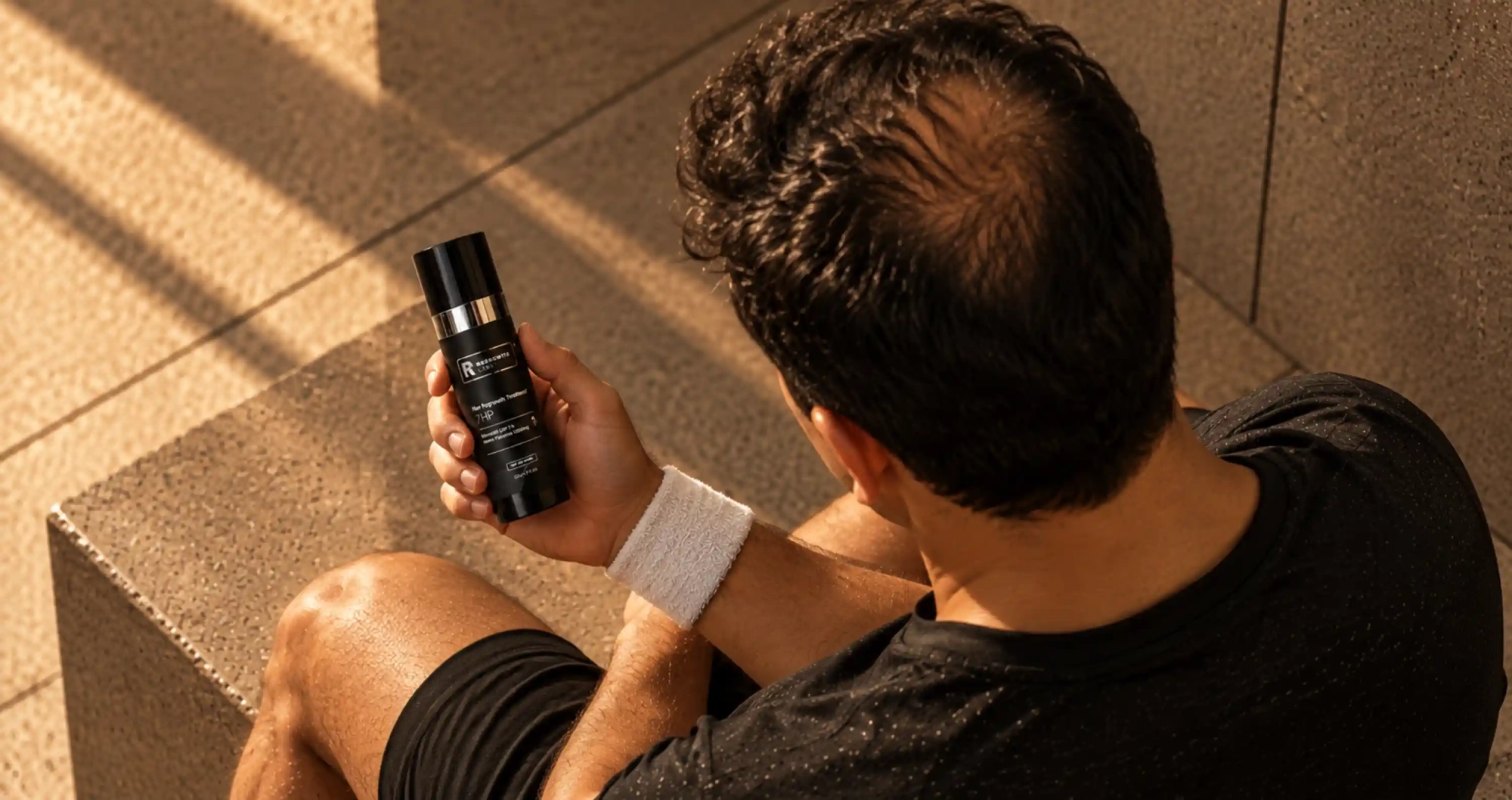
A buyer researching 7HP receding hairline treatment UAE needs to distinguish between three different scalp zones: the frontal hairline and temple corners, the central or mid-scalp area, and the crown or vertex.
The live 7HP Hair Regrowth Treatment page markets the formula for thinning hair, receding hairlines and reduced hair density. It lists Minoxidil USP 7% w/w, Dutasteride 0.1% w/w, Horse Placenta Extract 1.67% w/w and Oxytocin 0.1% w/w. It also directs users to apply five sprays twice daily to the area affected by hair loss and massage for two to four minutes.
However, the same product page contains an important inconsistency:
- Its title and main description mention receding hairlines and reduced density.
- Its “Indications” section states that the product is formulated for hair regrowth on the scalp vertex.
That conflict must be corrected before buyers are told that the physical product is officially indicated for the hairline.
Independent evidence also requires careful interpretation. Standard 5% minoxidil solution labels remain limited to the vertex and specifically state that the product is not intended for a receding hairline. Separate clinical studies of a particular 5% minoxidil foam have nevertheless reported responses in frontotemporal and vertex regions. Those studies did not test 7HP’s 7% multi-active solution.
The evidence-safe conclusion is:
7HP is marketed for receding hairlines and reduced density, but the page’s own indication text is vertex-only and no finished-product clinical study confirms equivalent results across the frontal hairline, temples, mid-scalp and crown.
Direct Answer
Is 7HP intended for a receding hairline?
The main 7HP description says the product was developed to target receding hairlines and reduced density.
The page’s formal indication text, however, says:
“Formulated for hair regrowth on the scalp (vertex).”
Until the manufacturer resolves that discrepancy, the physical label and qualified medical instructions should determine whether a user applies 7HP to the hairline.
Can 7HP be used on the crown?
Yes, the public indication explicitly names the vertex—the crown or upper-back region of the scalp—as its treatment area.
Can the five sprays be divided between the hairline and crown?
The webpage says to apply five sprays directly to the hair-loss area but does not explain how to divide them when more than one region is affected.
Do not invent:
- Three sprays for the crown and two for the hairline.
- One spray per temple.
- Five sprays for each separate region.
- Ten sprays when treating two regions.
- An additional spray for the mid-scalp.
The five-spray instruction needs clarification when multiple zones require coverage.
Does a receding hairline respond the same as the crown?
Not necessarily.
Hairline and vertex follicles can differ in:
- Degree of miniaturisation.
- Duration of hair loss.
- Remaining follicle activity.
- Hair density.
- Scalp anatomy.
- Treatment history.
- Response to a particular vehicle.
A clinical trial of one 5% minoxidil foam reported improvements in both frontotemporal and vertex regions, but it did not establish identical outcomes for every individual or for 7HP.
7HP Receding Hairline Treatment UAE: The Four Main Scalp Zones
Zone 1: Frontal hairline
The frontal hairline forms the forward border of the scalp hair.
Early changes may include:
- A higher central hairline.
- Reduced density directly behind the frontal edge.
- Finer hairs along the border.
- Difficulty styling the front.
- Greater scalp visibility under bright light.
A thinning hairline is different from a completely smooth bald area.
Topical treatments depend on reaching living, potentially responsive follicles. They cannot be assumed to create new follicles in skin where viable follicles are no longer present.
Zone 2: Temporal corners
The temporal corners sit on the left and right sides of the frontal hairline.
Changes may create:
- An M-shaped pattern.
- Uneven recession.
- One temple appearing deeper than the other.
- Fine miniaturised hairs.
- Increased forehead width.
Temple corners are small, cosmetically important areas.
They are also difficult to treat neatly because topical liquid may:
- Run onto the forehead.
- Enter the eyebrow area.
- Transfer onto the face.
- Remain on hair instead of scalp.
- Be over-applied when users repeatedly spray a small region.
The 7HP page does not provide a temple-specific spray allocation.
Zone 3: Mid-scalp or central density
The mid-scalp sits between the frontal hairline and crown.
Reduced density here may appear as:
- A visible central channel.
- Greater scalp show-through.
- A widening area between the front and crown.
- Lower coverage under overhead lighting.
- Reduced volume even when the hairline remains present.
The phrase “reduced hair density” on the product page may include this region, but the page does not specifically define the mid-scalp as an approved treatment zone.
Zone 4: Crown or vertex
The vertex is the circular or whorl-shaped area near the top-back of the scalp.
The 7HP indication explicitly mentions this region.
Vertex thinning may appear as:
- A widening whorl.
- A circular area of scalp visibility.
- Reduced density under overhead light.
- Hair that remains present but progressively finer.
- A crown area that becomes difficult to cover.
The crown is the scalp region most consistently represented in standard topical-minoxidil labels and clinical research.
Scalp-Zone Diagram
FRONTAL HAIRLINE
┌────────────────────────┐
│ Left temple Right │
│ corner corner │
└──────────┬─────────────┘
│
MID-SCALP
│
▼
CROWN / VERTEX
Evidence position by zone
| Scalp Zone | 7HP Website Positioning | Direct 7HP Clinical Evidence |
| Frontal hairline | Mentioned in main marketing description | Not displayed |
| Temple corners | Implied by receding-hairline language | Not displayed |
| Mid-scalp | May be implied by reduced-density wording | Not displayed |
| Crown/vertex | Explicitly included in indications | Not displayed |
| Completely bald smooth skin | Not specifically addressed | Not displayed |
What the 7HP Product Page Actually Confirms
The current page confirms the following formula.
Active ingredients
- Minoxidil USP 7% w/w.
- Horse Placenta Extract 1.67% w/w.
- Dutasteride 0.1% w/w.
- Oxytocin 0.1% w/w.
Other ingredients
- Deionised water.
- Propylene glycol.
- Ethanol.
- Peppermint oil.
- Menthol.
- African pepper extract.
Verified directions
The page instructs users to:
- Apply five sprays.
- Use the product twice daily.
- Spray directly onto the scalp in the hair-loss area.
- Massage it into the scalp for two to four minutes.
- Avoid using more or applying more often than directed.
- Continue use to maintain regrowth.
Verified warnings
The page states:
- For external use only.
- Do not apply to other body areas.
- Avoid eye contact.
- Do not use with heart disease or blood-pressure-lowering medicine.
- Stop and see a doctor for chest pain or rapid heartbeat.
- Do not use below age 18.
- Keep out of reach of children.
Claims that require qualification
The product page also calls 7HP:
- A nutritional supplement.
- A stress reducer.
- A non-irritating formula.
- An advanced liposphere formula.
Those phrases should not be presented as independently verified clinical outcomes.
Important Product-Page Conflicts and Gaps
| Issue | Why It Matters |
| Receding-hairline marketing versus vertex-only indication | Buyers cannot determine the official labelled treatment area |
| Five sprays for an unspecified number of zones | Creates risk of under- or over-application |
| Horse placenta stated as 1,000mg in title and 1.67% w/w in ingredients | The container-weight denominator is needed to reconcile both statements |
| “Non-irritating” claim despite propylene glycol, ethanol, peppermint, menthol and pepper extract | These ingredients may not suit every scalp |
| No dry-scalp direction | Standard minoxidil labels commonly specify a dry scalp |
| No leave-in time | Users do not know when washing, swimming or sweating is appropriate |
| No hand-washing instruction | Important for topical dutasteride transfer control |
| No pregnancy-transfer warning | Essential for a wet dutasteride-containing topical |
| No PSA-disclosure information | Potentially relevant if dutasteride is systemically absorbed |
| No missed-dose direction | Users may incorrectly double the next application |
| No finished-product trial | Regional efficacy and safety cannot be quantified |
| No systemic-exposure data | Minoxidil, dutasteride and oxytocin exposure remain unknown |
| No storage directions displayed | Important for UAE heat and ethanol-containing products |
| No exact bottle weight or volume | Prevents duration and milligram calculations |
For discrepancies between the website and physical pack, contact Hims & Hers UAE before starting treatment.
What Standard Minoxidil Labelling Says About the Hairline
They also state that the standard product is not intended for:
- Frontal baldness.
- A receding hairline.
- Sudden hair loss.
- Patchy hair loss.
- Unknown causes of hair loss.
This regulatory labelling should not be ignored.
However, it also should not be overstated as proof that minoxidil has no biological activity in frontal scalp follicles.
What Frontotemporal Minoxidil Research Shows
A 24-week randomised controlled study enrolled 70 men with moderate androgenetic alopecia.
Participants applied 5% minoxidil foam or placebo to the frontotemporal and vertex regions twice daily.
The study reported:
- Significant increases from baseline in frontotemporal and vertex hair measures through week 16.
- A significant frontotemporal cumulative-hair-width difference at week 24.
- Improved user-rated scalp coverage in frontal and vertex regions.
- Similar regional responses under the tested conditions.
A longer open-label extension followed men for up to 104 weeks and reported stabilisation of hair-density, width and scalp-coverage measures in both frontotemporal and vertex areas.
Why these studies are relevant
They show that frontal scalp follicles are not necessarily biologically unresponsive to topical minoxidil.
Why they do not prove 7HP’s hairline results
They tested:
- Minoxidil 5%.
- A foam vehicle.
- A defined research protocol.
- A particular study population.
- Known frontotemporal and vertex assessment zones.
They did not test:
- Minoxidil 7%.
- Propylene glycol and ethanol solution.
- Dutasteride 0.1%.
- Horse placenta 1.67%.
- Oxytocin 0.1%.
- Five sprays.
- The completed 7HP formula.
The studies support biological plausibility—not a direct 7HP claim.
Does 7% Minoxidil Work Better on the Hairline?
No direct evidence was identified proving that Minoxidil 7% produces better frontal-hairline results than Minoxidil 5%.
The percentage increase alone does not establish:
- Greater follicle exposure.
- Better hairline retention.
- Faster response.
- Greater temple regrowth.
- Lower irritation.
- Better adherence.
- Better long-term results.
The vehicle and dose per application also matter.
The 7HP page gives five sprays but does not state:
- Millilitres per spray.
- Grams per spray.
- Minoxidil milligrams per spray.
- Total daily minoxidil dose.
Therefore, the daily exposure cannot be compared reliably with a standard 5% product.
What Dutasteride Evidence Says About Frontal and Vertex Hair
Dutasteride inhibits 5-alpha-reductase, reducing conversion of testosterone into DHT.
Oral dutasteride research has reported improvements in global photographic assessments of frontal scalp hair as well as overall hair counts. In a large 24-week randomised study, oral dutasteride produced dose-dependent changes and improved frontal photographic assessments compared with finasteride and placebo at the tested oral doses.
A separate phase III oral study also reported significant hair-count and photographic improvements compared with placebo.
Why oral evidence cannot be copied to 7HP
7HP is topical, not oral.
It uses:
- Dutasteride 0.1% w/w.
- A multi-active vehicle.
- Five sprays twice daily.
- An undisclosed amount of solution per spray.
Oral dutasteride produces systemic exposure by design.
Topical exposure may differ substantially.
What topical dutasteride research shows
A 2025 phase II trial tested topical dutasteride solutions at:
- 0.01% w/v.
- 0.02% w/v.
- 0.05% w/v.
The study’s primary target-area hair-count endpoint was measured at the vertex. The 0.05% formulation produced the strongest results among the tested topical concentrations.
Why that study does not prove 7HP target-area efficacy
7HP uses Dutasteride 0.1% w/w rather than the tested 0.05% w/v formulation.
The trial did not test:
- 7HP.
- A 0.1% w/w formula.
- Horse placenta.
- Oxytocin.
- Minoxidil 7%.
- Frontotemporal target-area hair counts for 7HP.
- Five-spray regional distribution.
It cannot establish that 7HP restores a receding hairline.
Why the Hairline May Be More Difficult Than the Crown
The visible response of a scalp zone depends partly on what remains there before treatment.
A recently thinning hairline may still contain:
- Miniaturised hairs.
- Short, fine hairs.
- Follicles producing thinner shafts.
- Reduced density but not complete follicle absence.
A long-standing smooth recession may contain:
- Very few visible terminal hairs.
- Advanced miniaturisation.
- Areas less likely to produce cosmetically meaningful coverage.
- Skin requiring surgical rather than topical restoration for major repositioning.
A topical treatment is generally more realistic as a strategy to:
- Support remaining follicles.
- Improve density where follicles are still active.
- Slow further miniaturisation where medically appropriate.
It should not be marketed as a guaranteed method to redraw a completely lost hairline.
Receding Hairline Versus Mature Hairline
Not every higher hairline represents active pathological loss.
A mature hairline may involve:
- Mild, stable recession.
- Symmetrical temple change.
- No ongoing density loss.
- No rapid progression.
- No significant crown thinning.
Progressive androgenetic recession may involve:
- Increasing temporal depth.
- Finer hairs along the edge.
- Reduced frontal density.
- Mid-scalp involvement.
- Crown thinning.
- Family history.
- Gradual progression.
A dermatologist can assess:
- Miniaturisation.
- Distribution.
- Scalp disease.
- Hair-shaft diameter variability.
- Whether treatment is appropriate.
Do not start 7HP solely because the forehead appears larger in one photograph.
Reduced Density Is Not Always Androgenetic Alopecia
Reduced density may arise from:
- Telogen effluvium.
- Nutritional deficiency.
- Thyroid disease.
- Medication effects.
- Autoimmune alopecia.
- Scalp inflammation.
- Traction.
- Scarring alopecia.
- Hair-shaft breakage.
- Recent illness or surgery.
- Androgenetic alopecia.
7HP contains both minoxidil and dutasteride.
That makes diagnosis especially important.
A dutasteride-containing formula should not be self-selected for every diffuse shedding pattern.
Can Five Sprays Cover the Hairline and Crown Together?
The public direction says:
Apply five sprays twice daily directly onto the scalp in the hair-loss area.
It does not say whether five sprays represent:
- The total dose for the entire scalp.
- The total dose for one target area.
- The total dose for hairline and vertex together.
- A dose designed only for the vertex.
Do not create an unverified regional map
Avoid publishing instructions such as:
Left temple: 1 spray
Right temple: 1 spray
Frontal centre: 1 spray
Mid-scalp: 1 spray
Crown: 1 spray
That allocation looks convenient but is not stated by the manufacturer.
Information required for safe mapping
The manufacturer needs to clarify:
- Whether five sprays are the total per application.
- Maximum treatment area.
- Surface area covered by one spray.
- Distance from the scalp.
- Whether hairline and vertex can be treated simultaneously.
- Whether the total changes with multiple zones.
- Whether the spray should be delivered directly or through parted hair.
Correct Treatment-Zone Principles Without Inventing a Dose
Until precise regional instructions are available:
- Confirm the exact diagnosis.
- Confirm the intended treatment zones from the physical label.
- Treat scalp skin rather than spraying mostly onto the hair.
- Keep the solution away from the forehead, eyebrows and eyes.
- Do not exceed five sprays per application unless a qualified prescriber explicitly changes the regimen.
- Do not repeat sprays because hair absorbed part of the solution.
- Do not apply a separate five-spray dose to every zone.
- Massage only for the verified two-to-four-minute period.
- Stop if the scalp becomes significantly irritated.
- Wash the hands after application as a conservative transfer precaution, even though the current webpage omits this instruction.
The exact detailed technique should be added only after physical-label verification.
Hairline Mapping Checklist
Frontal edge
- Is the area gradually thinning?
- Are small miniaturised hairs still visible?
- Is recession symmetrical?
- Is the skin smooth and completely bald?
- Is there redness or scaling?
- Has the physical label approved frontal use?
Temple corners
- Is one side progressing faster?
- Can the scalp be exposed without spraying the forehead?
- Is the area too small for reliable spray placement?
- Are eyebrows at risk of contact?
- Has the total spray allocation been clarified?
Mid-scalp
- Is density reduced between front and crown?
- Is there enough parting access to reach the scalp?
- Is the area part of diagnosed androgenetic alopecia?
- Can it be covered within the total approved dose?
Crown or vertex
- Does the whorl show progressive widening?
- Is the product being applied to scalp rather than hair?
- Can the five-spray total cover the area?
- Is the user following the twice-daily direction?
- Is the crown the only explicitly confirmed indication?
Comparing 7HP With Related Hims & Hers UAE Formats
This is not an efficacy ranking.
7HP
7HP Hair Regrowth Treatment combines:
- Minoxidil 7% w/w.
- Dutasteride 0.1% w/w.
- Horse placenta 1.67% w/w.
- Oxytocin 0.1% w/w.
- Five-spray, twice-daily directions.
5HP
5HP Hair Regrowth Treatment is another hybrid formula built around Minoxidil 5%, dutasteride, horse placenta and oxytocin.
Its current page does not disclose the dutasteride or oxytocin concentrations as clearly as the 7HP page does.
A complete 7HP-versus-5HP comparison belongs to its separately scheduled article.
M7α
M7α 7% Minoxidil treatment is a different 7% minoxidil formula that does not use the same dutasteride, placenta and oxytocin combination.
It is positioned as an alcohol-free and propylene-glycol-free solution and says it treats vertex and hairline areas.
Do not assume that matching 7% minoxidil concentrations make M7α and 7HP interchangeable.
D5a
D5a Dutasteride 0.5% treatment is a dutasteride-focused topical that also contains azelaic acid.
It does not provide the same Minoxidil 7%, horse-placenta and oxytocin formula as 7HP.
Do not combine 7HP and D5a without medical direction because both contain dutasteride.
Is 7HP a “Non-Irritating” Formula?
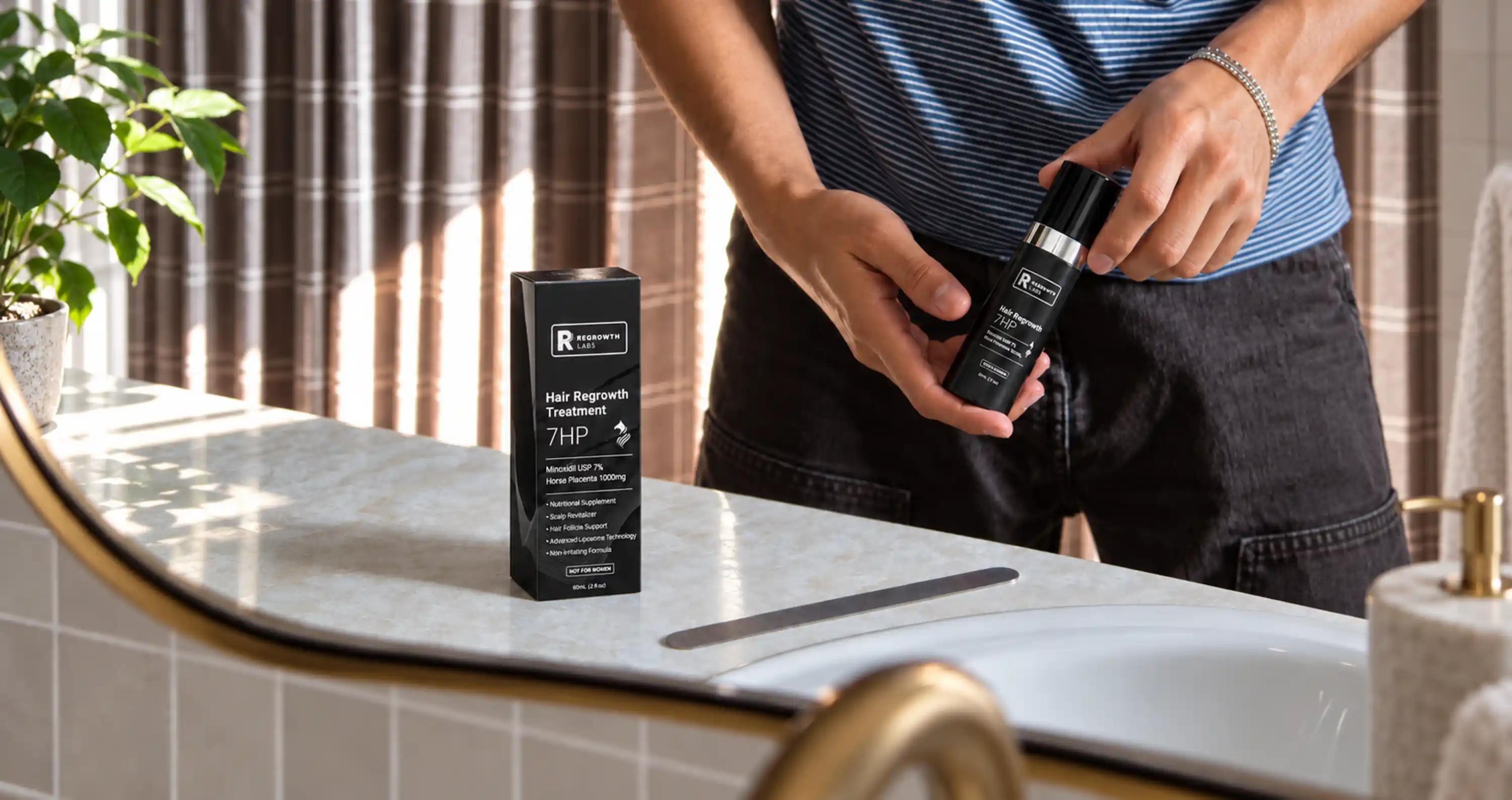
The product page labels 7HP as non-irritating. It also lists:
- Propylene glycol.
- Ethanol.
- Peppermint oil.
- Menthol.
- African pepper extract.
These ingredients do not prove that irritation will occur.
They also prevent a responsible publisher from promising that irritation cannot occur.
Potential local symptoms may include:
- Burning.
- Stinging.
- Dryness.
- Flaking.
- Redness.
- Itching.
- Rash.
- Scalp tenderness.
- Runoff irritation around the forehead or ears.
Use qualified wording:
The manufacturer positions 7HP as non-irritating, but individual scalp tolerance is not guaranteed and no finished-product irritation rate is displayed.
Minoxidil Safety Context
Standard minoxidil labels warn users not to apply the medicine when:
- Hair loss is sudden or patchy.
- The cause is unknown.
- The scalp is red, infected, irritated or painful.
- Other scalp medicines are being used without professional advice.
- The user is below 18.
They also advise stopping and seeking medical advice for:
- Chest pain.
- Rapid heartbeat.
- Faintness or dizziness.
- Sudden unexplained weight gain.
- Swelling of the hands or feet.
- Persistent scalp irritation.
The 7HP page itself specifically warns against use in heart disease or while taking blood-pressure-lowering medication and tells users to stop for chest pain or rapid heartbeat.
Because 7HP contains 7% minoxidil and additional actives, standard 5% warnings should be treated as general safety context—not a complete FR-specific safety profile.
Dutasteride Safety Context
Dutasteride reduces DHT by inhibiting 5-alpha-reductase.
Oral dutasteride labels include warnings relating to:
- Pregnancy exposure.
- Skin absorption from leaking capsules.
- PSA interpretation.
- Sexual and reproductive adverse effects.
- Breast symptoms.
- Hypersensitivity.
These official warnings concern oral capsules.
They cannot quantify risk from 7HP’s topical 0.1% formula.
However, topical exposure should not be assumed to be zero.
The 7HP page does not publish:
- Plasma dutasteride levels.
- Serum-DHT changes.
- Scalp-DHT changes.
- PSA effects.
- Fertility data.
- Sexual adverse-event rates.
- Long-term topical safety.
Medical disclosure
Tell the clinician that 7HP contains Dutasteride 0.1% before:
- PSA testing.
- Fertility assessment.
- Sexual-health evaluation.
- Prostate evaluation.
- Adding oral finasteride or dutasteride.
- Starting another topical DHT blocker.
Pregnancy and Household Transfer Precautions
Official dutasteride labelling states that dutasteride can be absorbed through skin and warns pregnant or potentially pregnant people against handling leaking capsules because of potential risk to a developing male fetus.
A capsule warning is not a direct 7HP topical study.
Nevertheless, 7HP is a wet topical containing Dutasteride 0.1% w/w.
Until the manufacturer publishes product-specific handling instructions:
- Apply the treatment yourself where possible.
- Keep it on the intended scalp area.
- Wash hands thoroughly after application.
- Prevent wet treatment from contacting another person.
- Keep it away from pregnant or potentially pregnant people.
- Avoid transfer through pillows, towels, caps and helmets.
- Clean forehead runoff promptly.
- Clean spills.
- Store away from children.
- Replace leaking or damaged packaging.
Accidental skin exposure
After unintended contact:
- Wash the exposed skin with soap and water.
- Review the physical product instructions.
- Seek qualified advice when pregnancy exposure is involved.
Do Not Use 7HP on a Damaged Scalp
Do not apply it automatically over:
- Open cuts.
- Severe dermatitis.
- Active infection.
- Bleeding skin.
- Fresh microneedling channels.
- Recent transplant sites.
- Blisters.
- Painful scalp lesions.
- Severe sunburn.
- An unexplained widespread rash.
A disrupted scalp barrier may increase:
- Irritation.
- Runoff.
- Uncontrolled absorption.
- Systemic exposure.
- Contact-allergy risk.
The product page does not provide a microneedling or transplant interval.
Can 7HP Be Combined With Another Hairline Product?
Do not combine it independently with:
- 5HP.
- M7α.
- D5a.
- Generic Minoxidil 5%.
- FR10.
- FR12.
- FR15.
- FR16.
- Oral minoxidil.
- Oral dutasteride.
- Finasteride tablets.
- Topical finasteride.
7HP already provides:
- Minoxidil 7%.
- Dutasteride 0.1%.
- Multiple supporting ingredients.
Using more than one product may increase:
- Cardiovascular symptoms.
- Scalp irritation.
- Hormonal exposure.
- Transfer risk.
- Dose confusion.
- Difficulty identifying which ingredient caused a reaction.
UAE Routine Considerations
Morning hairline application
Do not apply immediately before:
- Heavy sweating.
- A gym session.
- Swimming.
- Wearing a tight helmet.
- A shower.
- A haircut.
- Hairline cosmetic application.
Complete activities that may wash or spread the solution before applying the treatment.
Motorcycle helmets
A wet hairline application may transfer to:
- Helmet lining.
- Forehead skin.
- Hands.
- Shared headwear.
Finish the final helmet use first where practical.
Head coverings and caps
Do not cover visibly wet treatment.
The page does not state a drying time, so use the physical label or manufacturer guidance.
UAE heat
The page does not publicly display storage temperature instructions.
Until verified:
- Do not leave it in a parked vehicle.
- Avoid direct sunlight.
- Avoid hot balconies or windows.
- Keep the container closed.
- Do not store it in a wet gym bag.
- Follow the physical bottle’s stated temperature range.
Swimming
The webpage does not provide a leave-in period.
Do not invent a four-hour rule for 7HP merely because it appears on some standard minoxidil labels.
Obtain product-specific guidance before timing swimming or shampooing.
Treatment-Zone Decision Table
| User Concern | Is It Mentioned by 7HP Marketing? | Evidence-Safe Next Step |
| Early frontal thinning | Yes, through receding-hairline wording | Confirm physical-label hairline indication |
| Temple-corner recession | Implied | Confirm diagnosis and avoid forehead runoff |
| Mid-scalp reduced density | Possibly implied | Confirm whether it fits the approved treatment area |
| Vertex thinning | Yes, explicitly | Follow verified five-spray total without exceeding it |
| Smooth, long-standing bald hairline | Not specifically addressed | Set realistic expectations and seek specialist assessment |
| Sudden patchy loss | No | Do not self-treat; obtain diagnosis |
| Inflamed or painful scalp | No | Do not apply until medically assessed |
| Hairline plus crown together | Not clarified | Ask how five sprays should be distributed |
| Scarring or shiny bald skin | No | Specialist assessment is required |
Product-Label Verification Checklist
Product identity
- Name states 7HP Hair Regrowth Treatment.
- Bottle and carton match.
- Product is stated to be for men.
- Batch number is visible.
- Expiry date is visible.
- Manufacturer is identified.
- Container weight or volume is stated.
Target areas
- Vertex indication is confirmed.
- Frontal-hairline indication is confirmed or removed.
- Temple application is clarified.
- Mid-scalp application is clarified.
- Maximum treatment surface is stated.
- Multi-zone spray allocation is explained.
Active ingredients
- Minoxidil USP 7% w/w is confirmed.
- Dutasteride 0.1% w/w is confirmed.
- Horse Placenta Extract 1.67% w/w is confirmed.
- Oxytocin 0.1% w/w is confirmed.
- The 1,000mg placenta claim is reconciled with 1.67% w/w.
- Every batch uses the same formula.
Other ingredients
- Propylene glycol is listed.
- Ethanol is listed.
- Peppermint oil is listed.
- Menthol is listed.
- African pepper extract is listed.
- Preservatives are identified.
- Fragrance or fragrance-free status is clarified.
- Potential allergens are declared.
Spray calibration
- Five sprays per application are confirmed.
- Twice-daily frequency is confirmed.
- Weight or volume per spray is stated.
- Minoxidil amount per spray is stated.
- Dutasteride amount per spray is stated.
- Maximum daily amount is stated.
- Pump-priming instructions are present.
- Multi-zone dosing is clarified.
Application directions
- Dry-scalp wording is checked.
- Two-to-four-minute massage is confirmed.
- Hand washing is stated.
- Drying time is stated.
- Leave-in time is stated.
- Shower and swimming interval is stated.
- Missed-dose instructions are stated.
- Early-washing instructions are stated.
- Eye-contact directions are included.
Safety
- Heart-disease warning is included.
- Blood-pressure-medicine warning is included.
- Chest-pain warning is included.
- Rapid-heartbeat warning is included.
- Dizziness and faintness warning is checked.
- Swelling and weight-gain warning is checked.
- Irritated-scalp warning is included.
- Pregnancy-transfer warning is included.
- Sexual and fertility guidance is included.
- Breast-symptom guidance is included.
- PSA disclosure is included.
- Child-use restriction is included.
- Microneedling warning is included.
Storage
- Storage temperature is stated.
- Direct-sunlight warning is stated.
- Excessive-heat warning is stated.
- Freezing guidance is stated.
- Container-closure instructions are stated.
- Expiry after opening is stated.
- Flammability information is checked.
For missing treatment-zone, spray-allocation or safety information, contact Hims & Hers UAE before starting use.
Who Might Discuss 7HP With a Clinician?
7HP may deserve professional consideration for an adult man who:
- Has confirmed androgenetic alopecia.
- Has gradual vertex or patterned density loss.
- Has a receding hairline with remaining miniaturised hairs.
- Understands the website’s target-area inconsistency.
- Has verified the physical label’s approved zones.
- Has reviewed Minoxidil 7%.
- Has reviewed topical Dutasteride 0.1%.
- Can follow the five-spray total.
- Can follow twice-daily use.
- Can prevent wet-product transfer.
- Is not using another minoxidil product.
- Is not using another dutasteride product.
- Has no active scalp inflammation.
- Understands that 7HP-specific regional results are not published.
- Has realistic expectations for long-standing recession.
Who Should Not Self-Start 7HP?
Professional assessment is especially important for:
- People without a confirmed diagnosis.
- People with sudden hair loss.
- People with patchy loss.
- People with a completely smooth receded hairline.
- People with scalp pain, redness or infection.
- People with heart disease.
- People using blood-pressure-lowering medicine.
- People using oral minoxidil.
- People using another topical minoxidil.
- People using oral or topical dutasteride.
- People using finasteride.
- Men with fertility concerns.
- Men undergoing PSA assessment.
- Pregnant or breastfeeding individuals.
- People who may expose a pregnant household member.
- Children and adolescents.
- People planning microneedling.
- People with a recent hair transplant.
- People unable to confirm how five sprays cover multiple areas.
Buyer Decision Checklist
Before purchasing 7HP, confirm:
- My hair loss has been diagnosed.
- I know whether my main concern is hairline, temples, mid-scalp or vertex.
- I understand that the webpage’s hairline and vertex wording conflicts.
- The physical label approves my intended treatment zone.
- I know whether five sprays are the total dose.
- I know how multiple areas should be covered.
- I will not use five sprays separately on every region.
- I understand that Minoxidil 7% is not automatically superior to 5%.
- I understand that frontal minoxidil studies tested a different 5% foam.
- I understand that topical-dutasteride research tested different formulations.
- I have checked all active ingredients.
- I have checked propylene glycol, ethanol and botanical ingredients.
- I am not duplicating minoxidil.
- I am not duplicating dutasteride.
- Pregnancy-transfer precautions can be followed.
- My scalp is intact.
- I know which cardiovascular or scalp symptoms require medical advice.
- I have realistic expectations for a long-standing receding hairline.
Buyer Decision Flowchart
Considering 7HP for a receding hairline?
│
▼
Has androgenetic alopecia been confirmed?
┌─────┴─────┐
No Yes
│ │
Seek diagnosis Are viable miniaturised
hairs still present?
┌────┴────┐
No Yes
│ │
Discuss realistic Is frontal use
medical/surgical confirmed on the
options physical label?
┌────┴────┐
No Yes
│ │
Clarify before Are multiple scalp
applying zones affected?
┌────┴────┐
Yes No
│ │
Confirm how five Follow verified
sprays are shared single-zone dose
│
▼
Can safety, transfer
and twice-daily use
be followed?
┌────┴────┐
No Yes
│ │
Reassess format Consider only with
professional oversight
Evidence Hierarchy
Level 1 — Verified 7HP product information
The live page confirms:
- Minoxidil USP 7% w/w.
- Dutasteride 0.1% w/w.
- Horse Placenta Extract 1.67% w/w.
- Oxytocin 0.1% w/w.
- Five sprays twice daily.
- Two-to-four-minute massage.
- Vertex indication.
- Receding-hairline marketing language.
Level 2 — Standard minoxidil regulatory labelling
Standard 5% minoxidil solution is labelled for vertex loss and not for frontal baldness or a receding hairline.
Level 3 — Frontal minoxidil clinical research
A specific 5% minoxidil foam has shown frontotemporal and vertex responses in controlled and extension studies.
Level 4 — Oral dutasteride research
Defined oral dutasteride doses have improved hair-count and frontal photographic outcomes in male androgenetic alopecia studies.
Level 5 — Topical dutasteride research
A 2025 phase II study tested topical dutasteride concentrations up to 0.05% w/v using a vertex target-area endpoint.
Level 6 — Missing 7HP clinical bridge
No public evidence currently shows:
- 7HP hairline hair counts.
- 7HP temple-corner outcomes.
- 7HP mid-scalp outcomes.
- 7HP vertex hair counts.
- Direct comparison between 7HP regions.
- Five-spray surface-area validation.
- 7HP systemic minoxidil exposure.
- 7HP systemic dutasteride exposure.
- 7HP serum-DHT change.
- 7HP finished-product trial.
- 7HP long-term adverse-event rates.
Manufacturer Claims Versus Independent Evidence
| Topic | 7HP Product-Page Positioning | Evidence-Safe Interpretation |
| Receding hairline | Main description says 7HP targets it | Formal indication on same page says vertex only |
| Reduced density | Marketed as a target concern | Specific mid-scalp outcomes are not displayed |
| Vertex | Explicitly included in indications | No finished-product vertex trial is displayed |
| Minoxidil 7% | High-strength growth active | No proof that 7% is superior at the hairline |
| Dutasteride 0.1% | DHT-targeting active | Topical trials used different concentrations and vehicles |
| Horse placenta | Nutrient and growth-factor support | Its regional follicle contribution is unproven |
| Oxytocin | Stress-support component | No evidence that it selectively improves the hairline |
| Liposphere technology | Deeper-delivery claim | No 7HP regional penetration study is shown |
| Non-irritating | Manufacturer claim | Formula contains several possible irritants |
| Five sprays | Verified total instruction | Regional distribution remains unclear |
| Twice daily | Verified direction | Product-specific adherence and safety rates are absent |
Final Verdict: Which Scalp Areas Does 7HP Target?
The current 7HP webpage gives two conflicting answers.
Its marketing description says the formula targets:
- Thinning hair.
- Receding hairlines.
- Reduced hair density.
Its formal indication states:
- Hair regrowth on the vertex scalp.
That discrepancy should be corrected before the product is marketed confidently as a dedicated receding-hairline treatment.
Independent evidence suggests:
- Standard minoxidil labels remain vertex focused.
- A particular 5% minoxidil foam has produced frontotemporal responses.
- Oral dutasteride has shown frontal and overall hair-growth effects.
- Topical dutasteride is an emerging treatment area.
- None of these findings proves the regional performance of the finished 7HP formula.
The most accurate conclusion is:
7HP has a scientifically plausible formula for patterned thinning, but buyers should not assume equal hairline, temple, mid-scalp and vertex results—or invent a regional division of the five-spray dose—without corrected label instructions and direct product evidence.
Review the live 7HP Hair Regrowth Treatment page and physical packaging before use.
Relevant formula alternatives include:
Readers can also browse:
- The wider Regrowth Labs hair-care range
- Other men’s hair-care products available in the UAE
- The full collection of hair-loss treatments available in the UAE
- Ordering and delivery guidance in the Hims & Hers UAE FAQs
For clarification about frontal use, temple coverage, five-spray allocation, storage or product-label discrepancies, contact Hims & Hers UAE before continuing treatment.
Frequently Asked Questions
Is 7HP intended for a receding hairline?
The main product description says it targets receding hairlines, but its indication section says vertex scalp. Confirm the intended area from the physical label before applying it to the hairline.
Can 7HP be applied to the crown?
Yes. The current indication explicitly identifies the vertex or crown as a treatment area.
Can 7HP be used on the temple corners?
The receding-hairline description may imply temple use, but the website does not provide temple-specific directions or dose allocation.
Can 7HP be used on the mid-scalp?
The page mentions reduced density but does not clearly define the mid-scalp as a formal indication. Confirm it from the physical label.
How many sprays of 7HP should be used?
The live product page states five sprays per application, twice daily.
Are five sprays used on every separate hair-loss area?
The page does not say that. Do not apply five sprays independently to the hairline and another five to the crown without explicit medical instructions.
How should five sprays be divided between the hairline and crown?
The current page does not provide a regional division. Ask the manufacturer or clinician rather than inventing an allocation.
Does 7HP contain Minoxidil 7%?
Yes. The active-ingredient list states Minoxidil USP 7% w/w.
Does 7HP contain dutasteride?
Yes. The page states Dutasteride 0.1% w/w.
Does 7HP contain horse placenta?
Yes. The page lists Horse Placenta Extract 1.67% w/w, while the title refers to 1,000mg. The denominator should be confirmed.
Does 7HP contain oxytocin?
Yes. The active list states Oxytocin 0.1% w/w.
Is Minoxidil 7% proven better than 5% for a receding hairline?
No direct clinical evidence was identified proving that a 7% concentration provides better frontal-hairline results.
Does minoxidil work on the frontal scalp?
A clinical study of a specific 5% minoxidil foam reported effects in frontotemporal and vertex regions. It did not test 7HP.
Why do standard minoxidil labels say vertex only?
Standard 5% solution labels were developed around approved vertex-use evidence and state that those products are not intended for frontal baldness or receding hairlines.
Does dutasteride work on frontal hair loss?
Defined oral dutasteride doses have improved frontal photographic assessments in clinical research. Those results cannot be assigned directly to topical 7HP.
Has topical dutasteride been clinically studied?
Yes. A 2025 phase II trial tested topical dutasteride solutions up to 0.05% w/v, using a vertex target-area endpoint. 7HP uses a different 0.1% w/w multi-active formula.
Can 7HP recreate a completely lost hairline?
No finished-product evidence shows that 7HP can reconstruct a smooth, long-standing bald hairline.
Should 7HP be applied to dry scalp?
The current page does not provide dry-scalp wording. Check the physical label before use.
How long should 7HP remain on the scalp?
The public page does not state a leave-in period.
Should hands be washed after applying 7HP?
The webpage omits hand-washing instructions. Washing hands is a conservative precaution because the formula contains topical dutasteride.
Can 7HP cause irritation?
Yes. The formula contains propylene glycol, ethanol, peppermint oil, menthol and African pepper extract, and individual reactions are possible.
Can 7HP be combined with 5HP?
Do not combine them independently. Both contain minoxidil, dutasteride, horse placenta and oxytocin.
Can 7HP be combined with M7α?
Do not combine them without medical direction because both contain Minoxidil 7%.
Can 7HP be combined with D5a?
Do not combine them independently because both contain dutasteride.
Can pregnant women touch wet 7HP?
Pregnant or potentially pregnant people should avoid wet-product contact because 7HP contains Dutasteride 0.1%.
Can 7HP be used after microneedling?
Do not apply it over freshly microneedled or damaged scalp without a clinician-designed protocol.
What is the biggest label problem with 7HP?
Its marketing text mentions receding hairlines, while its indication section says vertex only. The manufacturer should publish one consistent target-area statement.